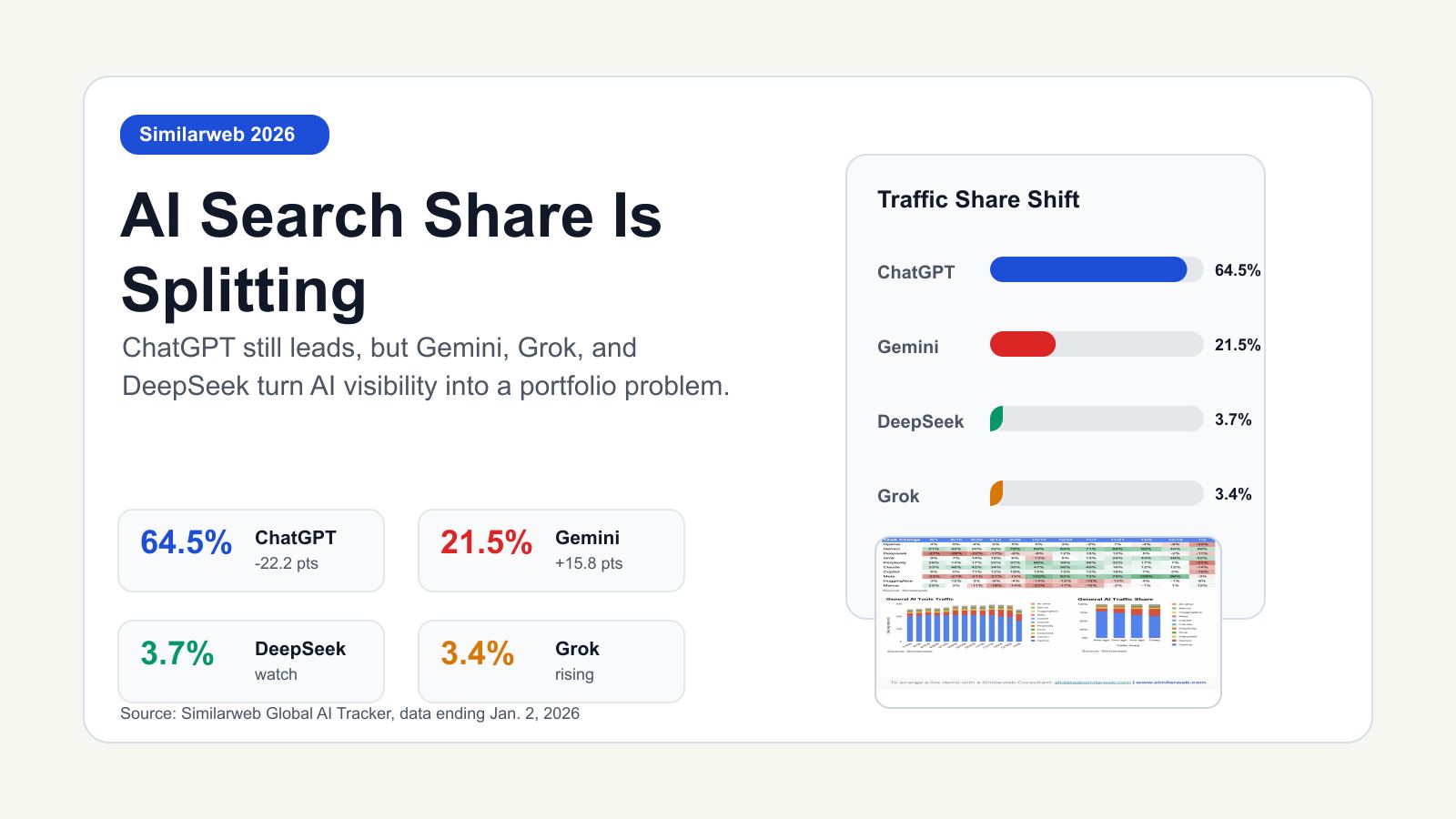
Similarweb’s 2026 AI Tracker shows ChatGPT at 64.5%, Gemini at 21.5%, DeepSeek at 3.7%, and Grok at 3.4%. Here is what that means for AI visibility and GEO strategy.
Similarweb's early 2026 AI Tracker sends a clear signal: AI search and assistant visibility is no longer a ChatGPT-only problem. ChatGPT still leads, but its share fell from 86.7% a year earlier to 64.5%; Gemini reached 21.5%; DeepSeek stood at 3.7%; and Grok reached 3.4%. That does not mean ChatGPT is collapsing, and it does not mean Gemini has already won. The practical takeaway is simpler: brands now need multi-platform AI visibility monitoring.
Convertos.ai cover: Similarweb's 2026 AI Tracker turns AI visibility into a multi-platform monitoring problem.
Quick Answer: What Should GEO Teams Do With Similarweb's 2026 AI Share Data?
Use Similarweb's platform-share shift as a starting signal, not the whole diagnosis. The practical next step is to separate platform share, prompt visibility, citations, sentiment, and AI referral behavior. If you are turning this data into a GEO plan, the follow-up guides below cover the missing layers.
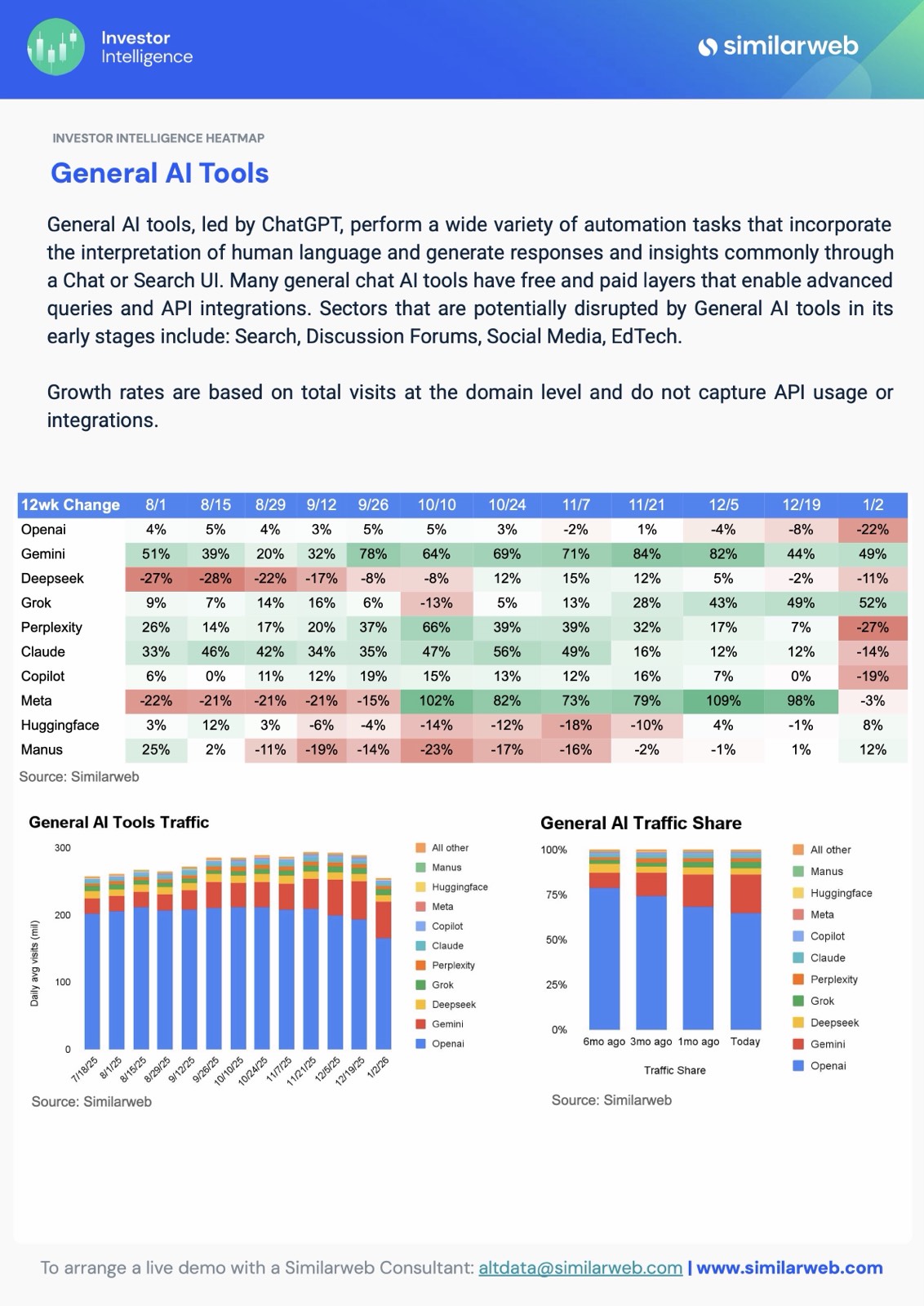
Search Engine Journal reported on Similarweb's January Global AI Tracker, and the core numbers match the original Similarweb PDF: ChatGPT held about 64.5% of generative AI chatbot website traffic share, Gemini reached 21.5%, while DeepSeek and Grok stood at 3.7% and 3.4%. The PDF is titled AI Global: Global Sector Trends on Generative AI, with data ending on January 2, 2026.
Original data screenshot: Similarweb Global AI Tracker, page 3, General AI Tools, data ending January 2, 2026. Screenshot used for source context and commentary.
Platform
Share on Jan. 2, 2026
Share one year earlier
Change
ChatGPT / OpenAI
64.5%
86.7%
-22.2 percentage points
Gemini
21.5%
5.7%
+15.8 percentage points
DeepSeek
3.7%
Newly visible in the main set
Small but established
Grok
3.4%
Newly visible in the main set
Closing in on DeepSeek
There is one important limit: Similarweb is measuring domain-level website visits. It does not capture API usage, mobile app behavior, browser or operating system integrations, or enterprise workflows. So the dataset is useful for tracking direct website attention, but it is not a complete map of all AI usage. For a fresher ranking-style view, cross-check Similarweb's AI Chatbots and Tools website list; for the traditional search baseline, compare it with StatCounter search engine share.
This Is Not ChatGPT Decline. It Is Entry-Point Fragmentation.
If you only look at "ChatGPT fell from 86.7% to 64.5%," it is tempting to write a dramatic headline. That would be sloppy. A 64.5% share is still a large lead, and ChatGPT remains strong in brand recognition, ecosystem usage, developer workflows, and paid adoption.
The real change is the structure of entry points. Gemini's growth looks less like a normal challenger story and more like Google's distribution starting to show up: Android, Chrome, Workspace, Google accounts, Search, and assistant surfaces all give Gemini more chances to become a default path.
For content teams, the question is no longer "Should we stop monitoring ChatGPT?" The better question is: if your brand only checks ChatGPT, how much of the answer environment are you missing across Gemini, Grok, DeepSeek, Perplexity, and Copilot?
Why Gemini at 21.5% Matters
Gemini is not just another assistant gaining traffic. It sits close to the Google search ecosystem, which makes its growth strategically different.
First, Google remains the biggest bridge between traditional search and AI answers. AI Overviews, AI Mode, Gemini, and regular SERPs will not behave as completely separate worlds. If your content is crawlable, clear, current, and verifiable in Google, it is more likely to become usable evidence for Google-linked AI experiences. Similarweb's own 2026 generative AI statistics article also treats AI referrals and brand discovery as separate trends.
Second, Gemini may shape fact-checking and comparison answers. When someone asks, "Which AI visibility monitoring tool is best for a B2B SaaS team?", Gemini can combine search results, official sites, third-party coverage, and entity signals. A thin blog post is not enough. You need product pages, evidence pages, FAQs, comparison pages, clear update dates, and external mentions that reinforce the same facts.
Grok Near DeepSeek Is A Volatility Signal
Grok at 3.4% and DeepSeek at 3.7% may look small. For GEO teams, the signal is still useful: new platforms can change discussion paths quickly. Grok is tied to real-time X conversations. DeepSeek has visibility in Chinese-language and developer contexts. Their shares are not large enough to justify equal investment for every brand, but they are large enough to watch.
A practical monitoring model has three layers:
Core layer: ChatGPT and Gemini, covering brand mentions, competitor comparisons, cited sources, and recommendation reasons.
Research layer: Perplexity, Copilot, and Claude, with more focus on source citations and expert workflows.
Watch layer: Grok and DeepSeek, especially for real-time discussion, regional language behavior, and emerging platform volatility.
This does not mean every platform gets the same budget. It means you avoid the false comfort of doing well in one assistant while being absent or misrepresented in another.
What Similarweb Gets Right, And What It Cannot Tell You
The value of the Similarweb dataset is that it gives an external benchmark for changing direct web attention. It shows that user behavior is moving away from a single ChatGPT-centered map and toward a multi-entry AI environment.
But it cannot answer three deeper business questions.
Question
Why traffic share cannot answer it
What brands should measure
Which platform influences our conversions?
Website visits are not the same as buying influence
Tag AI-source journeys in CRM, GA4, and sales notes
Which platform cites or recommends us?
Traffic share is not citation or recommendation frequency
Run fixed prompt sets by brand, category, competitor, and use case
Which pages become answer evidence?
Domain-level data cannot show page-level adoption
Track cited URLs, page structure, entity consistency, and update cadence
That is why this data should not be read as "Gemini will soon overtake ChatGPT." It is better understood as a planning signal: AI search optimization is about managing brand facts across several answer systems.
What Content And Growth Teams Should Change
If your reporting is still built only around traditional SEO metrics, start with five changes.
Build a cross-platform prompt set. Ask about the brand, category, competitors, alternatives, pricing, use cases, and risks.
Store answers by platform. Do not average ChatGPT, Gemini, Perplexity, Copilot, Grok, and DeepSeek into one score.
Record cited sources. Track whether answers cite your site, third-party media, documentation, forums, review pages, or no sources.
Increase fact density on key pages. Product positioning, feature limits, pricing cues, case examples, FAQs, comparison tables, and update dates should be explicit.
Keep Google crawlability central. Gemini's growth makes crawlability, indexing, structured content, and page performance more important, not less. Convertos.ai's URL Review and Citation Check can help catch basic blockers before publishing.
That is the core logic behind Convertos.ai GEO: do not rename SEO and call it done. Connect search, AI answers, cited sources, and brand facts in one monitoring system.
A Better AI Visibility Dashboard
After this Similarweb update, an AI visibility dashboard should have at least four metric layers.
Metric layer
What to watch
Why it matters
Platform coverage
Whether ChatGPT, Gemini, Perplexity, Copilot, Grok, and DeepSeek are monitored
Prevents single-platform bias
Brand presence
Whether the brand appears and is described correctly
Tests entity stability
Source quality
Whether answers cite official pages, trusted media, or weak sources
Shows where trust comes from
Scenario recommendation
Whether the brand is recommended in "best for," "alternatives," and "risk" prompts
Connects visibility to buying paths
Mentions alone are not enough. A brand can appear but be described incorrectly. A brand can be cited in low-intent answers and still produce no pipeline. GEO matters because it breaks those details apart instead of hiding them behind a broad score.
Source Statement
This article is based on Similarweb's Global Sector Trends on Generative AI PDF, Search Engine Journal's reporting on the dataset, and Convertos.ai's practical work on AI visibility monitoring. Similarweb's data is based on domain-level website visits and does not include API usage, app usage, embedded assistants, or enterprise workflows. The screenshot in this article comes from the original Similarweb PDF and is used for source context and analysis.
FAQ
Does ChatGPT falling to 64.5% mean it no longer matters?
No. A 64.5% share is still a clear lead; stop monitoring only one platform.
Source signal: Similarweb Global AI Tracker and Search Engine Journal reporting on ChatGPT and Gemini share movement.
What is the biggest SEO or GEO impact of Gemini reaching 21.5%?
The biggest impact is the rising importance of Google-linked AI entry points. Gemini and AI Overviews make crawlable, verifiable content more important.
Source signal: Similarweb AI Tracker and Google's distribution path for Gemini-linked experiences.
Why watch Grok and DeepSeek if they are only around 3%?
Because small-share platforms can matter in specific audiences, languages, and real-time discussion contexts.
Source signal: Similarweb's Grok and DeepSeek traffic share data and related SERP question patterns.
Can Similarweb's AI share data represent total AI usage?
No. It mainly reflects website visits, so it is a trend benchmark rather than a complete usage map.
Source signal: Similarweb PDF methodology note on domain-level visits.
Which AI platform should a company optimize for first?
Most B2B teams should monitor ChatGPT and Gemini first, then add other platforms by audience.
Source signal: Similarweb platform share data and Convertos.ai AI visibility monitoring practice.
What to do after reading this report
If Similarweb's share shift changes your platform priorities, do not stop at the news headline. Use the AI brand visibility dashboard to track whether your brand is mentioned and cited across the engines you now care about, then follow the AI brand visibility tracking workflow to turn gaps into page-level fixes.