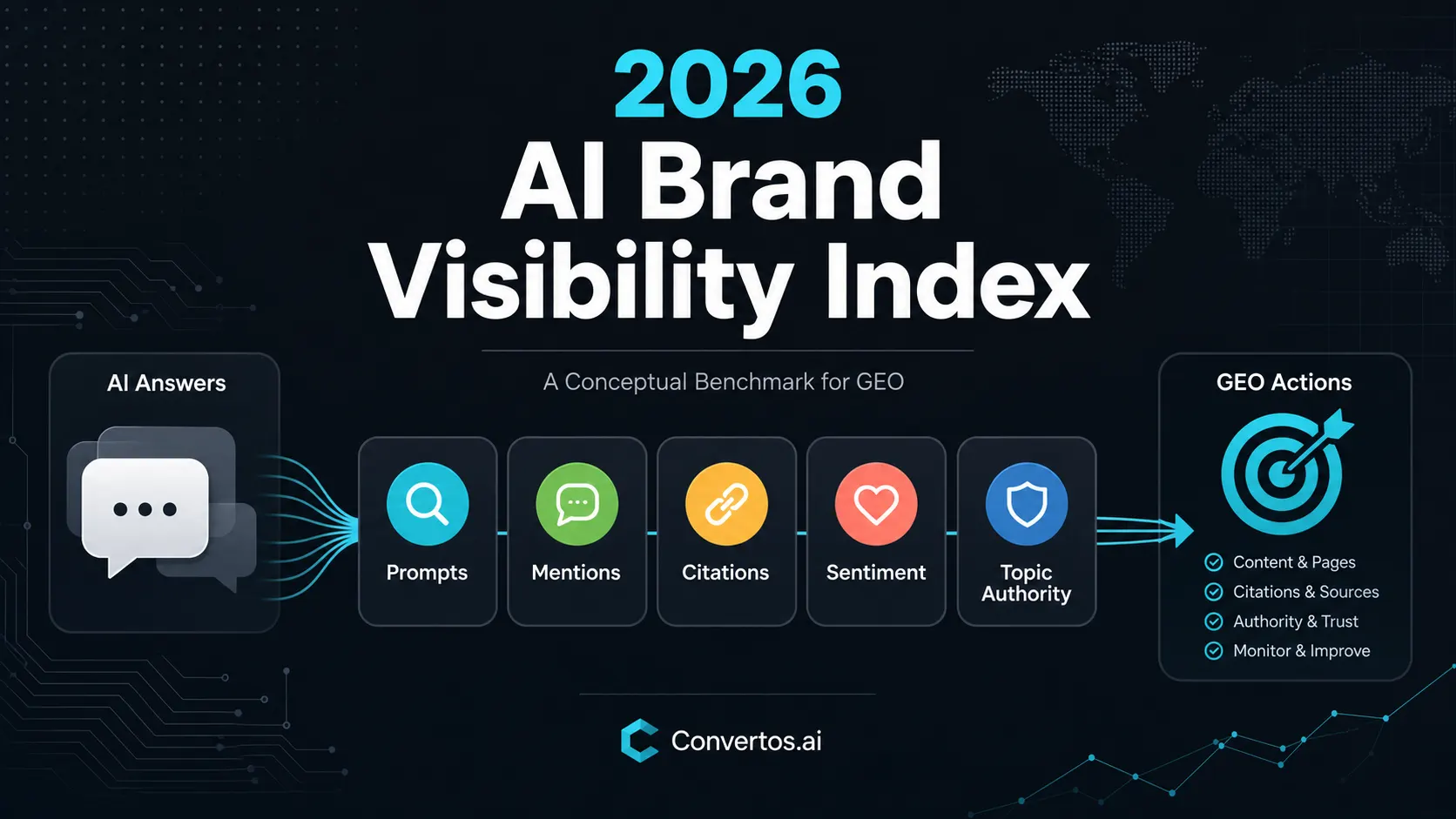
A practical GEO interpretation of Similarweb’s 2026 Generative AI Brand Visibility Index, with benchmark signals, limits, and a page-level action workflow.
Similarweb's 2026 Generative AI Brand Visibility Index is useful for GEO because it reframes AI search as a visibility problem, not only a traffic problem. The report benchmarks brands across six sectors and highlights a hard lesson for marketers: large brands do not automatically win AI answers. Specialist authority, clear positioning, strong third-party citations, and sustained topical coverage can help smaller or narrower brands appear more often than their search demand would suggest.
Last updated: 2026-06-19
Key Takeaways
Similarweb's index benchmarks AI leaders, fastest growers, and overachievers across Finance, Travel, Consumer Electronics, Beauty, Fashion, and News.
The most important GEO lesson is that visibility can matter before traffic. If AI answers create the shortlist, a missing brand may never receive a search impression or click.
The report's public material points to authority, specialist content, recognizable positioning, and topic-level visibility as recurring patterns.
Teams should not copy the report as a generic leaderboard. They should use it to define prompt sets, citation gaps, sentiment risks, and page-level fixes.
The index is most useful when it becomes a GEO benchmark, not just a brand leaderboard.
What The 2026 Generative AI Brand Visibility Index Measures
The public Similarweb report page describes the 2026 Generative AI Brand Visibility Index as a cross-industry report on brands that dominate AI-generated discovery. The landing page says it benchmarks leaders, fastest growers, and unexpected overachievers across six sectors.
Similarweb's press release adds more detail: the report examines favorable mentions from ChatGPT and competing generative AI tools across Finance, Travel, Consumer Electronics, Beauty, Fashion, and News. It also says the report ranks 113 brands and looks at brands that are cited frequently, gaining momentum, or overperforming relative to conventional search demand.
That makes the index different from a normal SEO ranking report. It is not asking "who ranks first for a keyword?" It is asking a broader answer-engine question: when users ask AI systems about a category, which brands appear, which ones are recommended or cited, and which brands are absent even though they may have strong search demand?
Index concept
Plain-English meaning
GEO implication
AI visibility
How often a brand appears in AI-generated answers
Track prompts where your brand is included or omitted
Momentum
Whether visibility is rising or falling over time
Review content freshness, source coverage, and category demand shifts
Overachiever
A brand with more AI visibility than its traditional search demand would predict
Specialist authority can beat raw brand size
Favorable mention
AI answers describe the brand positively or usefully
Sentiment matters; a mention is not always a win
Citation source
A domain or URL that AI systems use to support the answer
Source strategy is part of GEO, not separate PR work
For Convertos readers, the practical point is simple: use the index as a model for what to measure in your own category.
The Big Lesson: Size Does Not Equal AI Visibility
The strongest idea from Similarweb's public report page is that brand size does not automatically create AI visibility. Similarweb calls out examples such as NerdWallet, Travelmath, and WhoWhatWear as brands that can outperform larger competitors in AI answers. The press release also mentions specialist retailers and support-led platforms such as B&H, Adorama, and iFixit gaining visibility in Consumer Electronics, plus ScienceDirect as an overachiever in News.
That pattern should change how teams think about GEO. AI answers often prefer pages and sources that explain a topic clearly, resolve a specific need, or appear in trusted third-party contexts. A broad brand with shallow category pages can lose to a narrower brand with better topic coverage and clearer source signals.
For a GEO team, the question is not "are we famous?" The better question is: when AI systems assemble an answer for this buying situation, do they have enough clear, current, and corroborated evidence to include us?
Old SEO assumption
GEO correction
Search demand proves authority
AI systems may rely on specialist sources that answer the prompt better
Brand awareness creates default inclusion
AI answers need retrievable facts, examples, comparisons, and citations
Traffic is the main signal
Mentions, sentiment, and citations can shape demand before the click
One prompt win is enough
Sustained topic visibility matters more than isolated prompt screenshots
This is why the index matters even for teams that will never buy a broad enterprise dashboard. It shows that AI visibility can be earned through structure and authority, not only inherited from brand scale.
Why Visibility Now Matters More Than Referral Traffic
Similarweb's report page says one theme is why AI referrals are plateauing and why visibility now matters more than traffic. That matters because AI search often answers the question directly. The user may read the answer, form a shortlist, and only later use search or a website to confirm details.
Similarweb's 2026 GEO guide says that 35% of US consumers use AI at the product discovery stage, compared with 13.6% who use traditional search. Its prompt research guide makes the same strategic point: a GSC query list and a ChatGPT prompt list are not the same thing. Google Search Console tells you what people searched in Google. It does not tell you which long, conversational questions users asked in AI systems.
So a low AI referral count does not prove low AI influence. A brand can influence an AI answer without receiving a click. A brand can also lose a shortlist without ever seeing an impression in GSC.
The GEO measurement stack should therefore separate four layers:
Layer
What to measure
Why it matters
Prompt visibility
Whether the brand appears in relevant AI answers
Finds pre-click discovery gaps
Citation share
Which sources AI systems use
Shows where authority is being borrowed from
Sentiment and description
How the brand is framed
Detects wrong, weak, or negative positioning
Referral and conversion
Whether AI-originated visits convert
Connects visibility to business outcomes
Traffic still matters, but it is no longer enough by itself.
How To Turn The Index Into A GEO Workflow
The index is most useful when it becomes an operating model. Instead of asking "who won the report?", ask how Similarweb-style measurement can be recreated for your own topic, market, and pages.
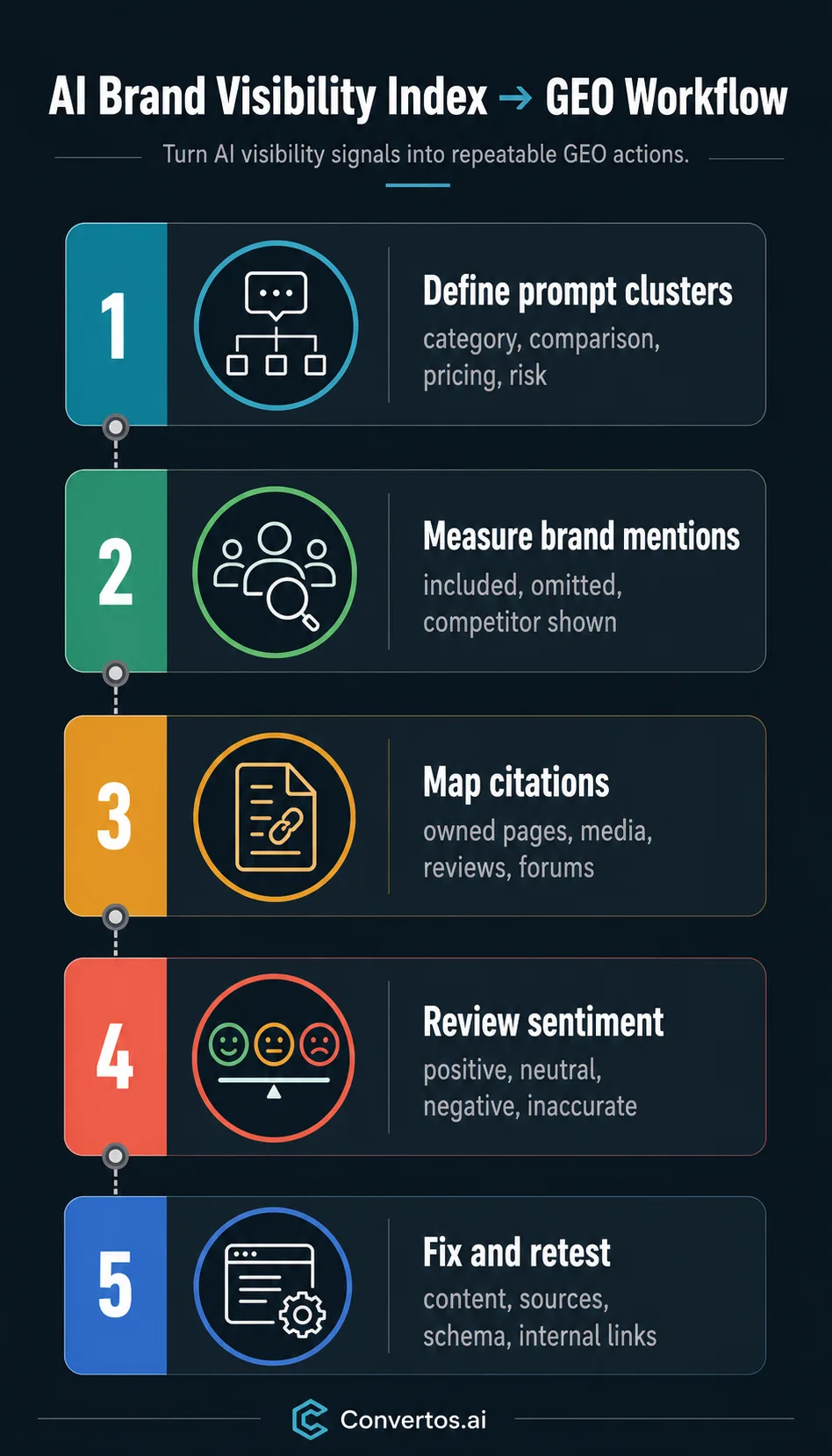
Define the category. Choose one product category, buyer problem, or use case. Do not start with every keyword in the business.
Build prompt clusters. Include category prompts, comparison prompts, alternatives, pricing questions, risk questions, review prompts, and "best for" prompts.
Track brand mentions. Record whether your brand, competitors, and adjacent alternatives appear across ChatGPT, Gemini, Perplexity, Google AI Mode, and other systems relevant to your audience.
Inspect citations. Separate owned pages, review sites, media, forums, partner pages, and competitor-controlled sources. A citation check is often the fastest way to see whether you are being mentioned or actually cited.
Score sentiment and accuracy. A neutral or inaccurate mention may need product facts, correction pages, documentation, or clearer comparison language.
Map gaps to pages. Missing category prompts may require a category page. Weak comparison prompts may require a comparison page. Repeated factual errors may require FAQ or documentation improvements.
Retest after publishing. GEO is not complete when a page goes live. It is complete only when AI answers change or when you learn the source layer needs more work.
This is also where a lightweight AI visibility snapshot can help. A large index shows market patterns; a snapshot shows whether your brand is present in the prompts that matter this week.
Turn index-style benchmark signals into specific prompt, citation, and page fixes.
A Practical Benchmark Table For Your Own Brand
Here is a simple benchmark template a GEO team can use after reading the report:
Benchmark question
Evidence to collect
Action if weak
Are we mentioned for category prompts?
Prompt tests by buyer stage and topic cluster
Build or rewrite category and solution pages
Are competitors mentioned more often?
Brand mention share across the same prompt set
Add clearer positioning, comparison logic, and proof
Which sources support the answer?
Citation domains and cited URLs
Improve owned pages and pursue better third-party sources
Are mentions favorable and accurate?
Sentiment notes and answer excerpts
Publish correction-ready facts, FAQs, and docs
Do specialist competitors overperform?
Competitors with low search demand but high AI presence
Study their topic coverage, schema, and source ecosystem
Does AI traffic convert?
Analytics referral paths and landing-page behavior
Improve landing-page clarity, CTAs, and proof
The goal is not to create a prettier report. The goal is to decide what should be fixed first.
What The Index Does Not Prove
Similarweb's index is useful, but it should be interpreted with boundaries. A public benchmark cannot tell every brand exactly which page to edit tomorrow. It can show patterns, but your own result depends on your prompt set, market, language, geography, sources, and AI platforms.
Keep these limits visible:
Report sectors are not your whole market. Finance, Travel, Consumer Electronics, Beauty, Fashion, and News are useful examples, but B2B SaaS, healthcare, education, and local services may behave differently.
A winning brand in a report is not a universal playbook. You still need to know which prompts and sources caused the visibility.
AI answers are volatile. Similarweb's GEO guide notes that AI citation share can change because models rebalance for diversity, freshness, and coverage.
Mentions are not recommendations. A brand can appear but be framed weakly or inaccurately.
Visibility and revenue need a bridge. The bridge is page-level conversion, source quality, and repeated measurement.
The index should create urgency, not panic. It shows that AI discovery is measurable enough to manage, but still messy enough to require human judgment.
Similarweb Index Vs Convertos Page-Level GEO Review
Similarweb's index is best for market-level benchmarking. It helps leadership understand that AI visibility is real, competitive, and not always correlated with brand size. Similarweb's AI Brand Visibility tracker also explains the product-level mechanics: visibility share, citation analysis, prompt intelligence, competitor comparison, topic breakdown, and sentiment analysis.
A Convertos-style workflow is narrower. It starts with a URL, a prompt set, or a citation gap and turns it into editorial action. For example:
Situation
Better first step
Leadership needs to understand the AI discovery shift
The strongest program connects both. Use the index to choose the right measurement questions. Use page-level GEO work to change the answers.
Short explainer: how to turn the 2026 AI Brand Visibility Index into a GEO workflow.
Video transcript summary: The index matters because AI answers can shape a shortlist before the click. Teams should translate report signals into their own prompt clusters, citation checks, sentiment reviews, and page-level fixes.
FAQ
What is the 2026 Generative AI Brand Visibility Index?
It is Similarweb's cross-industry benchmark of brands appearing in generative AI answers. Public Similarweb material says it covers leaders, fastest growers, and overachievers across six sectors and ranks brands by AI visibility patterns.
Source signal: Similarweb report page and Similarweb IR press release.
Which industries does the Similarweb index cover?
The public press release lists Finance, Travel, Consumer Electronics, Beauty, Fashion, and News. Teams outside those sectors can still use the report as a measurement model, but they should build their own prompt and citation benchmark.
Source signal: Similarweb IR press release.
Does a high AI visibility score mean more traffic?
Not always. Similarweb's public report page highlights the idea that visibility can matter more than referrals because AI answers may influence the buyer before a click happens. Traffic should be measured, but it should not be the only KPI.
Source signal: Similarweb report page and GEO guide.
How can a smaller brand outperform a larger brand in AI answers?
A smaller brand can overperform if it has stronger specialist content, clearer topical authority, better third-party citations, and more retrievable facts for the prompts AI systems answer. The report's public material emphasizes that authority can outperform brand demand.
Source signal: Similarweb report page and press release.
How should a GEO team use the index?
Use it as a blueprint. Define your category prompts, track brand and competitor mentions, inspect cited sources, review sentiment, map gaps to pages, and retest after changes. Do not treat the public report as a replacement for your own prompt-level evidence.
Source signal: Similarweb AI Brand Visibility page, GEO guide, prompt research guide, and Convertos GSC opportunity review.
Source Statement
This article is based on Similarweb's public 2026 Generative AI Brand Visibility Index landing page, Similarweb's March 3, 2026 investor relations press release, Similarweb's AI Brand Visibility product page, Similarweb's GEO and prompt research guides, a live SERP review on 2026-06-19, and Convertos.ai page-level GEO workflow experience. The full Similarweb report may include additional gated details not visible on the public landing page, so teams should verify the current report and product documentation before making purchase or strategy decisions.