A practical GEO guide to Similarweb’s GenAI Intelligence and AI Search Intelligence signals: prompts, brand visibility, citations, sentiment, and AI traffic.
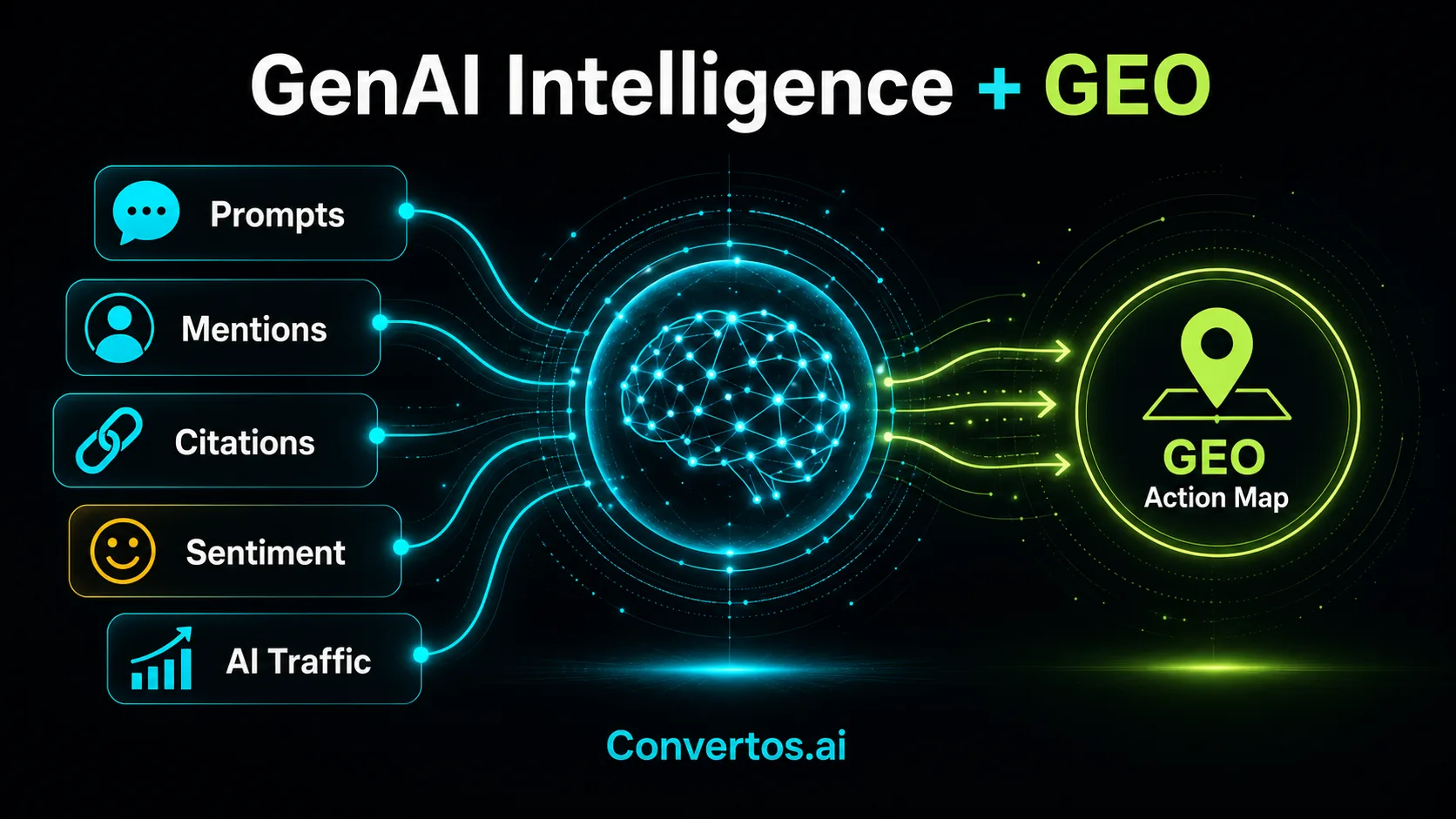
Similarweb's GenAI Intelligence and AI Search Intelligence products support GEO by turning AI answer visibility into measurable signals: prompt tracking, brand mentions, citation sources, sentiment, competitor comparison, and AI referral traffic. For a GEO team, the value is not just seeing a score. The useful part is knowing which prompts mention your brand, which sources shape the answer, where competitors appear instead, and which pages need clearer evidence or entity signals.
Last updated: 2026-06-19
Key Takeaways
Similarweb's AI Search Intelligence maps AI visibility through brand visibility, prompt analysis, citation analysis, sentiment analysis, and AI traffic.
GEO teams can use those signals to decide which prompts, pages, citations, and third-party sources need work.
Google Search Console still matters, but it cannot show whether ChatGPT, Gemini, Perplexity, or other answer engines mention your brand.
Similarweb-style dashboards are strongest for market intelligence; page-level GEO fixes still require content audits, source work, and follow-up testing.
Similarweb-style AI search intelligence turns scattered AI answer behavior into measurable GEO signals.
What Similarweb Means By GenAI Intelligence
Similarweb uses GenAI Intelligence and AI Search Intelligence to describe a toolkit for measuring how brands appear across AI search and chatbot environments. The public Similarweb AI Search Intelligence page lists modules for AI Brand Visibility, Prompt Analysis, Citation Analysis, Sentiment Analysis, and AI Traffic. Similarweb's Gen AI Intelligence Toolkit announcement frames the product around tracking visibility and traffic across AI chatbots.
The difference from a normal SEO dashboard is the object being measured. A normal SEO report often starts with keywords, rankings, impressions, clicks, and landing pages. A GEO report starts with AI prompts, answer mentions, cited sources, competitor visibility, answer sentiment, and traffic from AI assistants. Both matter, but they answer different questions.
Similarweb signal
What it measures
GEO question it helps answer
AI Brand Visibility
How often a brand appears in analyzed AI answers
Are we being mentioned when users ask category questions?
Prompt Analysis
Which prompts and responses include the brand or competitors
Which user questions should our content answer better?
Citation Analysis
Which URLs and domains influence AI answers
Which sources should we improve, earn, or correct?
Sentiment Analysis
Whether AI mentions are positive, neutral, or negative
Is the answer describing us accurately?
AI Traffic
Visits referred from AI assistants
Are AI answers sending any measurable demand to the site?
The practical takeaway is simple: Similarweb supports GEO when the team uses these metrics as a diagnosis layer, not as a trophy dashboard.
Similarweb's Using Gen AI Intelligence support article also describes the intended users as SEO and GEO leads, content teams, marketers, brand teams, product marketers, and agencies. That is a useful clue: the product is not only an SEO rank tracker. It is built for teams that need to explain how AI answers affect discovery, reputation, and demand.
How Those Metrics Map To GEO Work
GEO is the work of making a brand easier for AI answer systems to understand, cite, and recommend. A visibility dashboard becomes useful only when each metric leads to a content or source action. Otherwise, a team may know it is invisible but not know what to fix.
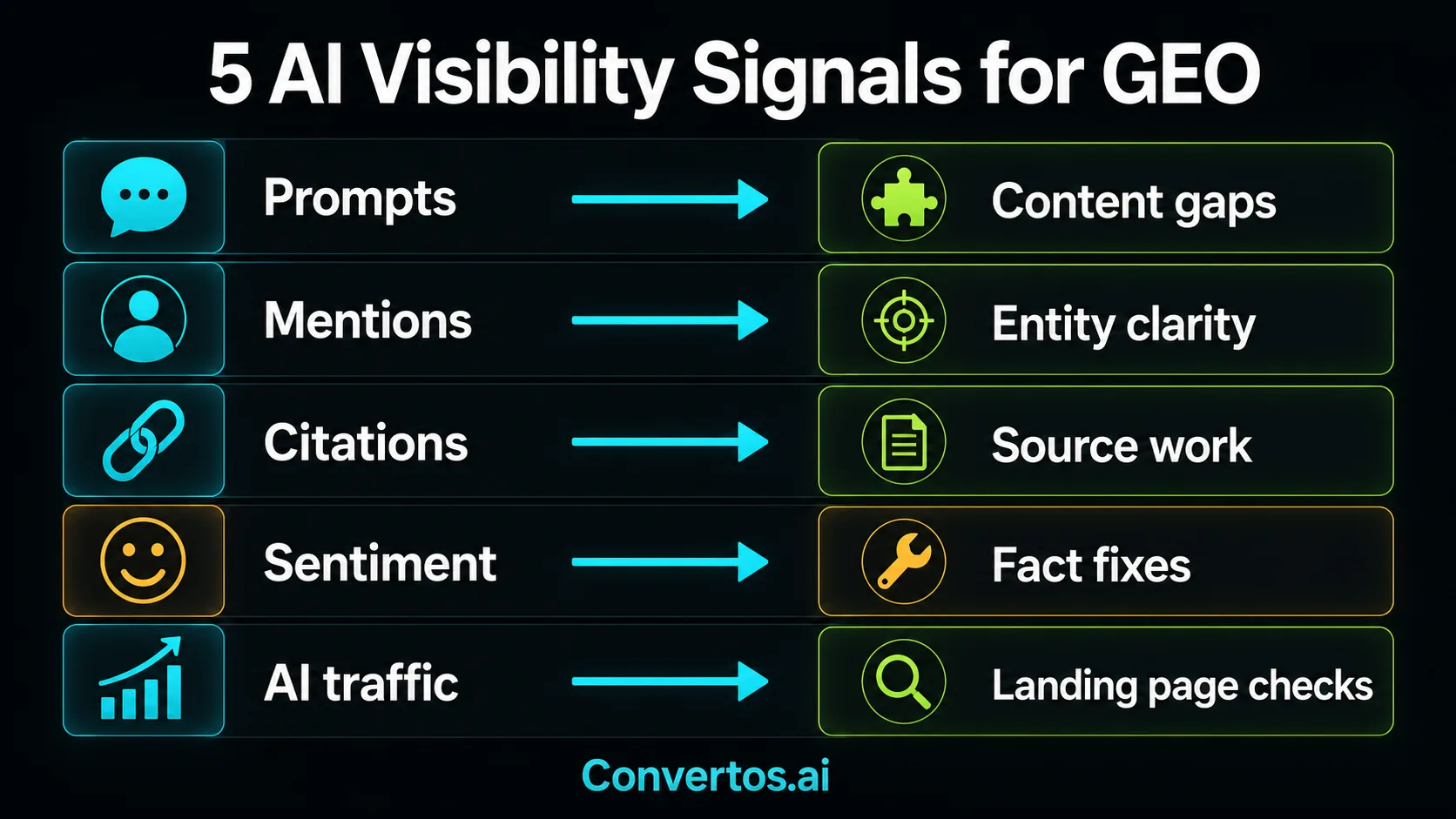
The strongest workflow is to map every AI visibility signal to a next action:
Signal found in an AI visibility tool
What it usually means
GEO action
Brand is missing from category prompts
AI systems do not associate the brand with the topic strongly enough
Build clearer category pages, comparison pages, and third-party mentions
Competitors appear with better descriptions
Their entity facts or source coverage are clearer
Add answer blocks, feature boundaries, customer-fit language, and comparison evidence
AI cites weak or outdated sources
The answer source layer is not controlled well
Update owned pages and pursue better external citations
Sentiment is negative or inaccurate
AI answers may be repeating stale reviews or incomplete product facts
Publish correction-ready facts, FAQs, docs, and rebuttal content
AI traffic exists but landing pages convert poorly
Visibility is present, but the page does not satisfy high-intent users
Improve landing-page clarity, proof, CTAs, and next-step routing
This is where many GEO programs fail. They stop at "we are mentioned" or "we are not mentioned." A better team asks: which prompt caused the gap, which source shaped the answer, and which page should be fixed first? If the page itself is the likely bottleneck, a focused URL review is usually faster than waiting for another monthly dashboard.
Use each AI visibility signal as a trigger for a specific page, source, or measurement fix.
What Similarweb Can Show That GSC Cannot
Google Search Console shows how a site performs in Google Search. It is still essential for impressions, clicks, average position, query discovery, and page indexing checks. But GSC does not show whether a brand was mentioned in a ChatGPT answer, cited by Perplexity, compared inside Gemini, or described negatively in an AI response. That is why the Similarweb share-shift page on AI search platform share in 2026 is useful as a market signal, but not enough as a page-level GEO diagnosis.
That gap matters because AI search creates a layer before the click. A user can ask "best AI visibility tools for B2B SaaS" and receive a short list without visiting Google results at all. If your brand is missing from that answer, there may be no impression, no click, and no obvious GSC signal.
Tool layer
Best for
Blind spot
Google Search Console
Google Search queries, impressions, clicks, ranking movement, page indexing
AI answer mentions outside Google Search reporting
Brand mentions, prompt coverage, citations, sentiment, AI referral traffic
Page-level editorial fixes still need human review
Manual GEO audit
Specific answer quality, source gaps, page-level action plan
Hard to scale without tooling
The right answer is not "replace GSC." The right answer is to connect GSC with AI visibility monitoring. GSC tells you how Google Search users discover pages. AI visibility tools tell you whether answer engines are using, citing, or skipping your brand. For a quick first pass, an AI visibility snapshot can show whether the brand appears before a team commits to a larger monitoring suite.
Where Similarweb Data Still Has Limits
Similarweb-style AI intelligence is useful, but it should not be treated as a complete map of all AI behavior. Public Similarweb material such as Similarweb's 2026 Gen AI Stats and the 2026 Generative AI Brand Visibility Index relies on defined datasets, tracked platforms, and stated methodology boundaries. Those are valuable signals, but they are still samples of a larger answer environment.
Similarweb's public AI Brand Visibility page is also careful to frame the module around measured answers and tracked topics. That framing matters because GEO teams should define their topic and prompt set before interpreting any visibility number.
There are four limits to keep in mind:
Platform coverage can vary. A dashboard may include ChatGPT, Gemini, Perplexity, AI Mode, or other sources, but coverage depends on the product and plan.
Prompt sets shape the result. If the tracked prompts are too narrow, the report may miss real buyer questions.
Website visits are not total AI usage. API calls, embedded assistants, mobile apps, enterprise tools, and private workflows may not appear the same way.
Mentions are not the same as recommendations. A brand can be named but described poorly, cited weakly, or shown only in low-intent answers.
This is why GEO reporting should keep a source statement near the metric. A chart should explain what was measured, when it was measured, which platforms were included, and what the metric cannot prove.
A Practical GEO Workflow Using Similarweb-Style Signals
A practical GEO workflow starts with prompts, not pages. Pages matter, but AI answers are triggered by user questions. A team should first define the questions it wants to win, then check whether AI systems mention the brand, cite trustworthy sources, and describe the brand accurately.
Choose prompts by buying stage. Include definition prompts, category prompts, comparison prompts, alternative prompts, pricing prompts, risk prompts, and "best for" prompts.
Track brand and competitor mentions. Do not average everything into one score. Separate ChatGPT, Gemini, Perplexity, Google AI features, and other engines when possible.
Inspect cited sources. Record whether answers cite the company site, docs, review sites, media, forums, competitor pages, or no source at all. A lightweight citation check can help separate "mentioned" from "actually cited."
Fix the page-level gaps. Add direct answer blocks, product facts, comparison criteria, FAQs, schema, author information, and stronger internal links.
Improve the source layer. If AI answers cite third-party pages, decide whether those sources need outreach, correction, partnership, or replacement with stronger owned content.
Recheck sentiment and citation movement. A GEO fix is not finished until answer quality changes across prompts.
Compare AI traffic with GSC and analytics. If AI traffic grows but conversions do not, the landing page may be the next bottleneck.
This workflow keeps the dashboard connected to work the team can actually do.
Similarweb Vs A Lightweight Convertos Workflow
Similarweb is strongest when a team needs broad market intelligence, competitor views, AI traffic estimates, and a mature dashboard. That can be valuable for enterprise SEO, brand, product marketing, and agencies that need recurring reporting across many topics.
A lighter Convertos-style workflow is better when the team needs to inspect a specific URL, diagnose why AI systems may not cite it, and turn the result into page-level fixes. For example, a team can start with an AI visibility snapshot, run a citation check, review a URL, and then update the page's answer blocks, evidence, internal links, and source statements.
The decision is not either-or:
Team situation
Better starting point
Why
Enterprise brand with many competitors and topics
Similarweb-style AI intelligence
Needs broad dashboarding and competitor monitoring
Small SaaS team improving a few high-value pages
Convertos-style URL and citation workflow
Needs fast page-level fixes before buying a larger suite
Agency managing recurring reports
Similarweb plus manual GEO QA
Needs scale plus editorial judgment
Founder checking whether AI search understands the product
Lightweight snapshot and prompt test
Needs clarity, not a complex dashboard
The healthiest GEO program uses both ideas: measurement for direction, page audits for action.
Short explainer: how AI visibility signals become GEO actions.
Video transcript summary: GEO is not only about rankings. Teams need to measure prompts, mentions, citations, sentiment, and AI traffic, then turn each signal into a concrete content or source fix. Dashboards show where attention is needed; audits decide what to change.
FAQ
Does Similarweb support GEO directly?
Yes. Similarweb's public AI Search Intelligence material includes GEO-related tools for AI brand visibility, prompts, citations, sentiment, and AI traffic. Those signals support GEO when they lead to page and source improvements.
Source signal: GSC query sample for this topic, Similarweb AI Search Intelligence page, and Similarweb support documentation.
Which Similarweb metrics matter most for GEO?
The most useful GEO metrics are brand visibility, prompt coverage, cited sources, competitor mentions, sentiment, and AI referral traffic. A single score is less useful than knowing which prompt and source caused the gap.
Source signal: Similarweb AI Search Intelligence module list and AI visibility monitoring SERP patterns.
Is AI Brand Visibility the same as AI traffic?
No. AI Brand Visibility measures answer presence. AI traffic measures referred visits.
Source signal: Similarweb AI Search Intelligence FAQ and Gen AI Intelligence announcement.
Can Google Search Console show AI answer visibility?
Not fully. GSC can show Google Search impressions, clicks, queries, and rankings. It does not show every ChatGPT, Gemini, Perplexity, or chatbot answer where a brand was mentioned or omitted.
Source signal: GSC product scope and visible GSC URL filter data for this article.
Should teams monitor ChatGPT and Gemini separately?
Yes. ChatGPT, Gemini, Perplexity, and Google AI features can produce different answers, sources, and competitor mentions. Averaging them hides the exact platform where the brand needs work.
Source signal: Similarweb AI visibility trend reporting and the existing Convertos share-shift article.
Source Statement
This article is based on public Similarweb pages about AI Search Intelligence, Gen AI Intelligence, AI Brand Visibility, Similarweb support documentation, Similarweb trend reporting, Google Search Console observations for Convertos.ai, and public AI visibility tool SERP patterns reviewed on 2026-06-19. Similarweb product features and platform coverage can change, so teams should verify current product documentation before making a purchase decision.