
Key Takeaways
- ChatGPT GEO should emphasize conversational prompts, direct answer assets, source-worthy pages, and citation checks.
- Gemini GEO should also account for Google Search surfaces such as AI Overviews, AI Mode, entity signals, structured pages, and classic SEO foundations.
- The same brand can be visible in ChatGPT but weak in Gemini, or strong in Google AI surfaces but absent from ChatGPT answers.
- Platform-specific GEO should measure prompt coverage, citation sources, sentiment, freshness, and page-level fix actions separately.
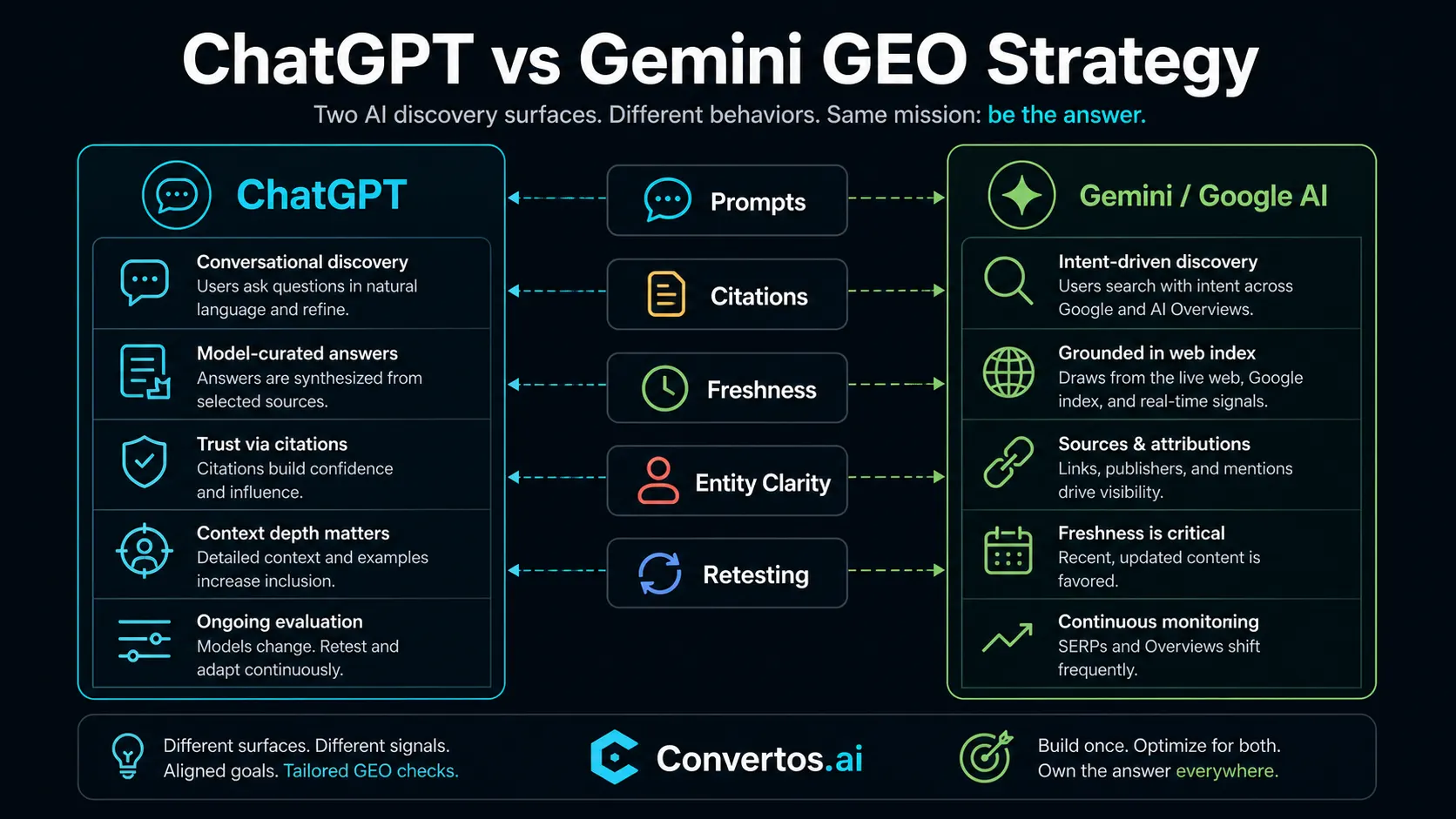
The Difference Is Discovery Context, Not Just Model Quality
Most "ChatGPT vs Gemini" comparisons focus on model quality, price, speed, or user preference. GEO teams need a different comparison. The question is: where does the answer appear, what sources does it use, how does the user ask, and what page or source can change the answer? OpenAI's ChatGPT Search announcement and ChatGPT Search help article describe answers that can include links and source panels. Google's AI Mode page describes an AI-powered Search experience that can handle follow-up questions and search across subtopics. Google Search Central's AI features documentation frames AI Overviews as part of Search, with links that help users explore further.| Platform surface | GEO question |
|---|---|
| ChatGPT Search | Are we mentioned or cited when users ask conversational research prompts? |
| Gemini app | Are we understood in broad assistant-style answers and follow-up tasks? |
| Google AI Overviews | Are our pages eligible and useful for AI-generated search summaries? |
| Google AI Mode | Are we visible when Google decomposes a complex question into subtopics? |
| Perplexity or other cited-answer tools | Are we a source, not just a brand mention? |
ChatGPT GEO: Build For Conversational Research And Citations
ChatGPT queries often look like advisory prompts: "what should I use," "compare these options," "best tool for this scenario," or "explain the tradeoffs." The answer may mention brands, summarize criteria, and include sources when web search is used. That means ChatGPT GEO should prioritize:- Clear answer blocks. Major pages should include concise, self-contained answers to buyer questions.
- Comparison-ready language. Explain who the product is for, when it is not a fit, and what alternatives exist.
- Citation-worthy pages. Publish pages that are useful as sources, not just sales copy.
- Freshness and factual correction. Keep pricing, product details, integrations, and positioning current.
- Prompt retesting. Re-run the same prompt set after content changes and record mentions, citations, and sentiment.
Gemini GEO: Treat Google Search Foundations As Part Of The Strategy
Gemini strategy cannot be separated cleanly from Google Search. Gemini appears in the Gemini app, but Google's AI answer ecosystem also includes AI Overviews and AI Mode. Google's AI Overviews support page describes AI-generated snapshots with links to dig deeper, while AI Mode help explains that AI Mode can search across subtopics. For GEO, that means Gemini work should include:- Strong crawlable pages. Google must be able to discover, render, and understand the content.
- Entity clarity. Brand, product, author, organization, and category relationships should be consistent.
- Structured answer sections. Use headings, comparison tables, FAQs, and schema only when the content is visible and accurate.
- Source and author trust. Make claims easy to verify with dates, sources, and named expertise.
- Google Search diagnostics. Use GSC, indexing checks, and page performance data alongside AI prompt tests.
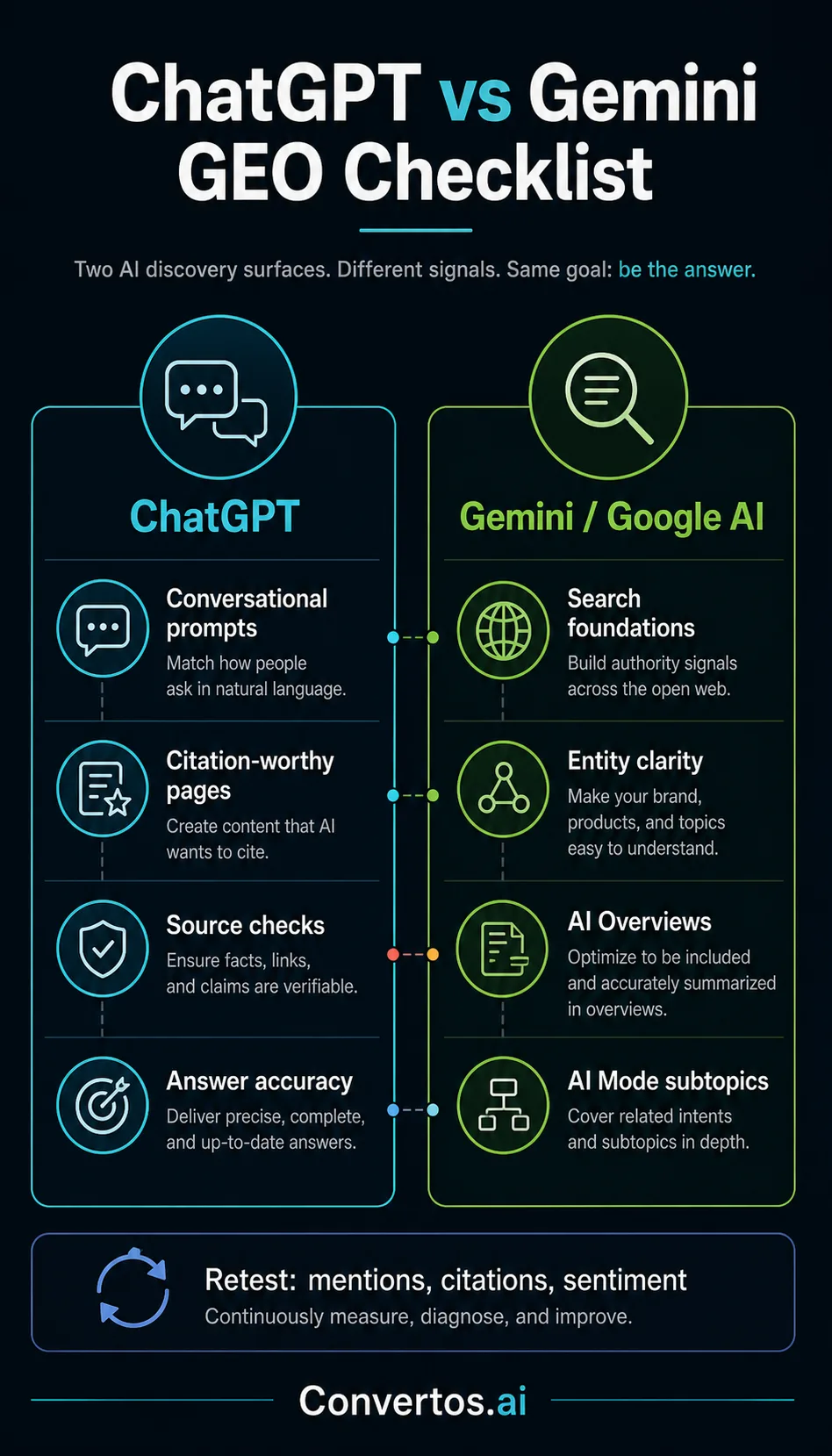
A Platform-Specific GEO Checklist
| GEO task | ChatGPT emphasis | Gemini / Google emphasis |
|---|---|---|
| Prompt set | Conversational research, comparisons, recommendations | Search-like questions, follow-ups, AI Overviews, AI Mode |
| Source work | Citation-worthy pages, third-party mentions, factual pages | Crawlable pages, entity consistency, Search quality signals |
| Content format | Direct answer blocks, pros/cons, buyer scenarios | Structured headings, tables, FAQs, schema-consistent visible content |
| Freshness | Current product facts and correction-ready pages | Updated pages, indexing checks, date clarity, canonical stability |
| Measurement | Mentions, citations, sentiment, answer accuracy | GSC, AI prompt tests, AI Overview presence, citation and link checks |
Platform Fit: Where Each Surface Is Strongest
Use this table to decide which platform to test first. The "best fit" column is not a permanent ranking. It is a practical starting point for prompt selection.| Platform option | Best fit | Main GEO risk | Evidence to collect |
|---|---|---|---|
| ChatGPT Search | Conversational research, vendor recommendations, pros/cons, "what should I use" prompts | Brand is named without citation, or a competitor is recommended from stronger third-party sources | Mention rate, cited URLs, sentiment, answer accuracy |
| Gemini app | Assistant-style follow-up tasks, Google ecosystem users, broad discovery prompts | Brand facts are vague or blended with outdated Google-indexed sources | Mention rate, entity accuracy, freshness, source patterns |
| Google AI Overviews | Search-result summaries for informational and commercial research queries | Page ranks but is not linked or summarized in the AI snapshot | GSC query data, linked sources, page eligibility, answer wording |
| Google AI Mode | Complex, multi-step questions that Google decomposes into subtopics | Content covers one subtopic but misses the full task | Subtopic coverage, internal links, comparison tables, schema consistency |
| Perplexity | Cited research answers and source-heavy exploration | Brand is mentioned but third-party sources dominate the citations | Citation share, source quality, competitor citations, recency |
What To Test First
Start with the prompts closest to buyer decisions:- "Best [category] tools for [use case]"
- "[Brand] vs [competitor]"
- "Alternatives to [competitor]"
- "Which [category] tool is best for [company type]?"
- "What are the risks of using [category] software?"
- "Does [brand] integrate with [platform]?"
A 30-Day Test Plan
Week one should build the prompt set and baseline. Choose 20 to 40 prompts across category, comparison, alternatives, pricing, risk, and integration questions. Week two should run the same prompts across ChatGPT, Gemini, Google AI surfaces, and one cited-answer tool such as Perplexity. Week three should fix the highest-value page gaps: missing answer blocks, weak comparison language, unsupported claims, outdated product facts, and thin source statements. Week four should retest the same prompts and compare mention rate, citation share, sentiment, and answer accuracy. This plan keeps platform strategy grounded. If ChatGPT mentions the brand but does not cite it, the fix may be source credibility. If Gemini misses the brand but Google Search sees the page, the fix may be entity clarity, topic coverage, or page structure. If both platforms omit the brand, the team probably needs stronger category authority and third-party proof.Common Mistakes
- Testing only one platform and calling it "AI visibility."
- Treating ChatGPT citations and Google AI Overview links as the same thing.
- Rewriting pages without first checking which prompt and source caused the gap.
- Publishing generic GEO content that does not answer buyer-stage prompts.
- Ignoring sentiment. A brand mention that describes the product incorrectly can be worse than absence.