A practical guide to reading AI search market share in 2026, including search engine share, AI chatbot traffic, AI referrals, and brand visibility metrics.
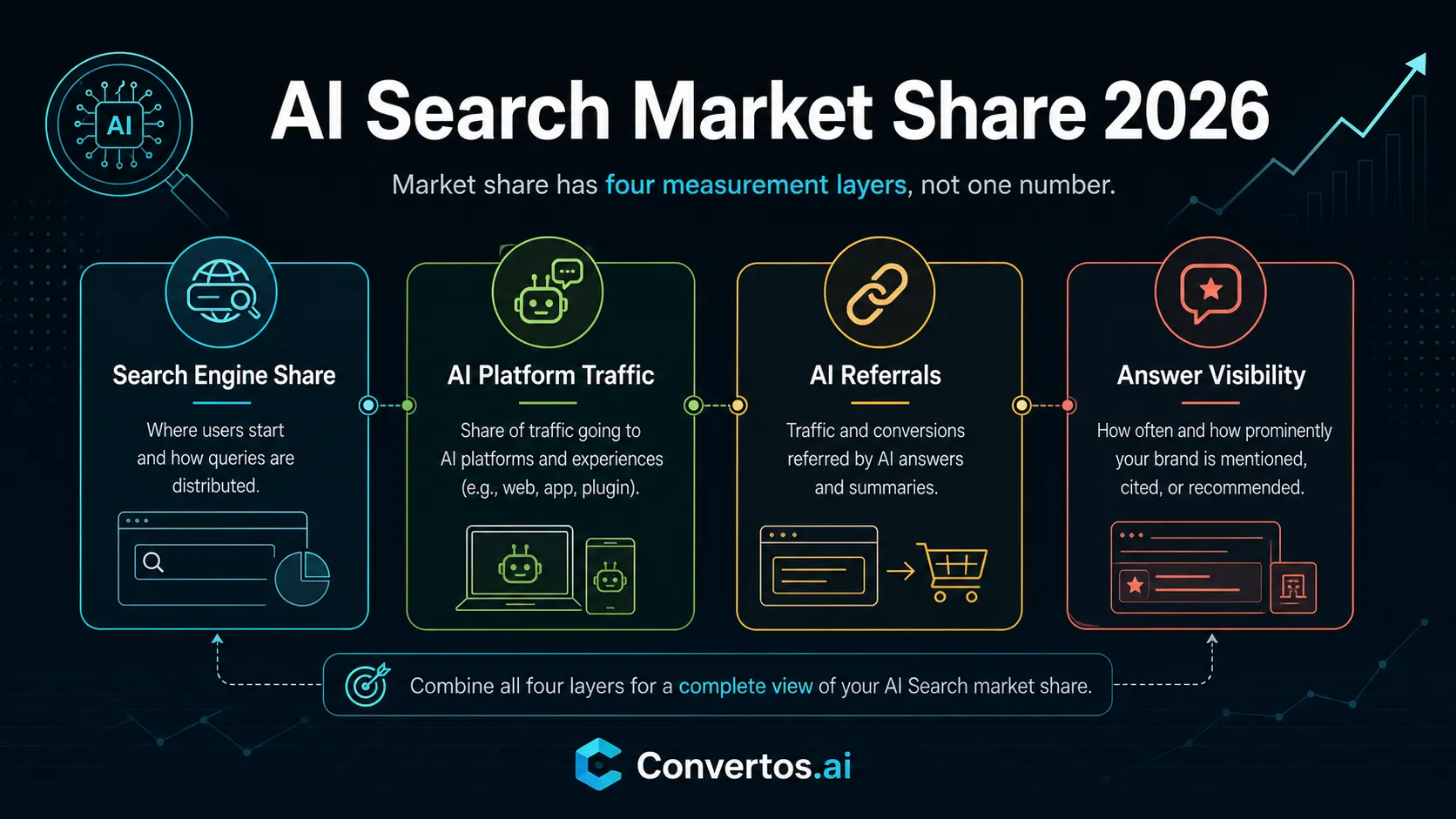
AI search market share in 2026 is not one number. Traditional search engine share, AI chatbot traffic share, AI referral traffic, and AI answer visibility all measure different things. For GEO teams, the useful question is not "which platform won the market?" The useful question is which platform shapes discovery for a specific audience, prompt type, and buying stage.
Last updated: 2026-06-19
Key Takeaways
Google still dominates traditional search engine share, but AI-native tools are absorbing informational, research, and comparison behavior.
Similarweb-style generative AI traffic share is useful for platform trend monitoring, not as a direct replacement for keyword volume.
AI referral traffic undercounts influence because many AI answers create brand memory or shortlist demand without a click.
GEO teams should split measurement into platform share, prompt visibility, citation share, sentiment, and downstream conversion.
AI search market share only becomes useful when the measurement layer is named clearly.
Why AI Search Market Share Is Easy To Misread
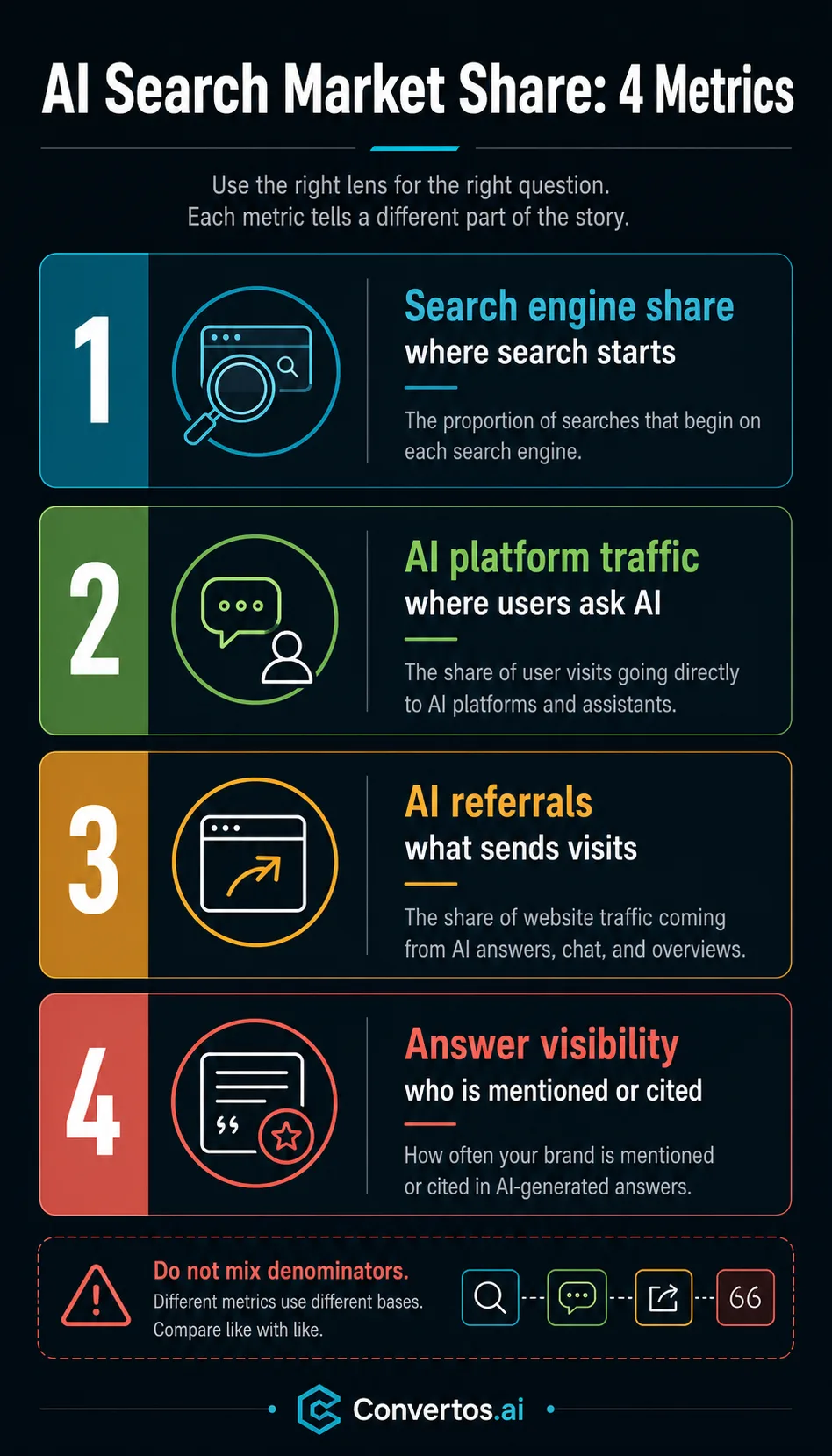
The phrase "AI search market share" can mean at least four different things. A report may compare search engines such as Google and Bing. Another may compare AI chatbots such as ChatGPT, Gemini, Perplexity, Claude, and Copilot. A third may measure referral sessions from AI platforms. A fourth may measure how often a brand appears in AI-generated answers.
Those are not interchangeable metrics. The StatCounter search engine market share chart still describes the traditional search engine layer. Similarweb's 2026 Gen AI stats describe generative AI platform traffic and trend behavior. Similarweb's AI Brand Visibility product page describes answer-side brand visibility, citation, sentiment, and topic signals.
Metric
What it measures
What it does not prove
Search engine market share
Search engine usage across devices and regions
How many buyer questions moved into AI chat
AI chatbot traffic share
Visits or usage distribution among AI platforms
Whether those tools influenced your category
AI referral traffic
Visits arriving from AI platforms
Non-click influence, shortlist formation, or answer mentions
AI answer visibility
Brand mentions, citations, sentiment, and prompt coverage
Total market size or total traffic opportunity
If a chart does not name the metric, do not use it to make budget decisions.
The Practical 2026 Picture
The practical 2026 picture is mixed. Google remains the largest search distribution layer for navigational, local, transactional, and many commercial queries. But AI systems are becoming a serious discovery layer for research-heavy tasks: "best tools for X," "compare A and B," "what should I choose," "what are the risks," and "which vendor fits this use case."
That is why Similarweb's AI search platform share shift article matters. Platform share can move even when traditional search share still looks stable. Market-size forecasts such as Precedence Research's AI search engine market outlook are useful for budget context, but they do not tell a team which prompts, sources, or pages are creating visibility. A brand can keep ranking in Google and still lose visibility in the answer layer where buyers build shortlists.
For GEO, do not ask whether AI search has replaced Google. Ask which query classes are shifting:
Query class
2026 risk level
Why
Navigational brand queries
Lower
Users already know where they want to go
Local and transactional queries
Medium
Google still has strong maps, shopping, and ads surfaces
Definitions and how-to content
High
AI answers can satisfy the need directly
B2B research and comparisons
High
AI answers can summarize vendors before any click
News and volatile facts
Mixed
Freshness, citations, and platform behavior vary
Market share is the top-level weather. Prompt-level visibility is the local forecast.
Four Market Share Views GEO Teams Should Track
A useful GEO dashboard separates market views instead of collapsing everything into one score.
Platform traffic share. Track whether ChatGPT, Gemini, Perplexity, Claude, Copilot, and Google AI surfaces are gaining usage in your market.
Prompt visibility share. Track how often your brand appears for the prompts that matter to your category.
Citation share. Track which URLs and domains are used as sources by AI answers. A citation check can reveal whether your brand is cited or merely mentioned.
AI referral and conversion share. Track traffic from AI platforms and whether those visitors convert.
This separation prevents a common mistake: assuming a platform with high total usage is the platform that matters most for your audience. A finance publisher, SaaS vendor, local service, and ecommerce brand may see very different AI discovery patterns.
Measure the market, the prompt, the source, and the business outcome separately.
Why AI Referral Traffic Undercounts Influence
AI referral traffic is useful because it is connected to real sessions. It can show whether users clicked from ChatGPT, Perplexity, Gemini, or another assistant. But it undercounts influence because many AI answers do not send a click. The answer may shape memory, trust, and the shortlist before the user returns through branded search, direct traffic, paid search, or a sales conversation.
Similarweb's 2026 Generative AI Brand Visibility Index makes this point from another angle: visibility can matter even when referral traffic is not the whole story. If a brand is repeatedly named as a category leader, it can gain consideration. If it is absent, it may lose demand without seeing a clean attribution path.
For reporting, split metrics into leading and lagging indicators:
Validate whether visibility is commercially useful
Do not discard referral traffic. Just do not mistake it for the entire market.
Turning Market Share Into GEO Priorities
Market share should guide attention, not replace page-level diagnosis. A practical prioritization process looks like this:
Pick the buyer stage. Discovery, comparison, validation, pricing, and risk prompts behave differently.
Choose the platform set. For most B2B and SaaS teams, start with ChatGPT, Gemini, Perplexity, and Google AI surfaces. Add Claude, Copilot, or vertical assistants when the audience uses them.
Run a prompt sample. Use prompts that real users ask, not only keywords. Similarweb's prompt research guide is useful because it separates keyword research from AI prompt research. Semrush's AI search trends research is also a reminder that AI visibility should be reviewed by query type and user behavior, not only by global platform usage.
Compare brand and competitor presence. Record mentions, citations, sentiment, and answer position.
Map gaps to assets. Missing category visibility may require a category page. Weak citation share may require stronger sources. Wrong descriptions may require docs, FAQs, or comparison pages.
Retest after changes. GEO is a measurement loop, not a one-time rewrite.
If you need a first pass, run an AI visibility snapshot before buying a larger dashboard.
What Not To Do With 2026 Market Share Charts
Avoid these common mistakes:
Do not compare Google's traditional search share with ChatGPT's chatbot traffic as if they are the same denominator.
Do not assume a global market share number reflects your country, language, buyer stage, or category.
Do not use referral traffic as the only AI search KPI.
Do not copy a competitor's platform priorities without checking your own prompts.
Do not treat AI Overviews, AI Mode, ChatGPT Search, Gemini, and Perplexity as one product. They cite and summarize differently.
The safest executive summary is: Google remains essential, AI answer systems are now a real discovery layer, and the impact is highest where users need synthesis, comparison, and advice.
Short explainer: how to read AI search market share without mixing incompatible metrics.
Video transcript summary: AI search market share should be split into search engine share, AI platform traffic share, AI referrals, and answer visibility. GEO teams should use market share to choose where to test, then rely on prompt and citation evidence to decide what to fix.
FAQ
What is AI search market share in 2026?
It depends on the metric. Traditional search engine share still measures Google, Bing, and other search engines. AI search share may refer to AI platform traffic, AI referrals, or answer visibility across tools such as ChatGPT, Gemini, Perplexity, Claude, and Copilot.
Source signal: StatCounter search engine share, Similarweb Gen AI stats, and AI visibility product pages.
Is ChatGPT replacing Google Search?
Not across the whole market. Google remains the dominant traditional search layer, especially for navigational, local, transactional, and commercial queries. ChatGPT and other AI systems are more disruptive in research, synthesis, and comparison workflows.
Source signal: search engine market share SERPs and AI search trend reporting.
Why do different AI search share charts disagree?
They often use different denominators. One chart may measure website traffic, another query volume, another referral sessions, and another brand visibility in AI answers. Always check the metric, geography, device, time range, and platform list.
Source signal: Similarweb Gen AI stats, StatCounter, and SERP review on 2026-06-19.
Which AI platforms should a GEO team monitor first?
Most teams should start with ChatGPT, Gemini, Perplexity, and Google AI surfaces, then add Claude, Copilot, or vertical assistants based on audience behavior. The right answer depends on prompt type and market, not only global usage.
Source signal: AI search platform share SERPs and Convertos platform testing workflow.
How does market share connect to page optimization?
Market share tells you where discovery may be shifting. Page optimization starts after prompt testing shows where your brand is missing, misdescribed, or uncited. That is when you improve answer blocks, comparisons, source statements, schema, and internal links.
Source signal: Similarweb prompt research guide and Convertos GEO workflow.
Source Statement
This article is based on public search engine market share reporting, Similarweb's 2026 Gen AI stats, Similarweb AI visibility product materials, Similarweb prompt research guidance, SERP research reviewed on 2026-06-19, and Convertos.ai GEO workflow experience. Market share numbers can change quickly and often use different denominators, so teams should verify the source, time range, geography, and metric definition before making budget decisions.