
Suppose you lead growth for an ecommerce brand. Your team still needs to track Google rankings, but it also wants to know whether ChatGPT recommends your products. You already use Semrush and have heard that Profound tracks AI answers. What should you add to your existing workflow, and when would a separate platform be worth its cost?
Start with the work your team needs to do:
- SEO remains the main job and AI monitoring is new: compare Semrush AI Visibility Toolkit with Semrush One. The toolkit focuses on AI visibility; One bundles SEO and AI capabilities. An ordinary SEO subscription should not be assumed to include the full AI toolkit.
- A larger team needs multi-market AI research, monitoring and agent workflows: put Profound Enterprise on the shortlist, and ask Semrush to demonstrate the same requirements. Profound's brand enterprise plan is custom-priced.
- An agency needs ongoing client delivery: write down the number of clients, prompts and engines before comparing quotes. Profound charges separately for its agency base and client workspaces; Semrush has distinct limits for brand-performance domains, prompts, users and reporting.
The products can also work together. A team may keep Semrush for traditional SEO and use Profound for AI-answer analysis and workflows. The case for buying both is strongest when the second product changes a decision the team could not already make.
Pricing and feature information was checked November 3, 2026. Prices below are published US-dollar figures; taxes, region, billing terms and enterprise quotes can change the final amount.
Semrush has three different kinds of AI data
A score from one report is not interchangeable with a figure from another. Each entry point answers a different question and has its own collection method and update schedule.
| Report or feature | Question it helps answer | Data and refresh | Main limitation |
|---|---|---|---|
| Visibility Overview / Prompt Research | Which AI topics mention a brand, and where do competitors appear? | Uses Semrush's prompt database, refreshed on a rolling basis; reports can be filtered by platform and market. | The database is a sample. Topic demand is an estimate, not a complete log of every AI user's queries. |
| Brand Performance | How do AI systems describe the brand, its attributes and competitors? | Semrush generates brand-related prompts from a domain and location and updates the report weekly. | This generated prompt set differs from custom tracking; domain and location limits need checking. |
| Prompt Tracking | Does the brand appear daily for questions we chose? | Tracks a custom set for a selected AI platform and location. | Each platform uses a separate campaign. Tracking the same prompt on two platforms consumes two prompt slots. |
See Semrush's feature guide, data methodology and Prompt Tracking setup. Platform support varies by report and account.
Reading a real overview without overstating the numbers
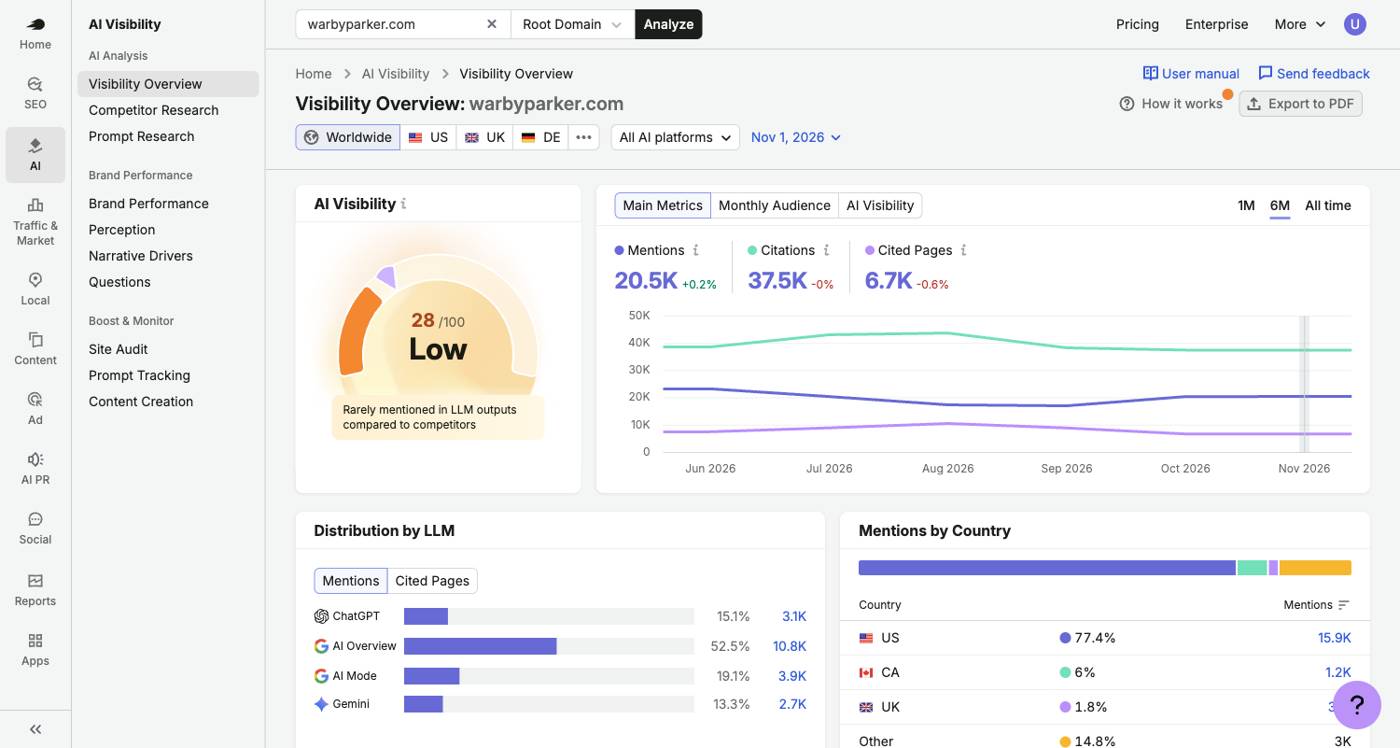
Semrush example for warbyparker.com, with Worldwide and All AI platforms selected and November 1, 2026 shown in the interface. Captured November 2, 2026, to illustrate the report; it does not represent the brand's sales performance.
The report displays a visibility score of 28/100, about 20.5K mentions, 37.5K citations and 6.7K cited pages, with platform and country breakdowns. Semrush describes its AI Visibility Score as a normalized measure combining topic coverage and mention consistency. A score of 28 does not mean 28% of consumers saw the brand. Mentions, citations and cited pages count different things; they cannot be added together or treated as visits or orders. Semrush's methodology.
To turn the report into work, inspect Topic Opportunities where competitors appear and the brand does not. Open the relevant answer and record the prompt, platform, update date, cited URL and brand mention. Then decide whether the next action is improving an owned page, correcting a third-party listing, or checking brand recognition. A summary score alone cannot tell you which page to change. Semrush's report guide.
Feature comparison: what each tool can do
✓ means the capability is publicly listed for at least the indicated product or plan; ✕ means that specific plan does not include it. “Plan-dependent” means the buyer should confirm the contract and allowance. A check mark does not imply identical scope.
| Job | Profound | Semrush | What to verify |
|---|---|---|---|
| Monitor brand mentions, competitors and citations in AI answers | ✓ Answer Engine Insights; trial and enterprise differ | ✓ AI Visibility reports and Prompt Tracking | Check custom prompts, answer-level evidence, regions and refresh frequency. |
| Track your own prompts over time | Enterprise, per contract; brand trial ✕ custom prompts | ✓ AI Toolkit / One, within the prompt allowance | Profound's trial uses recommended prompts and cannot serve as a controlled test of your own list. |
| Google keyword research, traditional rankings, backlinks and technical audits | External data and integrations can supplement the platform | ✓ SEO Toolkit / Semrush One, subject to plan limits | Check the cost of replacing or maintaining an existing SEO workflow. |
| Research AI questions and demand | ✓ Prompt Volumes; trial searches limited | ✓ Prompt Research with the relevant subscription | Both estimate demand from different datasets and methods. |
| Brand sentiment and competitor narratives | ✓ Plan-dependent | ✓ Brand Performance / AI Analysis | Read underlying answers; a sentiment label is not a fact check. |
| Check crawler access | Confirm capability and access by plan | ✓ AI-related checks in Site Audit | A rule allowing a crawler does not show that it actually visited. |
| Actual crawler logs and AI referrals | ✓ Agent Analytics, with relevant log or analytics integration | Enterprise AIO lists Agent Analytics; confirm logged data and referrals in the contract | Bot visits, citations, human visits and conversions are separate events. |
| Automation and content suggestions | ✓ Agents and AI Marketer; usage metered by credits or contract | ✓ Recommendations and audits; some content tools require separate purchase | Test evidence, review steps, integrations and usage limits. |
| API and enterprise controls | Enterprise per contract; brand trial ✕ | Product- and plan-dependent | Ask for fields, permissions and export limits. |
| Agency client management | ✓ Agency Growth workspace model | ✓ Multiple SEO projects; AI domains, seats and prompt limits priced separately | Viewing multiple domains is not the same as running a long-term brand report for each client. |
Profound's brand trial lists 50 recommended prompts run daily for seven days across ChatGPT, Gemini and Google AI Overviews. Enterprise lists capability for up to nine answer engines; the actual contract determines access. Semrush's Overview, Brand Performance and Prompt Tracking do not have identical engine coverage. Its Prompt Tracking documentation currently names ChatGPT Search, Google AI Mode and Gemini; seeing Perplexity in another report does not mean it is available for every custom campaign. Profound plans.
In Profound's Answer Engine Insights, Visibility, Sentiment, FactCheck, Citations and Prompts are separate views. FactCheck compares claims in AI answers with the brand's supplied facts and identifies relevant sources; a cited page and a direct brand mention are not the same event. Check filters, history and permissions in the plan you are evaluating. Profound's interface guide.
The cost of tracking 25 questions on two engines
Semrush's AI Visibility Toolkit help center lists $99/month, one Brand Performance domain and 25 custom prompt-tracking slots. An additional 50 slots costs $60/month. Its pricing page may show annual billing, and an add-on to an existing annual account can be prorated; check the actual checkout. The help center says the standalone AI toolkit has no free trial. Semrush One is a different bundle, with a trial available to eligible free accounts. Toolkit pricing; limits and billing; Semrush One.
Semrush's dashboard guide explains that a tracking campaign follows one AI platform. Monitoring the same questions on two platforms uses two campaigns and doubles the prompt slots:
| Requirement | Tracking slots | One published-price option | What to check |
|---|---|---|---|
| 25 prompts on ChatGPT | 25 | AI Toolkit: $99/month | Billing term, location and report permissions. |
| The same 25 prompts on ChatGPT and Gemini | 50 | AI Toolkit $99 + 50-slot add-on $60 = $159/month, for 75 slots total | The unused slots are not automatically discounted. |
| 50 prompts on each of two engines | 100 | Semrush One Pro+: $299/month on the monthly plan, including SEO tools and 100 slots | If you only need AI, ask about stacking add-ons; the bundle is not an itemized AI-only price. |
These examples assume every prompt runs on both named engines. 25 prompts × 2 engines = 50 tracking slots, not 50 users or 50 real searches.
Semrush One Starter lists $199/month on monthly billing for 50 AI tracking slots, 500 daily keywords and five SEO-monitored sites. Pro+ lists $299/month for 100 AI slots. Five SEO sites do not automatically mean five separate AI Brand Performance domains. Annual prices and billing differ. Semrush One plans.
Existing SEO Classic customers should compare adding the toolkit against their actual upgrade quote. The difference between two list prices is not a guaranteed upgrade fee: discounts, annual commitments and included features can differ. Additional users may require both a base user charge and AI access; check the rules for your account. Semrush user management.
Profound brand and agency prices are different purchases
Profound's current brand page lists a free Trial and custom-priced Enterprise. The trial runs 50 recommended prompts daily for seven days on ChatGPT, Gemini and Google AI Overviews. The prompt set cannot be customized, and the pricing page lists no history, exports, API or support for the trial. Use it to inspect the interface; get an enterprise quote for your own prompts, regions, engines and team permissions. Profound pricing.
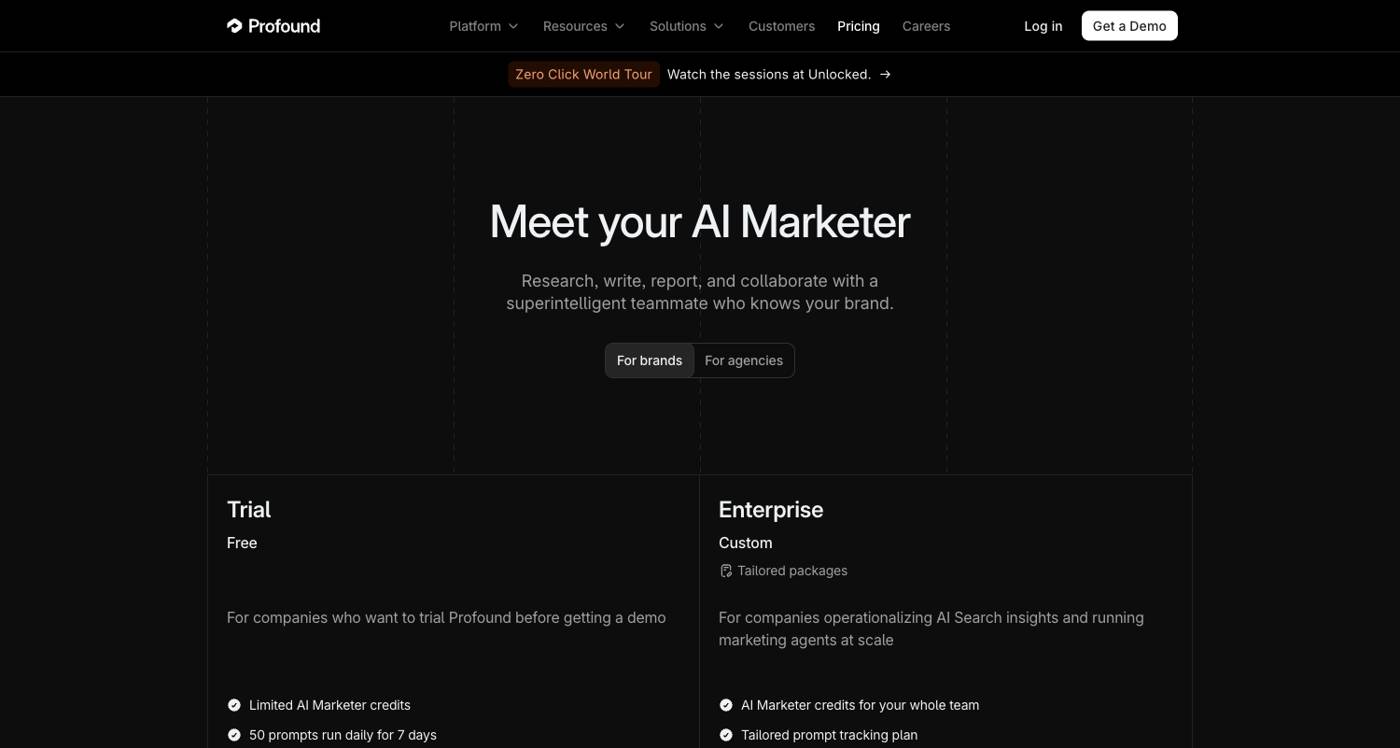
Profound's brand pricing page, captured November 2, 2026, separates the trial from a custom enterprise plan.
Agencies must add the base subscription to client workspace fees. The agency page showed Agency Growth at $99/month plus add-ons, with a full client workspace at $399/month. The ten monthly pitch workspaces are for prospect audits; they are not equivalent to ongoing client workspaces. Before taxes and other add-ons:
| Agency workload | Calculation | Estimated monthly price |
|---|---|---|
| Base plan for prospect pitches | $99 base | $99 |
| One ongoing client workspace | $99 + 1 × $399 | $498 |
| Five ongoing client workspaces | $99 + 5 × $399 | $2,094 |
The listed client workspace includes 100 prompts across ChatGPT, Perplexity and Google AI Overviews, daily tracking, and 400 monthly Agent credits. Pitch and client workspaces differ in duration and permissions. Confirm regions, history, seats, overages and contract terms; these are not identical packages to Semrush's offerings.
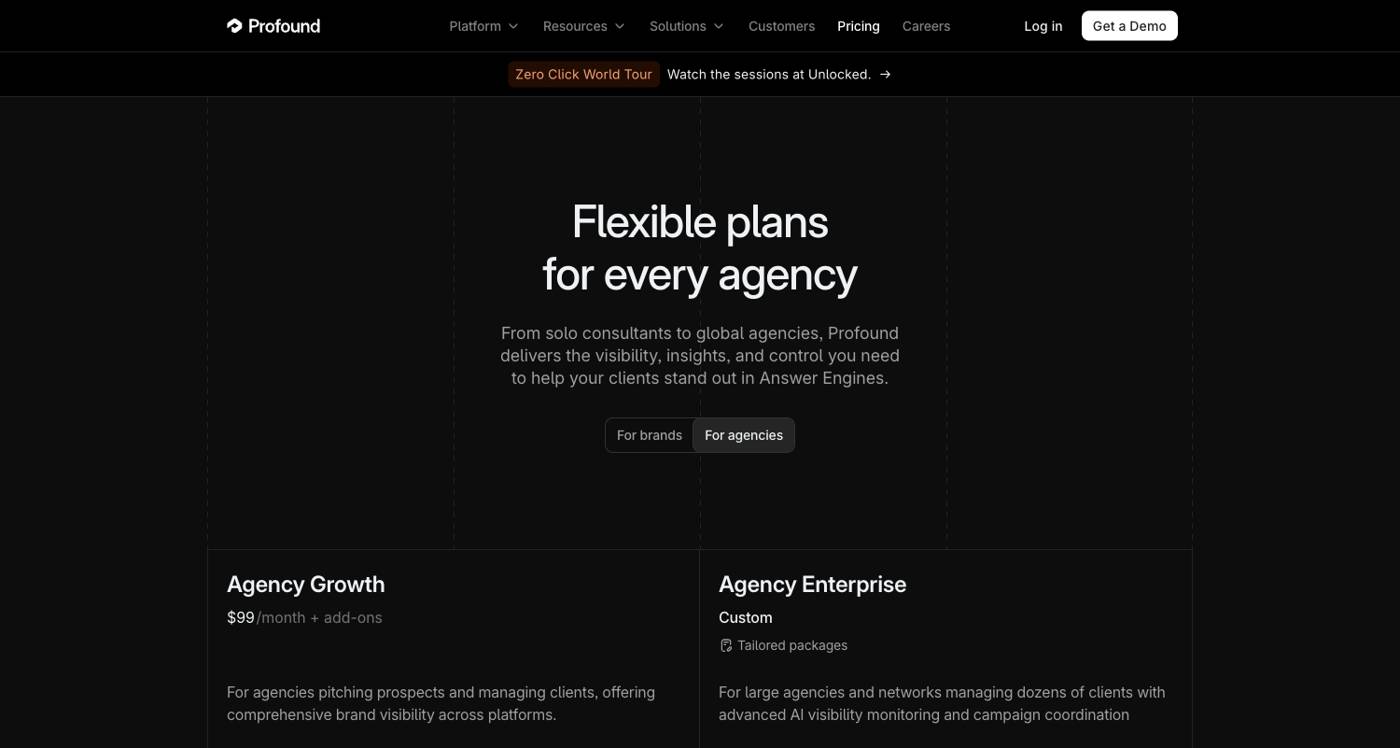
Profound's agency page, captured November 2, 2026, shows a base monthly charge plus add-ons; ongoing client workspaces are purchased separately.
How the tools find questions
For a company selling inventory management software to cross-border merchants, start with a customer decision: “How can a seller avoid overselling across marketplaces?”
| Task | Semrush approach | Profound approach |
|---|---|---|
| Discover related questions | Enter the topic in Prompt Research and review questions, intent, estimated demand and competitors. | Search Prompt Volumes for topic hierarchy, questions, intent and available audience dimensions. |
| Investigate a missing brand | Use Topic or Source Opportunities in Visibility Overview, then open the answer and cited sources. | Inspect answers, mentions and citations by question, engine and competitor in Answer Engine Insights, subject to plan access. |
| Choose a next action | Compare the finding with SEO keywords, existing pages and site audits. | Use AI Marketer or Agents to organize research, drafts or tasks; check integrations, credits and review permissions. |
Semrush says it combines AI-search clickstream data, Google AI Overviews keyword data and modeling. Similar prompts are grouped into topics, and AI Volume is a topic-level estimate. Profound says Prompt Volumes starts with double-opt-in consumer-panel data and uses statistical modeling to extrapolate; its reported corpus is not a census of the market. Different samples, processing, markets and modeling can produce different estimates. The larger number alone does not show which one is right. Semrush methodology; Profound Prompt Volumes.
Keep two lists: a stable baseline of 15–30 questions drawn from sales, support, Search Console and public competitor research; and a separate list of tool-suggested questions to review monthly. Label by product, buying stage, country and language. Do not paste customer names or sensitive conversations into a third-party tool.
For example, the inventory team might track questions about avoiding overselling, selecting software for ten people, and comparing two products' multichannel support. The first two are unbranded discovery questions; the third reflects an explicit purchase comparison. Report new prompts separately from the baseline so a changed sample is not mistaken for improved performance.
Choose by team stage and responsibility
Starting small: prove the workflow is useful
If your team mostly manages Google rankings and content, define the essential questions and platforms first. Semrush's 25-slot AI Toolkit may cover one platform; two platforms require a new calculation. If you need the broader SEO suite, compare One against your actual existing subscription. Check separately for content tools, users and additional brand domains.
Profound's free trial can show the interface and the kinds of answers available. Its recommended prompts cannot establish which vendor is more accurate on your own 20 key questions.
Growing brand: AI visibility is a recurring responsibility
When someone needs to explain every week why competitors are recommended, which sources appear and what to change, ask both vendors to demonstrate the same business problem from discovery through source review, action and recheck. Semrush connects AI reports with SEO and site-audit workflows. Profound may be worth the additional cost when its AI research, answer monitoring and agent workflows solve a problem that would otherwise consume meaningful team time.
A recurring industry list that cites competitors may call for checking third-party inclusion criteria, not rewriting your homepage. A competitor's explanation page cited for a missing feature may call for improving your own documentation. Neither tool guarantees that an edit will lead to a citation.
Enterprise and agencies: make the quote testable
Ask vendors to specify:
- Coverage: prompts per brand, country and language; how cross-engine tracking consumes capacity; refresh frequency and history.
- Evidence: access to prompt text, answers, collection date, cited URLs, aliases and missing or failed runs; exportable fields.
- Collaboration: client isolation, read-only roles, billing administration and charges for extra projects or domains.
- Automation and governance: Agent credit consumption, CMS and analytics permissions, human review before publication, API and SSO terms.
- Total price: base fee, workspaces, domains, platforms, prompt packs, users, reports, taxes, contract term and renewal conditions.
Keeping Semrush and Profound together can be reasonable when each supports a distinct task. Avoid paying twice for reports that nobody is responsible for interpreting.
Test the same job before buying
Prepare 10–15 fixed prompts spanning discovery, competitor comparison, pricing and implementation. Select a country, language and engines both products support. Because Profound's brand trial cannot use a custom set, request a demonstration or plan that can before claiming a same-prompt comparison. AI answers can differ across time and collection methods.
| Check | Ask both vendors to show | A warning sign |
|---|---|---|
| Prompt quality | Where questions come from, the intended audience and what can be edited. | A “high-value prompt” label without a business rationale. |
| Answer and sources | Original response, platform, time, brand, competitors and cited URL. | A score with no answer-level evidence or distinction between missing and failed runs. |
| From finding to action | A specific page or external source, owner and recheck method for the same problem. | Generic recommendations without evidence or a responsible owner. |
| Reporting and collaboration | Export actual fields and demonstrate client roles and workspaces. | Reports omit dates, prompts or engines, or client data cannot be isolated. |
| Ongoing cost | A written quote for expected prompts, platforms, users and clients in three months. | Only an entry price, without add-ons or contract terms. |
Compare whether your team can trace and act on the results. A handful of responses collected at different times cannot establish an overall accuracy winner.
How to check whether an optimization worked
Suppose the inventory team updates its multichannel synchronization page and corrects product information on a third-party directory. Save the original page, change date, target questions and answers. Continue observing the same questions and engines; retain valid answer counts, brand mentions and cited URLs each week. A comparable set of unchanged questions can help interpretation, but it does not establish causation by itself.
- Monitoring: look for sustained changes on the same questions and engines, not one favorable day.
- Content: check that the page is accessible, accurate and answers the buyer's question; confirm that external information was actually updated.
- Business: separately examine identifiable AI referrals, inquiries and orders, while recording Google traffic and other marketing activities. Referrers are not always passed, so measurable AI referrals are incomplete.
If a brand appears in four out of ten valid responses, its generic sample coverage is 40%; it does not mean 40% of prospects saw the brand or bought. Profound defines its Visibility Score using responses that mention at least one brand as the denominator. If only eight of those ten answers mention any brand and four mention yours, its definition gives 4 / 8 = 50%. Semrush's 0–100 Visibility Score is a different normalized measure. Do not treat these figures as interchangeable. Profound metric definition; AI visibility metrics guide.
For other AI monitoring options, see Profound vs Peec AI, Profound vs Otterly.AI, and Peec AI vs Otterly.AI.
Frequently asked questions
Can Profound replace Semrush?
Profound is worth evaluating on its own if the job is AI-answer monitoring, related research and agent workflows. If your team also needs daily Google keyword research, traditional rank tracking, backlinks and technical SEO, do not assume it includes the entire Semrush toolkit. Compare actual responsibilities before replacing either product.
Does Semrush's $99 include its full SEO toolkit?
The $99 figure refers to the AI Visibility Toolkit; it does not automatically include the complete SEO Toolkit. Semrush One is a separate bundle. Billing, domains, users and add-ons affect the final cost.
Is one Profound agency client $399/month?
The current public agency page lists a $99/month Agency Growth base plus $399/month for each ongoing client workspace. With only those two charges, one client is an estimated $498/month before tax, other features or negotiated terms.
Does higher AI visibility prove higher traffic or sales?
No. Monitored mentions, citations, actual visits, leads and orders measure different things. A score may also change as the sample or competitors change. Use consistent monitoring alongside website analytics and information about other campaigns to assess business value.