
Profound and Otterly.AI can both monitor whether your brand appears when people ask ChatGPT, Google AI Overviews, or Perplexity for buying advice. The better fit depends on what you need to do next. Otterly's public plans give smaller teams a more accessible starting budget. Profound's brand Enterprise offering deserves a closer look if you need sample-based AI demand research and automated workflows and can evaluate an enterprise quote. Agencies have a separate Profound pricing structure, so the brand-plan comparison does not tell the whole story.
This guide compares pricing, engines, prompt limits, research, and client management, then walks through how to select prompts and assess changes. Prices and features reflect official pages checked on November 2, 2026. Confirm access, taxes, and billing at checkout or in your contract.
Profound vs Otterly.AI feature comparison
Reading the table: ✓ means included; ✕ means not included in that plan; “add-on” costs extra; “confirm” means check the actual contract. Profound columns cover brand Trial and Enterprise; agency pricing is separate. Prices are in US dollars on monthly billing.
| Feature or cost | Profound brand Trial | Profound brand Enterprise | Otterly Lite | Otterly Standard |
|---|---|---|---|---|
| Price | Free for 7 days | Custom quote | $29/month | $189/month |
| Tracked prompts | 50, run daily for 7 days | Custom | 15 | 100 |
| Custom tracking prompts | ✕ Vendor-recommended prompts only | ✓ Add, edit, and deactivate | ✓ | ✓ |
| Daily monitoring | ✓ During trial | ✓ | ✓ | ✓ |
| ChatGPT, Google AI Overviews | ✓ | ✓ | ✓ | ✓ |
| Perplexity | ✕ Not in trial engines | ✓ Optional; confirm in contract | ✓ Included | ✓ Included |
| Gemini | ✓ Included | ✓ Optional; confirm in contract | Add-on: $9/month | Add-on: $59/month |
| Google AI Mode | ✕ Not in trial engines | ✓ Optional; confirm in contract | Add-on: $9/month | Add-on: $59/month |
| Claude | ✕ Not in trial engines | ✓ Optional; confirm in contract | Add-on: $29/month | Add-on: $109/month |
| Prompt discovery and research | ✓ Prompt Volumes: 5 searches | ✓ Prompt Volumes: per contract | ✓ Prompt Research | ✓ Prompt Research |
| Brand and competitor monitoring | ✓ | ✓ | ✓ | ✓ |
| Citation tracking | ✓ | ✓ | ✓ | ✓ |
| Report export | ✕ | ✓ CSV, JSON | ✓ Detailed reports and export | ✓ Detailed reports and export |
| API | ✕ | ✓ | ✕ Not included | ✓ 2,000 requests/month |
| MCP access | Confirm | Confirm | ✕ Not included | ✓ 2,000 requests/month |
| Agent Analytics | ✓ Data source connection required | ✓ Data source connection required; access per contract | ✕ Not included | ✓ 200,000 events/month |
| Workspaces | Project space; confirm permissions | Project space; confirm permissions | ✓ One | ✓ Multiple, with a shared prompt allowance |
| Single sign-on | ✕ | ✓ | ✕ Not listed for plan | ✕ Not listed for plan; available on Enterprise |
Three details are easy to miss: Profound's free brand trial does not allow custom tracking prompts; Otterly charges extra for Gemini, Google AI Mode, and Claude; and the two vendors' prompt-research figures have different sources and cannot be compared directly. Events, API requests, and prompts are separate allowances.
Sources: Profound pricing, Otterly pricing, and Otterly plan details. Features can change. “Not listed” means absent from the plan pages checked, not necessarily unavailable across the whole product.
Which situation sounds like yours?
| Your situation | Start by considering | Why, and what to check |
|---|---|---|
| One person or a small team tracking one brand and a few competitors | Otterly Lite | $29/month and 15 tracked prompts provide a small baseline. Add engine fees if your audience uses Gemini or Google AI Mode. |
| Several product lines, regular reporting, and evolving questions | Otterly Standard; also evaluate a Profound Enterprise quote | Standard's 100 prompts and multiple workspaces help organize monitoring. Check Profound's available research capabilities and quote if deeper demand analysis matters. |
| An agency preparing client pitches before a contract is signed | Compare both vendors' pitch workspaces | Profound Agency Growth includes short-term pitch workspaces; Otterly's Agency Partner program also offers presales workspaces. Confirm eligibility and limits. |
| An agency serving multiple clients over time | Model both products by client, prompt, and engine | Otterly Standard offers multiple workspaces with a shared prompt allowance; Profound charges separately for full client workspaces. |
| A team looking for new buyer questions | Compare Otterly Prompt Research and Profound Prompt Volumes | Otterly's Intent Volume estimates demand using Google search volume; Profound uses consumer samples and modeling. Neither is a complete count of real questions asked on AI platforms. |
This does not establish that Profound is more accurate or that Otterly cannot support detailed work. The useful buying question is: what kind of research, monitoring scale, and execution workflow do you need, and what can you spend on them?
Pricing: separate brand and agency plans
Otterly: a low entry price, plus any engines you need
| Monthly plan | Published monthly price | Tracked prompts | Typical use |
|---|---|---|---|
| Lite | $29 | 15 | A small baseline for one market and a few competitors. |
| Standard | $189 | 100 | Regular monitoring across product lines or workspaces organized by client. |
| Premium | $489 | 400 | A larger prompt library and higher limits. |
| Enterprise | Contact sales | From 1,000 | Larger-scale or custom requirements. |
These are published US-dollar monthly prices. Prompt limits refer to configured monitoring prompts, not the number of real questions users ask or a promise of unlimited answer generation. Listed base engines include ChatGPT, Google AI Overviews, Perplexity, and Microsoft Copilot; check the add-ons for Gemini, Google AI Mode, and Claude. Lite includes one workspace, three recommendations per week, and 1,000 GEO URL audits per month. Standard supports multiple workspaces, API and MCP access, and 200,000 Agent Analytics events per month.
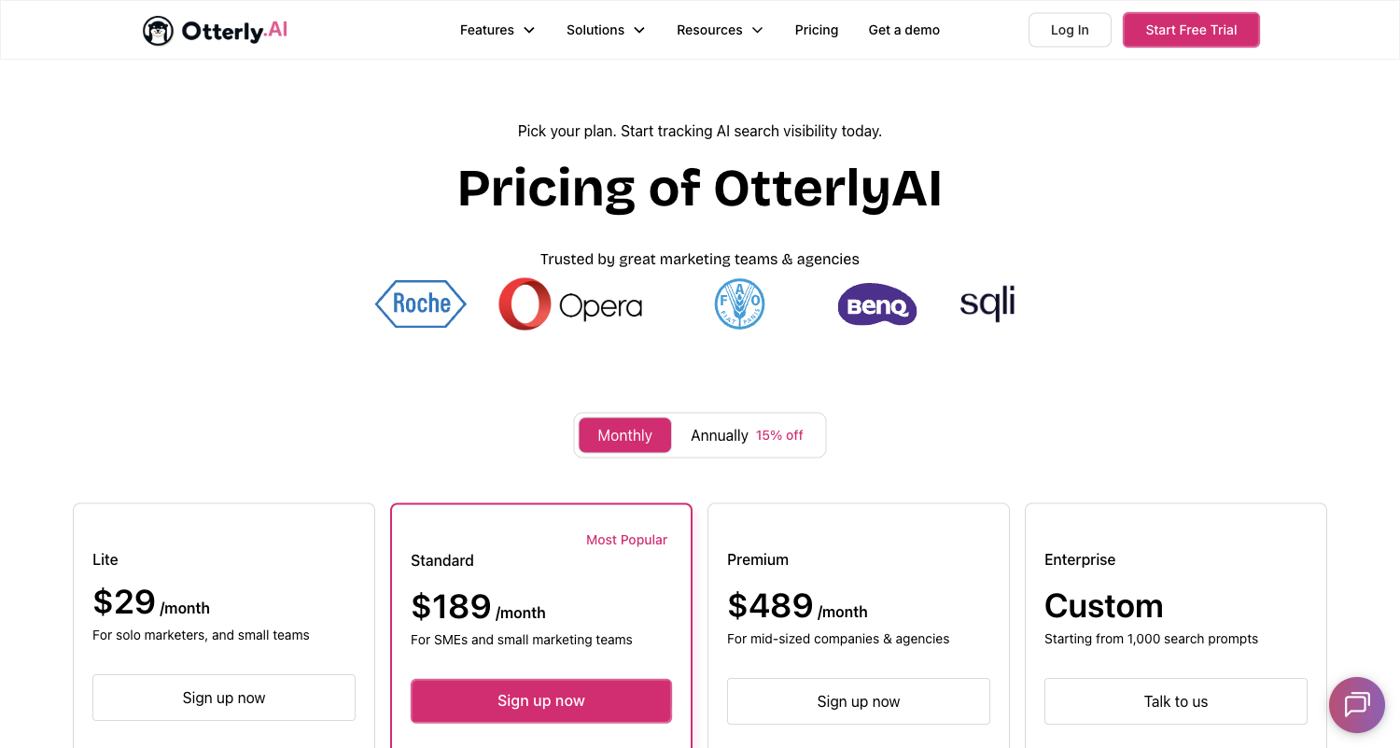
Otterly's published plans; check the current pricing page.
The add-ons can change the budget substantially:
- Lite costs $29/month. Add Gemini ($9), Google AI Mode ($9), and Claude ($29), and the published total is $76/month. The prompt allowance remains 15.
- Standard costs $189/month. The same add-ons cost $59, $59, and $109 respectively, for $416/month. Extra prompts, taxes, and contract differences are additional.
Google AI Mode and Google AI Overviews are different products. If your audience mainly uses one, list it explicitly before checking the final price.
Profound: brand Enterprise and agency pricing are different
Profound's brand page lists a free Trial and a custom-priced Enterprise plan. The trial includes 50 unique prompts, daily tracking for seven days, one region, and one language, across ChatGPT, Gemini, and Google AI Overviews. It does not include historical data, exports, or API access; check the current page for details.
One constraint can decide whether the trial answers your buying question: Profound recommends the trial prompts by industry, and brand trial users cannot replace them with their own. It is useful for seeing the reports, but it cannot establish how your own 50 sales questions would perform. Ask sales about access to custom prompts.
For agencies, the published Agency Growth plan starts at $99/month plus add-ons. It includes 10 pitch workspaces per month for short-term demonstrations. A full client workspace is a $399/month add-on per workspace, with 100 unique prompts, daily tracking, and specified engine and user allowances. At published rates, the base plus one full client workspace comes to $498/month, before taxes and other add-ons. Ten pitch workspaces are not ten ongoing client workspaces.
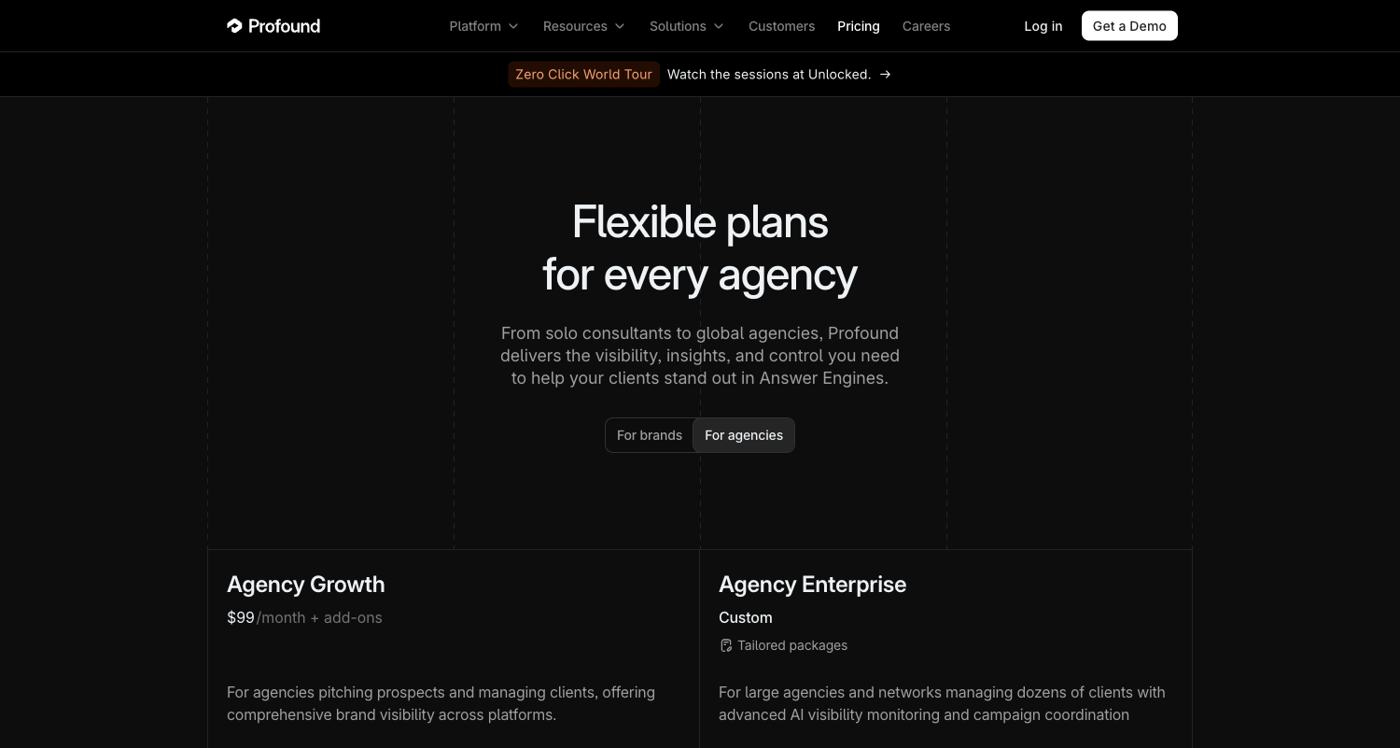
Profound's agency pricing; see current pricing and the agency plan explanation.
The $416 and $498 examples do not establish which product is better value: their engines, workspace purposes, allowances, and other capabilities differ. Give both vendors the same requirements: number of clients and markets, custom prompts, engines, retention period, export permissions, and total price.
Where the workflows differ
1. Ongoing monitoring: coverage depends on the plan
Both products repeatedly observe answers to a set of prompts, including brand mentions, competitors, and citations. In a demo, look beyond the monitoring checkbox:
- Can you set the questions? Otterly's paid plans let you build your own prompt set; Profound's brand Trial uses recommendations. An Otterly tracked prompt cannot be edited in place: changing its wording means deleting and adding it again, without automatically transferring its history. Ask Profound to demonstrate creation, editing, deactivation, and how Enterprise limits are counted.
- Where do you monitor? Plan coverage differs. Check add-ons and contract terms for Gemini, Google AI Mode, and Claude individually. A Google AI Overview that did not trigger is not simply a brand absence.
- What can you inspect? Start with individual prompts and original answers, then examine results by engine, region, and time. A combined score can hide a brand mention in ChatGPT alongside an AI Overview that never triggered.
- What happens to the data? Confirm retention, export scope, API access, and permissions if you report to clients or combine datasets. The brand Trial's lack of export and API does not imply Enterprise lacks them.
Otterly makes it easier to begin daily monitoring on a stated budget. When evaluating Profound Enterprise, ask whether its segmentation, data access, and collaboration match your work, and confirm their cost in the quote.
2. Prompt discovery: different inputs, different estimates
Otterly Prompt Research generates candidate questions from keywords, brands, or pages; the pricing page lists it on Lite. Its Intent Volume estimates demand using Google search volume. It can help prioritize questions, but it is not a count of actual questions asked on AI platforms.
Profound's Prompt Volumes uses consented, anonymized, aggregated consumer samples and statistical modeling to estimate demand for AI questions. It can reveal related questions and relative topic importance; it is not a complete public log of platform queries. Brand Trial includes five Prompt Volumes searches. Confirm Enterprise access and geographic coverage.
For “remote project management,” Otterly might produce candidate questions and use a search-volume-based estimate to help rank them. Profound focuses on modeled demand from consumer samples. Neither tool's figure can directly validate the accuracy of the other's. Use sales records, Search Console, and customer interviews to select useful candidates, then add important questions to a fixed monitoring set.
Research and ongoing monitoring answer different questions: repeated observations of a fixed set help track change but do not represent every potential buyer's questions. Ask each vendor to start with the same business topic and show where candidates came from, how they are ranked, available regions, and how they become tracked prompts.
One buying question, two demonstrations
Suppose a cross-border marketplace wants to know which merchants US consumers see when asking for “affordable wedding favors.” The questions, outputs, and decisions below are hypothetical.
| Business question | How Otterly could help | What to ask Profound to demonstrate | Buying test |
|---|---|---|---|
| How else might buyers ask? | Generate candidates from a category, page, or brand and use Intent Volume to prioritize. | Show related wording, geographic and audience segments in Prompt Volumes, and explain the estimate. | Do candidates reflect real price, quantity, shipping, and selection constraints? Count alone is not enough. |
| Which answers mention competitors, and what do they cite? | Track selected prompts and inspect source URLs, brands, and related prompts in citation reports. | Show answers, citations, and competitors for the same question, then the route from opportunity to workflow. | Being able to inspect the answer and source is more useful than a single score. A citation alone does not prove why a competitor appeared. |
| Who acts next? | Group relevant questions and pages; use GEO audits and suggestions to assign work to content or merchandising. | Use brand context, product constraints, and existing data to generate a brief or task; show the human review step. | Can the owner complete the work in the existing process? Generated content is not evidence of citations or orders. |
Otterly's citation-report guide describes filtering by country, engine, and time and inspecting pages and associated prompts. Profound's research page explains its sample, modeling, and coverage. If your main market is outside a supported area, ask for evidence of actual availability there; a global platform list does not guarantee equivalent data in every region.
3. Citations and competitors: move from a chart to a page
Imagine you sell project management software. An answer to “project management tools for remote teams” mentions two competitors and cites a third-party comparison, but omits your brand. Instead of assigning a vague task to “improve visibility”:
- Open the original answer and confirm the omission. Save the date, engine, region, and prompt.
- Read the cited page. Does it explain remote collaboration, permissions, pricing, and suitable team sizes? Check whether your relevant page answers those same selection questions.
- If the source is a third-party review, check whether its product information is accurate and whether it covers your product. Contact the publisher with factual additions only when relevant and appropriate; payment or outreach does not guarantee a citation.
- Assign a specific change to your own page, such as adding verifiable feature limits, pricing conditions, and suitable team sizes. Record the publication date.
- Recheck the same prompts and engines. Record changes in mentions, sources, and answer content without attributing one improvement directly to that edit.
Available segments and raw data depend on the plan. Ask each vendor to walk through the example, not just a summary dashboard.
4. Recommendations and execution: how much automation do you need?
Otterly offers GEO URL audits and optimization suggestions. A small team can inspect a page and decide which recommendations warrant action; Lite limits weekly recommendations. Profound's Agents can bring visibility data into reports, competitor tracking, and content tasks, triggered on a schedule or by events. Its workflows and content editor can connect to some external tools. Agent usage is billed in credits; confirm access, per-run costs, and overage handling for the plan.
If your content workflow already works and you need a prioritized list of pages, Otterly's suggestions may be enough. If a team repeatedly researches, briefs, and routes content across clients, Profound's automation is worth a demonstration, alongside setup, human-review, and credit costs. A knowledgeable person should check either tool's recommendations; neither guarantees a citation after a change.
5. AI crawler visits are leads, not citations or orders
Otterly includes Agent Analytics on Standard and other plans; Profound also offers related analytics. Otterly requires a connection to the relevant log source. Live collection begins after connection; supported methods are needed to import existing history. These tools can show AI agent or crawler visits present in connected sources. Ask which sources require integration, which bots are covered, retention, and event or request limits.
A recorded crawler request establishes a visit, not a citation or a sale. Check crawling against server or CDN records, then inspect answers and website analytics separately to distinguish visits by bots, citations, and referred traffic.
Choosing by stage
Starting out: build a useful 15-prompt baseline
For one main market with no dedicated AI search owner, Otterly Lite's entry price makes it a practical starting point. Don't spend all 15 slots on branded questions. Include questions people ask before they know your brand, review original answers each week, and assign actionable gaps to a content or product owner.
With no budget, Profound's brand Trial can show recommended prompts and report structure, but it cannot test your own questions. With either product, check engines and regions first.
Growing: expand coverage before buying deeper analysis
Fifteen prompts may not cover the most important comparisons and buying scenarios across several products, audiences, and regions. Prioritize questions first, then assess whether Standard's larger allowance and workspaces are needed. Unlimited brands or workspaces do not imply unlimited tracked questions.
If a growth team needs demand research or more complex market and competitor analysis, and can afford an enterprise contract, include Profound in the demo. Ask for pricing, engines, regions, and export terms before deciding whether the extra research capability is worth the cost.
Agencies: budget for pitches and delivery separately
Profound pitch workspaces can support short-term demonstrations, while ongoing monitoring requires separately priced full client workspaces. Three full workspaces at the published $99 base plus $399 each would be $1,296/month, before other add-ons and taxes; confirm the contract.
Otterly Standard can organize clients in multiple workspaces, but all clients share the prompt allowance. Otterly also lists an Agency Partner program: Standard or Premium subscribers can apply; once approved, Standard may increase from 100 to 150 prompts and Premium from 400 to 500, with pitch workspaces and branded reports. Confirm presales workspace limits and conditions. On ordinary Standard, five clients with 20 unique prompts each would use all 100 slots. Ask how additional clients, regions, and segmentation are charged. A workspace organizes work; it does not automatically give each client a separate full allowance.
How to find questions worth tracking
A report covers the questions you or the vendor selected. A polished chart cannot fix the wrong question set.
Step 1: collect candidates in customers' own words
- Sales and support: Gather selection questions, objections, feature limits, and alternatives, such as “Does it work for a team of 10?” or “Can we migrate from our old system?” Remove personal information and do not send sensitive customer data to a third-party tool.
- Search and on-site behavior: Use relevant Search Console queries, site search, and landing-page data as leads. Search queries are not identical to AI prompts; rewrite them as natural questions and review them.
- Competitor research: Inspect comparison pages, review sites, communities, and public customer discussions for recurring buying criteria. Record the source; one post does not represent the market.
- Customer journey: Include problem discovery, available options, vendor selection, and price or migration risk, rather than monitoring only brand terms.
Step 2: label questions and keep a fixed baseline
The following 15 questions are fictional examples for a project management software team, not observed monitoring results.
| Group | Example questions | What it reveals |
|---|---|---|
| Discover needs (5) | How can remote teams plan projects across time zones? / How can we prevent missed task handoffs? / How should a small team track project progress? / How can we organize customer feedback? / How can we reduce project meetings? | Needs expressed before a product is specified. |
| Solutions and competitors (5) | What project management tools suit remote teams? / What kind of Kanban software suits a small team? / Is A or B better for cross-functional collaboration? / What are alternatives to A? / How do project management tools compare on permissions? | Comparison sets, descriptions of differences, and third-party sources. |
| Purchase and implementation (5) | How much does project management software cost for ten people? / What should we consider when migrating from spreadsheets? / Which tools support guest permissions? / How should we estimate implementation costs? / How do agencies choose project management software? | Questions closer to a purchase decision. |
Replace A, B, and the industry terms with your own. Record market, language, intent, owner, relevant product page, and priority for each question. Keep a set fixed for trend comparisons and label additions separately; an expanded sample can change a score without any business improvement.
Step 3: turn opportunities into a deliverable backlog
Each week, choose questions most closely connected to revenue or customer decisions. Record question → original answer → missing information → page or source to change → owner → date. Prioritize factual errors, missing evidence on key product pages, and frequently cited competitors where your relevant page lacks useful information. Not every missing mention deserves a project.
For Google-specific coverage, see how to measure and improve Google AI Overview visibility. For a broader operating loop, see how to improve brand visibility in AI search.
How to read visibility metrics
Comparing one score from each vendor can mislead. Record each metric's definition, eligible sample, engine, region, and period. For example, Otterly's Brand Report KPI definitions describe:
- Brand Coverage: the proportion of eligible prompt–engine–date executions that mention the brand. Its documentation excludes executions where Google AI Overviews did not trigger from the denominator; they should not simply count as non-mentions.
- Share of Voice: the brand's mentions as a share of mentions of all brands. A brand counts once per prompt–engine–date execution even if it appears repeatedly; competitors also change the denominator.
- Likelihood to Buy: calculated from average rank according to the vendor, not an actual purchase probability or conversion rate.
For illustration, if four of ten eligible answers mention your brand, Coverage is 4 ÷ 10 = 40%. If all brands received 20 mentions across those answers and yours contributed four, Share of Voice is 4 ÷ 20 = 20%. The denominators differ; neither number proves one tool is better.
Before comparing Profound and Otterly, request both sets of definitions and check eligible answers, brand aliases, engines, sampling periods, and missing data. Record specific citation URLs and page types. A brand mention is not the same as a citation of its official website.
Why small prompt sets can swing
Otterly's stability study covered 520 prompts, seven engines, and 252,407 answers. In its 320-prompt AI search monitoring category, the vendor repeatedly sampled random subsets while fixing brand, engine, and a 30-day window. With 10 prompts, 90% of results fell between 39% and 71%; with 100, between 51% and 60%. These are results from that vendor's study and method, not a confidence interval for your site or proof that 15 prompts have no value.
Small samples are useful for finding specific issues, but a single day's overall score is a weak basis for judging performance. The same study found that 48% of 46,009 URLs in its monitored category's 30-day sample were cited only once. One link disappearing on one day does not necessarily indicate an overall decline. Keep a fixed set, observe multiple days, and inspect original answers. For important changes, check region, engine, sample, and monitoring errors.
How to evaluate the tool and your changes
Before buying: use a shared checklist
- Write down 10–20 commercially useful questions, priority markets, languages, required engines, and a budget ceiling.
- Ask which prompts are customizable, whether regions or engines consume extra prompt allowance, update frequency, and history retention.
- Ask to see original answers, citation URLs, alias handling, exports, and failed-run flags. Have each vendor demonstrate a competitor comparison and a review following a page repair in your scenario.
- If both paid plans permit custom tracking, compare the same prompts, markets, languages, and as consistent an engine and time window as possible. Record collection methods and differences. Profound's free brand Trial cannot accept your custom set, so it is not a same-question free test.
- Manually inspect several answers and confirm that aliases, non-triggered AI Overviews, and failed runs are labeled correctly. Failure is not brand absence.
- Calculate annual cost from the actual requirements: base fee, workspaces, engines, extra prompts, taxes, and contract term. Collection methods and timing may differ; one day's numerical difference does not establish which vendor is right.
Ask both vendors to demonstrate the same question
Provide the question, target country, language, competitors, and page to inspect. Confirm that demo access and data support customization. Results collected at different times or by different methods are not a controlled head-to-head test.
| Check | Ask to see | When to follow up |
|---|---|---|
| Where questions come from | Candidates, selection criteria, and demand-estimate sources. | Suggestions look relevant, but the vendor cannot explain audience, region, or estimation. |
| Where answers come from | Original answers, collection time, engine, region, and flags for non-triggered and failed runs. | Only an aggregate score is available, with no answer or denominator. |
| Whether citations are traceable | Specific URLs, answers in which they appeared, and relevant competitors; inspect the pages. | Only domains are shown, or you cannot determine whether a page mentions the brand. |
| Whether the result supports action | A page recommendation, owner, exportable record, and retest method for that question. | A task is generated, but its page and factual basis cannot be verified. |
Before purchase, request an anonymized sample report, recording, or relevant industry case. Check its objective, actions, observation period, and outcome definitions. A vendor case illustrates a possible application, not a guarantee for your team. If your business spans markets, a large catalog, or languages, ask whether the sample covers comparable complexity.
After rollout: connect observation to action over 30 days
| Timing | Action | Evidence to retain |
|---|---|---|
| Week 1 | Fix the prompt set; check aliases, markets, engines, and original answers; record the baseline. | Eligible answer count, mentions, specific citation URLs, and collection dates per prompt. |
| Week 2 | Select 3–5 commercially relevant gaps; inspect pages and third-party sources; assign owners. | Original answers, pre-change pages, reasons, and action plans. |
| Week 3 | Complete content, factual, or technical fixes; check accessibility and accuracy. | Changes, release dates, and page links. |
| Week 4 onward | Continue observing the same prompts, regions, and engines; review weekly alongside site analytics. | Before-and-after answers, eligible samples, independent measures such as referral visits, and other concurrent changes. |
If mentions rise while citations to your site do not, third-party sources may be involved. If citations rise without a visible traffic increase, that does not necessarily mean monitoring is wrong: users may not click. If AI referral traffic rises, check attribution and concurrent campaigns before crediting a specific content change.
Frequently asked questions
Is Profound better for large enterprises?
Its enterprise sales process and demand-research capabilities are worth evaluating, but company size alone is not enough. The right choice depends on regions, engines, research needs, users, data requirements, and the quote. Ask both vendors to demonstrate your workflow and compare total costs.
Is Otterly Lite enough?
It can start a continuous baseline if 15 slots cover your key questions and the engines you need fit your budget. For separate monitoring across multiple products and regions, or more history and integrations, check higher plans and alternatives. A small sample can surface leads; it should not be presented as a precise picture of the whole market.
Can Profound's free trial provide a fair head-to-head test?
Not a complete same-prompt test: the brand Trial uses vendor-recommended questions that you cannot replace. Use it to inspect the interface and reports. To compare your own fixed set, confirm paid or demonstration access on both sides and align markets, engines, timing, and collection methods as closely as possible.
Do more AI citations always mean more traffic and orders?
No. Citations, clicks, visits, and conversions occur at different stages and have different measurement boundaries. Record citations in original answers, referral visits in analytics, and actual business conversions separately, then consider concurrent activity. A visibility score alone cannot establish revenue.
The buying decision
If your budget is limited and you already know which questions to follow, choose an appropriate Otterly plan and establish a baseline. If you need broader demand research and cross-team analysis and can evaluate an enterprise quote, give Profound's enterprise demo a serious look. Agencies should price presales pitches and ongoing client workspaces separately, using their actual client and engine requirements.
Whichever product you choose, the useful work is finding important questions, inspecting original answers, making specific improvements, and retesting consistently.
Sources
- Profound pricing: brand and agency plans
- Profound agency plans
- Profound Prompt Volumes
- Otterly pricing, add-ons, and agency program
- Otterly prompt research guide
- Otterly Intent Volume
- Profound Agents
- Otterly Brand Report KPI definitions
- Otterly Agent Analytics
- Otterly AI search visibility stability study