
Imagine a home goods brand selling across borders. Its customers ask AI which storage brands are suitable for small homes, but the team does not know whether its products appear in the answers. It needs to find out what else customers ask, which sources AI cites, and who should address the gaps.
Profound and Peec AI both track brands and sources in AI answers, but they approach the buying decision differently. Peec publishes brand plans starting at $95 per month and lets customers choose their own prompts for ongoing monitoring. Profound's paid brand offering requires an enterprise quote; its consumer-sample-based Prompt Volumes and Agent workflows are worth evaluating. Both vendors offer monitoring, source analysis, and Agents, so it would be misleading to describe one as a tool that acts and the other as just a reporting dashboard.
The comparison below follows the fictional brand from prompt research through purchasing and measurement. Prices and plan details were recorded from official pages on November 2, 2026. Confirm the final bill and access at checkout or in your contract.
Start with the questions customers ask AI
The brand cannot track only its own name. Before buying, customers may ask about space, budget, or returns. The two tools offer different ways to investigate those questions.
Profound's Prompt Volumes uses a double-consented consumer sample, anonymization, and statistical modeling to estimate AI question demand at a broader scale. It can help investigate groups of questions and differences by region or audience. It is not a complete live log of every platform's queries, so check whether long-tail, regional, and audience segments are stable enough for your use.
Peec's pricing page also lists prompt and topic suggestions and Prompt Volume levels from 1 to 5. It supports organizing questions by keyword, brand context, audience, and intent. Ask Peec to explain the source and definition of each demand level. Do not add those levels to Profound's absolute volume estimates, or treat either estimate as a count of actual customers.
If you have customer records, give both vendors the same seed question, such as “What are some no-drill storage options for a small kitchen?” Ask each to show its suggested questions, data sources, target country, purchase intent, and reasons for the suggestions. Compare those with the language in sales conversations and Search Console. A high-demand question that has little to do with your products, prices, or target market is not necessarily worth tracking.
Build a first prompt set
Start with the language of the business, then use the tools to expand it:
- Sales and support records: collect recurring questions about comparisons, switching, price, after-sales service, and implementation. Remove personal and sensitive information.
- Site search and Search Console: find queries with impressions, clicks, or internal searches and turn them into natural questions. Search queries are clues, not counts of AI prompts.
- Competitors and independent sources: read buying guides, reviews, and public communities to see which conditions people compare. Individual comments do not represent the whole market.
- Existing content and product data: use core categories, priority countries, product pages, and return reasons to identify questions that affect purchase decisions.
The fictional storage brand could begin with 15 prompts:
| Question type | Examples | Suggested number |
|---|---|---|
| Problem discovery | How can I add storage to a small apartment kitchen? What no-drill options work in a rental? | 5 |
| Solutions and competitors | Which brands make storage for small spaces? How do Brand A and Brand B shelves differ? | 5 |
| Purchase and risk | Which shelf should I buy for under $50? How do I check dimensions and return terms when buying storage boxes from another country? | 5 |
Replace these examples with real business questions and add a country, language, purchase stage, relevant page, and owner to each. Keep a fixed baseline. Mark new prompts separately so a score change caused by an expanded sample is not mistaken for real growth.
For measurement planning, see AI visibility metrics and KPIs. For another comparison, see Profound vs Otterly.AI.
Check whether the brand appears in the answers
Both products can monitor answers to a prompt set over time. A report becomes useful when the team can return to the individual prompt and original answer.
Peec's brand visibility report can show brands, competitors, position, sentiment, and sources by prompt, model, country, date, and tag. Its visibility definition is the number of answers mentioning a brand divided by the total number of answers analyzed.
Profound's Answer Engine Insights also checks a fixed set of questions for brands, competitors, position, sentiment, and citations. For Enterprise, ask sales to demonstrate drilldowns by market, brand, and topic, and confirm whether the underlying answers can be exported. With either product, check the dates, regions, models, prompts, and number of valid answers. Matching metric names do not guarantee matching samples or calculations.
Suppose the storage brand's overall score falls for “storage brands for small spaces.” First check whether the drop comes from one model, a change in the prompt set, or a brand-name recognition issue. Inspect the original answers and competing brands before deciding whether to update a product page or add information to an independent source. A score change alone is not a reason to rewrite the entire site.
A cited website is not the same as a brand mention
Peec says a brand name in the answer text affects brand visibility. An official website URL can count toward source performance even if the answer does not name the brand. Conversely, an answer may mention a brand without citing its website. See Peec's explanation of sources and brands.
Suppose four of ten valid answers mention the brand, three cite its website, and only one does both. Brand visibility is 40%, while the share of answers citing the website is 30%. Do not add them into “70% exposure”: they overlap and answer different questions.
If Peec reports zero, check the brand name first
Peec's documentation says brand recognition uses case-insensitive exact matching against configured names. You can add aliases or use regular expressions. The domain identifies sources; it is not itself treated as a brand mention in answer text.
If the report shows 0%, inspect answers where the brand is most likely to appear. The model may have used an abbreviation, sub-brand, old name, or different spelling. Recheck after adding aliases, and avoid short terms so broad that unrelated answers become false positives. Before making changes, ask whether historical data will be recalculated.
Check the denominator before comparing position
Peec's Position is the average position in answers that mention the brand; answers without it do not automatically become position 10. Share of Voice is the brand's share of all tracked brand mentions. If four of ten answers mention you, Visibility is 40%. If those four mentions are yours and other brands receive 12 combined, Share of Voice is 25%.
These figures describe the monitored prompts and answers, not the proportion of the whole market seeing the same answers. When comparing with Profound, ask each vendor to show its denominator, competitor set, omitted answers, regions, and collection method. Do not simply subtract one provider's composite score from the other's.
A competitor appears in an answer. What next?
Peec's source analysis can show cited domains and URLs, source types, and sources that also mention competitors. Its Gap Analysis and Actions guidance suggests starting with an important prompt, then reviewing relevant sources and priorities.
Suppose an answer to a purchase question cites an independent buying guide that mentions two competitors but not your brand:
- Open the answer and save the prompt, date, country, model, and cited URL. Confirm that the source is relevant to the purchase question.
- Check whether the guide covers your category and whether your site publicly explains pricing conditions, delivery coverage, and comparison details.
- On your own page, add verifiable product details and limitations. For an independent source, decide whether an objective addition would be appropriate, then contact its editor with facts. Outreach does not guarantee inclusion.
- Retest the same prompt set after the changes. Record sources, brand mentions, and business data separately; a single appearance does not prove the change caused it.
Profound also tracks sources and competing brands. To compare depth, ask both vendors to demonstrate the same prompt and cited URL, including the related answers, brands, and filters.
Give the finding to a person or an Agent?
Profound's Agents can use brand context and monitoring data in research, reporting, and content workflows. Runs consume credits. During a demo, inspect the evidence behind the output, who maintains the brand information, whether human approval is required, and the cost of a multi-step task.
Peec also lists Agents, preset and custom skills, suggested actions, and brand context. Starter lists 500 Agent credits and Pro lists 750. These are Agent workflow allowances, distinct from the agency monitoring credits discussed below. Confirm the available capabilities, consumption, and connected tools. If you already have content or PR workflows, Peec's source analysis and suggestions may be enough. If you want multi-step tasks generated automatically, ask both vendors to demonstrate the same job and compare configuration and review time.
A generated article draft, crawlability recommendation, or optimization task does not mean a page was cited, traffic grew, or orders increased. Check facts, product information, and external references before publishing.
When the question is about a specific product
For ecommerce teams, Peec's brand plan matrix lists catalog upload, SKU visibility, position, and Win Rate. Its Win Rate is the proportion of analyzed answers in which a product is the first recommendation, not an order win rate. Profound Enterprise also lists ChatGPT Shopping capabilities; confirm markets, product sources, and access in a demo. For acceptance, choose ten representative SKUs and check that product names, prices, stock, links, and monitoring prompts match, then assess the results separately from actual sales.
Both vendors also list AI crawler analysis, which requires connecting a CDN, server, or another data source. Peec's brand plans additionally list robots.txt checks, source visits, and AI referral traffic analysis, with usage limits that vary by plan. A bot request in a log establishes a recorded visit; it does not establish that an AI answer cited the page.
Turn requirements into a budget
Once you know the questions, countries, and models you need, check project limits, engine combinations, and task allowances as well as the headline price.
Brand teams: Peec has public prices; Profound requires a quote
| Brand plan | Monthly billing | Prompts | Models selected at once | Projects | Countries |
|---|---|---|---|---|---|
| Starter | $95 | 50 | 3 | 1 | 1 |
| Pro | $245 | 150 | 3 | 2 | 3 |
| Advanced | $495 | 350 | 3 | 5 | 3 |
| Enterprise | Custom quote | Custom | Per contract | Custom | Custom |
All three public plans list daily monitoring and unlimited team users. Peec displays monthly answer volume using prompts × models × frequency. On Starter, 50 prompts run across three models for all 30 days would produce 4,500 planned runs. The number of successful answers depends on execution. This is neither 4,500 different prompts nor 4,500 real consumers.
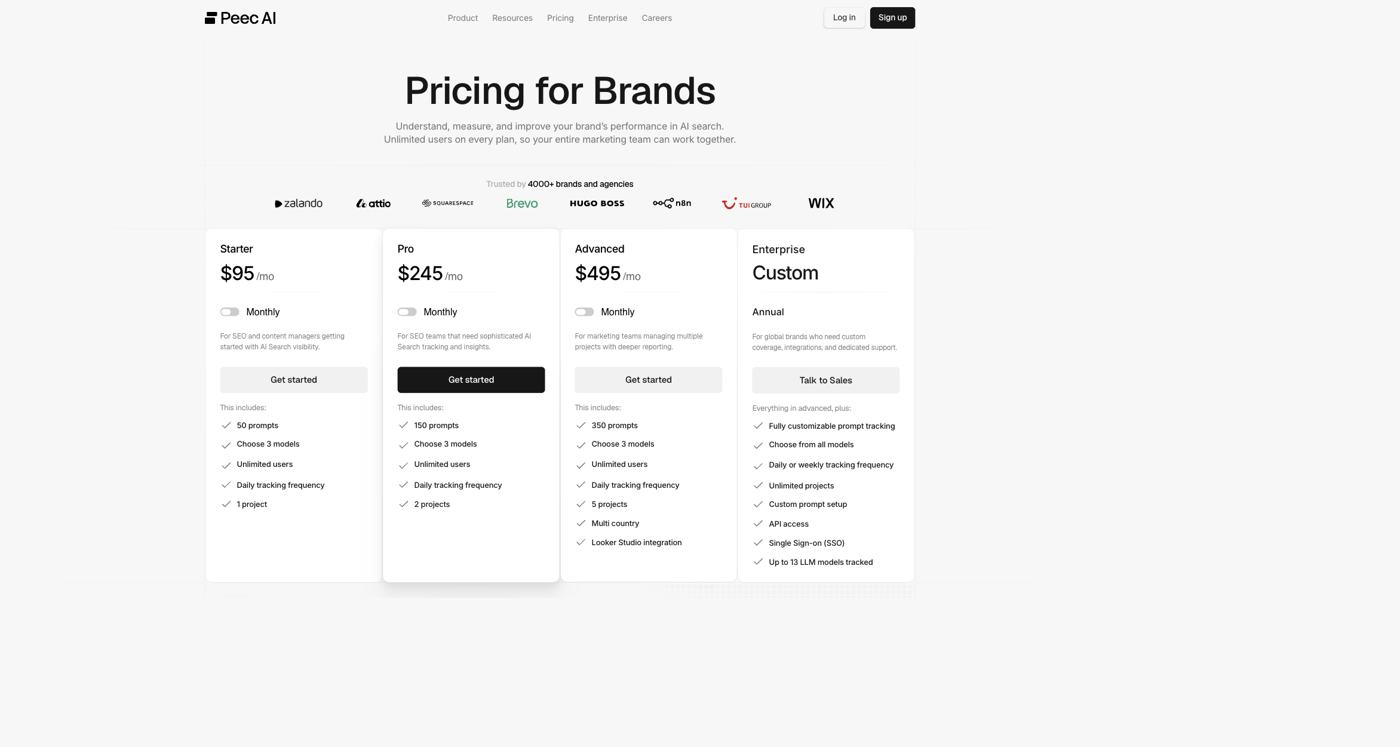
Peec AI's official brand pricing page, showing monthly plans. Check current pricing.
Check which models you can select. The current brand-plan base list includes ChatGPT, Google AI Mode, Google AI Overviews, Microsoft Copilot, Gemini, and Naver AI; the entry plan allows a choice of three. Perplexity appears among add-on model options, with applicable plans and prices to be confirmed at checkout. Extended models such as Claude appear in the Enterprise list. Profound's brand trial is fixed to ChatGPT, Gemini, and AI Overviews. Google AI Mode and AI Overviews are distinct monitoring targets.
If you need ChatGPT, Gemini, Google AI Overviews, and Perplexity at the same time, do not assume “Starter at $95 covers four platforms.” Ask the vendor to show how all four would be configured in your account and what the fourth costs. Availability changes; also confirm whether API models and consumer-facing interfaces use the same collection method.
Projects and prompts are different limits. Whether a brand's US and UK markets fit in one project depends on the plan's country and project settings. Pro lists three countries, but its 150 prompts should not be assumed to be available separately for each project. Peec says the account's prompt allowance can be allocated across projects or brands. Ask sales or check the self-service configuration before paying.
Profound's brand plans include a free Trial: 50 distinct prompts run daily for seven days across one region, one language, and three specified engines. The system recommends prompts by industry and users cannot replace them. The trial has no historical export or API. It is useful for evaluating the interface and reports, but cannot validate your own custom prompt set.
Enterprise pricing and prompt allowances are custom. The page lists up to nine engines, export, API, and SSO. Do not treat older online references to brand Starter at $99/month and Growth at $399/month as current public brand prices, or assume a quote given to one customer applies to everyone.
Ask Profound to itemize prompts and regions, specific engines, historical retention, user permissions, Agent credits, overages, and contract term. Without an enterprise quote, a fair total-price comparison with Peec's brand plans is not possible.
Agencies: calculate for three clients
Peec's agency pricing allocates monitoring across client projects:
| Peec agency plan, monthly billing | Price | Monitoring credits | Full client projects | Prompts per pitch project |
|---|---|---|---|---|
| Essential | $245 | 10,000 | 3 | 25 |
| Growth | $495 | 25,000 | 10 | 50 |
| Scale | $795 | 65,000 | 25 | 75 |
| Comprehensive | Custom | Custom | Custom | Per contract |
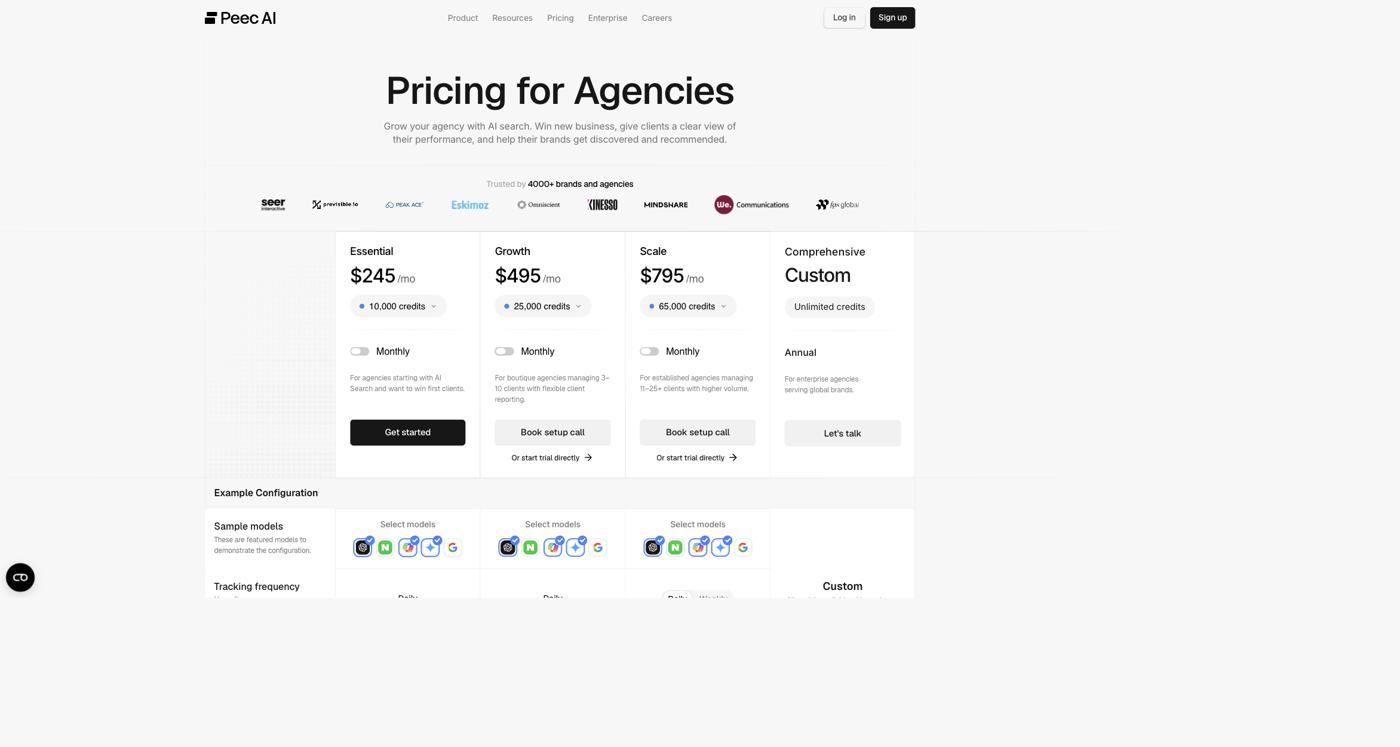
Peec AI's official agency pricing page. Frequency and model combinations change the number of prompts that can be allocated.
Under Peec's formula, one prompt × one model × one day = one credit. For three clients with 30 distinct prompts each, monitored daily on three models over 30 days, the plan requires 3 × 30 × 3 × 30 = 8,100 credits. That fits Essential's 10,000 credits and three full client projects, subject to confirming model combinations, countries, minimum allocations, pitch projects, and taxes. At 50 prompts per client under the same conditions, the requirement is 13,500 credits, exceeding Essential's 10,000.
Profound Agency Growth has a public base fee of $99/month, plus $399/month for each full client workspace. The base plan also includes ten short-term pitch workspaces per month. Three full client workspaces plus the base fee therefore total $1,296/month, before taxes and other add-ons. Full client and short-term pitch workspaces have different purposes.
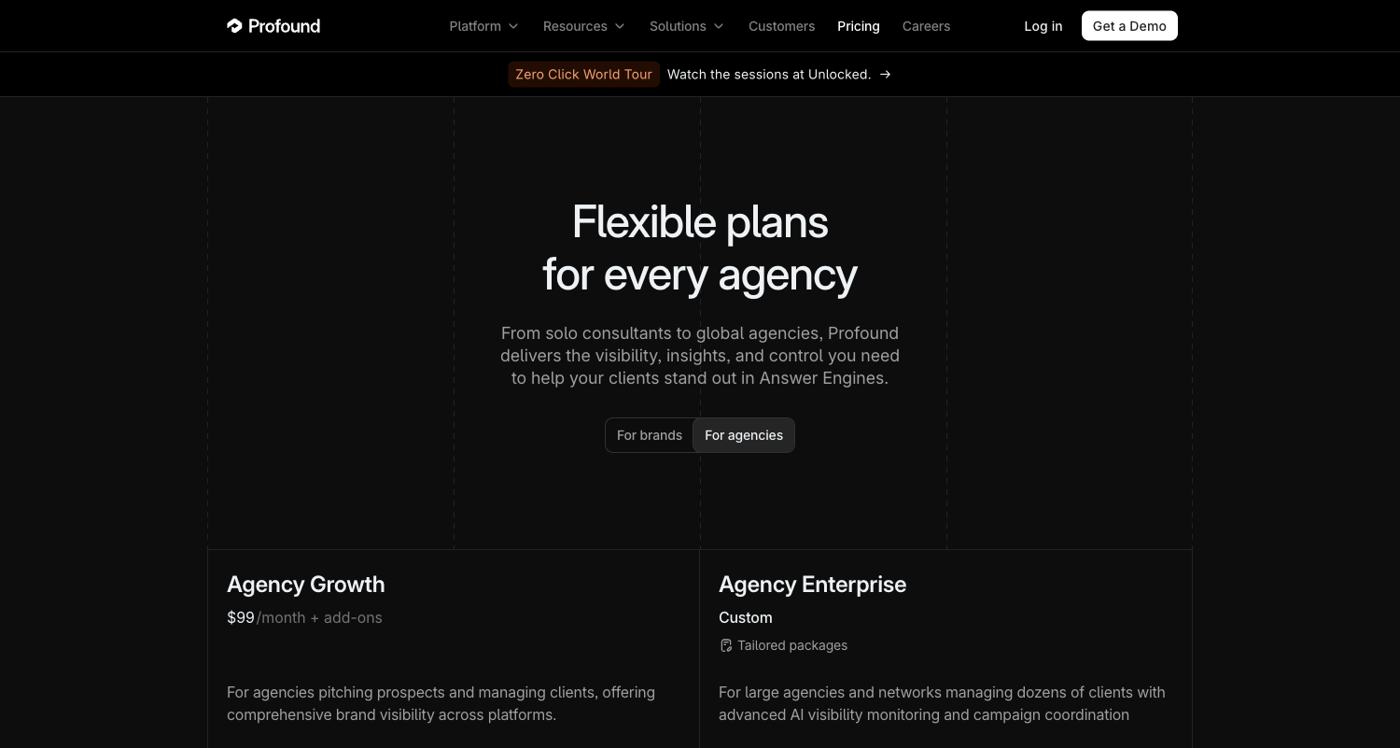
Profound's official agency pricing page; the full-workspace charge is described in its agency plan explanation.
These are not equivalent quotes for 8,100 credits and three workspaces. Model combinations, prompt counts, permissions, automation, and service scope may differ. Profound Agent credits pay for workflows; they are not synonymous with Peec's monitoring credits above. Ask both vendors to quote the same client count, prompt set, and engines, then clarify short-term pitches, ongoing service, and overages.
Choose for your team and stage
| Your situation | What to examine first | Why |
|---|---|---|
| A solo operator or small team already knows 30–50 customer questions | Peec Starter | You can choose prompts and monitor daily with a relatively clear budget and project scope. Confirm that the three models you need are available. |
| One brand entering several markets or operating two main product lines | Peec Pro and a Profound Enterprise quote | Pro's 150 prompts, two projects, and three countries provide a planning starting point. Assess enterprise spending if research and collaboration needs are more complex. |
| A large brand researching how different audiences ask AI questions | Profound Prompt Volumes | Its research uses a consented consumer sample and statistical modeling. Request a demonstration of coverage for your countries, industry, and long-tail questions. |
| Content, brand, and PR teams want workflows built around shared brand context | Demo both Agents, then evaluate Profound Enterprise | Profound brings brand context and Agent workflows into one system; Peec also has Agents, suggestions, and reusable skills. |
| An agency managing several clients | Compare both agency plans | Peec allocates shared monitoring credits; Profound distinguishes pitch and full client workspaces. |
| An ecommerce team wants to know whether specific products are recommended | Demo Peec AI Shopping and confirm Profound Shopping access | A brand mention does not establish that a particular SKU was recommended. Request the real catalog, prompts, and corresponding answers. |
Plan features at a glance
✓ means the plan lists the capability; ✕ means it is not included; “Confirm” means check the account or contract. Profound columns are brand plans, with agency plans separate. Peec columns are its brand Starter and Pro plans.
| Feature and condition | Profound brand Trial | Profound brand Enterprise | Peec AI Starter | Peec AI Pro |
|---|---|---|---|---|
| USD monthly price | Free for 7 days | Contact sales; custom quote | $95/month | $245/month |
| Monitoring prompts | 50, run daily for 7 days | Custom | 50 | 150 |
| Custom monitoring prompts | ✕ Industry-recommended prompts | ✓ Add, edit, and deactivate | ✓ | ✓ |
| Daily monitoring | ✓ During trial | ✓ | ✓ | ✓ |
| AI engines | ChatGPT, Gemini, Google AI Overviews | Up to 9; per contract | Choose 3 from base list | Choose 3 from base list |
| Perplexity | ✕ Not in trial | ✓ In Enterprise options | Confirm add-on eligibility | Confirm add-on eligibility |
| Claude | ✕ Not in trial | ✓ In Enterprise options | ✕ Not listed as a base model | ✕ Not listed as a base model |
| Discover prompts to monitor | ✓ Prompt Volumes, 5 searches | ✓ Prompt Volumes, allowance per contract | ✓ Prompt suggestions and demand levels | ✓ Prompt suggestions and demand levels |
| Brand and competitor monitoring | ✓ | ✓ | ✓ | ✓ |
| Cited domain and URL analysis | ✓ | ✓ | ✓ | ✓ |
| Fact checking | Confirm access | Confirm access | ✓ 5 monitored prompts, 5 brand facts | ✓ 10 monitored prompts, 20 brand facts |
| AI crawler and source visits | ✓ Data connection required | ✓ Data connection required | ✓ Data connection and usage limits | ✓ Data connection and usage limits |
| CSV export | ✕ | ✓ CSV, JSON | ✓ | ✓ |
| API | ✕ | ✓ | ✕ Official matrix says not included | ✓ Listed in official matrix |
| MCP | Confirm | Confirm | ✓ | ✓ |
| Projects and countries | 1 region, 1 language | Custom | 1 project, 1 country | 2 projects, 3 countries |
| SSO | ✕ | ✓ | ✕ | ✕ Listed for Enterprise |
Peec Starter lets a paying brand choose three models; its base price does not automatically cover every model on the page. Profound's trial shows reports but does not let you substitute your own prompts. Confirm enterprise coverage in the quote and account configuration.
The table uses Peec's official brand pricing and Profound pricing. Plans also limit models, regions, and usage.
Before signing: give both vendors the same business problem
Prepare 10–20 real business questions, priority countries and languages, competing brands, and required models. Ask each vendor to demonstrate the same scenario:
| Examine | What you should see | Limits to ask about |
|---|---|---|
| Prompt research | Candidate questions, sources, demand estimates, and country | Are long-tail samples sufficient? Are estimates based on samples or other signals? |
| Answers and citations | Original answer, date, model, domain, and specific URL | Are non-triggered or failed runs, regions, and API versus UI collection marked? |
| Brand recognition | Brand name, aliases, competitors, and matched text | How are ambiguous names and false positives handled? Do alias changes affect history? |
| Action | A specific page update or independent-source task | What evidence supports it? Is human approval required? |
| Total cost | Projects, countries, models, allowances, users, and contract | How are Agent credits, monitoring credits, add-on models, and overages charged? |
If both accounts permit it, run the same custom prompts at similar times in the same country and language. Record the models, frequency, original answers, and failures. Profound's brand Trial does not allow custom prompts, so it cannot support a same-prompt test. Even with aligned conditions, collection time and API versus product-interface differences may produce different results. Inspect the original answers before comparing scores.
How to tell whether changes helped
| Time | Action | Evidence to keep |
|---|---|---|
| Week 1 | Fix the prompt set, countries, models, brand aliases, and competitors; sample original answers. | Valid answer count, mention rate, source URLs, collection dates, and failures. |
| Week 2 | Choose 3–5 important prompts and inspect cited pages, brand information, and relevant product pages. | Original answers, page versions before changes, reason for the opportunity, and owner. |
| Week 3 | Correct incomplete or inaccurate pages; provide verifiable facts to relevant independent sources. | Publication dates, change records, and outreach outcomes. |
| Week 4 onward | Retest the fixed prompts consistently, and review AI referral visits and business metrics. | Before-and-after answers, valid samples, source changes, referral data, and concurrent marketing activity. |
One opportunity worth investigating is a high-intent question where competitors repeatedly appear but your relevant page does not explain price, geography, or delivery terms. Repetition can justify prioritizing the work; it does not prove that adding information will earn a recommendation. Write the idea as a testable hypothesis and continue watching both answers and pages.
Frequently asked questions
Is Peec cheaper than Profound?
Peec's public brand pricing starts at $95/month; Profound's brand Enterprise plan requires a quote. That makes Peec's entry budget easier to estimate, but enterprise costs depend on engines, countries, projects, and contract terms. Agencies also need to calculate client workspaces and credits separately.
How many AI models can Peec Starter monitor?
The official page lists a choice of three base models, not simultaneous monitoring of every model. Check add-ons and costs for a fourth model or options such as Perplexity, and check higher-plan access for extended models such as Claude.
Can Profound's free trial compare the same prompts as Peec?
The brand Trial does not let users replace the recommended prompts. Use it to inspect reports and the interface. For a comparison with your own fixed set, first confirm demonstration or paid access on both sides.
Are these tools only for SEO teams?
No. Brand teams can check how AI describes products, PR teams can research cited sources, ecommerce teams can examine product-level questions, and agencies can prepare client reports. The value depends on someone taking responsibility for actions on pages, product information, or sources.
Does a higher mention rate mean more orders?
No. Mentions, citations, visits, inquiries, and orders are different stages. Record them separately and consider concurrent marketing activity. Visibility tools can expose questions and track changes, but a score alone cannot prove revenue growth.