
Key Takeaways
- AI visibility is not a trick. It comes from crawl access, clear entities, useful answer blocks, and trusted evidence.
- Google says AI Overviews and AI Mode use normal Search eligibility as the base: indexed, snippet-eligible pages with helpful content still matter.
- ChatGPT Search, Perplexity, and Bing/Copilot each have their own discovery and citation signals, so do not rely on one dashboard.
- The best starting workflow is a monthly loop: define prompts, test answers, find missing citations or wrong facts, fix pages, and retest.
- Measure brand mentions, citation share, cited pages, answer accuracy, competitor citations, and downstream search or referral behavior.
What AI Search Visibility Means
AI search visibility means your brand appears inside AI-generated answers, source panels, cited links, comparison summaries, or follow-up recommendations. It is different from a classic blue-link ranking because the user may never see a ranked list. They may see one synthesized answer with a few linked sources. That does not make SEO obsolete. Google’s AI features guidance says the same SEO fundamentals remain relevant for AI Overviews and AI Mode, and that pages need to be indexed and eligible to show snippets. Google also says there is no special schema or AI-specific file required for those features. In plain language: if a page cannot be crawled, indexed, understood, or trusted in normal Search, it is unlikely to become a strong AI source. The difference is what you measure. A strong AI visibility report includes:| Signal | What it tells you | Why it matters |
|---|---|---|
| Brand mention | Whether the answer names your brand | Measures awareness inside AI answers |
| Citation | Whether your URL is used as a source | Shows source inclusion, not just reputation |
| Answer accuracy | Whether the brand, product, price, features, and limits are described correctly | Prevents wrong AI summaries from shaping demand |
| Competitor citation | Which competitors are used instead of you | Shows source gaps and content opportunities |
| Prompt coverage | Which buyer, problem, comparison, and support prompts include you | Turns AI visibility into an actionable test set |
| Downstream demand | Branded search, direct visits, referral traffic, demo requests, assisted conversions | Connects visibility to business impact |
The Six-Step AI Visibility Operating Loop
The most reliable strategy is a repeatable operating loop. Do not rewrite your whole site at once. Pick the prompts that matter, test them, fix the pages and sources that shape the answer, then repeat.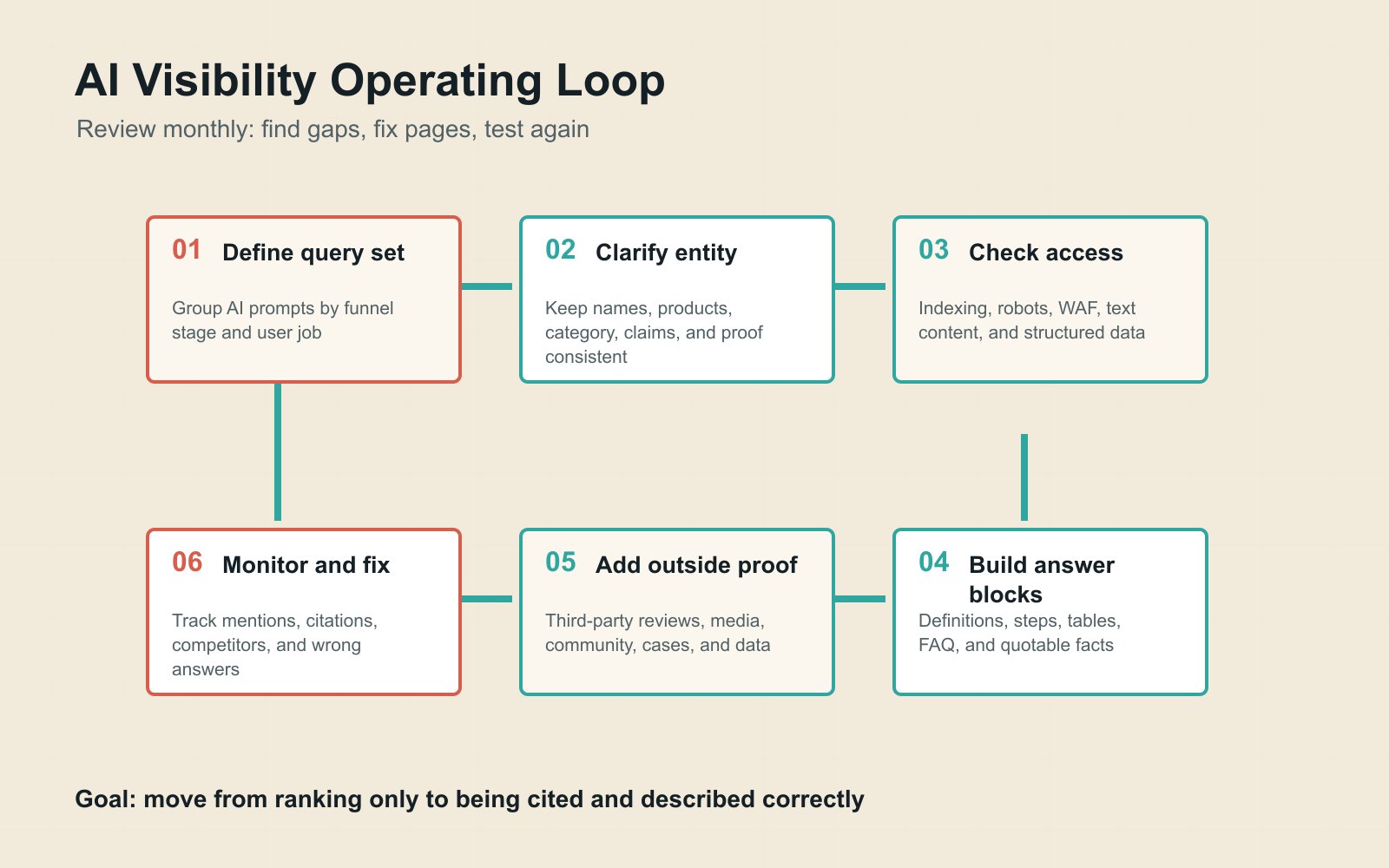
1. Define the AI prompt list
Start with prompts, not only keywords. AI search users often ask longer questions, comparison questions, and follow-up questions. Google says AI Mode and AI Overviews may use query fan-out, which means related searches across subtopics can shape the generated response. Build a simple prompt set with four groups:| Prompt group | Example | What to check |
|---|---|---|
| Problem | "How do I monitor brand visibility in AI search?" | Does your category appear? |
| Category | "Best AI search visibility tools for SaaS brands" | Is your brand in the shortlist? |
| Comparison | "Convertos.ai vs [competitor] for AI visibility monitoring" | Is the answer fair and accurate? |
| Evidence | "Which sources prove [brand] is credible for AI visibility?" | Are trusted pages cited? |
2. Make the brand entity unambiguous
AI systems need to know what your brand is, what it does, and which category it belongs to. If your homepage says one thing, your product page says another, and third-party profiles use outdated wording, AI answers may blend the wrong facts. Create one source-of-truth block for:- Official brand name and common spelling.
- Product category.
- Main use cases.
- Target customers.
- Key features.
- Pricing or plan caveats when public.
- Founder, company, location, and support details when relevant.
- Claims that require proof, such as case studies, benchmarks, awards, or integrations.
3. Make key pages crawlable, indexable, and text-readable
If an AI search system cannot access your page, it cannot reliably cite it. Google’s 2025 guidance on succeeding in AI search says site owners should make sure Google can find, crawl, index, and consider pages for Search. OpenAI’s ChatGPT Search help page says inclusion requires allowing OAI-SearchBot and relevant infrastructure access. Perplexity’s crawler documentation says PerplexityBot is designed to surface and link websites in Perplexity search results. Check these items before rewriting content:| Check | Good state | Risk sign |
|---|---|---|
| HTTP status | Important pages return 200 | Redirect chains, soft 404s, blocked pages |
| Robots and meta | Search and AI-relevant crawlers can access public content | Accidental disallow, noindex, or restrictive preview controls |
| WAF/CDN | Known crawlers and user-triggered fetchers are not challenged by default | Bot challenge blocks useful fetches |
| Text availability | Core claims appear in HTML text | Important facts live only in images, scripts, or PDFs |
| Canonical | One clear preferred URL per topic | Duplicate pages split signals |
| Structured data | Matches visible page content | Markup says more than the page shows |
4. Build answer-ready content blocks
AI answers favor sections that can be extracted without guesswork. A page should include clear definitions, direct answers, comparison tables, step-by-step instructions, and source-backed facts. Microsoft’s Bing Webmaster Blog says clear headings, tables, FAQ sections, evidence, and freshness help AI systems reference content more accurately. Add answer-ready blocks to priority pages:| Block | Example | Best placement |
|---|---|---|
| Definition | "AI search visibility is..." | Intro or first H2 |
| Step list | "To improve visibility, do these six things..." | How-to section |
| Comparison table | "AI visibility vs SEO ranking vs referral traffic" | Decision section |
| Evidence note | "Source: official docs, customer case, public dataset" | Near the claim |
| FAQ | Real questions from Search, sales calls, support, or community threads | End of article or product page |
| Update note | "Last reviewed June 4, 2026" | Intro or source statement |
5. Add third-party proof
Your own website is necessary, but AI search engines often rely on outside evidence too. That can include reviews, media mentions, partner pages, directory profiles, community discussions, podcasts, YouTube videos, case studies, and public documentation. For a B2B SaaS brand, useful proof sources include:- Official integration pages.
- Customer case studies with named facts.
- Third-party reviews and category pages.
- Expert comparisons that mention strengths and limits.
- Founder or team interviews.
- Public benchmarks or original data.
- Community answers that use the brand in the right category.
6. Monitor, fix, and retest
AI visibility changes as models, indexes, source selection, and SERP layouts change. Treat monitoring as a monthly workflow. Google’s June 3, 2026 announcement introduced Search Console generative AI performance reports with impressions, pages, countries, devices, and date granularity for a subset of sites. Bing’s AI Performance report exposes citation activity, cited pages, grounding queries, and trends in supported AI experiences. These official reports help, but they do not cover every AI search engine or every answer detail. For a Google-specific reporting walkthrough, use our Search Console generative AI performance reports guide alongside this broader AI visibility workflow. Use a dashboard with four views. If you are building the workflow from scratch, pair the operational checks here with the broader SEO hub for crawl and index hygiene and the GEO hub for citation and answer-accuracy work.| View | Metric | Action |
|---|---|---|
| Prompt coverage | Share of test prompts that mention the brand | Find missing topic clusters |
| Citation coverage | Share of prompts citing your URL | Improve source-ready pages |
| Accuracy | Wrong or outdated claims in AI answers | Fix source pages and third-party profiles |
| Competitive gap | Competitors cited when you are absent | Build comparison, evidence, and category pages |
What to Fix First
Use this scorecard to avoid random work. Score each item from 0 to 2. A priority page with a score under 8 needs attention before you expect stable AI visibility.| Area | 0 points | 1 point | 2 points |
|---|---|---|---|
| Crawl access | Blocked or unstable | Accessible to Google only | Accessible to Search and relevant AI crawlers |
| Entity clarity | Brand/category unclear | Clear on one page | Clear across site and third-party profiles |
| Answer structure | Long prose only | Some headings and lists | Direct answers, tables, FAQ, and examples |
| Evidence | Claims unsupported | Some internal proof | Internal and third-party proof linked near claims |
| Freshness | Outdated or undated | Updated occasionally | Dated reviews and refresh notes |
| Measurement | No prompt testing | Manual spot checks | Repeatable prompt set and monthly dashboard |
Platform Notes: Google, ChatGPT, Perplexity, and Bing
Each AI search surface has different reporting and retrieval behavior. Your strategy should share one content foundation, then adjust measurement by platform.| Platform | What the official docs suggest | Practical implication |
|---|---|---|
| Google AI Overviews and AI Mode | Google says normal SEO fundamentals still apply and no special schema is required | Keep technical SEO, helpful content, structured data accuracy, and multimedia quality strong |
| ChatGPT Search | OpenAI says search can include source links and sites should allow OAI-SearchBot | Check robots, CDN/WAF access, referral UTMs, and source accuracy |
| Perplexity | PerplexityBot is designed to surface and link websites in search results | Allow relevant bots and keep source pages clear and current |
| Bing/Copilot | Bing AI Performance shows citations, grounding queries, cited pages, and trends | Use cited-page and grounding-query data to improve page clarity and coverage |
Improve visibility in ChatGPT
For ChatGPT Search, focus on crawl access for OAI-SearchBot, direct answer blocks, and source-backed claims on comparison pages. Use the AI brand visibility dashboard to track whether ChatGPT mentions your brand and cites the right URLs.Improve visibility in Perplexity
For Perplexity, track answer placement, citation role, and competitor replacement with a dedicated Perplexity rank tracker instead of relying on classic rank reports.Improve visibility in Google AI Overviews
For Google AI Overviews, start with Search eligibility and supporting-link readiness. Use the Google AI Overview visibility guide and the generative AI performance reports guide for measurement.Choose the right monitoring platform
If you are evaluating vendors, use the AI visibility tools buyer checklist and the AI brand visibility tracking workflow before buying a dashboard.A 30-Day Implementation Plan
You can make meaningful progress in one month without rebuilding the whole site. The first month should create a baseline, fix obvious blockers, and publish a few stronger source pages.| Week | Work | Output | Success check |
|---|---|---|---|
| Week 1 | Build the prompt list and test baseline answers across Google, ChatGPT, Perplexity, and Bing/Copilot | 30 to 50 prompts, mention status, cited URLs, and competitor notes | You know which prompts mention the brand, omit it, or describe it incorrectly |
| Week 2 | Fix access and entity clarity on homepage, product page, about page, and top comparison pages | Cleaner robots, indexability, canonical, brand description, and visible product facts | Important pages are crawlable and use the same brand/category language |
| Week 3 | Add answer-ready sections to the pages most likely to be cited | Definitions, step lists, comparison tables, FAQ, source notes, and update dates | A reader can answer the main question from the first screen and tables |
| Week 4 | Add outside proof and retest the same prompts | Updated profiles, partner pages, review pages, case studies, or data references | More prompts mention the brand, cite the right page, or stop repeating old facts |