Quick Recommendation
If you already run a large SEO program, start with a platform that connects AI visibility to search workflows and competitor reporting. If you are building a new GEO practice, choose a tool that makes prompt monitoring, citation review, and client reporting easy. If your biggest risk is technical access or AI agent readability, prioritize audit and bot-traffic features over a pretty visibility score.| Tool | Best fit | Useful signals | Main caveat |
|---|---|---|---|
| Convertos.ai | SEO/GEO teams that want prompt evidence, citation sources, competitor gaps, and page-level fixes | Brand mentions, cited sources, prompt evidence, competitor gap, page fix workflow | Best used as an operating workflow, not a universal all-in-one marketing suite |
| Semrush AI Visibility Toolkit | Teams already using Semrush for SEO and competitive research | AI Visibility Score, cited pages, citations, prompt gaps, competitor research | Strongest when you also want traditional SEO data nearby |
| Profound Answer Engine Insights | Enterprise brands and agencies that need deep answer-engine monitoring | Visibility score, share of voice, sentiment, citations, browser-captured responses | Can be more than a small team needs on day one |
| Scrunch AI visibility platform | Teams focused on AI bot access, citations, and agent-readable content | Prompt monitoring, citations, AI bot traffic, AXP content delivery, trends | Advanced delivery features require stronger technical ownership |
| OtterlyAI features | Lean SEO teams and agencies that want fast monitoring across major AI surfaces | Daily prompt checks, brand mentions, citations, share of voice, reports | Validate sampling and prompt setup before treating trends as exact truth |
| Peec AI Actions | Teams that want prioritized action recommendations from visibility gaps | Opportunity scoring, source clusters, competitive gaps, action categories | Check how recommendations fit your content and PR capacity |
| SE Visible by SE Ranking | Teams wanting a lower-cost starting point for AI visibility tracking | Brand mentions, sentiment, competitors, key sources, localized prompts | Confirm platform and market coverage before scaling |
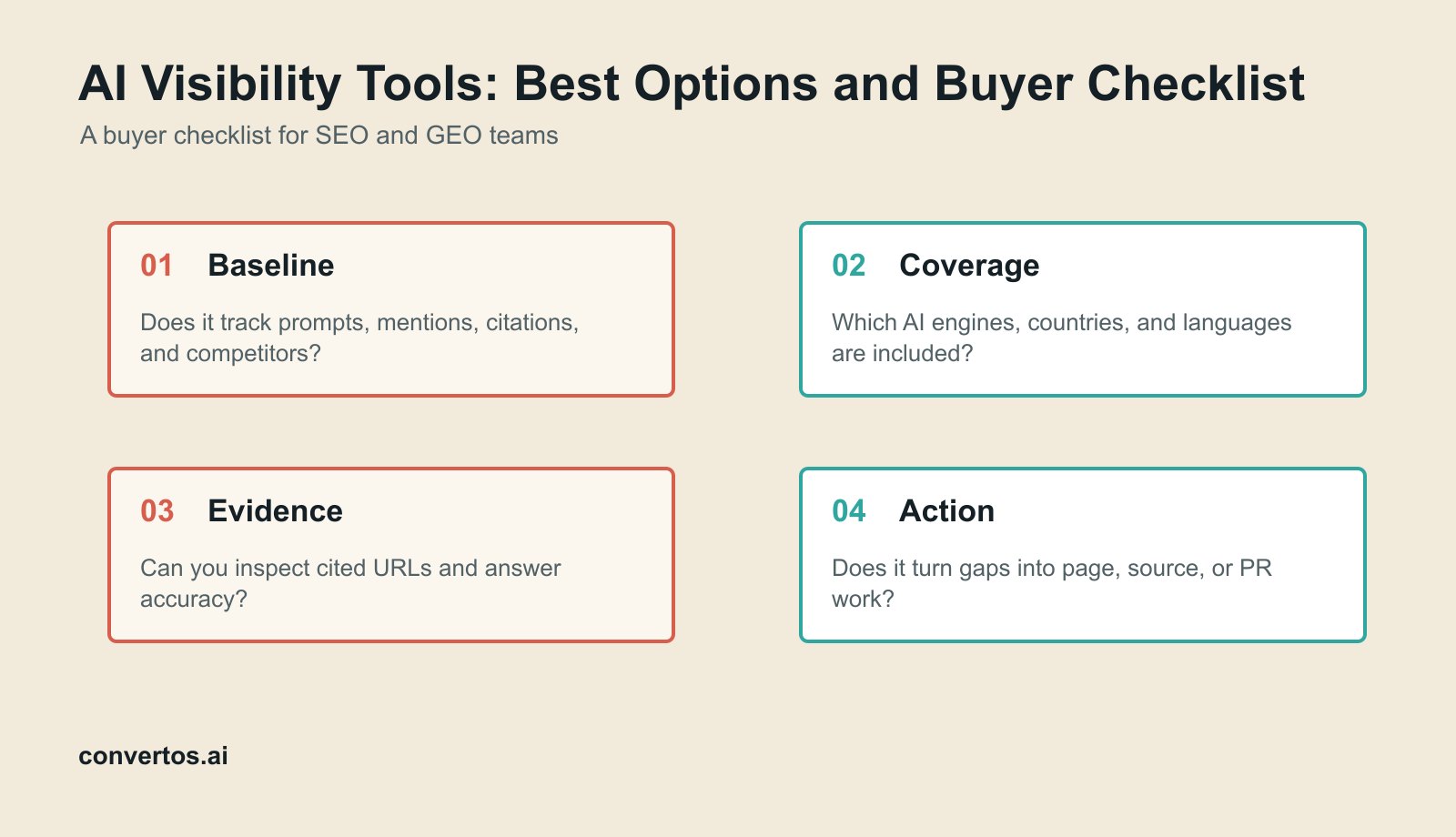
Buyer Checklist
Before buying, ask for a live demo using your own brand and two competitors. A generic demo can hide the hard parts: weak prompt selection, poor localization, messy citations, and recommendations your team cannot execute.| Requirement | Why it matters | Question to ask |
|---|---|---|
| Platform coverage | AI visibility is different across Google, ChatGPT, Perplexity, Gemini, Copilot, Claude, and other surfaces | Which platforms are tracked today, and which are on the roadmap? |
| Prompt control | Your business questions matter more than a vendor’s generic prompts | Can we upload, group, localize, and retest our own prompts? |
| Citation visibility | Mentions without cited URLs are hard to fix | Can we see the cited page, source domain, and answer context? |
| Competitor comparison | AI answers are often shortlist-driven | Can we compare share of voice by prompt group and country? |
| Accuracy review | A brand mention can still be wrong | Can we flag incorrect descriptions and track fixes over time? |
| Action layer | Data is useful only if it leads to work | Does the tool suggest page, source, technical, or PR fixes? |
| Reporting | Agencies and executives need repeatable evidence | Can we export dashboards, client reports, and before/after views? |
What Features Should You Look For In An AI Brand Visibility Platform?
An AI brand visibility platform should do two jobs at once: show where your brand appears in AI answers and explain what to do next. A monitoring-only tool is useful for trend reporting, but it will not help the team fix missing citations, weak answer accuracy, or competitor replacement risk unless it connects prompts, cited sources, page issues, and action owners.| Feature | What it should show | Why it matters for action |
|---|---|---|
| Prompt inventory | The exact questions tested, platform, country, language, device, and prompt group | Keeps visibility trends comparable instead of anecdotal |
| Brand appearance map | Whether the brand is named, ignored, partly described, or replaced by a competitor | Shows where the brand is present in AI answers |
| Citation and source view | Cited URL, source domain, passage context, and whether the citation is yours, third-party, or competitor-owned | Explains which pages or sources are shaping the answer |
| Answer accuracy review | Correct, incomplete, outdated, misleading, or unsupported claims | Protects brand trust before the team celebrates a mention |
| Action recommendations | Page fix, structured data check, source outreach, product fact update, or technical access review | Turns the report into work the team can assign |
| Retest and change log | Before/after prompt captures, page edits, source changes, and next review date | Separates real improvement from normal AI-answer variance |
| Executive reporting | Weekly or monthly trend, competitor gap, source gap, and business follow-through | Helps leadership see progress without reading every prompt capture |
What Most Tools Miss
Most AI visibility tools are good at monitoring outputs. They are weaker at explaining the full retrieval path behind a citation. That means a score can tell you that visibility changed, but not always why it changed. This is why tool data should be paired with source review, crawler checks, content edits, and normal SEO analysis. Use the AI brand visibility tracking workflow after you choose a tool. The workflow matters more than the logo on the invoice.FAQ
These questions reflect common decisions in tool buying, monthly reporting, and page repair. Each answer gives an operating boundary so AI visibility does not collapse into one score.What is the best AI visibility tool?
There is no universal best tool. Semrush fits teams that want AI visibility beside SEO data, Profound and Scrunch fit larger programs, and OtterlyAI, Peec AI, SE Visible, or Convertos.ai can fit teams that need faster monitoring and action. Source signal: commercial SERP results and vendor documentation for AI visibility tools.Should I trust an AI visibility score?
Use it as a directional signal, not a final truth. A 2026 uncertainty paper warns that single-run visibility metrics can look more precise than they really are. Source signal: measurement caveats from AI visibility research and tool discussions.Do I need a tool before improving AI visibility?
No. You can start manually with a stable prompt list, cited URL notes, and answer accuracy checks. A tool becomes useful when manual tracking becomes too slow or inconsistent. Source signal: recurring forum and search-result questions about manual versus paid AI visibility tracking.What should agencies look for?
Agencies should prioritize multi-client workspaces, repeatable reports, prompt grouping, exportable evidence, and clear client deliverables. A tool that only shows a score is not enough for client work. Source signal: agency-oriented vendor pages and AI visibility tool comparisons.What features should I look for in a platform that tracks and improves brand visibility in AI answers?
Look for prompt control, platform coverage, citation detail, answer accuracy review, competitor comparison, action recommendations, retesting, and exportable reporting. The key is whether the platform can show both where the brand appears in AI answers and which page, source, or technical issue should be fixed next. Source signal: GSC query language around AI answer visibility platforms and buyer-checklist search intent.Are there solutions that show both where a brand appears and what actions to take?
Yes, but check the action layer carefully. A useful solution should connect every visibility gap to a likely cause: missing answer block, weak cited source, blocked crawler, outdated product fact, thin comparison page, or stronger competitor evidence. Source signal: GSC query language around AI visibility solutions and action recommendations.30-Day Implementation Plan
Treat this guide as a one-month operating plan, not a one-time read. In week one, create the baseline. In week two, fix one high-value page group. In week three, improve source and citation signals. In week four, retest the same prompts and decide the next priority.| Time | Work | Output |
|---|---|---|
| Week 1 | Test 20-40 real prompts for brand mentions, competitors, citations, and answer accuracy | Baseline sheet, competitor gaps, incorrect-answer list |
| Week 2 | Update one page group with clearer first-screen answers, comparison tables, FAQs, and source notes | A set of citation-ready answer blocks |
| Week 3 | Review third-party sources that AI systems cite repeatedly, then plan PR, directory, documentation, or partner updates | Source-gap list and external signal plan |
| Week 4 | Retest the same prompt set and compare the result with normal SEO data | Monthly review and next-round priority list |
Common Mistakes
The first mistake is treating an AI visibility score as the final goal. A score is useful for trend reporting, but the real work is finding who is missing, what is wrong, which pages are cited, and why competitors are included when your brand is not. The second mistake is writing more articles before fixing existing pages. Many AI visibility gaps come from weak direct answers, unclear evidence, missing third-party sources, or restrictive technical settings. Fix the pages that already have search value before adding new content. The third mistake is skipping human review. Tools can capture answers, but a person still has to judge whether the brand description is accurate, whether the use case is fair, and whether the cited page actually supports the claim. Review a small batch of high-value prompts every month and keep wrong answers, weak citations, and competitor advantages in one operating sheet.Evidence Sources And Cross-Checks
Do not judge AI visibility from one tool alone. A stronger review combines platform documentation, search-console reporting, crawler rules, and commercial-tool metrics. Google’s Google AI features guidance explains that AI Overviews and AI Mode do not require special schema, but pages still need crawl access, indexability, useful content, preview eligibility, and structured data that matches visible content. Google Search Console generative AI performance reports adds reporting dimensions for generative AI features, including impressions, pages, countries, devices, and dates. Use those reports to watch trends, not to explain every individual answer change. The same review works better when it includes other AI-search surfaces. Bing AI Performance report announcement shows that Bing treats AI Performance as a distinct webmaster reporting area. OpenAI ChatGPT Search help page and OpenAI publisher FAQ help teams check ChatGPT Search behavior, publisher access, and crawler expectations. Perplexity crawler documentation helps technical teams confirm whether Perplexity-related crawlers are blocked by robots rules, CDN settings, or server controls. For commercial tracking, compare definitions in Semrush Visibility Overview report, Profound Visibility Score documentation, Scrunch AI visibility metrics FAQ, OtterlyAI daily monitoring note, and Peec AI performance documentation before treating visibility, citation, share of voice, prompt monitoring, or action priority as the same metric across tools.| Evidence source | Main question it answers | Action it should trigger |
|---|---|---|
| Google AI features documentation | Is the page eligible to appear in Google AI features? | Check indexing, preview controls, structured data, and visible answer text |
| Search Console generative AI reports | Which pages, countries, and dates show AI-feature exposure? | Build a trend baseline and review by week |
| Bing AI Performance | Does Bing show separate AI-search performance signals? | Add non-Google AI surfaces to the report |
| OpenAI and Perplexity documentation | Can AI search and crawlers access the page? | Review robots rules, CDN behavior, server logs, and cited sources |
| Commercial AI visibility tools | Is the brand mentioned, cited, compared, and described correctly? | Create page fixes, source-building tasks, and competitor-gap work |
How This Page Fits The Content Cluster
Use this support page with the pillar guide, How to Improve Brand Visibility in AI Search Engines: the pillar explains the operating loop, while the support pages answer specific questions about buying tools, tracking visibility, choosing metrics, measuring Google AI Overviews, and separating GEO, AEO, and SEO. Continue with: AI Brand Visibility Tracking: Metrics, Dashboard, and Workflow, AI Search Visibility Tool: What It Measures and What It Misses, AI Visibility Metrics: The KPIs SEO and GEO Teams Should Track, Google AI Overviews Visibility: How to Measure and Improve It. Let internal links follow the reader’s job. If the reader is choosing a tool, move from the buyer checklist to the metrics guide. If the reader is preparing a monthly report, move from the metrics guide to the tracking workflow. If the reader cares mainly about Google traffic, connect the Google AI Overviews article with the Search Console reporting guide and the broader AI visibility workflow.Tool And Platform Comparison Matrix
Each platform answers a different question. Google Search Console and Bing Webmaster Tools are closer to platform-side performance reports. Commercial AI visibility tools are better for cross-platform monitoring and competitor comparison. Server logs and crawler documentation explain why a page may not be accessed or cited. Rolling all of that into one score can hide the real priority.| Tool or platform | Best question to answer | Key output | Main limitation |
|---|---|---|---|
| Google Search Console generative AI reports | Did Google AI features expose my pages? | AI impressions, pages, countries, devices, dates | Does not explain why every answer cited a specific passage |
| Bing Webmaster Tools AI Performance | Is Bing-side AI search performance changing? | Bing AI Performance signals | Does not represent Google, ChatGPT, or Perplexity |
| Semrush / Profound / Scrunch | Is the brand mentioned and cited across AI-answer surfaces? | Visibility, citations, share of voice, competitor gaps | Metric definitions differ by vendor |
| OtterlyAI / Peec AI / SE Visible | How can a lean team start monitoring quickly? | Prompt checks, sources, sentiment, action suggestions | Sampling and platform coverage still need human review |
| Convertos.ai | How do visibility gaps become page-level fixes? | Prompt evidence, cited sources, competitor gaps, page-fix tasks | Requires monthly retesting; one snapshot is not enough |