The Short Comparison
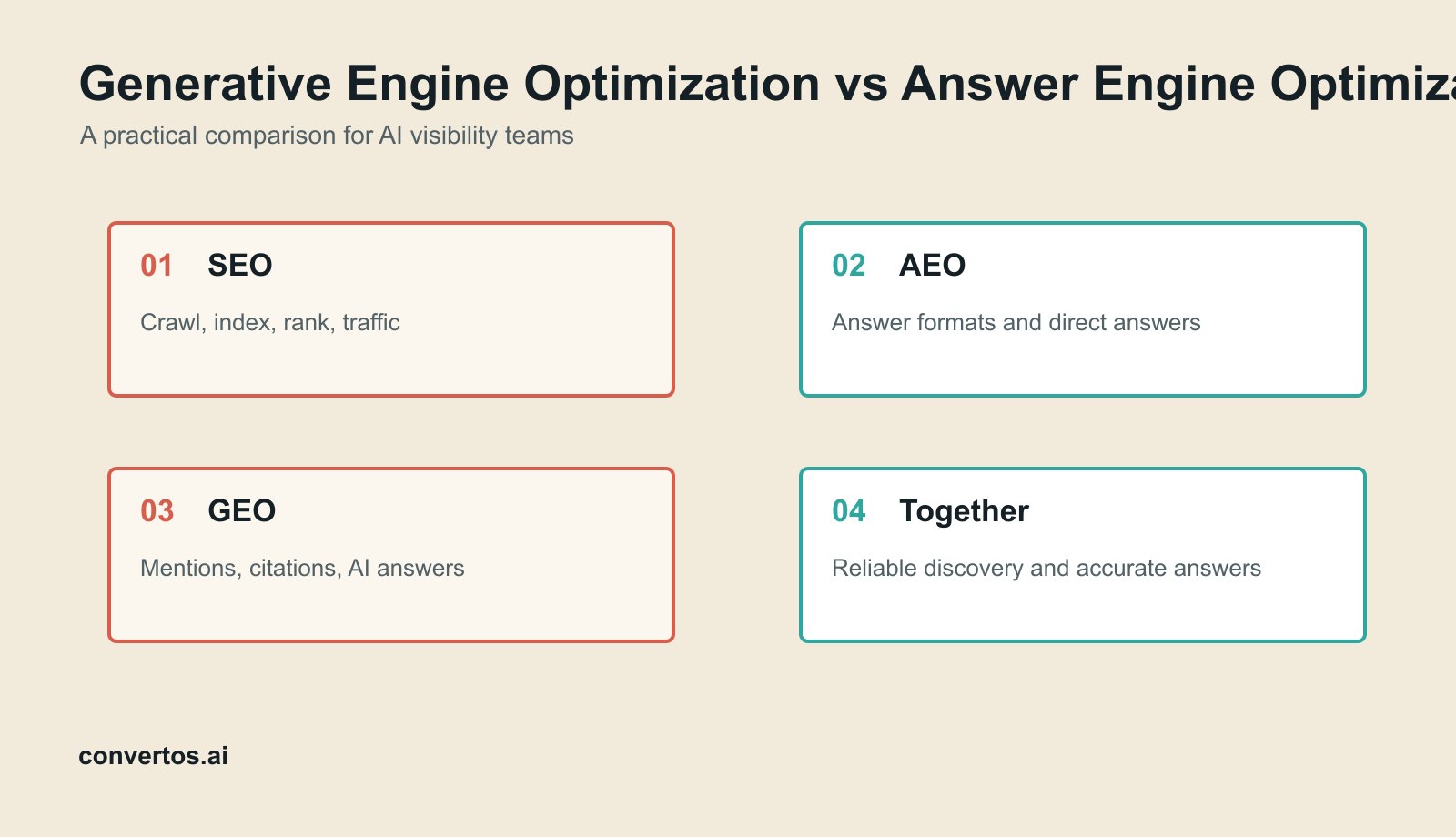
| Term | Main job | Typical work | Main metric |
|---|---|---|---|
| SEO | Help search engines crawl, index, understand, rank, and send useful traffic | Technical SEO, content, links, structured data, page experience | Rankings, clicks, impressions, conversions |
| AEO | Make content answer-ready for direct answers and answer boxes | Definitions, FAQs, snippets, schema alignment, concise answer blocks | Answer inclusion, snippet fit, answer clarity |
| GEO | Improve visibility inside generative AI answers | Prompt tracking, mentions, citations, source proof, answer accuracy | Mention rate, citation share, competitor gap, accuracy |
Where They Overlap
The overlap matters because teams rarely improve AI visibility with one isolated task. A technical SEO fix can make the page reachable, an AEO edit can make the answer extractable, and a GEO review can show whether AI systems actually mention and cite the brand after the change. Treat the overlap as a workflow, not a naming debate. All three depend on clear, useful, trustworthy content. A page with poor crawl access fails SEO. A page with vague answers fails AEO. A page with no citations, proof, or entity clarity fails GEO. The practical overlap is a page that can be crawled, explains the entity clearly, answers the user directly, cites evidence, and gives AI systems enough context to describe the brand without guessing. The overlap is strongest in answer-ready content: direct definitions, comparison tables, source-backed claims, update dates, and visible text. These help human readers, search engines, and AI answer systems.How Teams Use the Terms
Use SEO when the work is about crawl, index, canonical, page quality, internal links, traditional rankings, and search traffic. Use AEO when the work is about answer format. Use GEO when the work is about generative AI mentions, citations, competitor source gaps, and answer accuracy. In a real roadmap, the three labels become work queues: technical access, answer clarity, and citation trust. A page often needs all three before it becomes reliable in AI search. If the team argues about labels for an hour, the labels are hurting the work. Start with the user question and the measurement goal.FAQ
These questions reflect common decisions in tool buying, monthly reporting, and page repair. Each answer gives an operating boundary so AI visibility does not collapse into one score.Is GEO replacing SEO?
No. GEO depends on many SEO basics, especially crawl access, indexability, content quality, and source trust. Source signal: Google AI feature guidance and recurring GEO vs SEO questions.Is AEO the same as GEO?
No. AEO focuses on answer format; GEO focuses on generative AI visibility, citations, and answer accuracy. Source signal: comparison queries around AEO, GEO, and SEO.Which should a team start with?
Start with SEO basics if access and indexability are weak. Add AEO for answer clarity. Add GEO measurement when brand mentions, citations, and AI answer accuracy matter. Source signal: AI visibility workflow and technical SEO guidance.What should executives track?
Executives should track AI visibility trend, competitor gap, citation quality, answer accuracy, and downstream demand. They do not need every prompt-level detail. Source signal: reporting questions around SEO/GEO business impact.30-Day Implementation Plan
Treat this guide as a one-month operating plan, not a one-time read. In week one, create the baseline. In week two, fix one high-value page group. In week three, improve source and citation signals. In week four, retest the same prompts and decide the next priority.| Time | Work | Output |
|---|---|---|
| Week 1 | Test 20-40 real prompts for brand mentions, competitors, citations, and answer accuracy | Baseline sheet, competitor gaps, incorrect-answer list |
| Week 2 | Update one page group with clearer first-screen answers, comparison tables, FAQs, and source notes | A set of citation-ready answer blocks |
| Week 3 | Review third-party sources that AI systems cite repeatedly, then plan PR, directory, documentation, or partner updates | Source-gap list and external signal plan |
| Week 4 | Retest the same prompt set and compare the result with normal SEO data | Monthly review and next-round priority list |
Common Mistakes
The first mistake is treating an AI visibility score as the final goal. A score is useful for trend reporting, but the real work is finding who is missing, what is wrong, which pages are cited, and why competitors are included when your brand is not. The second mistake is writing more articles before fixing existing pages. Many AI visibility gaps come from weak direct answers, unclear evidence, missing third-party sources, or restrictive technical settings. Fix the pages that already have search value before adding new content. The third mistake is skipping human review. Tools can capture answers, but a person still has to judge whether the brand description is accurate, whether the use case is fair, and whether the cited page actually supports the claim. Review a small batch of high-value prompts every month and keep wrong answers, weak citations, and competitor advantages in one operating sheet.Evidence Sources And Cross-Checks
Do not judge AI visibility from one tool alone. A stronger review combines platform documentation, search-console reporting, crawler rules, and commercial-tool metrics. Google’s Google AI features guidance explains that AI Overviews and AI Mode do not require special schema, but pages still need crawl access, indexability, useful content, preview eligibility, and structured data that matches visible content. Google Search Console generative AI performance reports adds reporting dimensions for generative AI features, including impressions, pages, countries, devices, and dates. Use those reports to watch trends, not to explain every individual answer change. The same review works better when it includes other AI-search surfaces. Bing AI Performance report announcement shows that Bing treats AI Performance as a distinct webmaster reporting area. OpenAI ChatGPT Search help page and OpenAI publisher FAQ help teams check ChatGPT Search behavior, publisher access, and crawler expectations. Perplexity crawler documentation helps technical teams confirm whether Perplexity-related crawlers are blocked by robots rules, CDN settings, or server controls. For commercial tracking, compare definitions in Semrush Visibility Overview report, Profound Visibility Score documentation, Scrunch AI visibility metrics FAQ, OtterlyAI daily monitoring note, and Peec AI performance documentation before treating visibility, citation, share of voice, prompt monitoring, or action priority as the same metric across tools.| Evidence source | Main question it answers | Action it should trigger |
|---|---|---|
| Google AI features documentation | Is the page eligible to appear in Google AI features? | Check indexing, preview controls, structured data, and visible answer text |
| Search Console generative AI reports | Which pages, countries, and dates show AI-feature exposure? | Build a trend baseline and review by week |
| Bing AI Performance | Does Bing show separate AI-search performance signals? | Add non-Google AI surfaces to the report |
| OpenAI and Perplexity documentation | Can AI search and crawlers access the page? | Review robots rules, CDN behavior, server logs, and cited sources |
| Commercial AI visibility tools | Is the brand mentioned, cited, compared, and described correctly? | Create page fixes, source-building tasks, and competitor-gap work |
How This Page Fits The Content Cluster
Use this support page with the pillar guide, How to Improve Brand Visibility in AI Search Engines: the pillar explains the operating loop, while the support pages answer specific questions about buying tools, tracking visibility, choosing metrics, measuring Google AI Overviews, and separating GEO, AEO, and SEO. Continue with: AI Visibility Tools: Best Options and Buyer Checklist, AI Brand Visibility Tracking: Metrics, Dashboard, and Workflow, AI Search Visibility Tool: What It Measures and What It Misses, AI Visibility Metrics: The KPIs SEO and GEO Teams Should Track. Let internal links follow the reader’s job. If the reader is choosing a tool, move from the buyer checklist to the metrics guide. If the reader is preparing a monthly report, move from the metrics guide to the tracking workflow. If the reader cares mainly about Google traffic, connect the Google AI Overviews article with the Search Console reporting guide and the broader AI visibility workflow.Tool And Platform Comparison Matrix
Each platform answers a different question. Google Search Console and Bing Webmaster Tools are closer to platform-side performance reports. Commercial AI visibility tools are better for cross-platform monitoring and competitor comparison. Server logs and crawler documentation explain why a page may not be accessed or cited. Rolling all of that into one score can hide the real priority.| Tool or platform | Best question to answer | Key output | Main limitation |
|---|---|---|---|
| Google Search Console generative AI reports | Did Google AI features expose my pages? | AI impressions, pages, countries, devices, dates | Does not explain why every answer cited a specific passage |
| Bing Webmaster Tools AI Performance | Is Bing-side AI search performance changing? | Bing AI Performance signals | Does not represent Google, ChatGPT, or Perplexity |
| Semrush / Profound / Scrunch | Is the brand mentioned and cited across AI-answer surfaces? | Visibility, citations, share of voice, competitor gaps | Metric definitions differ by vendor |
| OtterlyAI / Peec AI / SE Visible | How can a lean team start monitoring quickly? | Prompt checks, sources, sentiment, action suggestions | Sampling and platform coverage still need human review |
| Convertos.ai | How do visibility gaps become page-level fixes? | Prompt evidence, cited sources, competitor gaps, page-fix tasks | Requires monthly retesting; one snapshot is not enough |