
Part 1 covered why healthcare content must be quotable by AI assistants, not just rankable by search engines. Here are the seven strategies that make medical content AI-ready.
Strategy 1: Build a Medical Content Authority System (E-E-A-T)
Google's Search Quality Rater Guidelines (2024) defines healthcare as the strictest YMYL category [1]. AI assistants apply the same standard. Here's what they look for: Author credentials: Every medical article needs a named author with verifiable credentials (MD, RN, PharmD). Anonymous or pen-named content gets deprioritized. Medical reviewer badge: Add "Reviewed by Dr. [Name], MD" or "医学审核:[姓名] 医生" to every health article. Not optional for medical content. Cite peer-reviewed sources: Link to PubMed, Cochrane Reviews, WHO guidelines, or clinical practice guidelines from recognized medical associations (AMA, AHA, ADA). Add medical disclaimers: Every page with health information should include a clear disclaimer: "This content is for informational purposes only and does not replace professional medical advice."Practical tip: Create a "Medical Review Board" page listing all reviewers with credentials, specialties, and affiliations. Link to it from every medical article.
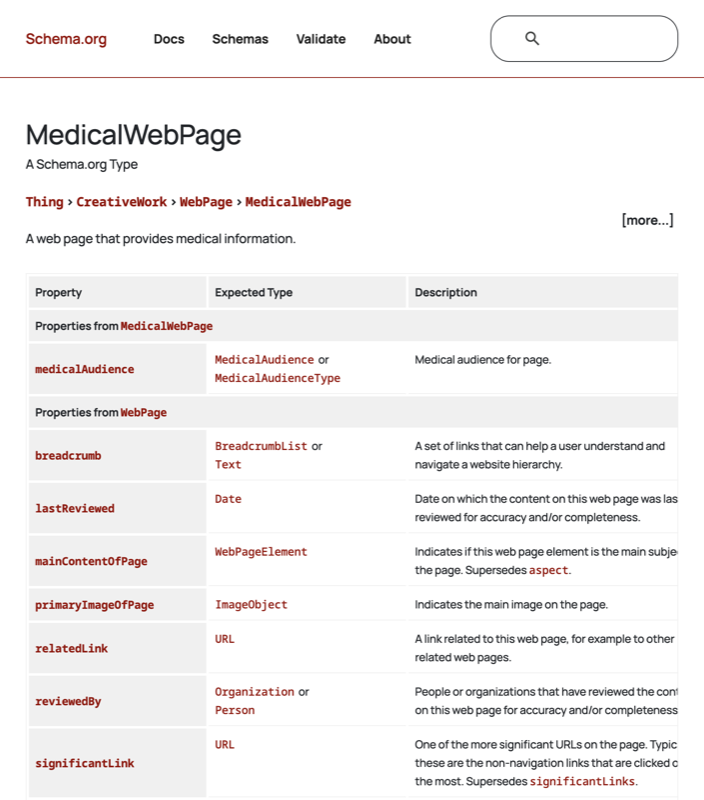
Strategy 2: Implement Medical Schema Markup
Schema.org provides specialized types for healthcare content. AI assistants use these to understand and categorize medical information. Essential medical schema types:| Schema Type | Use For | Example |
|---|---|---|
MedicalWebPage |
Health content pages | Disease info, treatment guides |
Physician |
Individual doctor profiles | Credentials, specialties, hospital affiliation |
MedicalOrganization |
Clinics, practices, hospitals | Services, locations, contact |
Hospital |
Hospital entities | Departments, emergency services |
MedicalCondition |
Disease/symptom pages | Symptoms, treatments, risk factors |
FAQPage |
Patient Q&A sections | Common patient questions |
<head> section.
Validate with: Google Rich Results Test (search.google.com/test/rich-results) or Schema Markup Validator (validator.schema.org).
Schema.org's complete medical type hierarchy is documented at schema.org/docs/meddocs.html [2].
Strategy 3: Optimize Content Structure for AI Extraction
AI assistants extract content differently than humans read it. Match your page structure to extraction patterns: 1. Lead with a clear definition (40–60 words) Assistants often lift the first clean definition when summarizing. Cover: what it is, who it's for, and why it matters. 2. Use FAQ format for common patient questions "What are the symptoms of…?" "When should I see a doctor for…?" These match how patients prompt AI assistants. 3. Use comparison tables with consistent columns AI systems handle structured data better than prose. Treatment comparison tables, medication charts, and "when to see a doctor" decision trees are highly extractable. 4. Keep paragraphs short (2–4 sentences) Long blocks force parsers to infer boundaries, which increases misquoting risk. 5. Use question-shaped headings "What is hypertension?" mirrors how people prompt LLMs and improves retrieval.Strategy 4: Local GEO for Healthcare
Most patients search for local healthcare: "cardiologist near me," "best pediatrician in [city]," "urgent care open now." Local GEO checklist:- Consistent NAP data (Name, Address, Phone) across all directories and your website
- Google Business Profile with healthcare-specific categories (e.g., "Cardiologist," "Pediatrician")
- Medical services listed in your Google Business Profile with accurate descriptions
- Patient reviews actively managed (respond to all reviews, especially negative ones)
- Local medical keywords in content: "in [city]," "near [landmark]," "serving [region]"
- Embed a Google Map on location/contact pages
Strategy 5: HIPAA Compliance & Privacy Protection
No other industry has federal privacy laws governing content like healthcare does. HIPAA compliance for content:- Never use Protected Health Information (PHI) in content, metadata, alt text, or schema markup
- Patient testimonials must be fully anonymized—remove names, dates, locations, and specific conditions unless you have written consent
- Avoid "fear-based" marketing or exaggerated outcome claims (regulated by FDA and state medical boards)
- Include a privacy policy that explains how patient data is handled
- Add medical disclaimers on every page with health information
Strategy 6: Content Freshness & Update Mechanisms
Medical content expires faster than most content. Clinical guidelines change. New treatments emerge. Drug approvals update. Content review schedule:| Content Type | Review Frequency | Example |
|---|---|---|
| Core medical pages (disease info, treatments) | Every 90–180 days | Diabetes management guidelines |
| Drug/medication information | Every 60–90 days | New FDA approvals, dosage changes |
| General health tips | Every 6–12 months | Nutrition, exercise advice |
| Physician profiles | Annually | Updated credentials, new certifications |
- Display "Last reviewed: [Date]" prominently on medical pages
- Include review dates in meta descriptions
- Log review dates in schema markup using the
dateModifiedproperty
Strategy 7: Authority Building Through Backlinks
AI assistants weigh source authority heavily. Build links from credible medical sources: High-authority link targets:- Medical journals and publications (JAMA, NEJM, BMJ)
- Medical associations (AMA, AHA, ADA, AAP)
- University medical centers and research institutions
- Government health agencies (CDC, NIH, WHO)
- Reputable health information sites (WebMD, Mayo Clinic, Healthline)
- Publish original clinical research or case studies
- Create comprehensive medical condition guides
- Share unique patient outcome data (anonymized, HIPAA-compliant)
- Partner with medical schools for educational content
- Contribute expert commentary to health news articles
Putting It All Together
| Strategy | Difficulty | Timeline | Impact |
|---|---|---|---|
| E-E-A-T (author credentials) | Medium | 1–2 weeks | High |
| Medical schema markup | Low | 1–3 days | High |
| Content structure | Low | 1 week | Medium |
| Local GEO | Medium | 2–4 weeks | High |
| HIPAA compliance | Medium | 1–2 weeks | Critical |
| Content freshness | Low | Ongoing | Medium |
| Authority building | High | 3–6 months | High |
Next Steps in This Series
- Part 1: Why Medical GEO Matters — The foundation
- Part 2 (this article): 7 core optimization strategies
- Part 3: Platform-Specific Optimization & Common Mistakes — AI platform differences and pitfalls
Frequently Asked Questions
What schema types should healthcare websites use?
The essential schema types are: MedicalWebPage for health content, Physician for individual doctors, MedicalOrganization for clinics and practices, Hospital for hospital entities, MedicalCondition for disease pages, and FAQPage for patient Q&A sections.
How often should medical content be reviewed?
Core medical pages (disease info, treatments) should be reviewed every 90–180 days. Drug/medication information every 60–90 days. General health tips every 6–12 months. Always display "Last reviewed: [Date]" on medical pages.
What are the HIPAA requirements for medical content marketing?
Never use Protected Health Information (PHI) in content, metadata, or schema. Fully anonymize patient testimonials. Avoid fear-based marketing. Include a privacy policy and medical disclaimers on every page with health information.