
What is Medical GEO?
Medical GEO makes healthcare content easier for AI assistants to extract, trust, and cite. Traditional SEO targets search engine rankings. GEO targets inclusion in AI-generated answers. Healthcare is different from other industries here. Medical content falls under Google's YMYL (Your Money or Your Life) category—the strictest content quality standard. AI assistants evaluate health information more carefully, prioritizing sources with clear medical expertise, peer-reviewed evidence, and institutional authority [3].Why Traditional SEO Is Not Enough
A hospital website can rank #1 for "best cardiologist near me" and not appear in ChatGPT's answer to "What should I know before seeing a cardiologist?" SEO and GEO measure different things.| Dimension | Traditional SEO | Medical GEO |
|---|---|---|
| Goal | Rank high in search results | Be cited in AI-generated answers |
| Content format | Keyword-optimized articles | Structured, evidence-backed answers |
| Authority signals | Backlinks, domain authority | Physician credentials, peer-reviewed citations, institutional affiliation |
| Technical focus | Meta tags, H1/H2, sitemaps | Schema.org medical types, FAQ structure, entity consistency |
| Evaluation | Rankings, organic traffic | Citation rate, citation accuracy, authority share |
Key Data: The Scale of AI Health Search
- 200M+ ChatGPT Health users within months of launch (OpenAI, January 2026) [1]
- Many U.S. consumers consider AI-generated health information reliable (Annenberg Public Policy Center research) [4]
- WHO tracks global digital health adoption through the Global Digital Health Monitor, showing accelerating growth in AI-powered health tools [5]
- AHRQ's 2025 AI in Healthcare Watch List documents the rapid integration of AI into clinical decision-making and patient information [6]
- PMC research confirms generative AI's growing role in evidence-based health information delivery, but also highlights accuracy concerns [7]
How AI Assistants Process Medical Content
AI systems evaluate content differently than search engines do. They look for different signals: 1. E-E-A-T (Experience, Expertise, Authoritativeness, Trustworthiness) Google's Search Quality Rater Guidelines (175 pages, October 2024) defines healthcare as the strictest YMYL category. For medical content, AI systems check: Does the content have a named, credentialed author? Is there a medical reviewer listed? Are claims backed by peer-reviewed sources? [3] 2. Structured Data Recognition AI assistants parse Schema.org markup to understand medical entities. Pages withMedicalWebPage, Physician, or MedicalCondition schema are significantly more likely to be accurately cited. Schema.org provides a complete hierarchy of medical types at schema.org/docs/meddocs.html [8].
3. Content Freshness
Medical content expires faster than most other content. Core medical pages should be reviewed every 90–180 days to reflect updated clinical guidelines. AI systems check timestamps and source dates when evaluating health information.
The Risk of Being Misquoted
Being cited incorrectly is worse than not being cited at all. If an AI assistant mentions your hospital but misstates your services or credentials, the reputational damage is real. A 2025 PMC study found that generative AI can provide generally accurate health information but also produces errors requiring human verification [7]. Medical GEO demands more rigor than other industries. Every claim needs to be verifiable. Every credential needs to be structured. Every update needs a timestamp.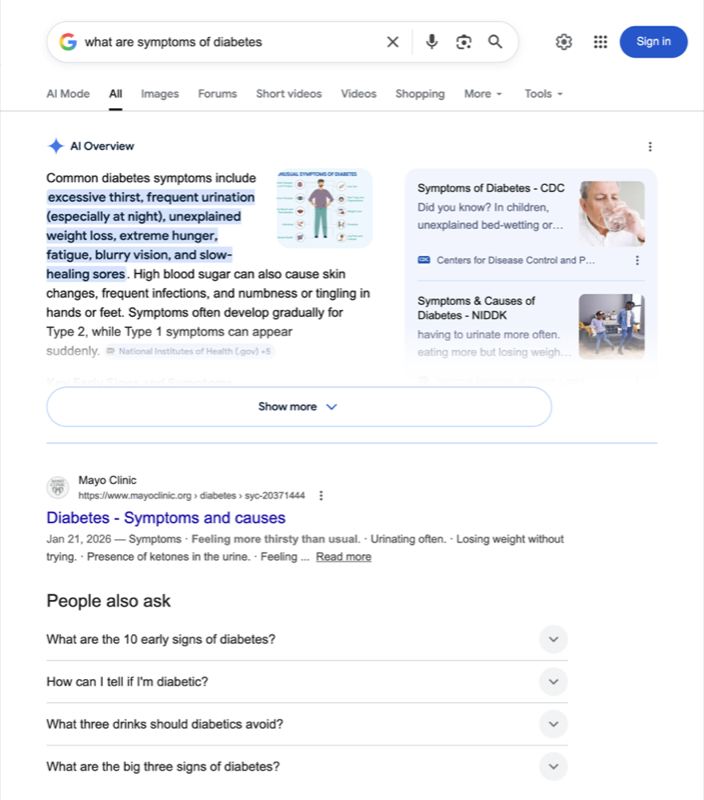
Google AI Overview displays health information with authoritative source citations — your content needs to meet the same standard to be included.
What You Can Do Now
- Audit your current content for AI quotability using the AI Citation Optimizer tool
- Implement medical schema markup using the Medical Schema Generator tool
- Review physician pages to ensure credentials and specialties are clearly stated
- Check FAQ pages against real patient questions
- Set up a content review schedule (90–180 days for core medical pages)
Next Steps in This Series
This is Part 1 of a 3-part series on Medical GEO:- Part 1 (this article): Why medical GEO matters and how it differs from SEO
- Part 2: 7 Core Strategies for Medical GEO — Actionable optimization techniques
- Part 3: Platform-Specific Optimization & Common Mistakes — AI platform differences and pitfalls
Frequently Asked Questions
What is the difference between SEO and GEO for healthcare?
SEO focuses on ranking high in search engine results (like Google). GEO focuses on being cited by AI assistants like ChatGPT Health and Perplexity Health in their generated answers. For healthcare, GEO requires stricter evidence, structured data (Schema.org), and clear author credentials.
Why does healthcare content need special GEO treatment?
Medical content falls under Google's YMYL (Your Money or Your Life) category—the strictest quality standard. AI assistants apply even stricter evaluation, requiring named credentialed authors, peer-reviewed citations, and institutional authority.
How many people use AI for health information?
OpenAI's ChatGPT Health gained over 200 million users within months of its January 2026 launch, out of 800 million total users. This represents a fundamental shift in how patients search for health information.