ChatGPT is showing more visible brand links, and referral traffic is rising. Learn how to measure AI referrals, improve homepage visibility, and win more AI search links.
Turn AI answer visibility into measurable visitsEnglish voiceover video: ChatGPT Referral Traffic Is Rising: How Brands Can Win More AI Search Links
ChatGPT referral traffic is the measurable traffic that arrives after a user clicks a link shown inside a ChatGPT answer. For GEO teams, the important shift is that visibility inside the answer can now connect to a real landing page, especially when ChatGPT turns a brand mention into a visible link.
The news signal is strong enough to act on, but it should not be overread. Similarweb ChatGPT referral traffic analysis reported that on May 7, 2026, ChatGPT began showing more prominent brand links in answers. Similarweb measured a 157.7% week-on-week increase in total ChatGPT referrals and a 354.7% increase in homepage referrals in its tracked panel. Qwairy ChatGPT linking shift study found a related linking pattern: the share of ChatGPT answers with an inline brand link moved from roughly 0.4% to 6.2% on May 7, about a 14x change.
The Short Answer
Treat ChatGPT referral growth as a GEO measurement problem, not as a normal SEO ranking report. A brand needs to know whether it is mentioned, whether the mention is linked, which page gets the click, how the visitor behaves, and whether the visit supports a business outcome.
The winning setup has four layers:
Layer
Question to answer
What to measure
Brand mention
Does ChatGPT name the brand for buyer-intent prompts?
Mention rate, sentiment, competitor share
Link presence
Does the answer make the brand clickable?
Linked mention rate, destination URL, link context
Landing page fit
Does the click land on a page that answers the prompt?
Homepage vs deep page, engagement, conversion path
Attribution
Can analytics separate AI traffic from generic referral or direct traffic?
AI assistant channel, referrer, UTM, assisted conversion
Why May 7 Changed The Conversation
Before this change, many AI search discussions focused on a no-click future. Users could get an answer without visiting a website. The May 7 shift does not cancel that risk, but it shows a second pattern: AI answers can become a discovery layer that sends users to brands when the answer needs a destination.
Similarweb’s finding that roughly 60% of post-change ChatGPT referrals landed on brand homepages matters. It means ChatGPT may be linking the entity, not the article. A classic SEO page asks, “Can this page rank?” A GEO page asks, “When an AI answer names this brand, what URL should represent it?”
That is why homepage visibility suddenly matters again. The homepage needs to explain the brand, category, audience, proof, product, pricing entry point, and next action without forcing the user to decode a marketing splash page.
The GEO Funnel For AI Referrals
AI referral traffic moves through a different funnel than search. A search visitor chooses from a results page. A ChatGPT visitor arrives after a model has already compressed the user’s question, compared options, and decided which names are worth mentioning.
Use this funnel:
Funnel stage
Failure mode
Fix
Prompt demand
The brand is never named for relevant questions
Build answer-ready pages around buyer questions and comparisons
Entity clarity
ChatGPT confuses the brand, product, or category
Align homepage copy, About page, schema, directories, and third-party mentions
Link target
ChatGPT links only the homepage, even for specific needs
Make homepage route users to use-case, comparison, pricing, and proof pages
Visit quality
AI visitors bounce because the page does not match the answer
Add clear above-the-fold answer blocks and proof modules
Measurement
Sessions appear as referral, direct, or mixed buckets
Use GA4 AI Assistants channel, custom channel groups, and landing-page segments
If ChatGPT is linking more brand names to root domains, the homepage becomes a GEO landing page. That does not mean stuffing it with AI keywords. It means making the brand easy to identify, verify, and route.
Use this homepage checklist:
State the brand category in one plain sentence.
Name the primary audience and jobs the product solves.
Link to comparison, use case, pricing, proof, and documentation pages.
Add Organization, WebSite, SoftwareApplication, Product, or Service structured data only when it matches visible content.
Keep author, company, social profile, and contact information consistent across the site.
Add concise proof: customer type, measurable outcome, case study, data source, or methodology.
Make the first screen useful even when the visitor arrived from a broad AI answer.
How To Build Pages That Earn AI Links
ChatGPT is more likely to link useful destinations when the brand has clear evidence pages. A homepage is often the first destination, but supporting pages help the model understand why the brand belongs in an answer.
Create pages for:
Do not report only “ChatGPT sessions are up.” That number can be noisy. Report the full path.
Metric
Why it matters
Segment
ChatGPT referral sessions
Shows click volume from the AI surface
Source / medium and AI Assistants
Homepage share
Shows whether links point to the root domain
Landing page
Pageviews per visit
Signals whether users keep exploring
AI vs organic vs direct
Time on site
Helps separate useful visits from curiosity clicks
AI referral cohort
Conversion or assisted conversion
Tells whether traffic creates business value
Form, signup, trial, demo
Prompt share of voice
Shows whether the brand is named before the click
Buyer-intent prompt set
Similarweb AI Chatbot Traffic documentation frames AI chatbot traffic as a way to identify traffic from ChatGPT, Perplexity, and other chatbots and compare which prompts lead to pages. That is the right idea for internal reporting too: traffic is useful, but prompts explain why the traffic exists.
Common Mistakes
The first mistake is treating AI referrals like normal backlinks. A ChatGPT link is not a link-building campaign. It is a visibility signal produced by an answer system. The better question is not “how do we get the link?” but “why would the model confidently name and route to us?”
The second mistake is ignoring homepage UX. If 60% of ChatGPT referrals land on brand homepages, the homepage must route high-intent visitors quickly. A generic homepage with vague positioning wastes AI-driven demand.
The third mistake is overclaiming. Similarweb and Qwairy measured clear changes, but they studied panels and answer samples. A brand still needs its own analytics, prompt tracking, and conversion checks before claiming AI referral growth is material for the business.
30-Day Action Plan
Week
Work
Output
Week 1
Build a prompt set for buyer questions, competitor comparisons, and category definitions
Create or refresh use-case, comparison, methodology, and case-study pages
Link-worthy evidence pages
Week 4
Configure AI traffic reporting and compare AI visitors with organic/direct cohorts
AI referral scorecard
FAQ
Is ChatGPT referral traffic a real SEO channel?
It is better described as an AI search or GEO channel. It can produce measurable referral sessions, but the upstream work is brand visibility inside AI answers, not classic ranking for a keyword.
Source signal: Similarweb referral analysis, Qwairy linking study, and Google Analytics channel documentation.
Why does homepage traffic matter so much?
Because ChatGPT often links the brand entity to the root domain. If the homepage is the destination, it must explain the brand, route users to specific jobs, and support conversion without relying on a search-result snippet.
Source signal: Similarweb’s homepage referral finding after May 7.
Should every brand create AI-specific landing pages?
Not always. Start with homepage clarity, comparison pages, use-case pages, and evidence pages. Create AI-specific pages only when they answer a real buyer question better than an existing page.
Source signal: Google helpful content guidance and Similarweb prompt-based traffic framing.
How should teams report AI referral growth?
Report volume, landing page, engagement, conversion, and prompt share of voice together. Referral sessions without prompt context can look good while the brand is still invisible for important buyer questions.
Source signal: Similarweb AI Chatbot Traffic documentation and GA4 channel group guidance.
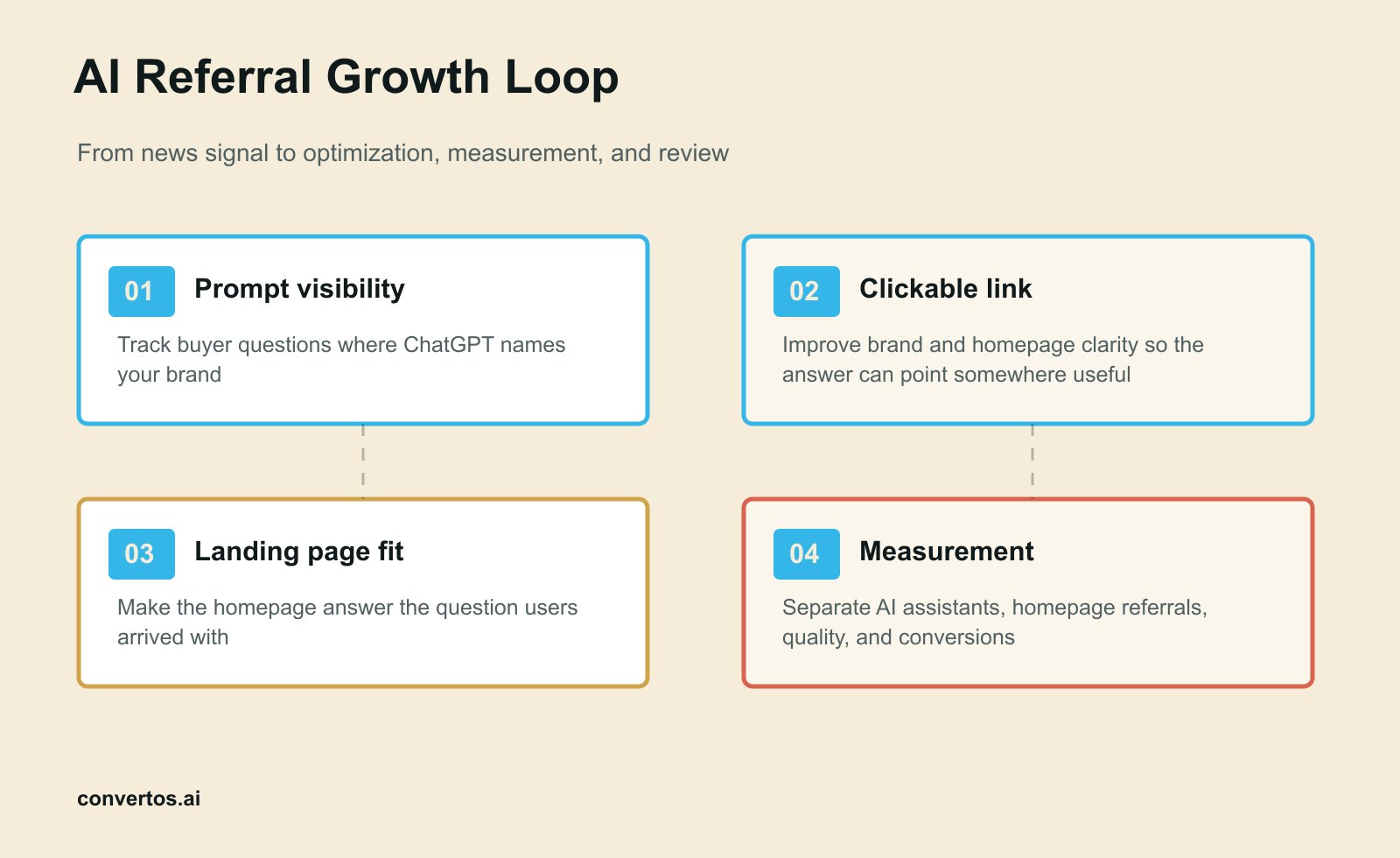
AI Referral Growth Loop: turning the news into a practical site optimization workflow.
Source Statement
This article is based on a June 4, 2026 review of Similarweb, Qwairy, Google Analytics documentation, BrightEdge AI referral data, and Convertos.ai’s AI visibility publishing standards. AI referral patterns can change quickly, so teams should refresh the analysis when ChatGPT, GA4, or Similarweb updates their methods.