Google’s CEO acknowledged that an AI Overview can be more opinionated than it should be. This GEO guide explains how SEOs should reduce AI answer risk and improve brand representation.
Make your facts easier for AI answers to use correctlyEnglish voiceover video: Google AI Overviews Are More Opinionated Than They Should Be: What SEOs Should Do
Google AI Overviews are AI-generated Search answers that can summarize sources, recommend options, and link to supporting pages. When those answers become too confident or too opinionated, the SEO problem changes: brands need to give Google better evidence, not just hope for a blue-link ranking.
The latest news made that risk concrete. Search Engine Journal coverage of Pichai and AI Overviews reported that after Google I/O 2026, Sundar Pichai reviewed a live AI Overview for a product query and acknowledged that the answer was more opinionated than it should be. The same coverage notes that Pichai discussed lower bounce clicks and did not dispute that publishers are planning for reduced search traffic. This is exactly why AI answer quality belongs in GEO, not only in SEO.
The Short Answer
Do not optimize for AI Overviews by chasing one magic markup type or one ranking factor. Build source pages that help AI answers stay grounded: clear definitions, dated facts, comparison criteria, caveats, visible author context, strong internal links, and structured data that matches visible content.
AI Overview risk
What it looks like
GEO response
Overconfident recommendation
AI names one “best” option without enough context
Publish criteria, use cases, limits, and methodology
Missing caveat
AI omits price, region, freshness, eligibility, or risk
Put caveats near claims and keep them crawlable
Brand omission
Competitors appear but your brand is absent
Build entity consistency, comparison pages, and proof pages
Wrong framing
AI describes the brand in the wrong category
Align homepage, About page, schema, and third-party profiles
Click loss
Users get enough answer without visiting
Measure citations, visibility, assisted conversions, and remaining clicks
Why “Opinionated” Matters For Search
Traditional search gives users a list of results. AI Overviews can compress the decision into one paragraph. If that paragraph chooses an option, frames a category, or describes a brand incorrectly, the business impact can happen before a user clicks anything.
This matters most for query types that already invite judgment:
best or top tools
product recommendations
“which is better” comparisons
local or ecommerce choices
health, finance, legal, or safety-sensitive topics
brand reputation questions
For those queries, SEO teams need to think like evidence editors. The goal is to make a good answer easy to assemble and a bad answer harder to justify. Google's SEO Starter Guide still frames SEO as helping search engines understand pages and helping users decide whether to visit. In an AI Overview environment, that same work now has to support answer construction, not only result-page visibility.
What Google Says About Eligibility
Google Search Central AI features guidance says the same foundational SEO practices apply to AI features as to Google Search overall. To appear as a supporting link in AI Overviews or AI Mode, a page must be indexed, eligible to show in Search with a snippet, and meet Search technical requirements. Google also says there are no additional technical requirements for AI features.
That does not mean “nothing changes.” It means AI visibility starts with ordinary crawlability and indexation, then adds a content-quality problem: can the page be confidently summarized, cited, and connected to the right entity?
Google helpful, reliable, people-first content guidance is useful here because it asks whether content provides original information, comprehensive description, clear sourcing, expertise, and a satisfying user outcome. Those are not only SEO quality questions. They are AI answer grounding questions.
Organization schema, consistent names, About page, author pages, profiles
Helps Google connect facts to the right brand
Monitoring
Priority prompt set, AI answer screenshots, citations, sentiment, click and conversion data
Shows whether the brand is represented correctly
This model connects directly with GEO content work, ChatGPT referral tracking, and SEO audit prioritization. Classic SEO keeps pages eligible. GEO checks whether AI answers use them correctly.
The practical difference is ownership. Technical SEO owns access and eligibility. Content owns the claim architecture. Brand and product teams own the canonical language that AI answers should repeat. GEO pulls those pieces into one operating model so the company is not optimizing isolated pages while the answer layer keeps changing.
How To Write Content For Opinionated AI Answers
AI Overviews become risky when the source material is thin, vague, outdated, or missing caveats. The fix is not to make every page longer. The fix is to make important claims easier to verify.
Use this pattern on pages that target recommendation or comparison queries:
Start with a direct answer that states the scope.
Define who the answer is for and who it is not for.
Show criteria before naming winners.
Include a comparison table with limits and evidence.
Add dates when product behavior, policy, or market data can change.
Link to source pages, methodology pages, and case studies.
Add FAQ questions that reflect real user uncertainty.
Example structure:
Section
Purpose
AI extraction value
Short answer
Gives the answer in 50-80 words
Easy summary block
Decision criteria
Explains how options are judged
Reduces arbitrary ranking
Fit table
Shows scenario-based recommendations
Helps avoid one-size-fits-all claims
Caveats
States limits and freshness
Lowers hallucination and overconfidence risk
Proof
Links to data, docs, screenshots, or cases
Improves trust and citation value
Use a decision table when the page targets recommendation intent. It gives AI systems a more balanced extraction target than a paragraph that simply declares one winner.
Option type
Best fit
Evidence to expose
Risk if missing
Official product page
Brand facts, pricing notes, feature claims
Current copy, visible dates, structured data
AI may use outdated third-party descriptions
Comparison page
“Which is better” and alternative queries
Criteria, fit, limits, update date
AI may choose a winner without context
Methodology page
Rankings, reviews, or category claims
Scoring rules, source list, exclusions
AI may treat subjective claims as objective
Case study or proof page
High-intent buyer validation
Results, segment, time period, constraints
AI may mention the brand without proof
What To Monitor After Publishing
Do not wait for traffic to tell the whole story. In AI search, the answer itself is part of the outcome.
Metric
What it tells you
Cadence
AI Overview trigger rate
Which tracked queries show AI Overviews
Weekly for priority terms
Citation presence
Whether your page appears as a supporting link
Weekly or after updates
Brand wording
How the answer describes your brand
Weekly for reputation queries
Competitor wording
Which competitors are named and why
Monthly
Click and engagement
Whether remaining clicks are high quality
Weekly in GSC/GA4
Conversion assist
Whether AI-influenced visits support pipeline
Monthly
Google’s public position is that AI features still rely on Search fundamentals. That means Search Console, crawl logs, analytics, and classic SEO diagnostics still matter. But they are not enough. You also need answer-level monitoring: what does the AI say, whose facts does it use, and where does it send users?
For click and query reporting, use Google Search Console performance reports as the baseline, then layer manual or platform-based answer checks on top. The combined view prevents a common mistake: assuming flat traffic means nothing changed, when the answer wording or citation mix may have changed before clicks moved.
Common Mistakes
The first mistake is treating AI Overviews as a normal featured snippet. Featured snippets quote or summarize a page. AI Overviews can synthesize, compare, and recommend. That makes entity clarity and comparison methodology more important.
The second mistake is optimizing only for clicks. If an AI Overview names your brand accurately but the user does not click, there may still be brand value. If it omits or misframes your brand, a click report may not show the damage.
The third mistake is publishing unsupported “best” pages. If a page says one vendor is best but does not explain criteria, tradeoffs, update date, or evidence, it invites AI systems to repeat a thin opinion.
The fourth mistake is leaving brand language inconsistent across the homepage, About page, product pages, and third-party profiles. AI answers are entity-driven. If the same company is described with different categories, claims, or use cases in different places, the model has more room to choose the wrong framing.
30-Day Action Plan
Week
Work
Output
Week 1
Pick 30 buyer, comparison, and brand reputation prompts
AI Overview monitoring set
Week 2
Audit pages for definitions, caveats, criteria, author/source context, and dated facts
AI answer risk sheet
Week 3
Rewrite top pages with answer blocks, comparison tables, and proof links
Grounded answer pages
Week 4
Compare answer wording, citations, clicks, and conversions before and after changes
GEO visibility report
Keep the plan small enough to repeat. Thirty prompts are enough to reveal whether the brand is missing, miscategorized, or cited from weak sources. After the first cycle, expand only the prompt families that show real business risk.
FAQ
Does Pichai’s comment mean AI Overviews are unreliable?
No. It means even Google’s leadership sees room for improvement in how some AI Overviews handle judgment-heavy queries. SEO teams should respond by improving evidence, not by abandoning Google Search.
Source signal: Search Engine Journal coverage of the Decoder interview.
Is there special schema for AI Overviews?
Google says there are no additional technical requirements for supporting links in AI Overviews or AI Mode beyond being indexed and eligible in Google Search with a snippet. Structured data still helps when it truthfully describes visible content.
Source signal: Google Search Central AI features guidance.
Should SEOs still care about rankings?
Yes. Rankings still matter because Google says foundational SEO practices apply. They are no longer sufficient by themselves, so teams should also monitor citation presence, brand wording, answer quality, and AI-influenced conversions.
Source signal: Google AI features guidance and helpful content guidance.
What pages should be fixed first?
Start with pages that influence recommendation, comparison, pricing, reputation, or high-intent buyer questions. These are the pages most likely to be compressed into AI answers that affect decisions.
Source signal: Pichai coverage, Google helpful content guidance, and Convertos.ai GEO workflow.
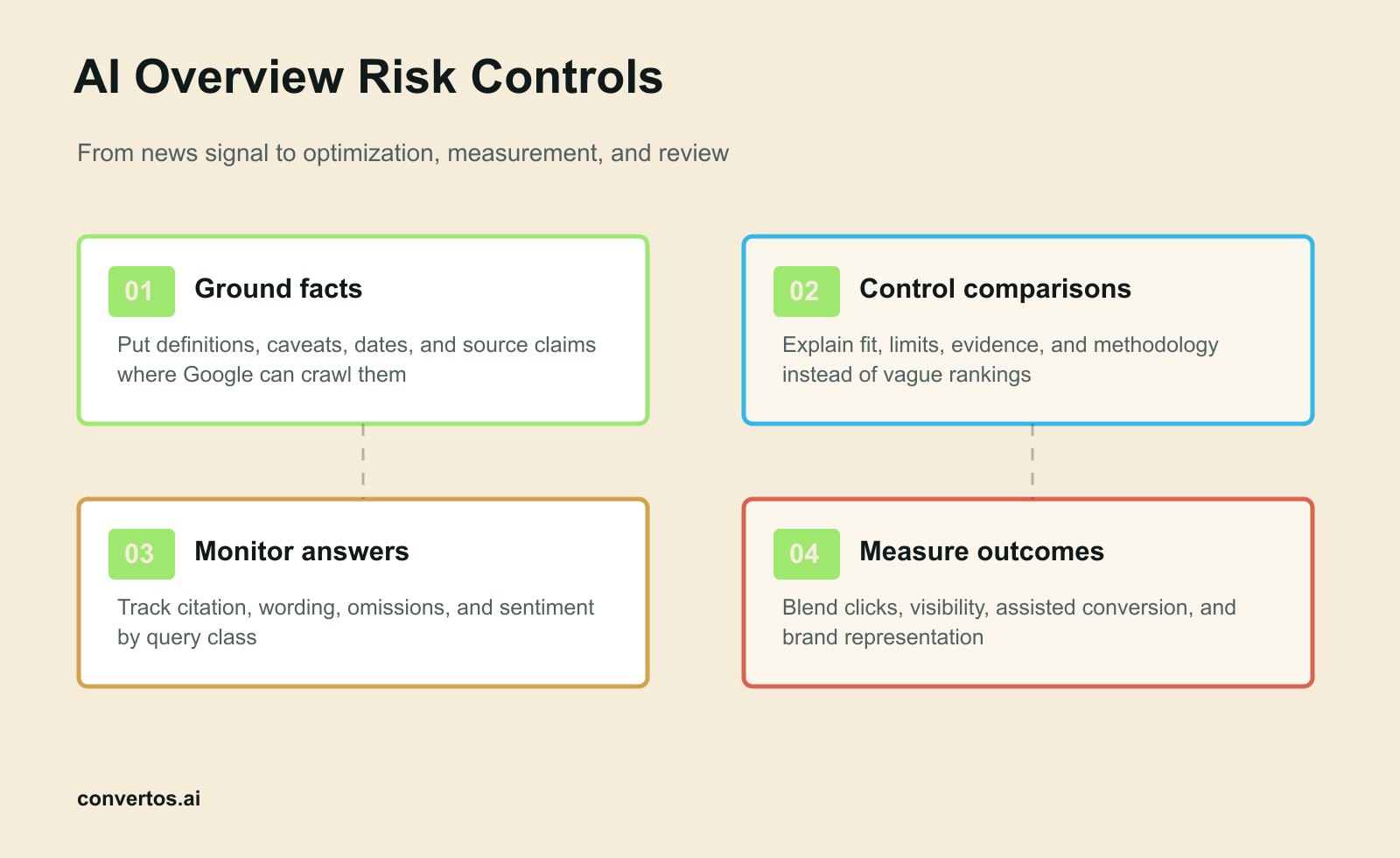
AI Overview Risk Controls: turning the news into a practical site optimization workflow.
Source Statement
This article is based on a June 4, 2026 review of Search Engine Journal coverage, Google Search Central documentation for AI features and helpful content, and Convertos.ai GEO publishing standards. AI Overview behavior varies by query, location, personalization, and time, so teams should recheck live answers before making business decisions.