
Key Takeaways
- Adobe’s data does not prove that every AI visit beats every Google visit. It shows that AI-referred retail traffic is becoming more purchase-ready in specific markets and periods.
- Ecommerce SEO now needs a second goal: help AI systems understand, verify, and recommend products, not only rank pages in Google.
- GEO work starts with product facts: structured data, Merchant Center feeds, third-party reviews, consistent brand information, returns, shipping, and visible product answers.
- GA4 referral reports undercount AI’s influence because many shoppers ask an AI tool first, then return through branded search, direct traffic, paid search, or a marketplace.
- The safest first move is not an “AI shopping trend” blog post. Fix product pages, schema, feeds, comparison content, FAQ, and evidence quality.
What Adobe’s AI Shopping Data Actually Shows
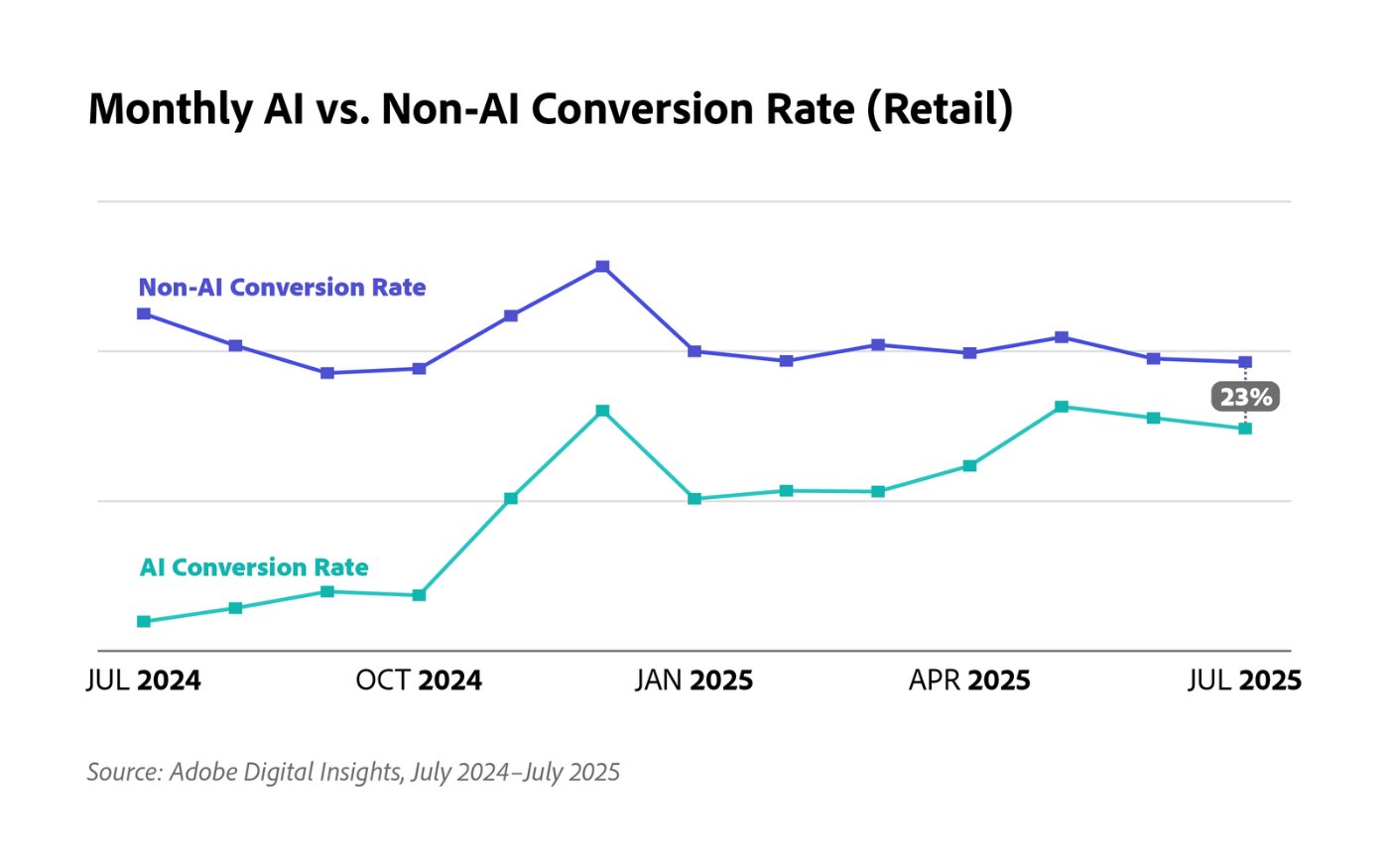
Adobe’s data points to intent compression. Shoppers are using AI tools to research, compare, narrow options, and find deals before they click to a retailer. When they arrive on a product page, they may be closer to validation and purchase than a typical search visitor who is still opening several tabs. In April 2026, Adobe said AI-referred U.S. retail traffic converted 42% better than non-AI traffic in March 2026. A year earlier, the same type of traffic converted 38% worse. Adobe also reported stronger engagement: AI-referred shoppers spent longer on site, viewed more pages, and engaged more than non-AI visitors. U.K. coverage of Adobe data went further: in May 2026, shoppers clicking from AI sources were more likely to buy than shoppers arriving from traditional online search. The wording matters. Adobe’s official U.S. comparison is usually “AI traffic” versus “non-AI traffic,” where non-AI sources can include paid search, organic search, email, social, affiliates, and direct. Some headlines summarize this as “AI beats Google Search,” but the careful conclusion is narrower: in some retail markets and time windows, AI-referred shopping traffic has started to outperform traditional search or non-AI traffic benchmarks.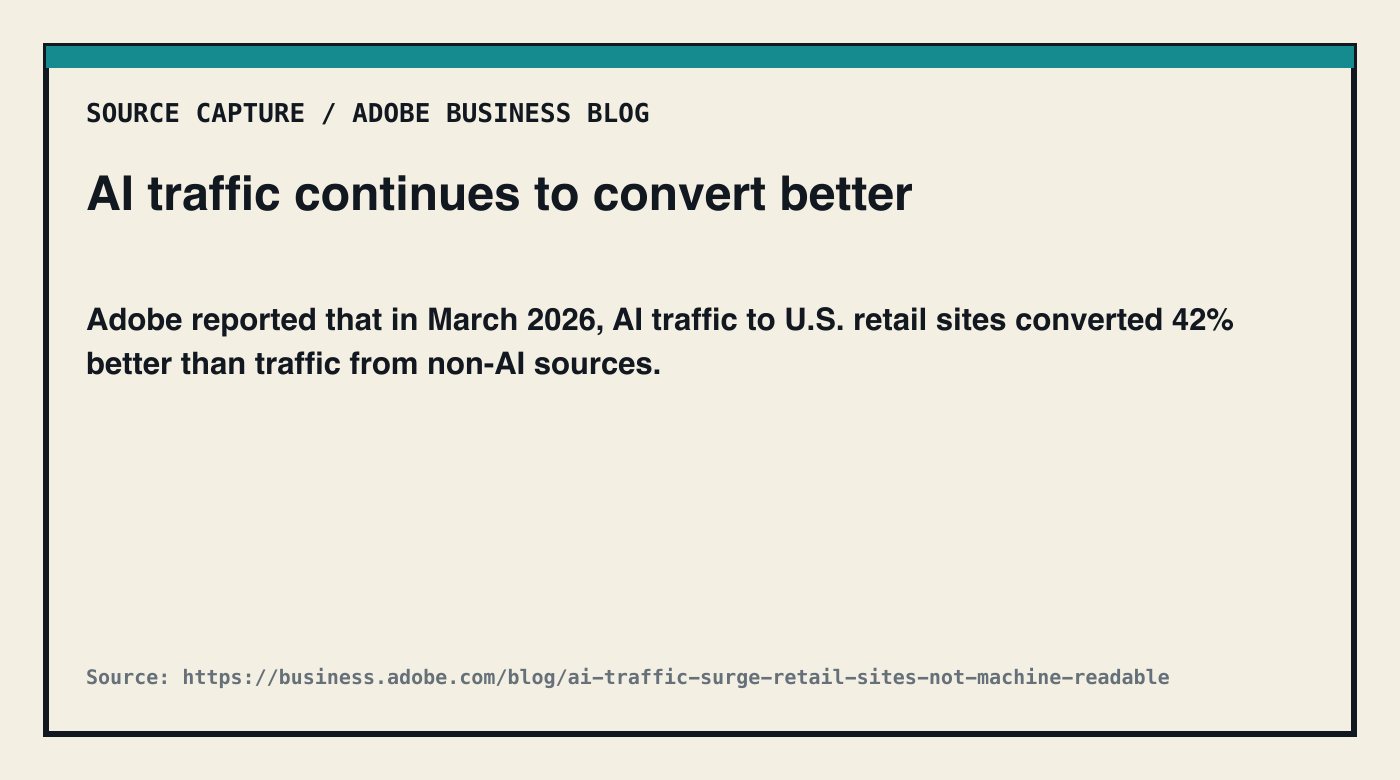
Why AI-Referred Shopping Clicks Can Convert Better
AI-referred clicks can convert better because part of the buying journey happens before the site visit. The shopper may already have described their needs, budget, constraints, and alternatives inside an AI tool. By the time they click, they are often checking proof, price, delivery, reviews, and return terms. Adobe’s August 2025 retail analysis already showed AI-referred shoppers spending more time on site, viewing more pages, and bouncing less often than non-AI shoppers. By 2026, Adobe’s U.S. retail data showed the conversion gap reversing. Search Engine Land’s February 2026 coverage of a Visibility Labs analysis found a similar pattern across 94 ecommerce brands: ChatGPT referrals converted at a higher rate than non-branded organic search on commercial pages, although organic search still had far more total traffic and revenue.| Behavior | Conversion Impact | What Ecommerce Teams Should Check |
|---|---|---|
| The shopper compares options before the click | The visit is closer to validation or purchase | Does the product page answer fit, price, proof, delivery, and returns quickly? |
| AI systems narrow the shortlist | Products not recommended may never get considered | Are product facts, reviews, and brand entities consistent across sources? |
| Attribution is messy | AI influence may show up as branded search or direct | Track AI referrals, brand queries, site search, post-purchase surveys, and logs together |
| Visitors have less patience | Generic intros and brand fluff slow the decision | Put price, stock, reviews, shipping, returns, and product fit near the top |
Why Ecommerce SEO Needs An SEO + GEO Model
An SEO + GEO model means classic SEO keeps product pages crawlable, indexable, useful, and visible in Google, while GEO makes product and brand information clear enough for AI answers, comparison lists, and recommendation flows. These two tracks share the same source of truth, but they optimize for different discovery surfaces. Classic SEO is still the base layer. Google Search Central’s guidance for AI experiences says site owners should keep focusing on unique, valuable content, strong page experience, and technical access so Google can crawl and index content. Google’s product structured data documentation also recommends Product markup, Merchant Center feeds, and rich product information such as price, availability, shipping, returns, ratings, and product variants. GEO adds a trust problem. AI systems do not only read your product page. They may compare your page with third-party reviews, forums, media coverage, creator content, support pages, return policies, and brand entity information. If the product page says “good for sensitive skin,” but reviews mention fragrance concerns and the FAQ never explains ingredients, an AI system has less reason to recommend it for a sensitive-skin query.| Job | Classic SEO Handles | GEO Adds |
|---|---|---|
| Product discovery | Crawl, index, canonical, internal links, page speed | AI crawler access and visible HTML product facts |
| Product understanding | Titles, categories, descriptions, Product/Offer schema, Merchant feeds | Use cases, limitations, audience fit, comparisons, FAQ, entity consistency |
| Trust | Reviews, returns, shipping, pricing, stock, rich results | Third-party reviews, expert mentions, community questions, fact correction |
| Conversion | PDP layout, CTA, price, promo, checkout | Answer AI-prequalified questions without repeating generic education |
| Measurement | Rankings, clicks, CTR, revenue, conversion rate | AI recommendation share, cited sources, answer accuracy, competitor co-mentions |
What Ecommerce GEO Teams Should Fix First
Ecommerce GEO should start with the product facts that AI systems need to read, verify, and trust. Do not begin with a broad “future of AI shopping” content campaign. Start with product pages, category pages, brand pages, FAQ, reviews, return policies, and third-party evidence.- Add and maintain product structured data. Use Google-supported Product, Offer, AggregateRating, Review, shipping, return, and variant fields where they match the visible page. Do not mark up fake ratings, hidden offers, or stock that is not shown to users.
- Keep Merchant Center feeds and PDPs consistent. Price, stock, GTIN, brand, images, variants, delivery, and returns should match across the feed and the product page. Google notes that feeds and structured data can help verify product data.
- Rewrite the product-page top section. Answer who the product is for, what it costs, whether it is in stock, why it is credible, and what the buyer needs to know about shipping and returns.
- Add comparison and “not for” language. AI shopping answers often need boundaries. “Best for small apartments, not open-plan living rooms” is more useful than “premium design.”
- Build third-party evidence. Reviews, creator tests, editorial mentions, expert roundups, and public Q&A can help AI systems verify that your product claims are not only self-description.
- Create a stable brand facts page. Company name, brand name, product lines, support terms, returns, certifications, location, and contact details should be consistent. Conflicting facts make recommendations riskier.
Ecommerce GEO Priority Scorecard
GEO priority should follow recommendation risk. Fix the facts AI needs before building trend content or campaign pages.| Priority | Check | Why It Matters | Passing Standard |
|---|---|---|---|
| P0 | Product pages are crawlable, indexable, and return 200 | Search and AI systems must reach the page first | Googlebot can crawl it; no noindex; core facts are not locked in images or scripts |
| P0 | Product/Offer schema matches the visible page | Price, stock, ratings, and reviews are recommendation facts | Rich Results Test has no critical errors; markup matches user-visible content |
| P0 | Merchant Center feed matches the PDP | Shopping surfaces can cross-check product data | Price, stock, GTIN, variants, shipping, and returns are consistent |
| P1 | The page answers buying questions above the fold | AI-referred shoppers often arrive close to decision | Fit, price, proof, reviews, shipping, and returns are visible quickly |
| P1 | Third-party proof exists for key products | AI systems need evidence beyond the seller’s claim | Important products have reviews, editorial coverage, creator tests, or public Q&A |
| P1 | Category pages include comparison criteria | Many AI prompts ask “which product fits me?” | Category content compares use case, budget, specs, and limits |
| P2 | AI recommendation share is monitored | Rankings miss the recommendation layer | Weekly prompt tests record brand mentions, citations, errors, and competitor overlap |
How To Measure AI Shopping Traffic And GEO Impact
AI shopping measurement needs both source data and influence data. GA4 referrals show some direct clicks from AI tools, but many shoppers ask AI first and then come back through Google, a brand query, direct traffic, paid search, or a marketplace.| Measurement Layer | What To Track | Source | Caveat |
|---|---|---|---|
| Direct AI traffic | ChatGPT, Perplexity, Gemini, Copilot, AI browser referrals | GA4 and server logs | Referral data misses many AI-influenced purchases |
| Search handoff | Growth in branded, product, and comparison queries | Google Search Console | AI recommendations may create later branded searches |
| Recommendation visibility | Whether products appear in core shopping prompts and which sources are cited | Manual tests, GEO tools, Convertos.ai | Keep prompt set, region, language, and date stable |
| Conversion quality | CVR, AOV, return rate, repeat purchase for AI-influenced users | GA4, CRM, order system, post-purchase survey | Small samples need cautious interpretation |
Common Mistakes
Adobe’s data deserves attention, but it is easy to stretch it too far. The biggest mistake is turning one market, one period, or one attribution method into a universal rule.| Mistake | Why It Hurts | Better Approach |
|---|---|---|
| “AI has fully replaced Google Search” | Adobe’s data shows retail conversion strength in specific contexts; Google remains a discovery and validation layer | Keep SEO investment and add AI recommendation monitoring |
| “GEO alone will create high-converting traffic” | AI recommendations depend on verifiable product facts, evidence, and accessible pages | Fix PDPs, schema, feeds, reviews, and policy pages first |
| “AI referral traffic is tiny, so AI does not matter” | AI influence may be attributed to branded search, direct, paid, or marketplace conversions | Combine referral data with brand-search growth and post-purchase questions |
| “More schema is always better” | Google requires structured data to match visible content; fake or stale data damages trust | Mark up only accurate, visible, maintained data |
| “Any third-party review will do” | AI systems need consistent and credible evidence, not scattered promotional mentions | Prioritize real tests, editorial reviews, creator experience, and user Q&A |