A definition block is a short, visible section that defines one concept in plain language, names the entity, explains the scope, and gives the reader the next useful detail. It helps human readers understand the page faster and helps search and AI systems extract the right meaning without guessing. For GEO work, a good definition block is not decoration. It is one of the most reliable answer assets on the page.
Last updated: May 10, 2026
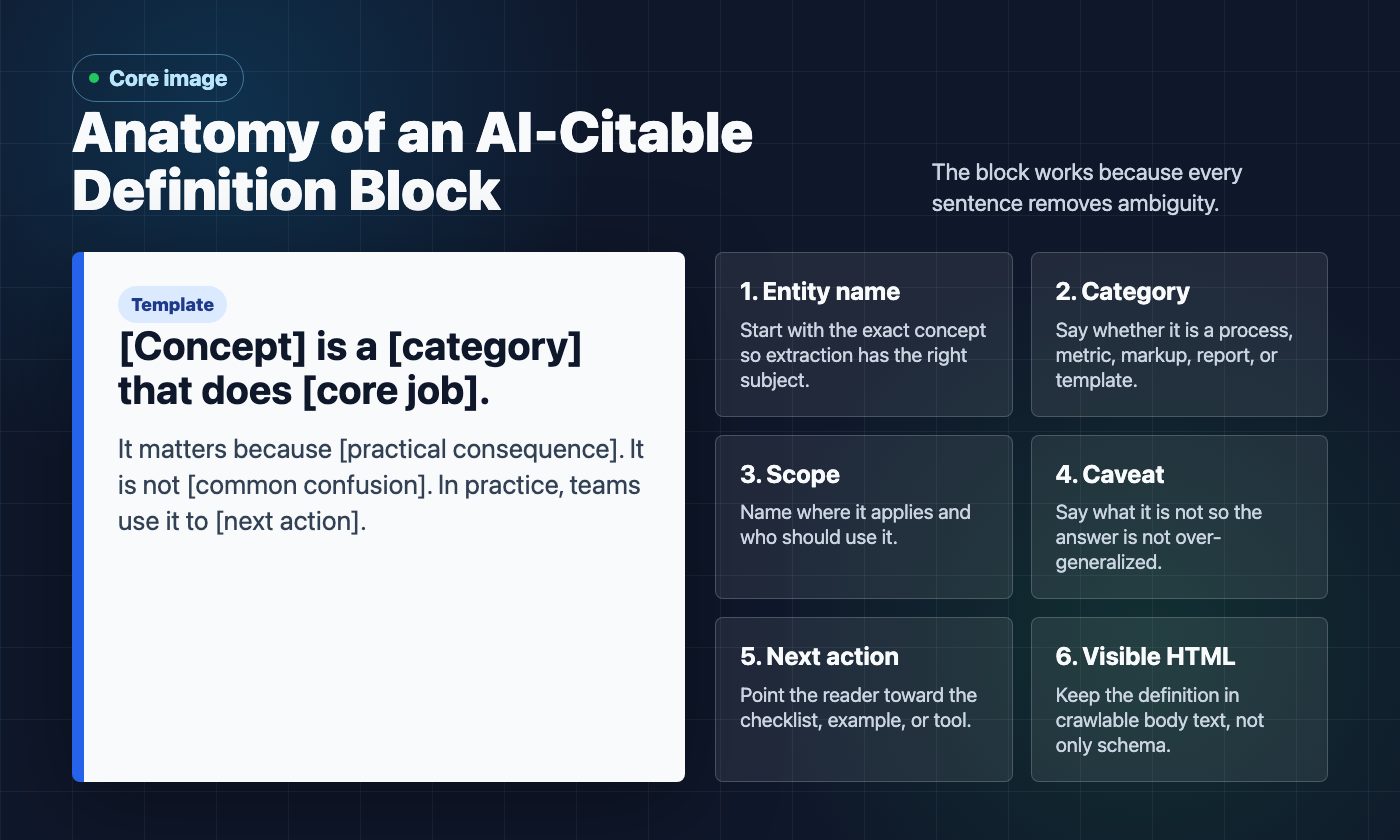
45-second explainer: how to write definition blocks that readers and AI search can understand.Core image: a definition block clarifies the concept, scope, caveat, and next action.
Key Takeaways
A definition block should answer "what is this?" in 40-90 words before the page gets tactical.
The first sentence should name the concept, not start with "it" or a vague setup.
The block should include scope, practical use, and one caveat when the concept is easy to misunderstand.
Definition blocks work best when they are visible HTML text, supported by clear headings and internal links.
Schema can help machine understanding, but it does not replace a clear definition in the body.
What Is a Definition Block?
A definition block is a compact answer unit that explains one term, method, metric, or entity in a way that can stand alone. It usually sits near the top of an article or at the start of a major section. A strong definition block gives the concept, the category it belongs to, the practical meaning, and the boundary of what it does not mean.
This matters because many SEO and GEO pages assume the reader already understands the term. AI systems have a similar problem: if a page uses a concept in loose ways, the system may summarize it incorrectly or connect it to the wrong entity. Google's SEO Starter Guide recommends organizing content clearly and using descriptive links and headings so users and search engines can understand page structure. A definition block supports that same goal in a more extractable form.
The Definition Block Template
Use this template when you introduce an important concept:
[Concept] is a [category] that [does the core job] for [audience/context]. It matters because [practical consequence]. It is not [common confusion]. In practice, teams use it to [next action or example].
Here is a GEO example:
A GEO audit is a structured review of how often and how accurately a brand appears in AI-generated answers. It checks citation visibility, entity clarity, answer accuracy, and content gaps across systems such as Google AI features, Perplexity, and ChatGPT Search. It is not just a traditional SEO audit with a new label; it focuses on whether answer engines can understand, trust, and quote the page.
The point is not to force every definition into one rigid paragraph. The point is to make every definition answerable, quotable, and hard to misread.
What a Strong Definition Block Must Include
Element
What to write
Why it helps
Named concept
Start with the exact term, such as "GEO audit" or "canonical URL."
Prevents vague extraction and pronoun confusion.
Category
Say what kind of thing it is: process, metric, markup, signal, report, or template.
Helps readers and machines place the entity.
Core job
Explain what it does in one direct sentence.
Gives the answer block its main quote.
Scope
State where it applies and who uses it.
Reduces overbroad claims.
Caveat
Name one thing it is not.
Prevents common misunderstandings.
Next action
Point to the workflow, checklist, or example that follows.
Makes the block useful, not just descriptive.
Google's structured data documentation also stresses that structured data should describe visible page content. That same principle applies here: if the definition matters enough to help machines, it should also help the reader on the page.
Where to Place Definition Blocks
Place a definition block where the reader first needs the term. On a glossary page, it belongs immediately after the H1. In a tutorial, it belongs before the first step. In a comparison article, each compared concept should get its own short definition before the comparison table. In a case study, define the method before presenting results.
For Convertos.ai content, the best pattern is:
Open with a direct answer.
Add a definition block for the central concept.
Follow with a table, checklist, or example.
Link to a deeper supporting page if the reader needs implementation detail.
This pattern makes the article easier to scan and easier for AI systems to chunk.
Good vs Weak Definition Blocks
Weak block
Better block
"This is an important part of modern SEO and can help brands get more visibility."
"A definition block is a short visible answer that defines one concept, gives its scope, and explains why it matters. It helps readers and AI systems understand the page without relying on hidden schema or vague context."
"GEO means optimizing for AI."
"GEO, or generative engine optimization, is the practice of making content easier for AI answer systems to understand, verify, and cite. It overlaps with SEO, but it focuses more on entities, answer blocks, evidence, and citation accuracy."
"Schema helps search engines."
"Structured data is machine-readable markup that describes visible page content. It can help search systems understand entities and page types, but it should match the content users can actually see."
The better blocks are not longer because they are trying to sound more advanced. They are longer because they remove ambiguity.
Definition Block Checklist
The first sentence starts with the exact concept name.
The block is visible in crawlable HTML text.
The answer fits in one short paragraph or two very short paragraphs.
The category is clear: method, metric, report, markup, tool, process, or page type.
The block includes a practical consequence: why the reader should care.
The block avoids unsupported ranking claims.
The block links to a relevant internal page only when the next step truly helps.
The surrounding heading says what the block defines.
The wording is plain enough that a new teammate could explain it back.
The block is updated when the platform behavior, product, or standard changes.
How to Use Definition Blocks for GEO
Definition blocks support GEO because they create clean answer units. They help AI systems connect the concept to related entities, reduce ambiguity, and quote the page without stripping away context. They also help human readers decide whether the page is relevant before reading the full article.
Use definition blocks for:
New methods, such as GEO audit, citation readiness, or AI visibility monitoring.
Technical terms, such as canonical URL, robots.txt, structured data, or schema type.
Metrics, such as citation share, answer accuracy, or source diversity.
Product concepts, such as a URL review, comparison report, or content gap score.
Distinctions that readers often confuse, such as SEO vs GEO or FAQPage vs QAPage.
Do not use definition blocks to make weak ideas look official. If the term is invented, unsupported, or only used inside your team, explain it honestly as your internal method rather than presenting it as an industry standard.
Common Mistakes
Mistake
Why it hurts
Better approach
Starting with a vague intro
AI systems may extract the wrong subject.
Start with the entity name.
Hiding the definition in FAQ schema only
Users and many crawlers may not see a useful answer.
Put the definition in visible body text.
Overclaiming SEO impact
The page loses trust if the claim is not sourced.
Say what the block can help with: clarity, extraction, and reader comprehension.
Using a slogan as a definition
Readers still do not know what the concept means.
Define the category, job, scope, and caveat.
Reusing the same block everywhere
Duplicate definitions can feel thin and contextless.
Adjust the definition to the page's user intent.
How to Measure Whether It Works
Measure definition blocks by whether they improve understanding and extraction, not by whether they create a single ranking jump. Track:
Scroll depth around the definition section.
Clicks from the definition block to deeper internal pages.
Search queries that include "what is", "meaning", "definition", or "vs".
AI answer accuracy when prompts ask for the concept.
Whether AI systems cite the page for the concept after indexing.
Support or sales questions that decrease after the page is updated.
For a GEO workflow, run a before-and-after prompt test. Ask the same AI-search prompt before and after adding the definition block, then record whether the answer names the concept correctly, uses the right source, and avoids the old misunderstanding.
FAQ
Is a definition block the same as a glossary entry?
No. A glossary entry is usually a standalone dictionary-style page or item. A definition block is a reusable answer unit inside an article, tutorial, product page, or case study.
Should every H2 section start with a definition block?
No. Use definition blocks when a concept needs to be named and clarified. A tactical section may need a step-by-step answer instead.
Does a definition block require structured data?
No. The visible text is the main asset. Structured data can support the page when it truthfully describes visible content, but it should not replace the block.
How long should a definition block be?
Most definition blocks should be 40-90 words. Complex technical concepts may need a second short paragraph, but the first sentence should still answer directly.
Can AI-generated content use this template?
Yes, but the facts still need human review. The template helps structure the answer; it does not verify claims, sources, or product behavior by itself.
Content Statement
This article is based on public search documentation, structured data guidance, and practical SEO/GEO editorial workflows. Platform behavior can change, so technical claims should be reviewed when Google Search Central, Schema.org, or major AI-search systems update their public guidance.
Conclusion
A definition block is a small section with a large job: it tells readers and machines exactly what a concept means. For SEO, it improves clarity and internal linking. For GEO, it creates a quotable answer unit that can support AI-search citation. Start with the concept name, define the category and job, add the caveat, then lead the reader to the next useful action.