AI-citable content is visible page content that an AI search or answer system can understand, verify, and quote without losing the original meaning. It uses clear answer blocks, named entities, source-backed claims, crawlable HTML, and updated context. It is not a trick for forcing citations. It is a way to make a page easier for people and machines to trust.
The practical job is simple: make the page's best answer easy to lift without making it misleading. A quoted passage should still name the subject, include the right scope, and point toward the evidence or next step. That is why this guide focuses on answer blocks, evidence, page structure, and measurement instead of citation hacks.
Last updated: May 11, 2026
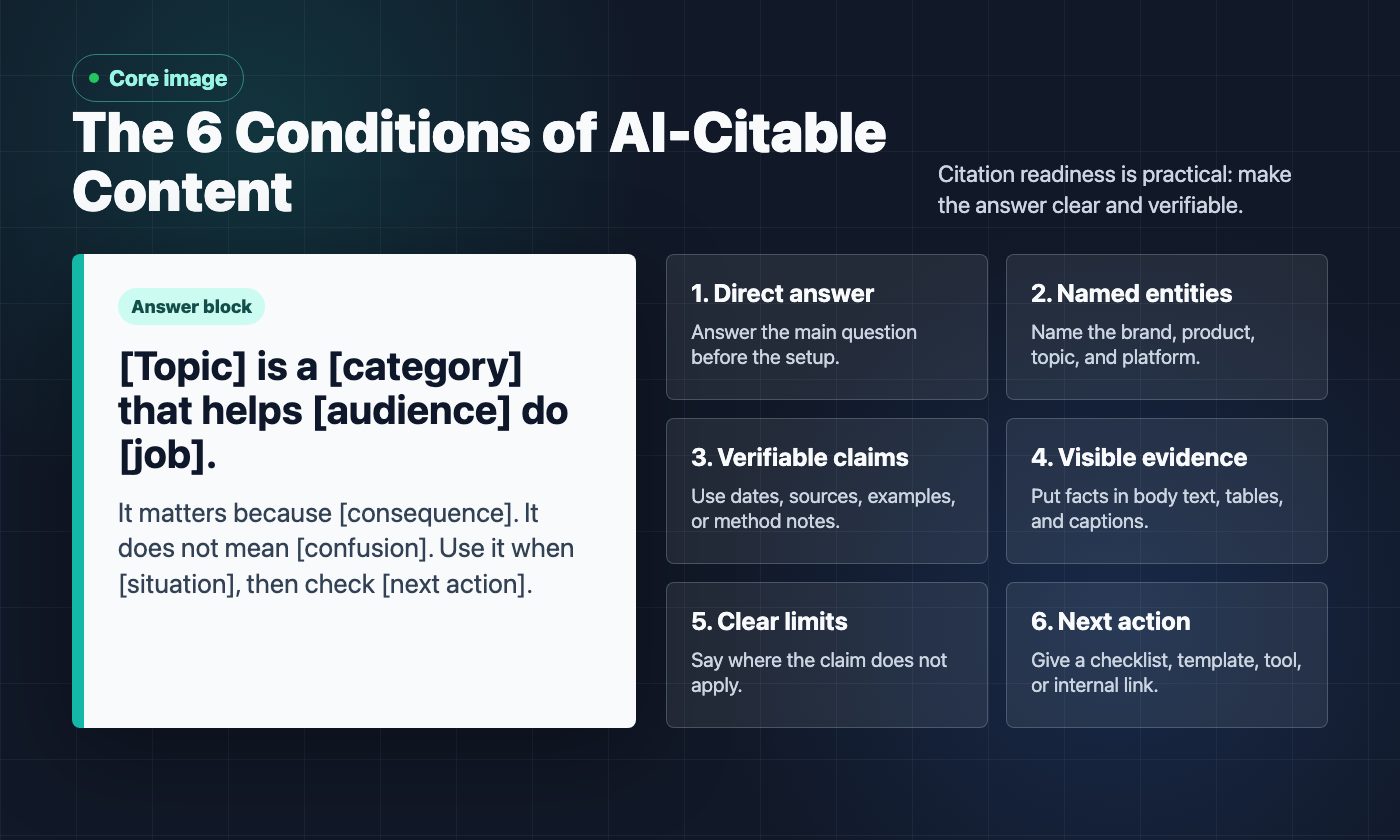
45-second explainer: AI-citable content makes answers visible, verifiable, and extractable.Core image: the six conditions of AI-citable content.
Key Takeaways
AI-citable content starts with a direct answer, not a long setup.
The answer must be visible in the body, not only in structured data, tabs, images, or schema.
Claims need dates, sources, examples, and limits so they can be quoted safely.
A page should make entity relationships clear: brand, product, topic, author, source, method, and next action.
You measure success by answer accuracy, citation visibility, source selection, and human usefulness, not by one ranking change.
Think of these points as a publishing standard, not a writing style. A page can sound natural and still be structured for extraction. The goal is to make the strongest answer easy to find, easy to verify, and hard to separate from its caveats.
What Is AI-Citable Content?
AI-citable content is content written so that answer systems can extract a useful passage and still preserve the page's meaning. A good passage names the topic, explains the claim, includes the right context, and shows why the reader should trust it.
This matters because AI search experiences often summarize pages into short answers. If the page only contains vague advice, unsupported claims, or hidden markup, the summary may be weak or wrong. Google's guidance on helpful, reliable, people-first content asks publishers to create content that serves readers first. Google's structured data documentation also says structured data should describe visible page content. Those two principles are a practical baseline for AI-citable pages: help the reader in the open, then use machine-readable support where it truthfully matches the page.
The Six Conditions for AI-Citable Content
Condition
What it means
Page-level check
Direct answer
The page answers the main question in the first useful section.
Can a reader copy one paragraph and understand the answer?
Named entities
The page names the product, concept, brand, method, metric, and platform clearly.
Are important nouns explicit, or does the copy rely on "it" and "this"?
Verifiable claims
Important claims have sources, dates, examples, or method notes.
Would a reviewer know where the claim came from?
Visible evidence
The strongest facts are in crawlable body text, tables, captions, and links.
Is the answer visible without relying on hidden schema?
Clear limits
The page explains what the claim does not cover.
Does it avoid pretending a tactic works everywhere?
Next action
The page tells the reader what to do with the answer.
Is there a checklist, example, template, or tool after the explanation?
If a page fails the direct answer and verifiable claim checks, it is not ready for AI search citation work. Fix the content before adding more schema.
Write the Answer Block First
An answer block is a short visible section that gives the reader a complete answer. Put it near the top of the page or at the start of an important section. The block should contain the topic, the category, the practical meaning, one caveat, and the next step.
Use this pattern:
[Topic] is a [category] that helps [audience] do [job]. It matters because [practical consequence]. It does not mean [common confusion]. Use it when [specific situation], then check [next evidence or action].
For example:
AI-citable content is visible content that answer systems can quote without stripping away context. It matters because AI search products may summarize only a small part of a page. It does not guarantee citation; it improves the page's clarity, evidence, and extractability.
This is the same family of work as the definition block template: one clean answer, written for humans first, structured enough that machines do not need to guess. It also supports broader AI search, GEO audit, and LLM brand visibility monitoring workflows because those tasks depend on stable answer units.
Make Claims Easy to Verify
AI-citable content needs evidence discipline. Do not say "AI tools prefer this format" unless you can point to a source, experiment, or observed prompt test. It is safer and more useful to say, "This format makes the answer easier to extract because the topic, scope, source, and caveat are visible in one passage."
Use this evidence ladder:
Before-and-after prompt set with screenshots or logs
Product claim
Product documentation or real workflow
Demo, screenshot, and owner review
Opinion or recommendation
Expert rationale
Clear caveat and example
Google's structured data documentation is useful here because it separates machine-readable markup from the visible page. If the content is not visible and useful to readers, do not expect schema alone to carry the trust burden. When crawler access matters, check official crawler pages such as OpenAI's bots documentation and Perplexity's bot guidance before changing robots rules.
Format the Page So It Can Be Extracted
AI systems and search systems do not only look for keywords. They need clean sections that can be parsed. Use normal HTML headings, short paragraphs, descriptive table headers, image captions, and internal links that describe the destination.
Good page structure:
Direct answer.
Definition block.
Evidence table.
Step-by-step checklist.
Example or before-and-after rewrite.
FAQ based on real reader questions.
Update note and source statement.
Weak page structure:
Long introduction before answering.
Important facts trapped inside a decorative image.
FAQ answers that repeat the same generic sentence.
Schema that says more than the visible page says.
Internal links labeled "read more" without context.
This structure also helps editors review the page. The editor can check the direct answer, evidence table, example, and FAQ as separate assets instead of reading the whole article as one long essay. That makes updates faster when platform guidance changes.
Before and After Example
Weak version
AI-citable version
"Our platform improves AI visibility with advanced optimization."
"Convertos.ai monitors whether a brand appears in AI-generated answers, which sources are cited, and whether the answer is accurate. Teams use it to find pages that need clearer entities, stronger evidence, or updated answer blocks."
"Schema helps AI understand your page."
"Structured data is machine-readable markup that describes visible page content. It can help systems understand page types and entities, but it should match what users can actually see on the page."
"GEO is the future of SEO."
"GEO, or generative engine optimization, is the practice of improving how accurately a brand or page appears in AI-generated answers. It overlaps with SEO, but it focuses more on entity clarity, source selection, answer accuracy, and citation visibility."
The better versions are not magic phrases. They are simply clearer, more specific, and easier to verify.
AI-Citable Content Checklist
Put the main answer in visible body text.
Start answer blocks with the exact entity or concept name.
Define technical terms before using them in a tactic.
Add a source or date for platform behavior claims.
Use tables when the page compares options, conditions, or steps.
Add image captions that explain the useful information in the image.
Link to supporting pages with descriptive anchor text.
Avoid inflated promises such as "guaranteed AI citation."
Include a caveat when the result depends on indexing, brand authority, page quality, or source availability.
Re-test prompts after the page is updated and indexed.
How to Measure Whether a Page Is Citable
Do not measure AI-citable content by rankings alone. Measure whether the page becomes easier to understand, quote, and verify.
Track:
Search Console queries for "what is", "how to", "template", "checklist", and comparison modifiers.
AI answer accuracy for prompts that match the page intent.
Whether AI systems mention the page, brand, or source in answers.
Whether cited passages preserve the page's original meaning.
Scroll depth and clicks from answer blocks to deeper supporting pages.
Support, sales, or customer questions that decline after the content is clarified.
Run a simple before-and-after prompt test. Ask the same question in ChatGPT Search, Perplexity, Gemini, and Google AI features before the page update and again after the page is crawled. Record whether the answer names the topic correctly, cites or references the page, and avoids the old misunderstanding. For production work, connect this test to your Convertos.ai audit workflow so the page update, prompt set, and source results stay together.
Common Mistakes
Mistake
Why it hurts
Better approach
Writing for an AI system before helping the reader
The page becomes stiff, vague, and less trustworthy.
Write a useful human answer, then structure it cleanly.
Hiding the answer in schema
The visible page may not satisfy the claim.
Put the answer in crawlable body text.
Making unsupported platform claims
The page can become outdated or misleading.
Link to official docs and add date-sensitive caveats.
Using generic answer blocks on every page
The page feels templated and thin.
Rewrite the answer for the page's exact intent.
Treating citation as guaranteed
AI systems choose sources based on many signals.
Improve clarity, evidence, accessibility, and monitoring.
The common pattern behind these mistakes is over-optimization. Teams add the visible signs of AI-search work without improving the actual answer. When in doubt, rewrite the passage so a human reader can explain it back, then add markup and measurement.
FAQ
Is AI-citable content the same as GEO?
Source signal: related questions around GEO definitions, AI search citations, and content citation optimization.
No. GEO is the broader practice of improving visibility and accuracy in generative answer systems. AI-citable content is one part of that practice: writing pages so answer systems can understand, quote, and verify them.
Can structured data make content citable by itself?
Source signal: Google structured data documentation and recurring SEO questions about schema-only content.
No. Structured data can support understanding when it matches visible content, but it should not replace the visible answer. The content needs to help the reader first.
How long should an AI-citable answer block be?
Source signal: editorial workflow questions about answer blocks, snippets, and definition sections.
Most answer blocks should be 50-120 words. The first sentence should answer directly, and the rest should add scope, caveat, evidence, or next action.
Should I remove marketing copy from AI-citable pages?
Source signal: B2B content and SaaS page questions about balancing product copy with verifiable answers.
No, but separate claims from slogans. A page can still explain value, but the quotable sections should use plain language, concrete nouns, and verifiable statements.
Does AI-citable content guarantee ChatGPT or Perplexity citations?
Source signal: AI search visibility questions and platform-citation discussions.
No. No content format can guarantee citation. The goal is to reduce ambiguity, improve evidence quality, and make the page a better candidate when an answer system needs a source.
Source Statement
This guide is based on public search documentation, structured data guidance, crawler documentation from AI-search providers, and practical GEO editorial workflows. AI-search products and crawler behavior can change, so review Google Search Central, OpenAI crawler documentation, Perplexity crawler guidance, and live prompts before making high-risk production decisions.
Conclusion
AI-citable content is not a shortcut. It is the habit of making useful answers visible, specific, sourced, and easy to extract. Start with the answer block, support it with evidence, keep the page crawlable, and measure whether AI systems preserve the meaning when they summarize the page.
For Convertos.ai, this page now replaces the old broad redirect to a medical GEO article. The internal link promise is simple: when a reader clicks "AI-citable content", they should land on a page that explains exactly how to make content easier to quote and verify.
Use this page as the foundation, then connect it to a live audit. A real page becomes more citable when the editorial structure, technical access, internal links, and prompt monitoring all reinforce the same answer.