A practical Google Merchant SEO guide for ecommerce and marketplace teams: Product + Offer schema, Merchant Center feed rules, Free Listings, variants, shipping, returns, and rollout priorities.
Make product pages machine-readable, feed-ready, and trustworthyEnglish voiceover video: the three-layer Google Merchant SEO rollout.
Google Merchant SEO is the work of making product pages and product data easy for Google to understand, verify, and display in shopping-related Search experiences. For an ecommerce site or marketplace, the goal is simple: Google needs to know that a URL is a buyable product page, what the product is, the price, availability, seller, variants, shipping rules, and return rules.
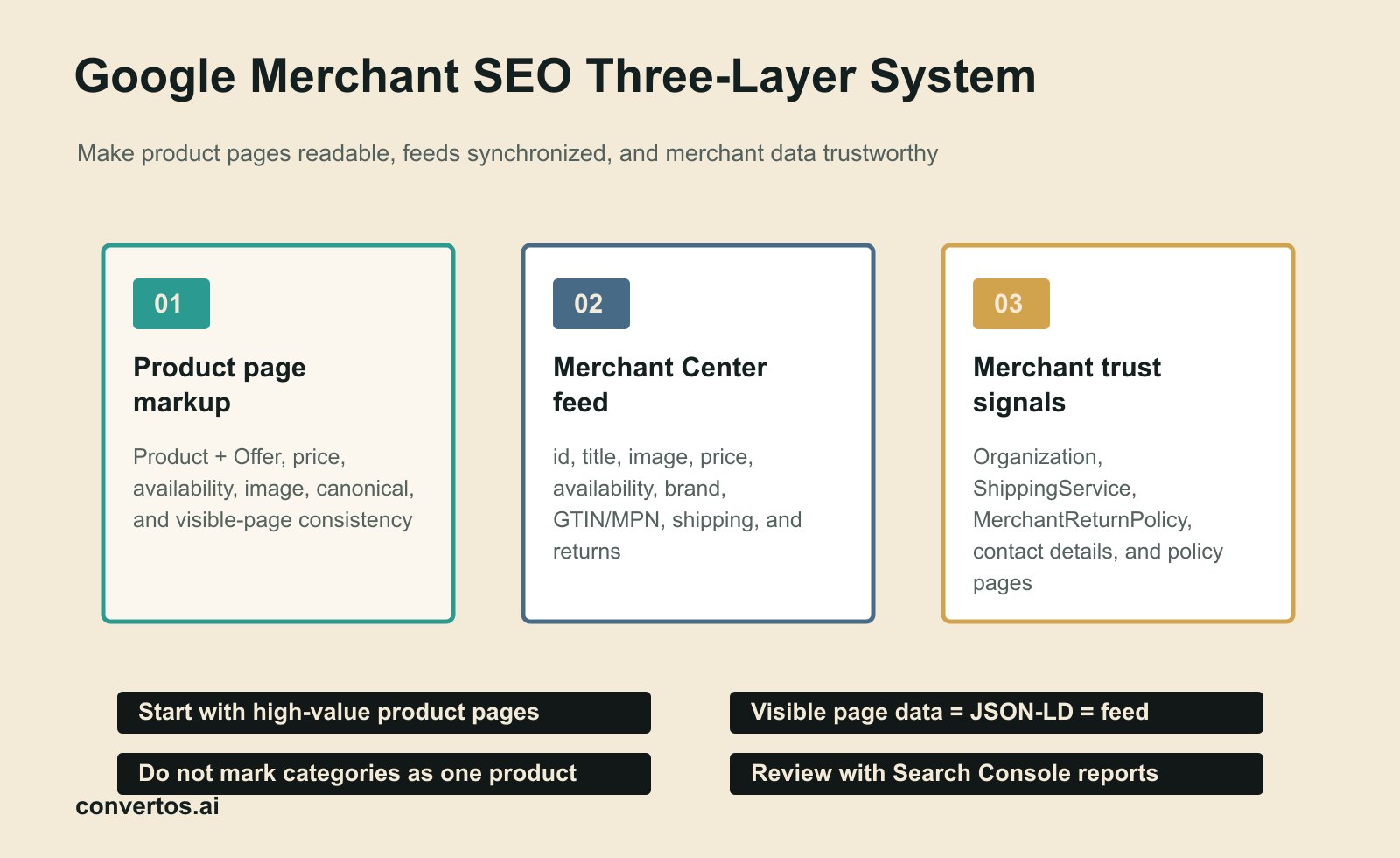
This is not only a schema task. Google Product structured data overview explains that ecommerce sites can share product data through product structured data, Merchant Center feeds, or both. Google Merchant listing structured data focuses on the \Product\ and \Offer\ markup that can make pages eligible for merchant listing experiences in Google Search, Google Images, popular product results, product snippets, and shopping knowledge panels. For large ecommerce sites, the winning pattern is a three-part system: product-page markup, Merchant Center feed hygiene, and merchant trust signals.
The Short Answer
Start with product detail pages that already have search value, stable inventory, clean images, and a working canonical URL. Add \Product + Offer\ structured data in the initial HTML, then make sure the visible page shows the same title, price, availability, image, condition, shipping, and return information. Next, keep a Merchant Center feed fresh for product identity, price, availability, image, brand, GTIN or MPN, condition, category, shipping, returns, and variants.
Do not turn category pages, search-result pages, or thin buying guides into fake single-product pages. Google’s merchant listing documentation is built around pages focused on one product or a variant set. A category page can rank and convert, but it needs a different SEO treatment: clear title, useful intro, product modules, internal links, breadcrumbs, and crawlable product links.
Page type
Merchant SEO treatment
Risk to avoid
Product detail page
Use \Product + Offer\, visible price, availability, images, shipping, returns, and canonical URL
Hidden or mismatched structured data
Variant product page
Use variant logic with \ProductGroup\, variant URLs, \item_group_id\, color, size, and availability consistency
Mixing multiple variants into one unclear offer
Category or listing page
Use category SEO, breadcrumbs, product modules, internal links, and crawlable product cards
Marking the page as one buyable product
Editorial buying guide
Use article structure and product snippets only when the content actually reviews or compares products
Pretending an article is a checkout-ready product page
Layer 1: Product Detail Page Markup
The first layer is the product page itself. Google’s merchant listing guide says merchant listings can highlight specific product data such as price, availability, shipping, and return information. That makes the product detail page the right place for \Product\ and \Offer\ markup.
At minimum, the page needs a stable product name, crawlable image, description, SKU or product ID, brand or store identity, offer URL, currency, price, availability, and item condition. For many ecommerce teams, the most important operational rule is not the schema vocabulary. It is consistency. Google structured data guidelines requires structured data to represent the main visible content of the page. If the JSON-LD says “InStock” but the page shows “sold out,” the data becomes unreliable.
For fast-changing data, put the markup in the initial HTML whenever possible. Google’s merchant listing documentation notes that dynamically generated markup can be less reliable for shopping use cases when price and availability change quickly. JavaScript can work, but ecommerce teams need to verify what Google actually receives, not only what a browser shows after hydration.
Layer 2: Merchant Center Feed And Free Listings
The second layer is the Merchant Center feed. Structured data helps Google read a page. A feed helps Google receive product data in a controlled, repeatable format. Google Merchant Center product data specification explains the product data fields Google uses to match products to relevant queries, and inaccurate or missing data can limit approval, visibility, or correctness.
The feed needs strict inclusion rules. Send products that are buyable, in stock or accurately labeled, image-compliant, canonical, and reachable without login. Remove or update products that are discontinued, blocked, soft-404, noindexed, or missing core commerce data.
Feed field
Why it matters
Page consistency check
\id\
Stable product identity
Does it map to one persistent product?
\title\
Query matching and product understanding
Does the page title match the product?
\description\
Relevance and eligibility
Is it useful and not keyword-stuffed?
\link\
Landing page verification
Is the URL canonical, indexable, and buyable?
\image_link\
Shopping surfaces and image eligibility
Is the image crawlable and high quality?
\price\
Offer accuracy
Does visible page price match the feed?
\availability\
Shopping eligibility and user trust
Does page availability match the selected variant?
\brand\, \gtin\, \mpn\
Product identity and matching
Are identifiers real and stable?
\shipping\, \return_policy\
Merchant trust and shopping details
Are policies visible and consistent?
Google Free listings for products is the organic shopping opportunity. Free listings can surface products across Google properties when product data and policy requirements are met. For marketplaces, feed governance is not optional. If seller data, stock status, image quality, or product identifiers vary widely, the feed becomes a quality-control system as much as an SEO asset.
Layer 3: Variants, Shipping, Returns, And Merchant Trust
The third layer is trust and completeness. Product pages are not only title, price, and image. Google also needs to understand variants, shipping, returns, organization details, and seller identity.
For variants, Google product variant structured data explains the use of \ProductGroup\, \variesBy\, \hasVariant\, and \productGroupID\ to group products such as size, color, material, or pattern. Feed-side variant logic usually maps to \item_group_id\ plus attributes such as color, size, gender, and age group. The key is that selected variant availability must match the landing page. Google Merchant Center availability attribute highlights the need to keep availability current, especially when price and stock change frequently.
For shipping and returns, Google merchant shipping policy structured data and Google merchant return policy structured data allow merchants to describe delivery cost, delivery time, destination, return window, return method, return fees, and refund details. These policies also need to exist as visible, user-facing pages. For merchant identity, Google Organization structured data can support brand profile and merchant knowledge panel information such as logo, contact details, address, and return policy.
Trust signal
Structured data or feed area
Human-visible requirement
Seller or store identity
Organization, OnlineStore, brand/store fields
Store name, contact path, merchant details
Shipping promise
ShippingService or feed shipping attributes
Delivery cost, destination, handling time, transit time
Return rules
MerchantReturnPolicy or feed return policy
Return window, fees, method, refund path
Product variant identity
ProductGroup, item_group_id, variant attributes
Clear selected color, size, quantity, stock
Reviews and ratings
Review or AggregateRating where valid
Real reviews only; no hidden or fabricated ratings
Rollout Priorities For Large Ecommerce Sites
Do not start with every URL. Start with products that have search demand, stable stock, clean media, and clear product identity. A marketplace with millions of product URLs needs sampling, validation, and rollback rules.
The first batch can be 100 to 500 product detail pages. Choose pages with historical clicks, stable inventory, clear title-image-price alignment, and few variant edge cases. Add markup in initial HTML, update feed mapping, validate in Rich Results Test, inspect selected URLs in Search Console, and watch Merchant listings and Product snippets reports. Then expand by category only after error rates are low.
Phase
Scope
Success measure
Pilot
100-500 high-value product URLs
No critical structured data errors; page and feed match
Variant pass
Product groups with size, color, or material variants
Correct canonical and variant availability
Feed hygiene
Products eligible for Free Listings
Low disapproval rate; fast price and stock updates
Trust pass
Shipping, returns, organization, seller pages
Policy data visible and machine-readable
Scale
Category-by-category rollout
Merchant listings report and Product snippets report improve
Product Schema, Feed, And Free Listings Compared
The three pieces are related, but they are not interchangeable. Product structured data describes the page. Merchant Center feed data supplies product information at scale. Free Listings is the organic shopping distribution opportunity that can use Merchant Center product data when eligibility and policy requirements are met. Treat them as a sequence, not as competing choices.
Option
Best fit
Not enough when
Operating owner
Product structured data
Help Google understand one product page or variant set
Price, stock, image, or policy data changes faster than Google crawls
SEO + frontend template owner
Merchant Center feed
Send product identity, price, availability, image, and policy data at scale
Landing pages do not match the feed or are not crawlable
Product data engineering
Free Listings
Make eligible products available for unpaid shopping surfaces
Product data is incomplete, disapproved, or policy-risky
Merchant Center owner
Shipping and return policy data
Build trust and expose shopping details
Policies are hidden, vague, or inconsistent by country
Commerce operations
Search Console reports
Monitor Merchant listings and Product snippets outcomes
The team needs root-cause analysis without page and feed checks
SEO analytics
No-inventory note: this guide does not recommend marking unavailable, discontinued, or non-buyable pages as in-stock products. If a product is out of stock, hidden behind login, blocked by robots rules, or no longer sold, the page and the feed need to show that state honestly.
Where This Fits In Convertos.ai SEO Work
This Merchant SEO workflow sits inside technical SEO and ecommerce growth. Use it with the broader SEO resource hub, the Chinese SEO resource hub, and the Search Console reporting guide for Google generative AI performance reports. If the team is also tracking AI search visibility, connect product-page data quality with the AI search visibility workflow, because clean product entities, visible facts, and trustworthy source pages help both classic search and AI-answer systems.
Common Failure Modes
The most common failure is marking the wrong page type. Category pages, search pages, and product collections are valuable, but they are not single offers. Use category SEO for them. Save merchant listing markup for product pages and variant pages where the buyer can inspect and buy a specific item.
The second failure is stale data. Price and availability move faster than normal SEO pages. Merchant Center automatic item updates explains that Merchant Center automatic item updates can help adjust price, sale price, availability, or condition from landing page data, but it is not a replacement for regular feed updates. Fast-changing inventory needs a feed or API process with short update cycles.
The third failure is invisible data. If the page does not visibly show price, availability, shipping, returns, or real reviews, do not hide those facts only in JSON-LD. That creates a trust problem for Google and for users. The markup needs to describe the page, not compensate for missing UX.
30-Day Implementation Plan
Use the first month to build a narrow, measurable system.
Week
Work
Output
Week 1
Audit product page templates, visible commerce fields, canonical rules, and current feed coverage
Product data gap sheet
Week 2
Add \Product + Offer\ markup to a pilot product group and validate against visible page data
Pilot markup release
Week 3
Align feed fields for price, availability, image, brand, GTIN or MPN, variants, shipping, and returns
Feed consistency pass
Week 4
Inspect URLs, review Search Console reports, fix errors, and choose the next category batch
Rollout decision log
Keep a small dashboard with product URL, markup status, feed status, price match, availability match, image status, canonical status, policy status, validation result, and next action. This turns Merchant SEO into a product-data workflow instead of a one-time SEO ticket.
FAQ
These questions come up when ecommerce SEO, engineering, and product-data teams decide where to start.
Is Merchant listing structured data enough without Merchant Center?
It can help product pages become eligible for merchant listing experiences, but large ecommerce sites usually need both page markup and a Merchant Center feed. The feed gives Google a repeatable product data source, while page markup helps verify landing-page consistency.
Source signal: Google Product structured data overview and Merchant Center product data specification.
Can category pages use Product and Offer markup?
Not as a fake single product. Category pages can use normal category SEO, breadcrumbs, product cards, internal links, and helpful copy. Product and Offer markup belongs on pages focused on a specific product or a clear variant set.
Source signal: Google merchant listing documentation and structured data guidelines.
What matters more: schema or feed?
They solve different problems. Schema describes the visible page; the feed supplies product data at scale. High-value ecommerce pages usually need both.
Source signal: Google Product structured data overview and Merchant Center feed documentation.
How often does price and availability need updating?
As fast as the business changes. If stock or price changes many times per day, use feed updates or Merchant API logic rather than waiting for normal crawling. Automatic item updates can help, but they do not replace the feed.
Source signal: Google availability attribute and automatic item updates documentation.
Source Statement
This guide is based on a June 4, 2026 review of Google Search Central and Google Merchant Center documentation, plus the attached internal note. Product eligibility, required fields, and Merchant Center policies can change, so implementation teams need to recheck official documentation before major template, feed, or policy updates.
Infographic: product page markup, Merchant Center feed, and merchant trust signals work together as Google Merchant SEO.