
Want to see whether AI answers already mention you?
Run a quick brand visibility check before you rewrite pages.
Test your brand visibility
Key Takeaways
Source-type fit means a page is not judged only by generic authority. It must be the right kind of destination for the query: a canonical reference, a local-market retailer, a transactional marketplace, an official source, a video, a comparison, a forum thread, or a product page. The May 2026 update made that mismatch more visible in several datasets.- Google confirmed the May 2026 core update started on May 21, 2026 and completed on June 2, 2026.
- Google recommends waiting at least a full week after a core update finishes before drawing Search Console conclusions, so the earliest cleaner comparison window began around June 9, 2026.
- Aleyda Solis' SISTRIX-based analysis found visibility shifts tied to intent, market fit, and source type rather than whole verticals simply winning or losing.
- The practical response is not mass rewriting. It is a query-cluster audit: what result type is Google rewarding now, and does your page truly match it?
- For GEO and AI visibility, add a second layer: whether AI answers cite, mention, or correctly describe the sources that now rank.
What Changed In The May 2026 Core Update?
The official Google record is simple: this was a broad core update affecting ranking systems, not a named penalty against one format or one site type. Google's core update guidance says broad updates are designed to improve helpful and reliable results overall, and that pages moving down are not necessarily broken. The interesting layer comes from visibility data. Aleyda Solis analyzed SISTRIX US and UK movement during the late rollout period and found a pattern she framed around intent, market fit, and source type. Search Engine Journal later summarized the same read: pages closer to the query's expected source, market, and result type tended to gain. Treat that as an early analytical lens, not a universal law. It covers specific markets, a specific tool, and a specific window. But it is useful because it turns "we lost rankings" into a better question: were we the wrong kind of answer for what the SERP became?What Source-Type Fit Means
Source-type fit is the match between user intent and the kind of source a searcher expects to land on. A high-fit page is not just relevant. It is the expected destination category for the task.| Query pattern | High-fit source type | Low-fit near match |
|---|---|---|
| Definition or language reference | Canonical dictionary, official reference, expert explainer | Thin aggregator, forum answer, utility wrapper |
| Product purchase in a country | Local-market retailer with currency, inventory, shipping, returns | Global .com page without local proof |
| Travel or job search | Category-defining transactional marketplace | Generic blog post about the category |
| Medical decision support | Clinically reviewed source with clear caveats | Tool page or thin summary without trust signals |
| Visual discovery | Image, video, or visual platform | Text-only page that cannot satisfy the format |
| Software comparison | Structured comparison with criteria, limits, and proof | Homepage or generic feature list |
The Patterns Worth Auditing
Aleyda's analysis is valuable because it separates source fit from authority alone. In her examples, canonical reference brands gained while pronunciation utilities and Q&A-style language layers fell. In UK ecommerce, local-market entities such as country-specific retail domains gained while some non-local .com marketplace pages fell. In jobs and travel, several transactional marketplaces gained, which argues against the easy claim that all aggregators lost. The pattern also matters for AI search. Google says AI Overviews and AI Mode can surface supporting links and may use query fan-out across related searches and data sources. If the classic SERP changes which sources it trusts for a cluster, AI answers may also shift the pool of links they can use for grounding, comparison, and citation. For a brand team, that means the post-update audit should cover both surfaces:- Which URLs gained or lost in classic Google Search?
- Which domains are cited or mentioned in AI answers for the same prompts?
- Are your owned pages still the right source type, or only a nearby page with decent authority?
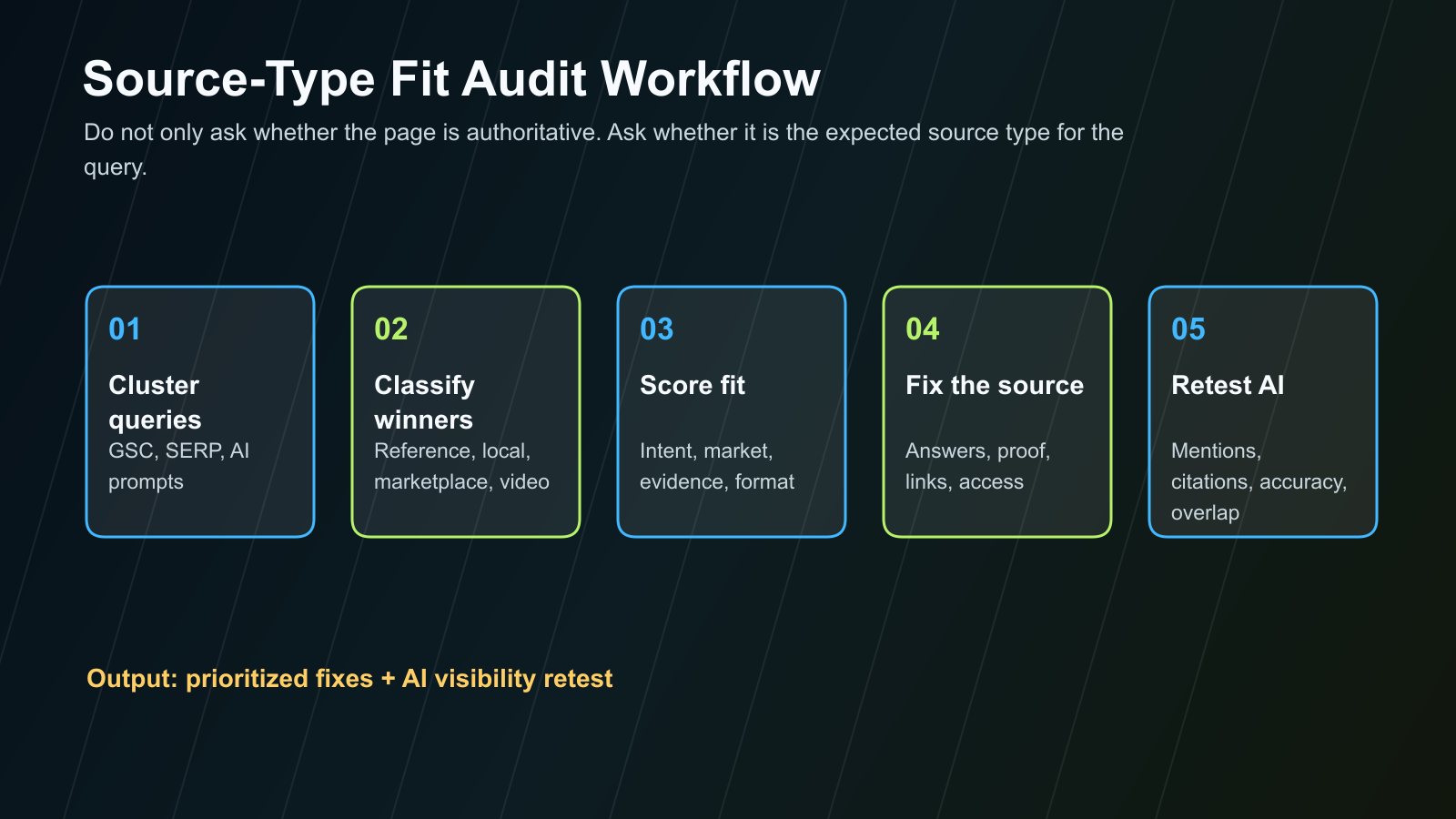
Source-Type Fit Audit Workflow
Start with your affected query clusters, not your affected URLs. A URL can lose because the SERP's preferred destination changed, even if the page itself did not become worse.| Step | Question to answer | Evidence to collect | Fix if weak |
|---|---|---|---|
| 1. Cluster the query | What job is the searcher trying to complete? | GSC queries, SERP screenshots, People Also Ask, AI prompts | Split mixed-intent pages into clearer destinations |
| 2. Identify the winning source type | What kind of page now ranks or gets cited? | Top 10 results, source domains, SERP features, AI citations | Change page format or create a better-fit page |
| 3. Check market fit | Is the winning result local, regional, regulated, or audience-specific? | Country domains, currency, shipping, legal caveats, local reviews | Build or strengthen market-specific pages |
| 4. Check answer format | Does the SERP want text, video, image, tool, list, marketplace, or official source? | SERP features, videos, images, forum modules, product grids | Add the missing format or stop forcing the wrong page |
| 5. Compare trust evidence | Why would the user and model trust this source? | Author, citations, update date, methodology, reviews, structured data | Add proof, caveats, methodology, and visible source links |
| 6. Measure AI visibility | Does ChatGPT, Perplexity, or Google AI cite or mention the same source set? | Prompt runs, citations, answer wording, competitor mentions | Create answer-ready sections and source pages |
Before you rebuild the page, check whether AI answers see the brand.
Test your brand visibility
The Source-Type Fit Scorecard
Use a 0 to 2 score for each row. A cluster scoring under 8 needs a content or format decision before you spend time on polish.| Dimension | 0 points | 1 point | 2 points |
|---|---|---|---|
| Intent match | Page answers a nearby topic | Page answers the topic but misses the main task | Page directly completes the searcher's task |
| Destination type | Wrong page type | Correct topic, weak format | Expected page type for the SERP |
| Market fit | Wrong country, audience, or policy context | Some local signals | Clear local/audience proof |
| Evidence depth | Claims without proof | Some proof or links | Specific data, sources, caveats, authorship |
| AI answer readiness | Hard to extract or cite | Some answer blocks | Clear definitions, tables, FAQ, source links |
| Technical access | Indexing or crawler ambiguity | Mostly accessible | Indexable, crawlable, canonical, fast |
What To Fix By Page Type
Do not apply the same rewrite to every loser. The fix should follow the mismatch.| If the winner is now... | Your likely mismatch | Better fix |
|---|---|---|
| A canonical reference | You are a secondary summary | Add original methodology, citations, and named expertise, or target narrower questions |
| A local-market entity | Your page lacks country proof | Create local pages with currency, availability, shipping, support, and local reviews |
| A marketplace | Your page is informational when the task is transactional | Build comparison, inventory, filters, or decision tools |
| A video or visual result | Your content is text-only | Add a real video, visual walkthrough, or image set with transcript |
| An official source | Your page is commentary | Link to primary sources, narrow the angle, and add operational interpretation |
| A comparison page | Your homepage is ranking for decision queries | Publish a criteria-led comparison or alternatives page |
Measurement Plan
Google's own advice starts with Search Console timing: confirm the rollout is complete, wait at least a full week, then compare the right date ranges. For this update, that means treating June 2, 2026 as the completion date and making the first cleaner comparison after June 9.| Metric | Source | Cadence | Why it matters |
|---|---|---|---|
| Query/page click change | Google Search Console | Weekly during the first month | Shows whether the affected cluster is stabilizing |
| Average position movement | Google Search Console | Weekly | Separates small movement from severe drops |
| SERP source-type mix | Manual SERP/DataForSEO/SISTRIX | Weekly for priority clusters | Shows whether the expected result type changed |
| Market mismatch rate | SERP and analytics by country | Weekly or monthly | Catches wrong-market ranking and localization gaps |
| AI mention rate | ChatGPT, Perplexity, Google AI prompt set | Weekly or monthly | Measures whether the brand appears in answer surfaces |
| AI citation rate | Prompt capture and citation extraction | Weekly or monthly | Shows whether owned or trusted pages are used as sources |
| Fix completion rate | Content/technical queue | Weekly | Prevents audits from becoming static reports |