Learn how to improve ChatGPT brand visibility with entity clarity, source pages, citations, crawler checks, prompt testing, and a practical GEO scorecard.
Cover image and workflow summary for How to Optimize Content for ChatGPT Brand Visibility.English voiceover video: How to Optimize Content for ChatGPT Brand Visibility.
ChatGPT brand visibility is the degree to which ChatGPT can find, understand, mention, cite, and describe your brand when users ask category, comparison, problem, or buying questions. Optimizing for it is not about forcing a brand name into every paragraph. It is about giving ChatGPT reliable source pages, clear entity facts, and repeatable evidence it can use safely.
OpenAI's public materials make the direction clear. ChatGPT Search can use web results and source links. OpenAI's publisher and developer FAQ explains that publishers can be surfaced in ChatGPT search experiences, while OpenAI's bot documentation separates crawlers such as GPTBot, OAI-SearchBot, and ChatGPT-User. Those systems do not give marketers a magic ranking formula, but they do define the access layer that every serious ChatGPT visibility program should check.
Quick Answer
To improve ChatGPT brand visibility, make your brand entity unambiguous, publish source pages that answer real buyer prompts, allow the right OpenAI crawlers where inclusion is desired, earn third-party mentions from trusted pages, and retest a stable prompt set. Track four outcomes together: whether ChatGPT mentions the brand, whether it cites useful URLs, whether the wording is accurate, and whether competitors are being preferred for prompts where your brand should be eligible.
This is a GEO workflow, not a copywriting trick. A page can rank in Google and still be weak for ChatGPT if the brand facts are scattered, claims are unsupported, or comparison answers are too vague to reuse.
If you need a baseline before editing, start with a measured AI visibility check and then use the AI search visibility tool guide to decide which prompts, citations, and competitor mentions are worth tracking.
What ChatGPT Brand Visibility Means
ChatGPT brand visibility has four parts: presence, citation, wording, and competitive position. Presence means the brand appears in an answer. Citation means a page or third-party source is linked or used as evidence. Wording means the description is accurate. Competitive position means the brand is included, excluded, recommended, or framed against alternatives.
Layer
What to check
Healthy signal
Warning signal
Presence
Does ChatGPT mention the brand for relevant category prompts?
The brand appears in natural shortlist, comparison, and problem prompts
Competitors appear while your brand is absent
Citation
Are your owned or trusted third-party pages used as sources?
Product, docs, case study, comparison, or review pages are cited
Only competitors, directories, or outdated pages are cited
Wording
Is the description current and specific?
ChatGPT names the product category, audience, strengths, and limits accurately
The answer invents features, misses core use cases, or uses old positioning
Position
How is the brand framed against alternatives?
The brand is recommended for the right fit and caveats are fair
A competitor owns the category narrative or your brand is framed as generic
How ChatGPT Finds Source Signals
Do not overclaim what any AI system does internally. The practical public facts are enough for a good workflow. OpenAI documents different bots for different jobs, and it gives publishers guidance on crawler access. If a site blocks important crawler traffic unintentionally, the best content in the world can become harder to discover or refresh.
OpenAI's launch note for ChatGPT Search also reinforces why source pages matter: the search experience can connect answers with timely web information and source links. That makes source quality, access, and freshness operational checks, not just editorial polish.
Use this access checklist before rewriting content:
Check
Why it matters
What to do
GPTBot policy
GPTBot is associated with improving OpenAI models and may be controlled separately
Decide whether model-training access fits your policy and privacy requirements
OAI-SearchBot policy
OAI-SearchBot is the key crawler to review for ChatGPT search inclusion scenarios
Make sure important public source pages are not blocked if you want inclusion
ChatGPT-User handling
ChatGPT-User can appear when a user asks ChatGPT to retrieve a page
Do not confuse user-triggered retrieval with general crawling
CDN and WAF rules
Bot rules can block official crawlers even when robots.txt allows them
Review logs for denied OpenAI user agents and important source URLs
The goal is not to allow every crawler everywhere. The goal is intentional access. Public marketing, product, docs, case study, and comparison pages usually need a different policy from private, gated, account, or experimental pages.
When the policy is unclear, compare the page against OpenAI's publisher FAQ and the official OpenAI bot documentation. If the page is public, useful, and safe to cite, make sure technical rules do not contradict the content goal.
Build Pages ChatGPT Can Reuse
ChatGPT-visible content needs to answer the exact questions users ask. A vague homepage is rarely enough. Build a small source system instead.
For broader planning, pair this page system with the AI visibility tools buyer checklist. The checklist helps decide whether your team can test prompts manually, needs a monitoring workflow, or should centralize reporting across ChatGPT, Perplexity, and other AI answer surfaces.
Page type
Job for ChatGPT visibility
What to include
Homepage
Establish the brand entity
What the product is, who it is for, core category, main outcome, and proof
About page
Resolve identity and authority
Company name, team or author signals, location if relevant, public contact, editorial stance
Product page
Describe capability and limits
Features, supported platforms, use cases, pricing or access caveats, integrations
Comparison page
Help answers choose fairly
Selection criteria, fit by scenario, limits, alternatives, and dated caveats
Case study
Provide evidence
Problem, baseline, action, result, screenshots or workflow proof, and limits
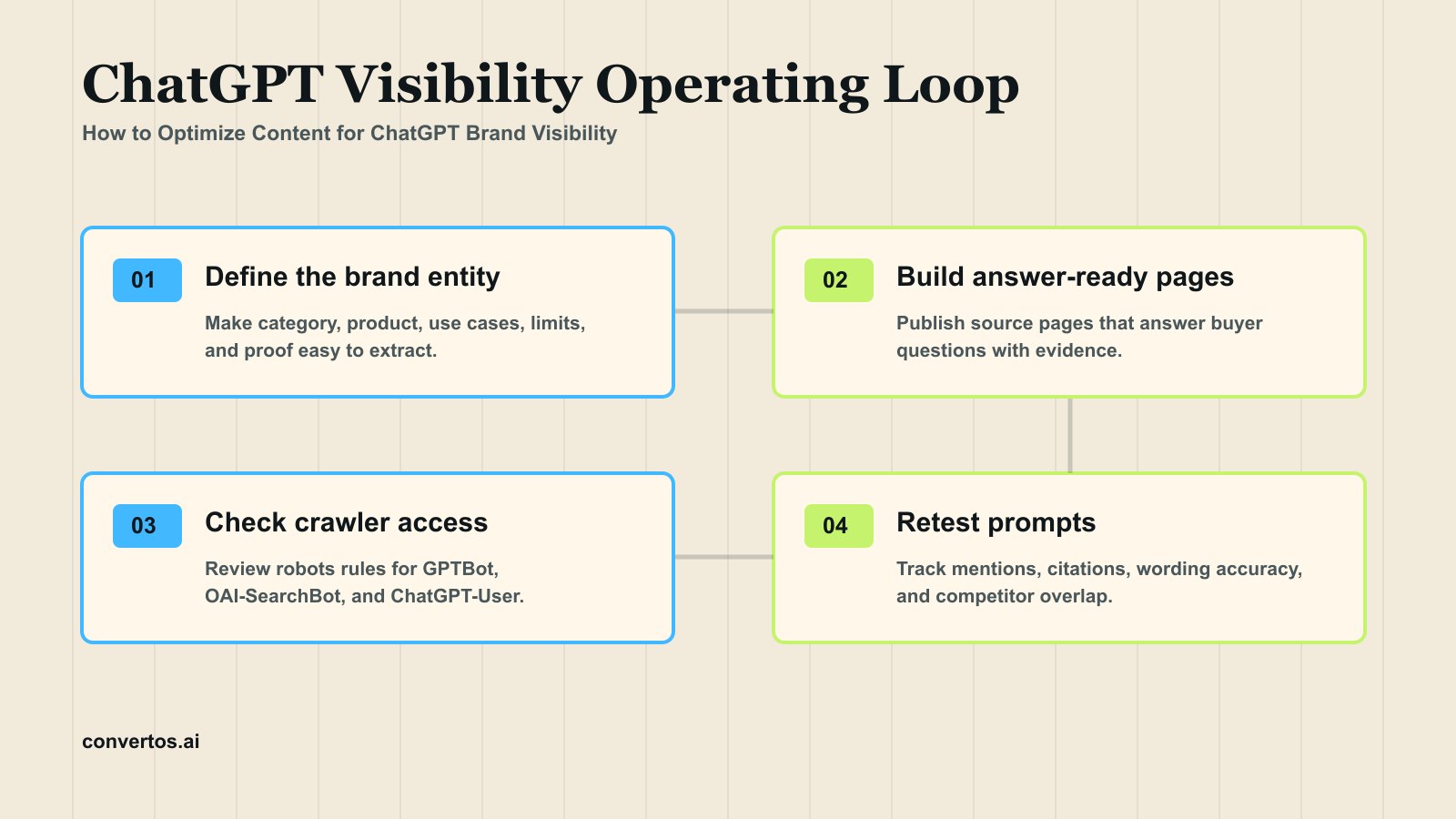
Define the prompt set. Include category prompts, problem prompts, comparison prompts, branded prompts, and competitor prompts.
Run the baseline. Save the answer, date, location if relevant, model surface, brand mentions, cited URLs, and competitor mentions.
Map the missing evidence. For each weak prompt, ask which source page ChatGPT should have been able to use.
Improve the source page. Add a direct answer, proof, dated caveats, comparison criteria, and internal links.
Check crawler access. Review robots.txt, server logs, CDN/WAF rules, canonical tags, and indexability.
Earn third-party validation. Review sites, analyst pages, directories, partner pages, and community discussions can all shape the wider evidence graph.
Rerun the prompt set. Compare mention rate, citation rate, wording accuracy, and competitor overlap.
Infographic: the core workflow behind How to Optimize Content for ChatGPT Brand Visibility.
Scorecard
Use a simple scorecard before and after content changes.
Metric
How to score
Good next action
Mention rate
Brand appears in relevant answers divided by tracked prompts
Expand prompt groups only after the core set is stable
Citation rate
Answers cite owned or trusted third-party pages
Strengthen pages that should be cited but are missing
Wording accuracy
Important product facts are correct
Rewrite source pages and public profiles with clearer facts
Competitor overlap
Competitors appear where you do not
Build comparison and alternative pages with real criteria
Source diversity
Mix of owned pages, reviews, docs, and trusted mentions
Reduce dependence on one thin page or one directory
Action completion
Fixes shipped and retested
Turn reports into content, technical, or PR tickets
Common Mistakes
Mistake
Why it hurts
Better approach
Treating ChatGPT visibility as keyword stuffing
Repetition does not create trust or evidence
Build clear source pages with answers, proof, and caveats
Blocking the wrong crawlers by accident
Important source pages may not be retrieved or refreshed
Review official OpenAI bot guidance and server logs
Publishing only broad thought leadership
AI answers need concrete facts, comparisons, and limits
Add buyer questions, tables, examples, and evidence
Ignoring third-party sources
AI systems often use external validation
Improve review profiles, directories, partner pages, and public mentions
Tracking only one prompt
AI visibility is prompt-cluster based
Monitor category, problem, comparison, branded, and competitor prompts
How do I optimize my content for ChatGPT brand visibility?
To optimize content for ChatGPT brand visibility, start with one real buyer prompt, then make the target page explicit about the brand entity, use case, proof, limitations, and next step. Do not only add the brand name. Give ChatGPT reusable source material: a clear answer block, a comparison or use-case table, supporting citations, and a page-level action the reader can take.
For ongoing measurement, pair this workflow with the AI brand visibility dashboard to watch ChatGPT and Perplexity visibility trends, and use the Perplexity rank tracker when the same topic also appears in Perplexity answers. The practical success metric is not one ranking number; it is whether brand mentions, citations, answer accuracy, and competitor replacement improve after publishing.
FAQ
How do I get ChatGPT to mention my brand?
Start by making your brand easy to identify and verify. Publish clear source pages, allow appropriate crawler access, earn credible third-party mentions, and retest the prompts where your buyers compare options.
Source signal: recurring prompt-cluster questions around "how do I get ChatGPT to mention my brand" and GEO workflow checks for brand/entity clarity.
Does OpenAI guarantee that crawler access will improve visibility?
No. Crawler access is only an eligibility and retrieval condition. The content still needs to be useful, current, credible, and relevant to the user's prompt.
Source signal: OpenAI public bot guidance and publisher FAQ language separate access control from answer selection or ranking guarantees.
Should I allow GPTBot, OAI-SearchBot, and ChatGPT-User?
Decide by page type and policy. Public product, docs, educational, and comparison pages may benefit from intentional access, while private, gated, or sensitive pages should be protected.
Source signal: OpenAI bot documentation distinguishes GPTBot, OAI-SearchBot, and ChatGPT-User, which is why this FAQ belongs in the article.
How often should I retest ChatGPT visibility?
For active categories, weekly or monthly retesting is enough for most teams. Use the same prompt set and log the answer, citations, and wording so changes are comparable.
Source signal: prompt-cluster reporting patterns from existing AI visibility workflows; retesting cadence is a measurement recommendation, not an OpenAI guarantee.
Source Statement
This article was prepared on June 14, 2026 using OpenAI public documentation, existing SERP research in this project, competitor page patterns, and Convertos.ai's GEO workflow. Platform behavior can change, so crawler names, access policy, and ChatGPT Search behavior should be rechecked against OpenAI's official documentation before major policy changes.