
In September 2025, a multilingual SEO project changed its page-title and meta-description templates. Two groups of French-language pages later recorded average organic click-through rate (CTR) increases of approximately 16% and 7%, while two reference groups declined.
Those numbers might seem to justify rolling the new templates out across every language. The full sequence gives a more complicated picture. Several groups rose together early on; the French groups diverged later in October, and other languages did not produce consistent results. To decide whether the changes deserved wider use, I looked at the implementation, the timing and the weekly data together.
Why start with titles and descriptions to improve organic CTR?
The work focused on titles, descriptions and CTR. I read that as a test of a straightforward hypothesis: if pages already receive search impressions, could wording that better reflects what people want turn more of those impressions into clicks?
Product listing pages often use templates to generate titles and descriptions at scale. A title identifies what is on offer; a description can add the product range, specifications or information that helps someone choose. Because one rule can affect many pages, a specific wording change is worth testing on a subset before extending it further.
On September 17, two target groups in each of the French and Italian language versions received title and description template changes. Product listing pages were among those groups. CTR was then tracked over time. Both elements changed together, so any subsequent improvement could only be assessed against the combined change, rather than attributed to the title alone.
A real English-language test: adding one word to a listing-page title
A separate ecommerce test published by SearchPilot in 2024 makes the wording change concrete. Its team hypothesized that shoppers might search for products using phrases containing “best.” Adding that word could better address their buying intent and encourage clicks. The test added it at the beginning of title tags for the product listing pages in the test group. SearchPilot case study
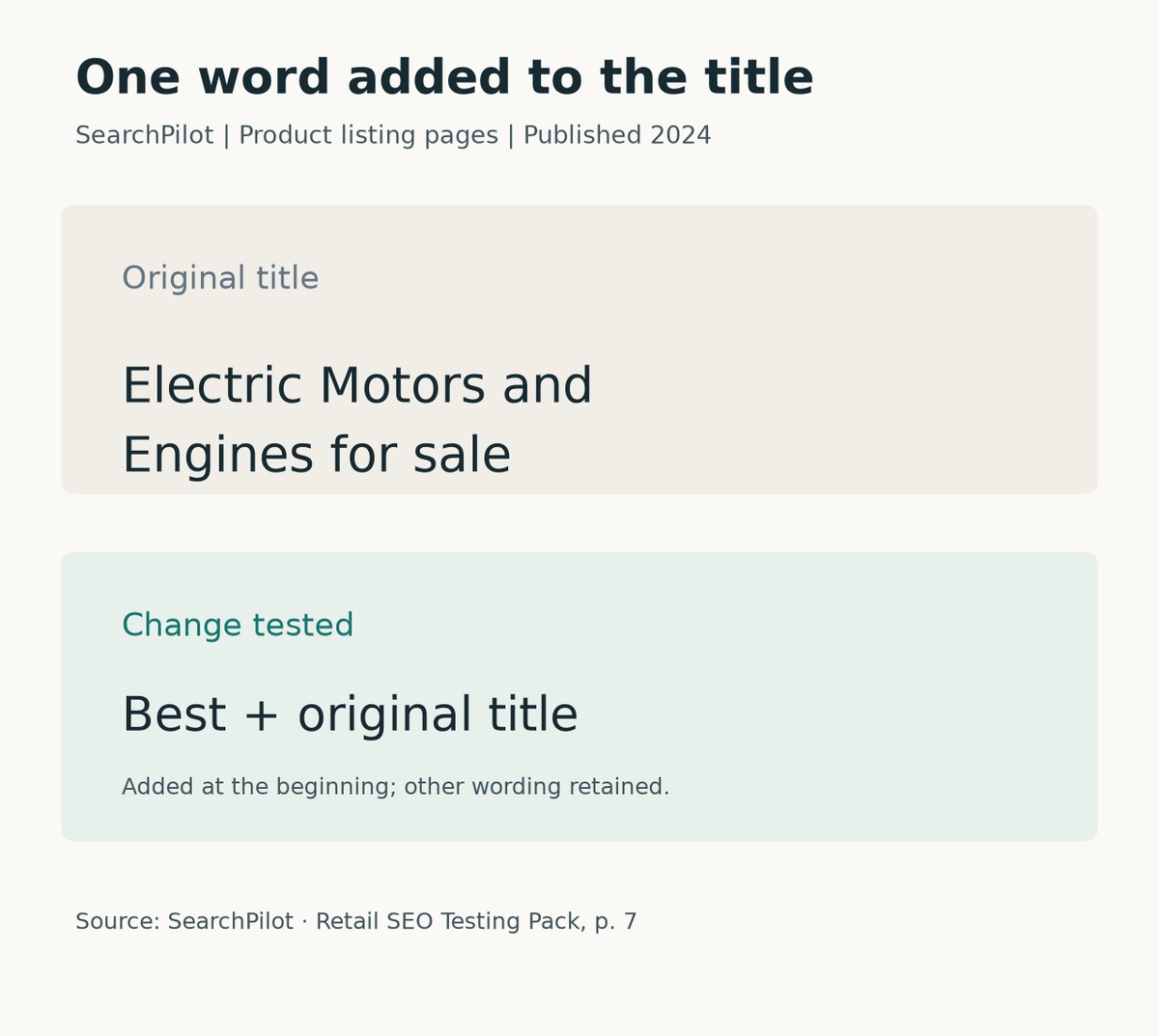
The product category and sales wording remained in place. SearchPilot reported an estimated 11% increase in organic sessions, with a positive result at the 95% confidence level. That is a measure of visits from organic search; it should not be read as an 11% increase in CTR. Test result and measurement
What I find useful here is how easy the change is to inspect. The reason for choosing the word, its position and the difference between versions are all clear. For a multilingual project, the transferable approach is to build a hypothesis around searchers' language and test it locally. This result alone would not justify adding “best” to every title.
That English-language experiment is independent of the 2025 project. The following implementation record and CTR data concern the multilingual project.
What happened between editing the templates and checking the live pages?
The four page groups below are labeled List A, B, C and D. A and D received the changes; B and C served as reference groups. These labels distinguish the groups, which originally represented different page types.
| Stage | Work carried out | What was checked |
|---|---|---|
| September 17 | Changed title and description templates for the French and Italian target pages | Recorded the change date and continued tracking CTR |
| September–October | Tracked Lists A and D alongside reference Lists B and C | Compared shared movements and when the groups began to diverge |
| Mid-October | Recorded template application rates | French Lists A and D were recorded at 50% and 60%, respectively |
| Late October–November | Extended the template work to more languages, uploading and checking it in stages | Checked logs, live page text and template-variable substitutions |
The method behind the recorded “application rate” was not fully specified. It should not be treated as the proportion of new titles or descriptions adopted by Google.
During the November rollout to more languages, template errors prevented some uploads. Subsequent work included staged uploads, log checks and verification that the live pages displayed the new wording and substituted template variables correctly. Writing the copy was one step; confirming that it appeared on the intended pages was another.
Later work also shortened English listing-page body text and checked translations of keyword roots, aiming for clearer phrasing and more accurate translations. Those changes came later and cannot explain the CTR movement already observed in October.
Early increases also appeared on other pages
By September 27, the French target groups had not shown a clear increase in CTR. Italian pages had improved more noticeably, but their reference groups were rising too. Several groups were still moving upward together in early October.
At that point, the case for the new templates was weak. Other pages were improving as well, suggesting shared influences across the groups. More observation was needed to see whether the changed pages would follow a different path.
The chart below sets each French group's own pre-change average CTR to 100 so their weekly movements can be compared.

The trend was uneven. All four groups fell during October 7–13. Lists A and D then recovered, while B and C did not show the same recovery. Looking only at the last two weeks would miss that shared dip.
By late October, the changed and reference pages had diverged
Comparing September 2–15 with October 14–27, average CTR increased for French Lists A and D and fell for Lists B and C.

| French page group | Pre-change average CTR | Observation-period average CTR | Approximate relative change |
|---|---|---|---|
| List A, changed | 1.40% | 1.61% | +16% |
| List B, reference | 14.27% | 12.57% | −12% |
| List C, reference | 8.45% | 7.91% | −6% |
| List D, changed | 0.75% | 0.80% | +7% |
For each comparison period, the table uses the simple average of its two weekly mean CTR values, rather than total clicks divided by total impressions for the fortnight. CTR values and relative changes were rounded separately. The approximately 16% rise is a relative increase, not an increase of 16 percentage points.
With the changed groups rising and the reference groups falling, a general upward movement across all groups no longer explained the whole pattern. Follow-up tracking through December continued to show an overall upward CTR trend for the French target pages. That gave the French templates a reason to remain under evaluation.
The differences between groups still matter. Before the change, List A's CTR was about 1.40%, compared with 14.27% for List B. Groups with such different baselines can help reveal shared movements without necessarily providing a sound estimate of incremental impact. The available evidence did not establish random assignment or show that query mix, rankings and pre-change trends were sufficiently similar. Subtracting a 12% fall from a 16% rise and calling it a “28% improvement from the templates” would overstate the result.
Keep testing the French version; assess other languages separately
In Italian, both the changed and reference pages rose. The later Spanish result remained unclear, alongside a broader CTR decline. Several German page types rose together, making the effect of the template changes difficult to separate there too.
For the next test, I would choose pages with similar pre-change performance within the same language and page type, and set aside reference pages in advance. Random assignment, where practical, plus saved before-and-after copy and actual implementation dates would make the comparison more informative. The question would be whether pages with the new templates performed better under otherwise reasonably similar conditions.
After implementation, check both the text output by the page and what appears in search. Google draws title links from several sources, and updates require recrawling and processing. Search snippets can also come from page content. Saving new text in the CMS therefore does not establish that searchers have seen it. Google's title-link guidance and snippet guidance
I would also compile a continuous record of clicks, impressions, CTR and position for the same pages and queries. A sustained CTR improvement is more informative when query mix and rankings are relatively stable. If impressions shift toward different queries or ranking positions, those changes need to be considered too. Search Console defines CTR as clicks divided by impressions; comparisons should use consistent page, query and device filters. Search Console Performance report
The decision supported by this review is to keep evaluating the French templates and test other languages separately. Continuous click and business-outcome data would help decide whether to expand their use. The title-template review log can record the next round of changes, and the weekly chart data is available for checking the comparisons above.