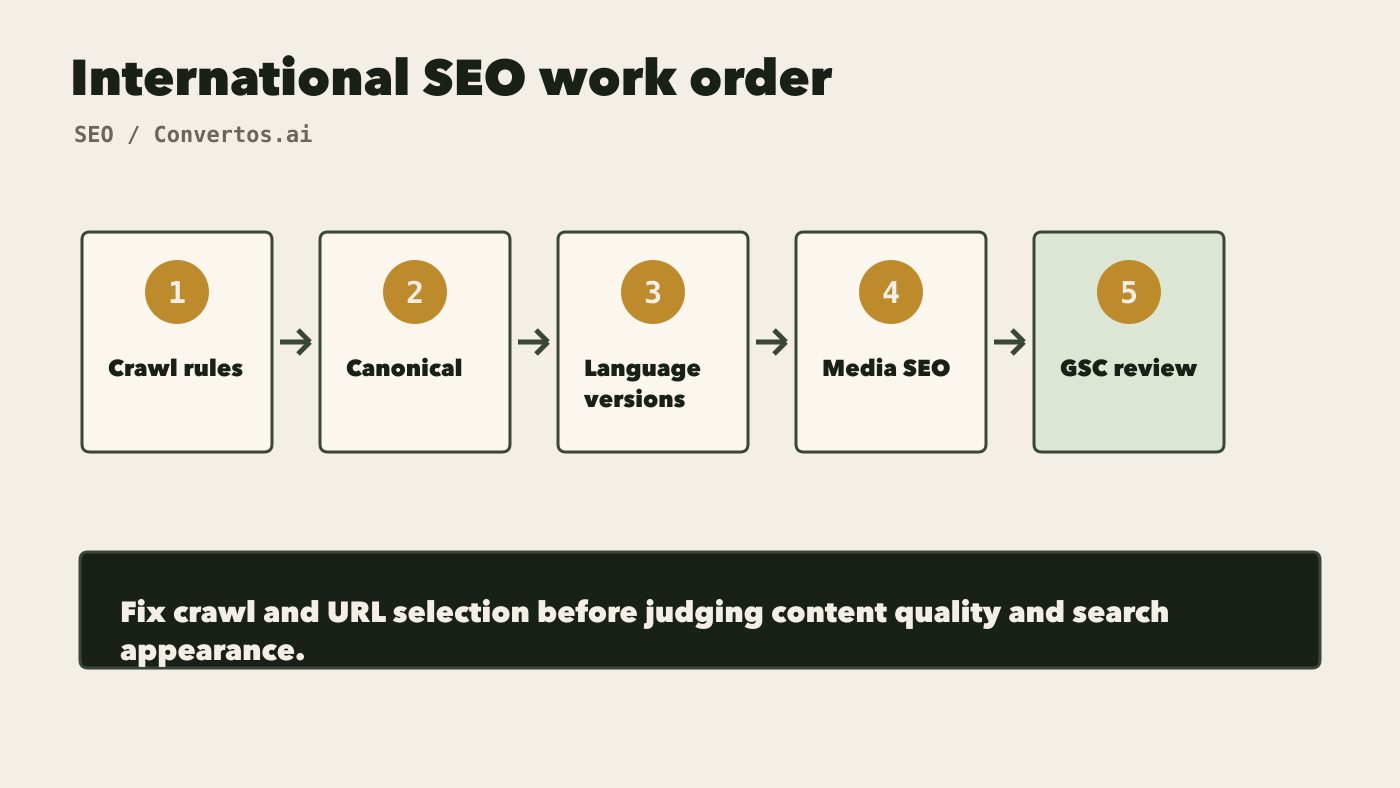
An international SEO checklist should start with market selection, crawl access, URL structure, canonical signals, language or region targeting, localized content, media SEO, structured data, and measurement. Search Central Live Shanghai 2026 is useful because its resource pack connects those foundations with Search Console, Google Trends, Google Analytics, and AI search guidance. For global sites, the order matters: fix access and URL selection before judging content quality or AI visibility.
40-second explainer: an international SEO audit should move from crawl and URL selection to localization, media, and reporting.International SEO work order: fix crawl and URL selection before judging content performance.
Key Takeaways
International SEO is not translation at scale. It is a system for choosing markets, serving the right URL, matching local intent, and measuring each language or region separately.
Start with crawl rules and indexability before content expansion.
Use canonical and hreflang together carefully; they solve different problems.
Localize intent, examples, offers, and vocabulary, not only the words.
Use images, video, and structured data only when they match visible content.
Report by country, language, page type, and query group.
The most useful checklist is ordered. A team should be able to run it before a launch, after a migration, or during a traffic drop without debating where to start.
What the SERP Expects From an International SEO Checklist
Current search results for "international SEO checklist" are dominated by step-by-step guides. Lokalise, Ahrefs, Semrush, Weglot, TransPerfect, and other competitors commonly cover market research, local keyword research, URL structure, hreflang, localization, technical setup, and reporting.
The gap is prioritization. Many checklists include the right tasks, but they read like long lists. A working team needs an order of operations. If a page is blocked or canonicalized incorrectly, local keyword research will not fix the problem. If a language version targets the wrong intent, structured data will not make the page useful.
SERP table stake
Why it matters
What this article adds
Market selection
Prevents launching pages where demand is weak
Connect demand, competition, and existing analytics
URL structure
Shapes crawl and reporting
Treat structure as a scaling decision, not a cosmetic URL choice
Hreflang and canonical
Helps Google choose the right version
Explain how they work together without merging language pages
Localization
Matches real search behavior
Separate translation from local intent
Reporting
Finds page-group problems
Use GSC, Trends, and analytics together
Step 1: Choose Markets Before Building Pages
Market choice comes before page creation. A global SEO project should not start by translating every page. It should start by asking which markets have demand, which markets already show early traction, which competitors are visible, and whether the business can serve those users.
Google Trends can show whether demand exists across countries. Google Analytics can show where current users already come from. Search Console can show existing impressions by country and query. Competitor tools can show which markets competing domains invest in. The point is not to find the biggest country; it is to find the market where search demand, business fit, and operational readiness overlap.
For a SaaS site, the right first market might be a smaller English-speaking or multilingual market where conversion is realistic. For ecommerce, logistics, currency, returns, and local trust signals can matter as much as search volume.
Step 2: Make Important Pages Crawlable
Crawl access is the first technical gate. A page cannot perform in international SEO if Google cannot fetch it, render it, or understand its main content. Start with robots.txt, status codes, redirects, noindex, and whether internal links expose the right pages.
Google's robots.txt documentation is the baseline source for access rules. The crawl budget documentation is most useful for large sites, faceted ecommerce, and sites with many duplicate or low-value URLs. Small sites often do not have a crawl budget crisis; they have a clarity problem.
Use a sample set for every market: homepage, category, product or service page, pricing page, blog article, and support or documentation page. Check whether each page returns the expected status, is internally linked, and appears in the sitemap when appropriate.
If the sample fails, pause expansion. Fixing ten blocked or mislinked templates usually beats publishing one hundred localized pages on top of the same crawl problem.
Step 3: Use Canonical and Hreflang Correctly
Canonical and hreflang solve different problems. Canonical helps Google understand the preferred URL among duplicates or near-duplicates. Hreflang helps Google show the right language or regional version to the right user. They should support each other, not fight each other.
Google's canonicalization documentation explains that canonical is a signal, not an absolute command. Internal links, redirects, sitemap URLs, and content similarity all matter. Google's multi-regional and multilingual site guide explains how to manage language and region variants.
A common mistake is pointing all localized pages back to one English canonical. That tells Google the localized page may not be the preferred version. Another mistake is adding hreflang while page content remains mostly duplicated, untranslated, or not adapted to local intent.
Situation
Better approach
Why
English and Chinese pages are separate versions
Each page self-canonicalizes and hreflang points across versions
Keeps both versions eligible
Country pages share boilerplate
Add local examples, offers, currency, and proof
Reduces thin duplication
URL parameters create duplicates
Canonical to the clean preferred URL
Keeps signals consolidated
Old market pages redirect
Update hreflang and internal links after redirect
Avoids pointing users and bots to dead variants
For Convertos.ai routing, English pages use no /en/ prefix, while Chinese pages use /zh/. That rule should stay consistent in canonical URLs, internal links, sitemap entries, and any hreflang implementation.
Step 4: Localize Search Intent, Not Only Language
Localization is not a word-for-word translation job. It is the work of matching local search behavior, examples, proof, pricing, formats, and risk signals. The SERP research for international SEO repeatedly shows local keyword research, market behavior, and cultural fit as table stakes.
If the English page targets "AI search visibility software," the Chinese page may need to explain GEO, AI 搜索可见性, LLM 监测, or Google AI Overviews differently. The same product can map to different query language, different objections, and different proof expectations.
Use this localization check:
Does the page answer the local user's query, not only the translated English query?
Are examples, screenshots, currency, units, and legal or logistics notes localized?
Does the page link to the right local support or sales path?
Does Search Console show the language page receiving the intended queries?
Does the content still make sense if read without the original English page?
Step 5: Use Media and Structured Data Only When They Match the Page
Images, video, and structured data can improve search appearance, but only when they support the visible page. Google's image SEO documentation focuses on context, filenames, alt text, and page relevance. Google's video SEO documentation requires videos to be visible and described. Google's Search Gallery shows which rich result types have requirements.
For international pages, media needs a language check. English screenshots, English video captions, and English schema descriptions should not appear unchanged on a Chinese page. The same rule applies the other way around. If the media is part of the content promise, the localized page needs localized media or a clear reason for using the original.
Element
Check
Better standard
Image
Does the filename and alt describe the visible subject?
Use language-specific alt text and compressed files
Video
Is the video visible and summarized in text?
Add transcript or a short text summary in the page language
Schema
Does structured data match visible content?
Use Article, FAQ, Breadcrumb, or VideoObject only when truthful
Table
Is it extractable and useful on mobile?
Keep columns simple and interpret the table after it
Step 6: Report by Page Group
International SEO reporting should separate markets and page types. A single sitewide traffic chart hides too much. Search Console can show queries, countries, pages, impressions, clicks, CTR, and position. Google Trends can help interpret demand changes. Google Analytics can show whether visitors take meaningful action after the click.
A useful weekly or monthly report answers five questions:
Which country or language page group changed?
Did impressions, clicks, CTR, or average position move first?
Did the SERP or demand change, or did the site change?
Are canonical, hreflang, noindex, or redirects involved?
Which content or technical fix should happen next?
Google's search traffic drops guide is a good reference for separating technical issues, seasonality, algorithm updates, and demand shifts.
For AI search reporting, keep the same page groups. If a language cluster loses clicks while impressions stay stable, sample AI answers for those queries before assuming the content itself got worse.
FAQ
What is international SEO?
International SEO is the work of helping search engines show the right language or regional version of a site to the right user. Source signal: related searches and competitor checklist headings.
Should I use subdirectories, subdomains, or country-code domains?
Each can work, but subdirectories are often easier to manage for many SaaS and content sites. Source signal: competitor SERP pages on URL structure. The best choice depends on brand, localization depth, engineering resources, and reporting needs.
Can canonical and hreflang be used together?
Yes, but they must point to a coherent set of URLs. Source signal: hreflang/canonical SERP and Google canonical documentation. Do not canonicalize all local pages to one global page if you want those local pages indexed.
Is translation enough for international SEO?
No. Source signal: recurring SERP sections on local keyword research and localization. You need local intent, examples, trust signals, and market-specific language.
How often should international SEO be audited?
Check technical signals monthly and after migrations, redesigns, URL changes, or new market launches. Source signal: checklist SERP patterns. Content and query fit should be reviewed quarterly or when Search Console trends change.
Source Statement
This article uses Google Search Central documentation, the Search Central Live Shanghai 2026 resource pack, current SERP research, and public international SEO guides. International SEO details vary by market, CMS, URL structure, and business model. Use this checklist as a workflow, then validate with your own Search Console, analytics, crawl, and log data.