
Key Takeaways
Quick answer: The May 2026 core update is official; a direct MUVERA-to-ranking-update claim is not. Use MUVERA as a practical model for semantic SEO: cover the user's full task, reduce redundant content, make facts traceable, and strengthen page-level evidence. That work helps both classic SEO and GEO without depending on a private algorithm story.- Google Search Status Dashboard says the May 2026 core update ran from May 21 to June 2, 2026. Google's own recovery advice is to wait at least a full week after completion before judging Search Console data.
- Google Research published MUVERA on June 25, 2025 as a way to make multi-vector retrieval faster by using fixed dimensional encodings and MIPS-style retrieval.
- Google has not publicly said that the May 2026 core update used MUVERA, or that MUVERA is a named SEO ranking factor.
- The SEO lesson is still real: pages that answer only one keyword phrase but miss the user's full decision path are weaker in semantic retrieval and AI answer contexts.
- Convertos' practical heuristic for this topic is:
ContentValue = (Uniqueness x Depth x Intent Match) / Redundancy. Treat it as an editorial audit model, not a Google formula.
What Is Confirmed, and What Is Speculation?
The confirmed facts are narrow: Google completed a May 2026 core update, and Google Research has published MUVERA as a multi-vector retrieval method. The speculative part is connecting those two into a public ranking claim. A strong SEO article should keep those layers separate.| Claim | Evidence level | What the source says | SEO implication | Caveat |
|---|---|---|---|---|
| May 2026 core update happened | Official | The Google Search Status Dashboard lists the event from May 21, 2026 to June 2, 2026. | Set the analysis window. | It does not name MUVERA. |
| Core update analysis needs patience | Official | Google's core updates documentation recommends waiting at least a full week after completion and comparing the right date ranges. | Avoid panic edits after one or two bad days. | Search Console data must be segmented by page, query, and search type. |
| MUVERA is real research | Primary / Google Research | Google's MUVERA blog describes fixed dimensional encodings that reduce multi-vector retrieval to a faster single-vector search problem. | Understand modern retrieval constraints. | Research publication does not equal live ranking disclosure. |
| MUVERA improves retrieval efficiency in tests | Primary / research paper | The Google Research publication page says FDEs can retrieve 2-5x fewer candidates at the same recall as prior heuristics. | Explain why multi-vector methods can become more practical. | Dataset results should not be translated into SEO guarantees. |
| "Keyword era is over" | Industry interpretation | Many SEO posts use this phrase when discussing AI and vector retrieval. | It is a useful warning against keyword-only pages. | Keywords still help define demand, titles, internal links, and measurement. |
| "Two independent sources increase AI recommendation weight by 34%" | Unverified from available public sources | I could not verify a primary source for this exact claim during research. | Use the safer editorial rule: important claims need corroboration. | Do not publish the 34% number as fact without the original white paper. |
Why MUVERA Matters for SEO Even If It Is Not a Confirmed Update
MUVERA matters because it explains a retrieval problem SEO teams feel every day: a page can contain the right keyword and still fail to satisfy the whole query. Multi-vector retrieval is designed to compare many parts of a query with many parts of a document, so page quality increasingly depends on coverage, structure, evidence, and fit. Classic keyword SEO often treats a query as one phrase. Modern retrieval systems can represent a query and a document with many vectors, meaning different tokens, passages, and concepts can be compared separately before the system decides what is relevant. Google's MUVERA work tries to make that more efficient by turning complex multi-vector comparisons into fixed dimensional encodings for fast candidate retrieval, then allowing richer re-ranking later. That interpretation is also why many industry explainers quickly connected MUVERA with SEO. Search Engine Journal's MUVERA coverage framed it as an algorithm that improves retrieval efficiency, while vector database teams such as Weaviate discussed implementation details for multi-vector embeddings. Those sources are useful for understanding the technology, but they still do not prove a specific live Search ranking deployment. You do not need to be an information retrieval engineer to use the lesson. Think about the query: "best Shopify alternative for EU B2B wholesale with VAT invoices." A thin page that repeats "Shopify alternative" may match the head term, but it misses the actual task. A better page covers B2B checkout, wholesale price lists, VAT invoices, ERP integration, EU data handling, migration cost, and who should avoid each option. That is the SEO translation of semantic retrieval. The page is no longer judged only as a bag of keywords. It is judged as a set of answerable passages that either cover the user's full problem or leave gaps. This does not mean keywords are dead. Keywords still show demand, shape title tags, guide internal links, and make performance measurable. The shift is that keyword coverage is only the starting point. The page also needs task coverage.What the May 2026 Core Update Changes for Content Teams
The practical change after a core update is not a new trick. It is a stricter review loop. Wait for stable data, compare the right periods, segment affected URLs, then ask whether the page deserves to be selected for that user task, source type, and answer context. Google describes core updates as broad changes to its systems, not manual penalties against individual pages. The official May 2026 status page gives the rollout window, while Google's core update guidance tells site owners to compare data after the rollout has finished and to avoid drastic action when movement is small. Industry trackers can help teams understand volatility, but they are secondary evidence. Search Engine Roundtable's May 2026 completion note reported strong ranking volatility around the rollout and summarized Google's statement that the update was designed to surface relevant, satisfying content. That is useful context, but your recovery plan should still start with your own Search Console data. That advice matters when a site sees a large drop. Industry and community posts often report dramatic losses during core updates. Some sites may indeed see 30-70% declines in affected folders or templates, but those numbers should be treated as your own analytics finding, not as a universal update statistic. The useful question is not "Which algorithm hit us?" The useful question is "Which page groups lost which query tasks, and who replaced us?" Use three layers:| Layer | What to check | Why it matters |
|---|---|---|
| Data layer | Compare the completed-update week with the week before rollout, then segment by URL group and query group. | It stops the team from rewriting pages based on noise. |
| SERP layer | Inspect the winners: are they forums, official docs, product pages, comparison pages, videos, or news sources? | It reveals source-type fit, not only content length. |
| Semantic layer | Check whether your page covers the full user task, not only the old primary keyword. | It shows where semantic retrieval and AI answers may prefer another source. |
A ContentValue Heuristic for Semantic SEO
ContentValue is an editorial heuristic, not a Google metric. It helps teams decide whether a page is worth retrieving: unique information, real depth, and intent fit should increase value; redundant filler should reduce it. The working model is:ContentValue = (Uniqueness x Depth x User Intent Match) / Information Redundancy
Here is how to apply it without pretending it is an algorithm score:
| Factor | Plain meaning | High-score example | Low-score example |
|---|---|---|---|
| Uniqueness | The page adds something the reader cannot get from ten similar pages. | Original audit checklist, current examples, named tradeoffs, real templates. | Rewritten definitions and generic advice. |
| Depth | The page explains conditions, exceptions, and next actions. | A section says what to do, when not to do it, and how to verify success. | A section repeats the heading in softer words. |
| User Intent Match | The page solves the actual task behind the query. | A "core update recovery" page includes dates, GSC comparison method, URL grouping, and decision rules. | It says "create helpful content" without showing a workflow. |
| Information Redundancy | Repetition that does not add evidence, examples, or decision support. | Short definitions, then original tables and examples. | Multiple sections say the same thing with different buzzwords. |
Semantic Retrieval SEO Checklist
A semantic retrieval audit checks whether a page can be matched, quoted, and trusted for the full user task. Start with query clusters, answer blocks, entities, source structure, media, schema, and post-publish monitoring.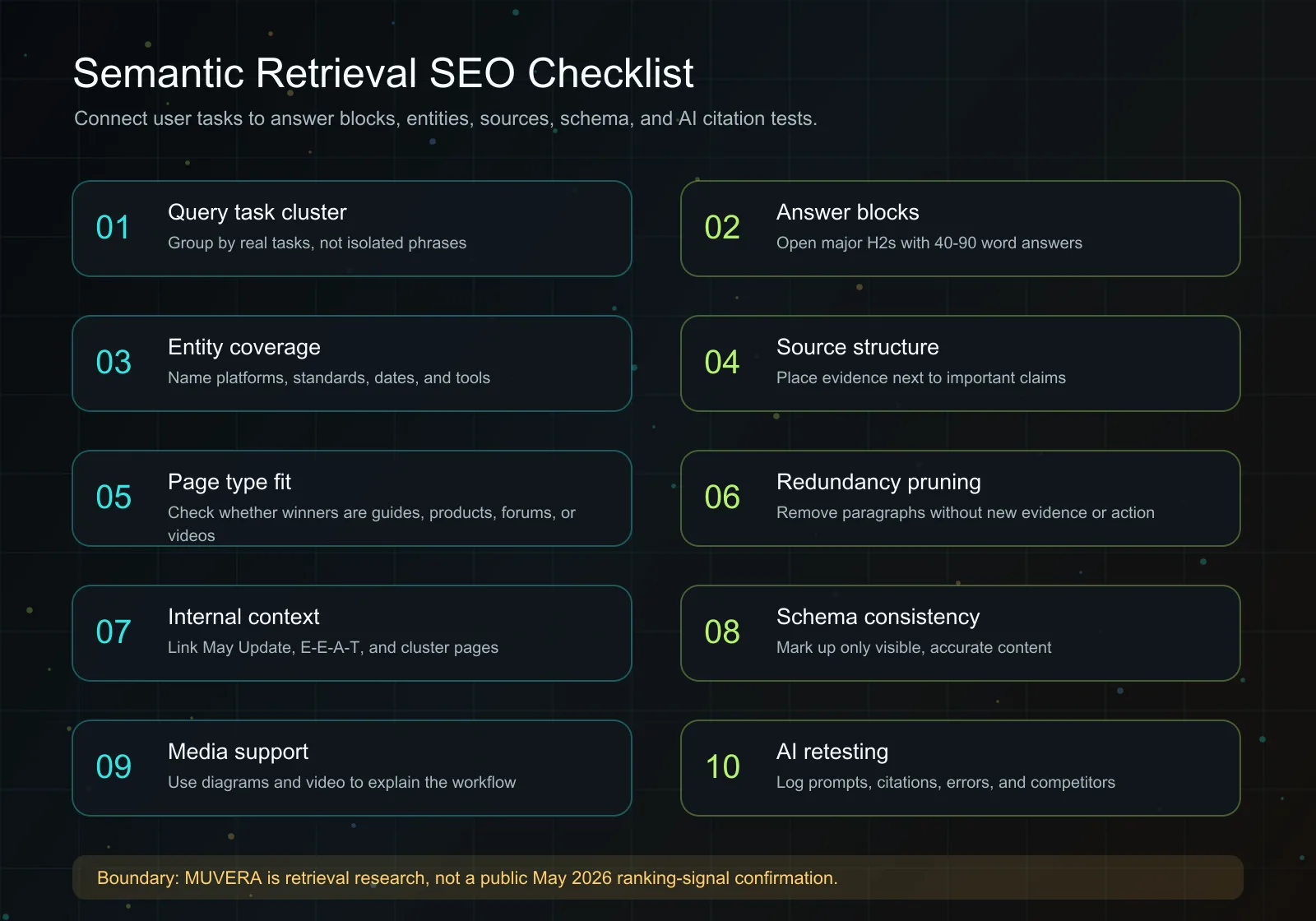
| Check | How to do it | Pass signal |
|---|---|---|
| Query task cluster | Group Search Console queries, People Also Ask patterns, sales questions, and AI prompts by user task. | The page targets one clear task, not a loose keyword list. |
| Answer blocks | Put a 40-90 word answer after major H2s. | Each section can be cited without the rest of the article. |
| Entity coverage | Name relevant platforms, documents, products, standards, and dates naturally. | Entities clarify claims instead of decorating the page. |
| Source structure | Link important factual claims near the sentence they support. | A reader can see which source supports which claim. |
| Page type fit | Match the content format to the SERP need: guide, comparison, official-source explainer, product page, forum-style experience, or video. | The page type fits the query and the current winners. |
| Redundancy pruning | Delete repeated paragraphs and combine overlapping H2s. | The page becomes shorter or clearer without losing meaning. |
| Internal context | Link to related cluster pages only where they help the next action. | Links feel useful, not forced. |
| Schema consistency | Use Article, FAQ, or VideoObject only when the visible page supports it. | Structured data matches what users can see. |
| Media support | Add diagrams, screenshots, or short videos where they explain a process. | Media has alt text, captions, and a text equivalent. |
| AI visibility test | Retest prompts in Google AI features, ChatGPT, Perplexity, Gemini, or your monitoring stack. | The log records prompts, answer accuracy, citations, and competitors. |
How to Audit a Page in 45 Minutes
A 45-minute audit is enough to find the biggest semantic gaps. Spend the time on evidence, not cosmetic rewrites: confirm the query task, compare winners, score section coverage, mark unsupported claims, and choose the smallest fix that changes the page's value. For one URL, the workflow is:| Time | Task | Output |
|---|---|---|
| 0-5 minutes | Define the page's primary user task in one sentence. | "This page must help the reader..." |
| 5-15 minutes | Compare current winners and your URL for page type, depth, source type, and media. | Winner pattern notes. |
| 15-25 minutes | Score every H2 for standalone answer, evidence, example, and next action. | Keep, expand, merge, or delete. |
| 25-35 minutes | Audit claims and entities. | Missing sources, stale dates, unclear entities. |
| 35-40 minutes | Check schema, canonical, indexability, media alt text, and internal links. | Technical fix list. |
| 40-45 minutes | Pick the next edit. | One prioritized content brief, not a vague rewrite request. |
Common Mistakes When Teams Chase "MUVERA SEO"
The biggest mistake is treating MUVERA as a secret ranking checklist. The safer interpretation is technical and editorial: modern retrieval rewards pages that match user tasks in more places, with clearer evidence and less redundancy.| Mistake | Why it hurts | Better approach |
|---|---|---|
| Writing "Google May update equals MUVERA" | Google has not publicly confirmed that link. | Say MUVERA is a useful retrieval lens, not a confirmed cause. |
| Declaring keywords dead | It removes the demand map and measurement layer. | Use keywords to map demand, then expand to tasks and entities. |
| Adding entities mechanically | It can make content noisy and less trustworthy. | Add entities only when they clarify the claim. |
| Quoting unverified multipliers | Fake precision undermines E-E-A-T. | Treat unsupported numbers as hypotheses or omit them. |
| Creating many similar articles | It causes cannibalization and weak internal clusters. | Upgrade the best URL and link supporting pages around it. |
| Adding schema for invisible content | It conflicts with structured data quality rules. | Mark up only visible, accurate content. |
| Ignoring source type | A blog cannot always beat an official doc, forum thread, video, or product page. | Audit source-type fit before rewriting. |