
Key Takeaways
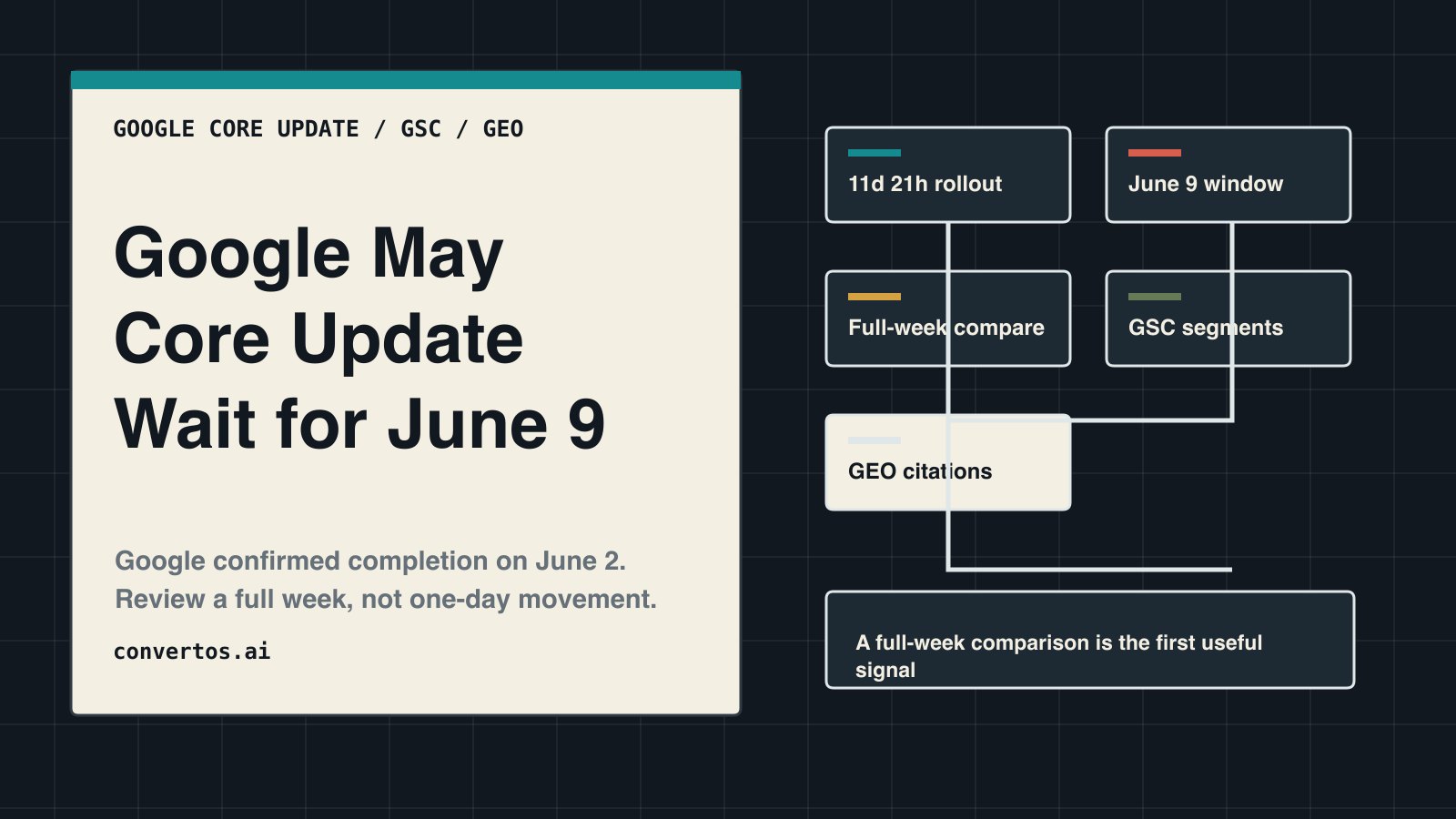
- Official status: Google marked the May 2026 core update complete on June 2, 2026 at 5:40 AM PDT.
- Earliest clean review window: wait until at least June 9, 2026, then compare a full post-completion week.
- Best comparison: use the week after completion against the week before rollout began. Avoid same-day or single-day comparisons.
- Industry read: Search Engine Journal and Search Engine Roundtable both recorded strong volatility and practitioner comments that May felt heavier than March. Treat that as a volatility signal, not as proof for your own site.
- GEO layer: review whether AI Overviews, AI Mode, Perplexity, ChatGPT Search, and other answer engines cite your pages and describe your brand correctly.
What Google Officially Confirmed
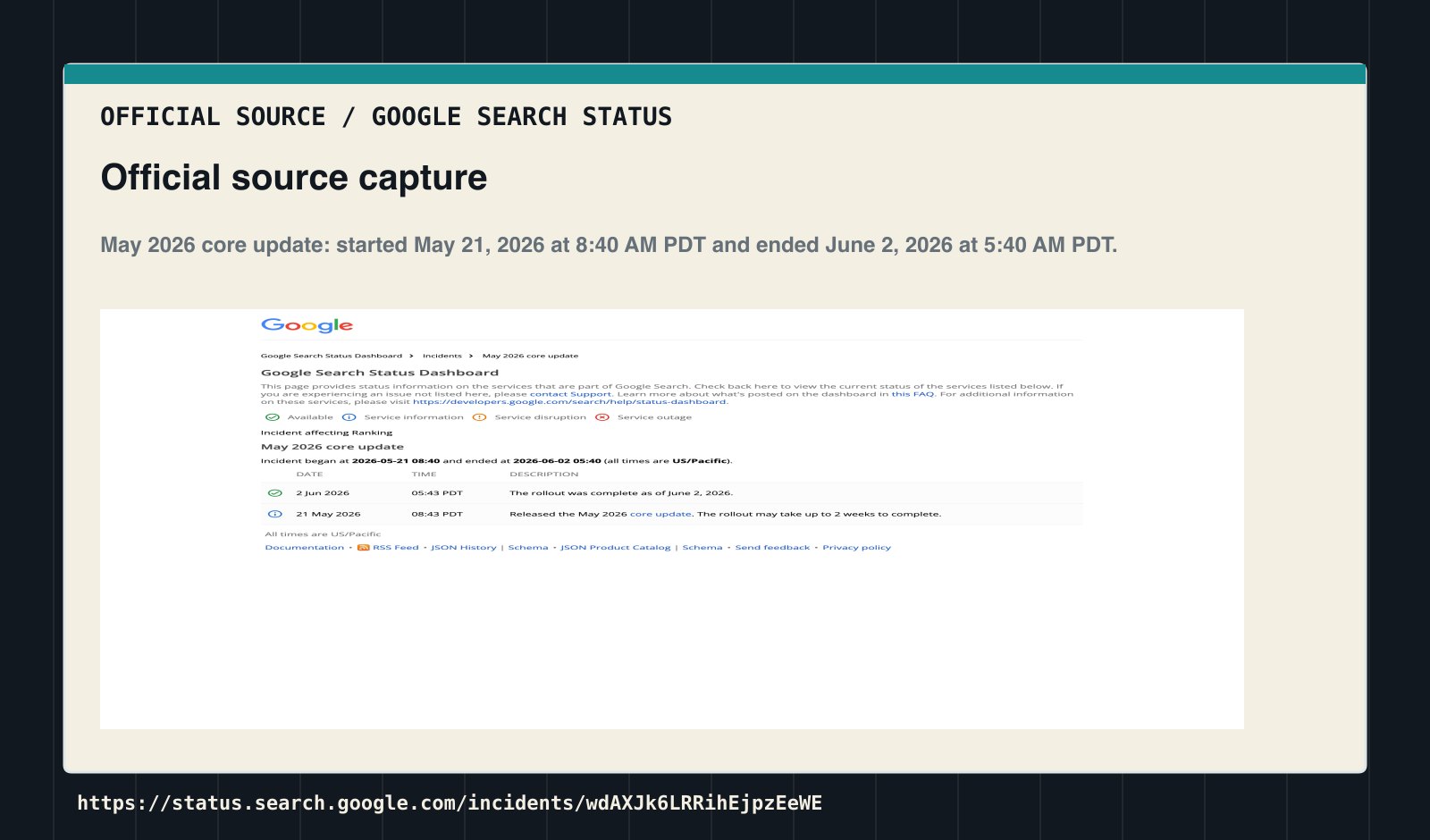
The Google Search Status Dashboard is the primary source for the rollout timeline. The incident affected Ranking, began on May 21 at 8:40 AM PDT, and ended on June 2 at 5:40 AM PDT. Google's June 2 update marked the rollout complete. That gives SEO teams a clear boundary. The update is no longer rolling out, but the data immediately around completion is still noisy. A broad core update is also not a manual penalty against one site. In Google's core update guidance, Google explains that core updates are broad changes to ranking systems and do not target specific pages.| Official fact | Date or window | What it means for SEO/GEO teams |
|---|---|---|
| Rollout started | May 21, 2026, 8:40 AM PDT | Keep the pre-update baseline before May 21 |
| Rollout completed | June 2, 2026, 5:40 AM PDT | June 2 can still include end-of-rollout movement |
| Duration | 11 days, 21 hours | Similar in length to the March 2026 core update |
| First useful review | At least June 9, 2026 | Use a full week, not one-day movement |
Why June 9 Is The First Useful Checkpoint
Google's guidance for core update analysis is practical: confirm that the update is finished, wait at least a full week, then compare that week with a week before the rollout began. This prevents teams from mistaking rollout noise, weekend demand, SERP layout changes, or Search Console delay for a lasting quality signal. The May update finished on June 2 at 5:40 AM PDT. One full week later is June 9 at 5:40 AM PDT. Your report does not need minute-level precision, but it should not claim winners or losers on June 3 or June 4. Use these windows for the first review:| Window | Suggested dates | Purpose | Caveat |
|---|---|---|---|
| Pre-rollout baseline | May 14-20, 2026 | Understand normal page and query performance before May 21 | Avoid rollout data |
| First post-completion review | June 9-15, 2026 | Review a full clean week after completion | Do not use June 9 alone |
| 30-day follow-up | After July 2, 2026 | Check sustained shifts and repair impact | Content changes may take longer to show |
Was May Heavier Than March?
Industry commentary points that way. Search Engine Journal summarized practitioner comments describing May as heavier than March. Search Engine Roundtable also recorded multiple volatility waves around May 30 and June 2 and described the update as feeling larger than the March core update. Keep the claim in its lane. Volatility tools and SEO chatter can tell you the broader search results were moving. They cannot prove why your own page moved. May 2026 also overlapped with Google I/O, AI Mode changes, AI Overviews interface updates, and wider AI search behavior changes. Rankings, click-through rate, and AI citations may all shift at the same time.| Observation | What it can tell you | What it cannot prove |
|---|---|---|
| Multiple industry sources recorded strong volatility | The wider SERP was active | Your own traffic drop was caused by the core update |
| May 30 and June 2 looked especially noisy | The rollout may have had late movement | Those two days are enough for a conclusion |
| May was described as heavier than March | Leadership should pay attention | Every drop deserves a rewrite |
| AI Search changed in the same period | Click paths may be changing | The core update was simply an AI update |
How To Review Search Console After June 9
Review grouped data, not sitewide totals alone. A SaaS site may keep brand-query clicks while losing comparison queries. A content site may see guide pages drop while tools stay stable. An ecommerce site may keep rankings but lose clicks if an AI Overview or shopping module changes the result page. Starting June 9, use this sequence:- Lock the two date windows: the pre-rollout week and the post-completion week.
- Group pages by type: blog, tools, product pages, category pages, case studies.
- Group queries by intent: brand, definition, problem, comparison, purchase.
- Separate search types: Web, Image, Video, News, Discover.
- Record SERP features: AI Overview, forum results, video, news, shopping, local packs.
- Review the worst affected pages by cause: technical issue, intent mismatch, weak evidence, outdated content, or SERP layout change.
| Check | Where to look | How to judge it | Next step |
|---|---|---|---|
| Clicks and impressions | Search Console Performance | Compare page groups and query groups | Find the affected topic cluster |
| Average position | Search Console pages/queries | Look for sustained movement, not one-day jumps | Prioritize large and lasting drops |
| CTR | Search Console | Stable ranking with lower CTR may mean SERP layout changed | Capture AI Overview, video, forum, or shopping modules |
| Indexing status | Search Console Indexing | Rule out noindex, canonical, crawl, and render issues | Fix confirmed technical problems immediately |
| AI citation visibility | Manual prompts or GEO monitoring | Check whether answer engines cite and describe you correctly | Create a GEO repair list |
Add A GEO Review Layer: Is AI Search Still Citing You?
Classic SEO review looks at rankings, clicks, and index coverage. GEO review asks a second question: do AI answer systems still treat your page or brand as a trusted source? Google's Search team described a more AI-shaped search experience during I/O in its AI Search update, so a post-update review that only checks blue-link rankings is incomplete. Add this GEO table beside your GSC report:| GEO question | How to check | What to record | Why it matters |
|---|---|---|---|
| Does an AI Overview appear? | Manually test core queries | Appearance rate, cited URLs, competitor URLs | Click loss may come from SERP layout |
| Are your pages cited? | Google AI features, Perplexity, ChatGPT Search | Cited URL, cited passage, answer context | Visibility now includes answer inclusion |
| Is your brand described accurately? | Test brand + category + problem prompts | Product facts, positioning, wrong claims | Wrong answers damage trust |
| Are competitors cited more often? | Compare the same prompt set | Source type: blog, review, docs, forum | Reveals content and proof gaps |
| Is your content quotable? | Review answer blocks, tables, FAQ, sources | Clear definition, steps, date, source links | AI systems need extractable evidence |
What To Fix Now And What To Wait On
Waiting until June 9 does not mean pausing all work. Fix confirmed technical problems now. Wait on broad content changes until you have a full comparison window. The rule is simple: fix known defects, but do not make major changes from uncertain data.| Situation | Act now? | Why |
|---|---|---|
| robots.txt error, noindex, 5xx, wrong canonical | Yes | These are confirmed technical issues |
| Crawled pages are not indexed at scale | Investigate templates, duplication, canonical, and internal links | It may be a mixed technical/content issue |
| One-day click drop | Record it | Rollout-end noise and GSC delay can mislead you |
| A page type is still down after the full post-completion week | Prioritize after June 9 | You need stable grouped data |
| AI Overview appears but does not cite you | Start monitoring now, repair later | This is a GEO issue, not necessarily a direct core-update cause |
| Content is clearly outdated or weakly sourced | Add it to the repair queue | Do not batch rewrite before segmentation |
Common Mistakes
The risk in this update is not lack of information. The risk is noisy information. Official status updates, volatility tools, SEO chatter, AI search changes, and Search Console lag are all happening at once.| Mistake | Why it hurts | Better approach |
|---|---|---|
| Declaring winners or losers from June 2 or June 3 data | Those dates are too close to completion | Wait for a full week after June 9 |
| Blaming every drop on the core update | Technical issues, demand shifts, and SERP layout can also explain drops | Segment by page group and query intent |
| Rewriting in bulk because May felt heavier than March | Industry context is not your site evidence | Separate official facts, industry signals, and your data |
| Ignoring AI citations | AI Overviews and answer engines can change clicks and source visibility | Add a GEO visibility column |
| Deleting large content sections immediately | Google treats deletion as a last resort | Improve salvageable content before removing it |
A Simple Weekly Report Template
A post-update report has two jobs. It needs to be readable for leadership, and it needs to be specific enough for the SEO or content team to act. The cleanest structure is conclusion, evidence, risk, GEO visibility, and next action. Use this template:| Module | What to write | Example |
|---|---|---|
| Conclusion | State whether the change is sustained | "Non-brand comparison pages are down 18%; brand queries are stable." |
| Evidence | Name the date window and page group | "Comparing May 14-20 with June 9-15." |
| Risk | Note technical issues or SERP layout changes | "Three core queries now show AI Overviews; CTR fell while average position stayed stable." |
| GEO | Record whether AI answers cite the brand | "Perplexity cites competitor review pages but not our product explainer." |
| Action | Say what will and will not change next week | "Improve evidence and FAQ on 10 comparison pages; do not delete content in bulk." |