Implement Google Preferred Sources correctly with the official button code, eligibility rules, screenshots, placement guidance, and measurement limits.
Google’s April 30, 2026 Search Central update should not be treated as a confirmed core algorithm update. The public record points to Preferred Sources, a user-side Search feature that lets people choose sources they want to see more often in relevant news and information surfaces. For SEO and GEO teams, the right response is not panic or broad site rewrites. The right response is to check Google’s official status record, segment Search Console data, and strengthen the trust signals that make a publication worth choosing and citing.
Key Takeaways
This is not a confirmed Google core update. Check the Google Search Status Dashboard before attributing traffic changes to a ranking-system update.
Preferred Sources is a user preference feature. It is not a publisher submission form, a Search Console button, or a direct ranking boost.
News publishers, industry media, finance sites, sports sites, and frequently updated information brands should pay closer attention than ordinary product pages.
For GEO, the lesson is simple: brands that become recognizable, verifiable sources are easier for users and AI answer systems to trust.
Video explainer: why the April 30 public update should be read as a Preferred Sources change, not a confirmed core algorithm update.
The video summarizes the article’s decision flow in 75 seconds: classify Preferred Sources correctly, check the official status dashboard, segment Search Console data, and turn the finding into source-trust improvements instead of update panic.
Video transcript
Do not call the April 30, 2026 Google Search Central change a core update without checking the official record first. The public signal points to Preferred Sources documentation and feature expansion. Preferred Sources is a user preference for trusted sources, while a core update is a broader ranking-system change that should appear in Google’s official status record. Publishers cannot submit a page to become a guaranteed source. If traffic changed around April 30, start with the status dashboard and segmented Search Console data. For GEO, the practical goal is to become a recognizable, citable, and verifiable source.
What Actually Changed On April 30, 2026
The public update was about Preferred Sources, not a confirmed broad ranking change. Google’s documentation describes Preferred Sources as a way for users to select sources they want to see more often in eligible Search surfaces. That distinction matters because the operational response is different. A ranking update diagnosis starts with volatility, impacted query classes, and quality systems. A Preferred Sources diagnosis starts with source recognition, publication consistency, and whether users would reasonably choose the site as a repeat information source.
Use the Search Central update log as the first public-documentation checkpoint. Then use the Search Status Dashboard to see whether Google recorded a core update or ranking-system incident around the date you are investigating.
August 2026 update: publishers can now add the Preferred Sources control
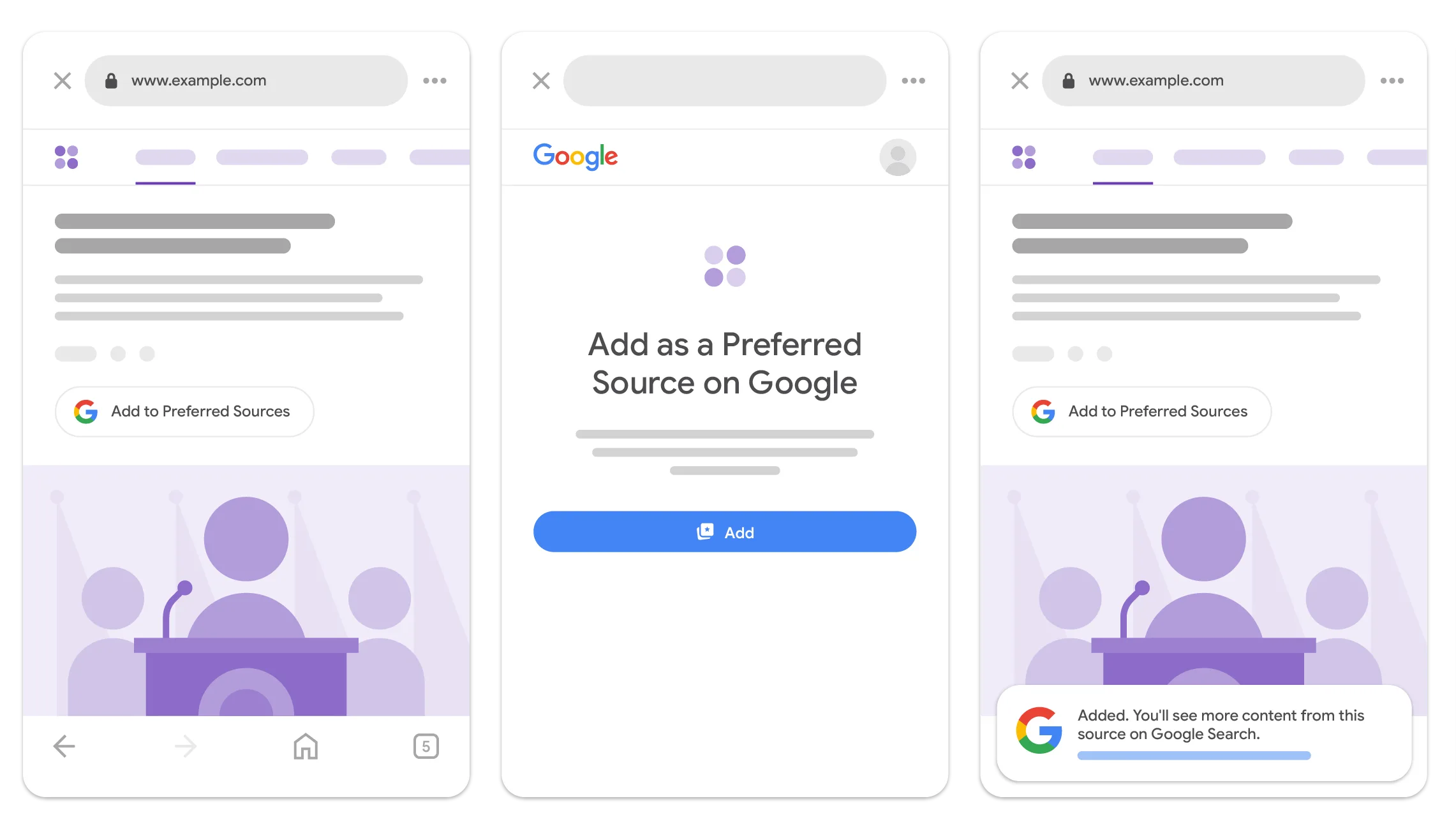
Google’s documentation, updated August 26, 2026, now gives publishers a supported way to place an “Add as a Preferred Source” control on their own sites. That changes the implementation advice in the original version of this article. Publishers cannot force themselves into a user’s preferences or buy preferred status; they can make the user-controlled action visible after earning a reader’s trust.
The eligibility boundary is precise: a domain or subdomain can be selected; a subdirectory cannot. If a company publishes news at news.example.com, that subdomain can be the source. A path such as example.com/news/ cannot be selected independently from the main domain.
Google’s standard implementation is:
Use Google’s own library rather than recreating the control. Place it where a returning reader has enough context to make a real preference—after the article, beside a publication follow module, or on an editorial hub. The SEO guides can carry a consistent follow module, while the workflow toolkit can hold the release and measurement checklist. Do not present the button as a ranking guarantee.
Original Google documentation screenshot. The control lets a signed-in reader choose the site; it does not enroll the publisher automatically.
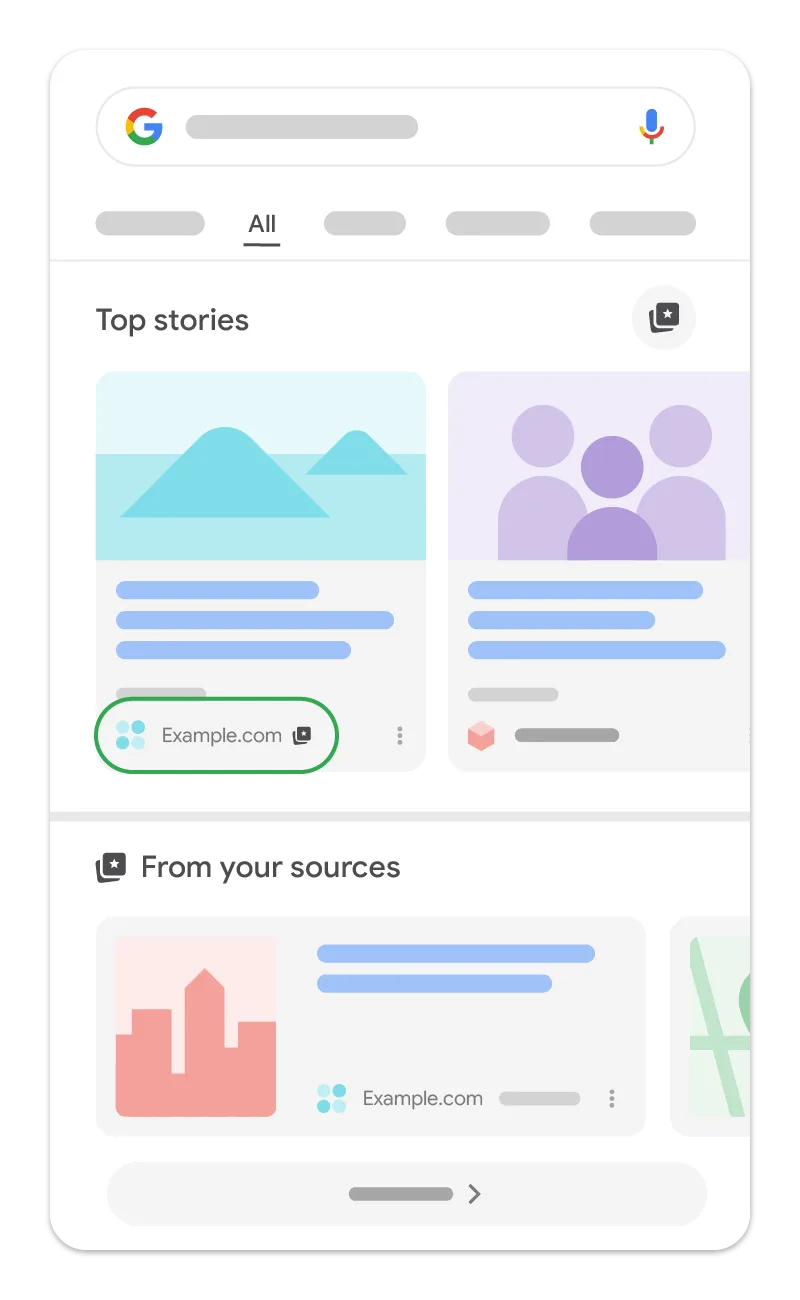
Google also documents a direct selection link. That is useful in newsletters or share modules where JavaScript cannot run. Test the final domain value, signed-in and signed-out states, mobile layout, and consent-policy impact before release.
Original Google screenshot showing the user-facing site-selection experience.
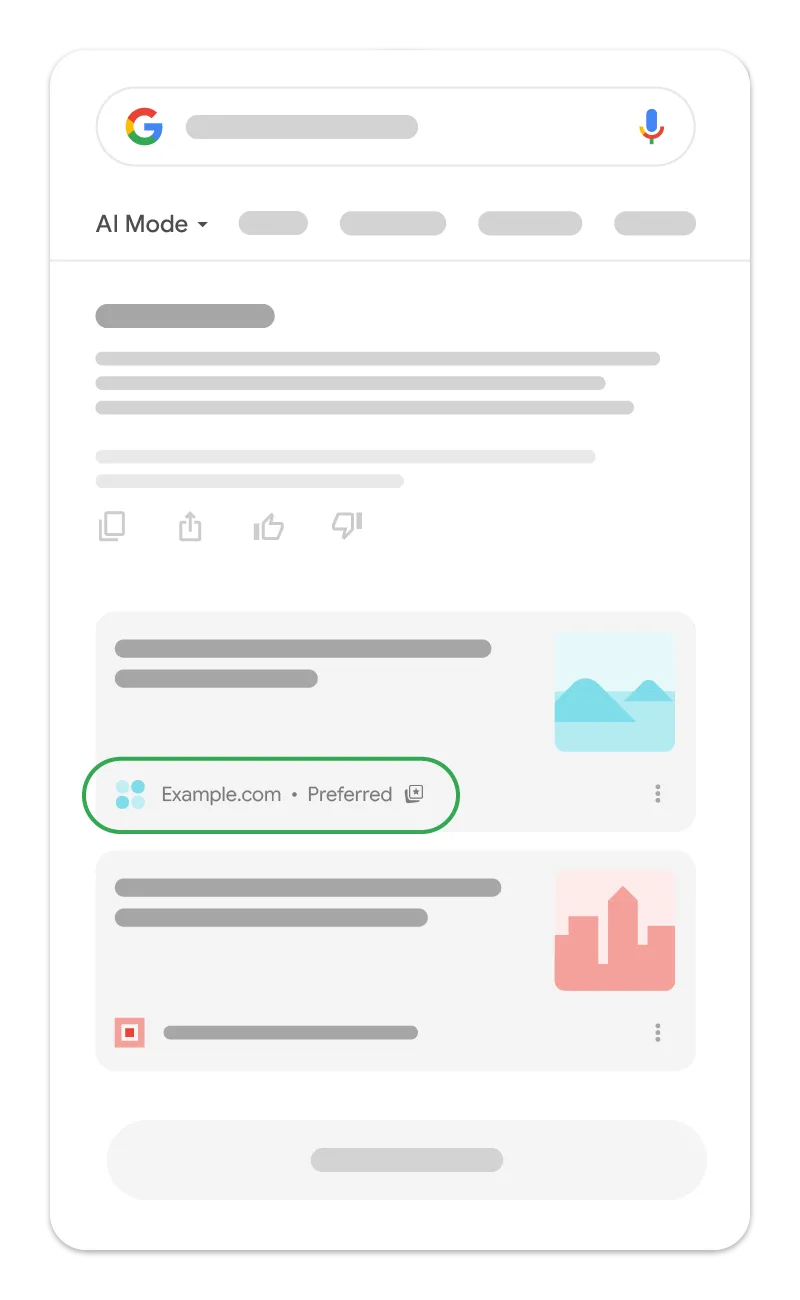
Preferred Sources may increase the chance that selected publishers appear more prominently in eligible Top Stories surfaces. Google’s current documentation also shows preference signals in AI Mode and AI Overviews. It does not promise a fixed ranking lift, traffic level, or citation rate, so measure the implementation as a reader-preference and distribution experiment.
Original Google screenshot showing the Preferred label inside AI Mode.
How This Differs From A Core Update
A core update can affect how Google’s ranking systems evaluate many pages across the web. Preferred Sources is narrower: it changes how a user can express source preference in relevant information surfaces. Treating both as the same thing leads teams to fix the wrong problem.
Question
Preferred Sources
Core update
Who controls the signal?
The user chooses sources they want to see more often.
Google’s ranking systems change how pages are evaluated.
Where should you verify it?
Google’s Preferred Sources documentation and Search Central updates.
The Search Status Dashboard and core update guidance.
Diagnose affected pages, queries, and quality patterns.
What should you avoid?
Do not treat it as a submission or ranking shortcut.
Do not make broad changes before you isolate the affected patterns.
Which Sites Should Pay Attention
Preferred Sources matters most to sites that users revisit for timely information: newsrooms, trade publications, financial coverage, sports publishers, local information sites, and niche expert media. A SaaS blog or product-led company can still learn from the feature, but its action plan is usually indirect. The job is to become a source that people and AI systems can identify, verify, and quote.
Site type
Likely relevance
What to improve now
News and current-events publishers
High
Clear topic beats, visible author/editor details, fast corrections, and consistent coverage pages.
Industry media and B2B publications
Medium to high
Named experts, repeatable explainers, source-backed analysis, and evergreen topic hubs.
SaaS blogs and company content
Indirect
Answer blocks, evidence links, product context, and clear dates on pages that explain fast-changing topics.
Ecommerce category pages
Low for the feature itself
Keep working on product data, reviews, comparison clarity, and crawlable category structure.
What SEO And GEO Teams Should Check Now
If the date lines up with a traffic change, do not diagnose from a single all-site chart. Google recommends using Search Console and looking at patterns when debugging Search traffic drops. Start with date range, query, page, country, device, and search type. Then decide whether the change looks like a Search feature mix shift, a page-level loss, a query class loss, a technical issue, or ordinary volatility.
Check the official status record for the exact window you are investigating.
Split Search, Discover, and News where the site has enough data.
Compare branded queries, non-branded queries, and topic clusters separately.
Check whether the pages that moved have weaker authorship, thin sourcing, stale dates, unclear ownership, or duplicated angles.
Only after that, decide whether the response is content improvement, technical cleanup, or watchful monitoring.
Decision Flowchart For The April 30 Update
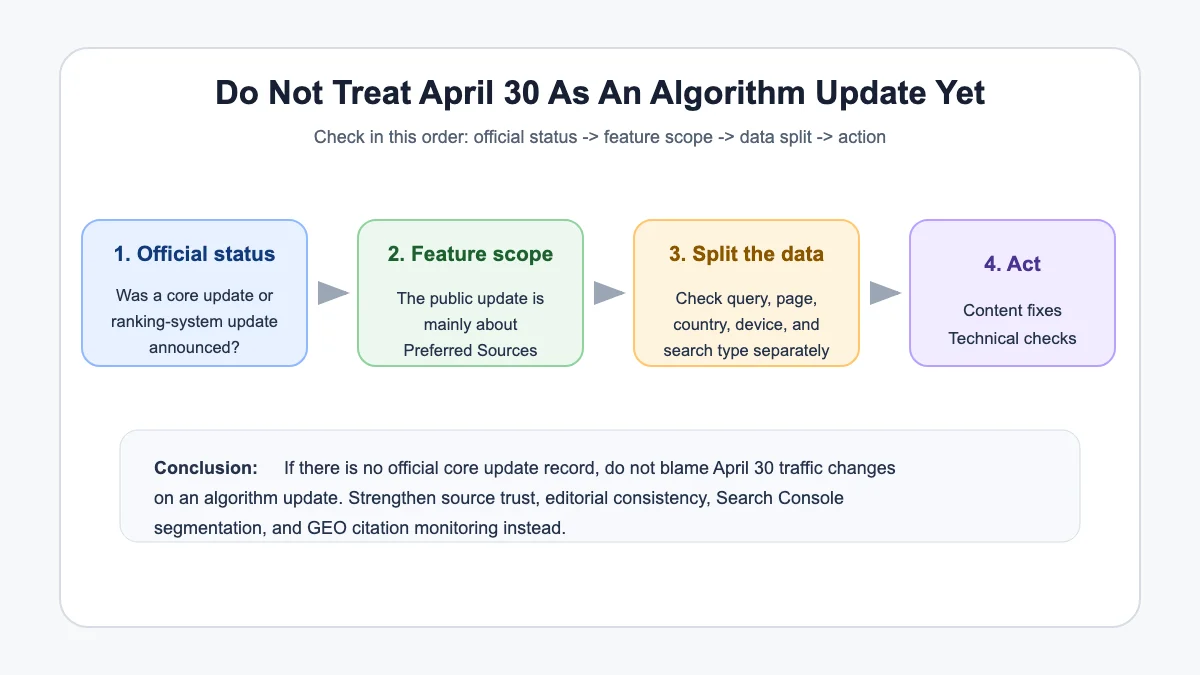
The fastest safe diagnosis is a short sequence: official status first, feature scope second, data segmentation third, and action last. The flowchart below is the version editors and SEO leads can use before making changes to live pages.
If the status dashboard shows no ranking incident, do not stop the analysis. Check whether the affected URLs belong to news or fast-changing information surfaces, whether the change is isolated to a country or device, and whether editorial cadence changed at the same time. The diagram is a triage sequence, not proof that one feature caused the movement.
Google April 30, 2026 update decision flowchart: verify the official record, confirm the Preferred Sources scope, split the data, then act.
Why This Matters For GEO
GEO, or generative engine optimization, is the work of making a brand easier for AI answer systems to understand, cite, and summarize accurately. Preferred Sources does not prove that user preference is a direct AI citation signal. But it does reinforce a broader direction: search experiences are giving more weight to recognizable sources, not just isolated pages.
For a GEO program, that means you should make every important page answer three questions clearly: who is speaking, what evidence supports the claim, and why this source should be trusted on this topic. Google’s documentation for AI features in Search also reinforces the need for crawlable, indexable, high-quality content that systems can understand.
Apply that standard to the publication, not only to one article. Keep author and reviewer identities consistent, link claims to their primary evidence, show when volatile facts were checked, and maintain a clear subject focus across related pages. Those practices help readers decide whether the site deserves a preference and give answer systems cleaner source context.
Five Mistakes To Avoid
Mistake
Why it hurts
Better action
Calling every date-matched drop an algorithm update
It pushes the team into broad changes before the cause is known.
Check official records and split the data first.
Thinking Preferred Sources is a publisher submission tool
It creates a false expectation that you can request ranking preference.
Build a source people would choose repeatedly.
Looking only at all-site clicks
Total clicks hide query, page, country, and surface-level patterns.
Use segmented Search Console views.
Removing useful content because traffic moved
You may delete pages that still support topical trust and AI citation.
Refresh, consolidate, or clarify before deleting.
Publishing unsourced commentary about Google updates
It weakens trust with readers and answer systems.
Link claims to official Google documents or first-hand data.
Execution Checklist
Record the exact traffic-change window and the comparison window.
Check the Search Status Dashboard before writing an internal update memo.
Separate Search, Discover, News, country, device, query, and page data where possible.
Mark whether each affected page is news, evergreen analysis, product-led content, or a documentation page.
Improve visible authorship, update dates, citations, and editorial ownership on pages that explain fast-changing topics.
Create or refresh topic hubs for subjects where users would reasonably want a repeat source.
Track whether AI answer systems mention the brand, cite the page, or summarize the answer accurately.
Assign an owner and review date to every item. The preferred-source control is a small front-end change, while source quality is an ongoing editorial commitment. Reporting them as separate workstreams prevents a successful button release from being mistaken for a completed trust program.
FAQ
These questions reflect related searches, related questions in current results, recurring discussion forums, and questions raised in Google’s own Preferred Sources documentation.
Was April 30, 2026 a confirmed Google core update?
No. Treat it as a Preferred Sources related public update unless the Search Status Dashboard records a core update for the window you are analyzing.
Can publishers submit themselves as Preferred Sources?
No. The feature is based on user preference, not a publisher submission form. The practical move is to become a source users would choose again.
Should I change my whole site if traffic dropped around April 30?
No. First use Google’s traffic-drop debugging guidance and segment the data. Broad changes come after you know which queries, pages, and surfaces moved.
Does this matter for SaaS and B2B blogs?
Yes, but indirectly. SaaS teams should focus on source trust: clear authorship, direct evidence, useful answer blocks, and updated topic hubs.
How does this connect to AI search visibility?
AI answer systems need sources they can parse and trust. A page with clear entities, evidence, dates, and concise answers is easier to cite accurately.
Disclosure
This analysis was last checked on August 28, 2026. It is based on Google’s public Search Central documentation, Preferred Sources documentation, Search Status Dashboard, Search Console help materials, and the visible page requirements for AI features in Search. Google documentation and Search features can change, so verify the official pages before making production SEO decisions.