A practical workflow for finding ecommerce pages where title tag changes can earn more clicks—without rewriting the whole catalog or trusting a universal CTR benchmark.
Rewriting every product title is a tidy project plan and a poor prioritization strategy. Most catalog pages either have too little search demand to judge, rank too low for a title change to do much, or are not the canonical page Google has chosen to show. Put them all in one spreadsheet and the genuinely useful candidates disappear into the backlog.
A better queue starts with pages that already have a chance to win: indexable, preferred URLs with impressions, a page-one ranking, and a click-through rate that trails comparable pages. In an anonymized 28-day ecommerce sample, both page-one cohorts averaged below 0.2% CTR. Roughly four in five of the page-one opportunities sat in positions 4–10. That is where we would begin—not because position 7 is magical, but because those pages already had visibility and still left clicks on the table.
The short version
Use this order:
Remove pages that are not eligible to compete. Exclude non-indexable URLs, duplicates, redirects, and pages whose canonical points elsewhere.
Require real search demand. A page needs enough impressions for its CTR to mean anything.
Split by ranking band. Positions 1–3 and 4–10 are title opportunities; positions 11–20 usually need ranking work first; deeper pages stay out of the rewrite queue.
Compare like with like. Judge a product page against the same category, device, country, query intent, and position band—not against a sitewide CTR average.
Borrow patterns from winners, not their wording. Look for useful attributes, intent matches, and phrasing among comparable high-CTR pages.
Ship a controlled batch and wait for reprocessing. Record the old title, new title, release date, and cohort before touching production.
This is a prioritization system, not a promise that changing title tags alone will lift traffic. Google may build a title link from the HTML title, the page’s main visual title, prominent text, anchor text, or other sources. Its official title-link guidance also notes that updates require recrawling and reprocessing, which can take days to weeks.
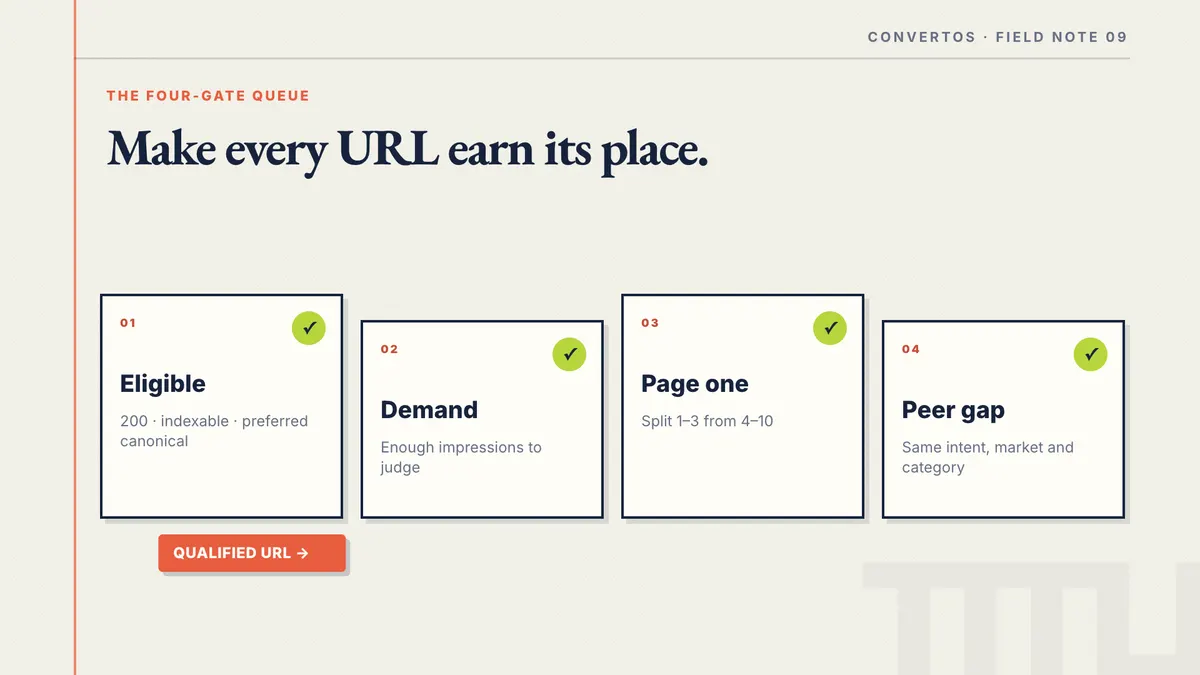
Start with four gates, not a giant export
The raw Search Console export is only the start. The useful unit is a page-query cohort that survives four gates.
Gate
Keep when…
Exclude or park when…
Technical eligibility
URL returns 200, is indexable, and is the preferred canonical
Redirect, noindex, duplicate, soft 404, or canonicalized elsewhere
Demand
The cohort has enough impressions to compare over the chosen window
A few impressions make CTR too noisy
Rank
Average position is 1–10, with separate bands for 1–3 and 4–10
Position 11+ usually needs relevance, authority, inventory, or internal-link work first
Evidence
A comparable high-CTR set exists in the same market and page type
No fair peer group or query intent is mixed beyond recognition
The canonical check matters more than it first appears. Search Console generally assigns performance to the canonical URL, and Google treats canonical declarations as signals rather than absolute commands. A title rewrite on the wrong member of a duplicate cluster can be perfectly executed and still affect nothing. Check the live page, its canonical declaration, and—where the risk justifies it—Google’s selected canonical before putting the URL into a test.
Four gates keep low-signal URLs out of the title rewrite backlog.
Why a universal CTR benchmark breaks the queue
CTR changes with rank, device, country, brand familiarity, query wording, price, SERP features, and whether the searcher wants a category or a specific product. A single “good CTR” threshold flattens all of that variation.
The private ecommerce sample made the problem visible. Across four large categories, the share of pages already clearing 2% CTR ranged from roughly 4.4% to 12.6%—a nearly threefold difference. Applying one sitewide threshold would over-flag some categories and miss opportunities in others.
Build peer groups in this order:
country and device;
page type, such as product versus category;
category or product family;
query intent, especially brand, product-specific, and generic discovery terms;
position band;
similar impression volume.
Then calculate a peer median or a percentile, not an aspirational number from an unrelated industry study. A useful opportunity score can stay simple:
Opportunity = impressions × peer CTR gap × business-value weight × confidence
Here, peer CTR gap is the positive difference between the peer benchmark and the page’s current CTR. Business-value weight can reflect margin, inventory depth, conversion rate, or strategic importance. Confidence falls when impressions are thin, rankings are volatile, or the queries are too mixed to compare fairly.
Do not turn this formula into false precision. Its job is to order work. If two URLs score almost the same, editorial judgment can break the tie.
What to inspect before writing a new title
A low CTR row is a symptom. Before rewriting anything, look at the result a shopper actually sees.
First, compare the current title link with the HTML <title>. If they differ, note the rewrite rather than assuming Google will adopt another metadata change. Then inspect the page’s main heading, prominent on-page text, breadcrumbs, internal anchors, structured product data, and og:title. Google’s title-link documentation confirms that it may use several of these sources when it generates the result.
Next, read the queries. A title can be grammatically clean and still miss the shopping task. For a generic product query, the useful differentiator might be material, compatibility, pack size, use case, or a meaningful range—not another adjective. For a model-specific query, brand and model accuracy matter more than marketing language. Never add an attribute the page cannot substantiate.
Finally, study the peer winners. The goal is to identify patterns such as:
the attribute shoppers repeatedly include in queries;
whether model or compatibility information appears early;
which modifiers separate category browsing from product purchase intent;
whether truncated titles bury the decisive detail;
whether high-CTR pages make a promise the landing page actually fulfills.
Copying a winner’s exact title gives you imitation, not evidence. Translate the pattern into a rule that fits the page template and available product data.
A practical batch workflow
From catalog export to a testable title queue: a Convertos original explainer.Read the 36-second video transcriptA million title tags. Which 50 go first? Use four gates: eligibility, demand, page-one rank, and a peer CTR gap. Protect positions 1–3. Test positions 4–10 first. Below page one, improve ranking before treating CTR as the main constraint. Ship one controlled pilot, keep the comparison cohort unchanged, wait for recrawling and reprocessing, then measure clicks and business value.
The video summarizes the workflow below; every essential instruction is also available in text.
1. Choose a stable window
Start with 28 days when the catalog has regular demand. Compare against the previous period, but mark promotions, stock outages, migrations, seasonality, and major SERP changes. A longer window may be better for slow categories.
2. Export at page and query level
Pull clicks, impressions, CTR, and average position. Keep country, device, and date available as filters. Search Console’s Performance report supports those dimensions, but the interface and API can aggregate data differently. Decide whether your working row represents a property, page, query, or page-query pair before calculating gaps.
3. Join technical and commercial fields
Add HTTP status, robots eligibility, canonical target, template, category, stock state, conversion rate, revenue or margin tier, and the current HTML title. This prevents the SEO queue from recommending out-of-stock products, duplicates, or low-value pages.
4. Make separate queues by rank
Positions 1–3: protect relevance. Test obvious message mismatch or persistent title rewrites; avoid casual churn.
Positions 4–10: primary title-testing queue. These pages have page-one visibility with room to earn more clicks.
Positions 11–20: ranking queue. Improve relevance, content, internal links, availability, or authority before treating CTR as the main constraint.
Positions 21+: exclude from the title program unless another signal creates a compelling exception.
5. Draft rules, then titles
Create one hypothesis for each batch: “Move compatibility before the generic product noun,” for example, or “Replace empty superlatives with the attribute shoppers use.” Generate candidates only after the rule is clear. Review manually for truth, readability, duplication, truncation risk, and landing-page match.
6. Release a forward-only pilot
Publish a small, traceable batch. Do not rewrite the comparison cohort. Keep a rollback value for every title and avoid mixing template, price, image, and title changes in the same test if you want a readable result.
How to measure a title test without fooling yourself
CTR is central, but it is not enough. A title can attract more clicks by making a promise the product page does not keep. It can also gain CTR while impressions or position fall, leaving total clicks unchanged.
Measure
Read it as…
Watch out for…
Clicks
The outcome the title is meant to influence
Seasonality and demand shifts
Impressions
Available search opportunity
Query-mix changes
CTR
Click efficiency within the observed results
Rank, device, SERP features, and low sample size
Average position
Context for CTR movement
It is an average, not a fixed rank
Google title rewrite rate
Whether the intended title appears
Manual spot checks are samples, not complete coverage
Conversion or revenue
Whether extra visits remain useful
Attribution lag and stock/price changes
Set the observation window before release. Wait for the changed pages to be recrawled and for search results to settle. Compare the pilot with a same-category holdout or a matched historical cohort, and review query-level shifts—not just the property total. Google’s guide to debugging search traffic drops is a useful reminder that absolute position can be misleading and small fluctuations rarely justify radical changes.
A result is worth expanding when the pilot shows a durable click gain, CTR improves without a damaging loss of impressions or position, title rewrites do not erase the intended message, and downstream behavior stays healthy. Otherwise, revise the rule or roll back the batch.
Common ways this project goes wrong
Rewriting the whole catalog. It consumes editorial and engineering time before the team knows which rule works.
Sorting by low CTR alone. A URL with six impressions and zero clicks looks terrible but tells you almost nothing.
Mixing every position together. Position 2 and position 18 have different problems. The first may have a message gap; the second often has a ranking gap.
Ignoring Google’s displayed title. If Google is already replacing your HTML title, another metadata-only rewrite may not address the conflicting page signals.
Benchmarking unrelated pages. A branded electronics query on desktop is not a fair peer for a generic apparel query on mobile.
Changing price, imagery, copy, and titles together. The release may perform better, but the team will not know why.
Counting CTR without business outcomes. A sensational title can win the wrong click.
A small operating sheet is enough
You do not need a complicated platform to start. One row per testable page-query cohort can include:
URL · query cluster · country · device · page type · category · clicks · impressions · CTR · position band · peer CTR · current title · displayed title · proposed title · hypothesis · release date · recrawl check · post-period metrics · decision
Keep the pre-release snapshot immutable. If the program grows, automate the imports and scoring, but preserve the same contract: evidence first, hypothesis second, release third, measurement last. The wider Convertos SEO library is useful when a losing cohort turns out to need technical, content, or internal-link work rather than another title edit.
For teams that also need to understand how their pages appear in AI-generated answers, the same cohort discipline applies. A Convertos visibility audit can add that second view without confusing it with conventional Search Console CTR.
FAQ
The FAQ below reflects related questions, Reddit discussions, and YouTube video results found in current search results. Claims about Google’s behavior were checked against the official title-link documentation.
Should we optimize titles for pages ranking below position 10?
You can fix an obviously inaccurate or duplicated title anywhere. As a growth program, however, positions 11–20 usually need ranking work before CTR becomes the main constraint. Keep those URLs in a separate queue.
What is a good ecommerce CTR?
There is no defensible universal number. Build a benchmark from comparable pages with the same market, device, intent, page type, category, and position band.
How many titles should be in the first batch?
Use the smallest batch that can represent one clear rule and still collect meaningful impressions. For a high-volume category that may be dozens of pages; for a slower catalog it may be fewer pages observed for longer.
How soon should we judge the result?
Only after Google has recrawled and reprocessed the changed pages and the cohort has accumulated enough comparable demand. Title updates may take days to weeks to appear.
Why does Google show a different title from our title tag?
Google can generate title links from several page and link signals. Check whether the HTML title, visible heading, prominent text, anchors, and other labels disagree or overstate the page.
Sources and methodology
The operating example comes from a private 2026 review of a large cross-border ecommerce site. Company, provider, domain, system, staff, screenshot, and absolute URL-count identifiers were removed. Percentages describe a 28-day observational sample; they show where opportunity was concentrated, not that title changes caused later performance.
The workflow was cross-checked against Google’s documentation for title links, Search Console Performance reports, metric definitions, data aggregation, and canonical consolidation. Search behavior and documentation can change, so recheck the rules before turning this into an automated production policy.