
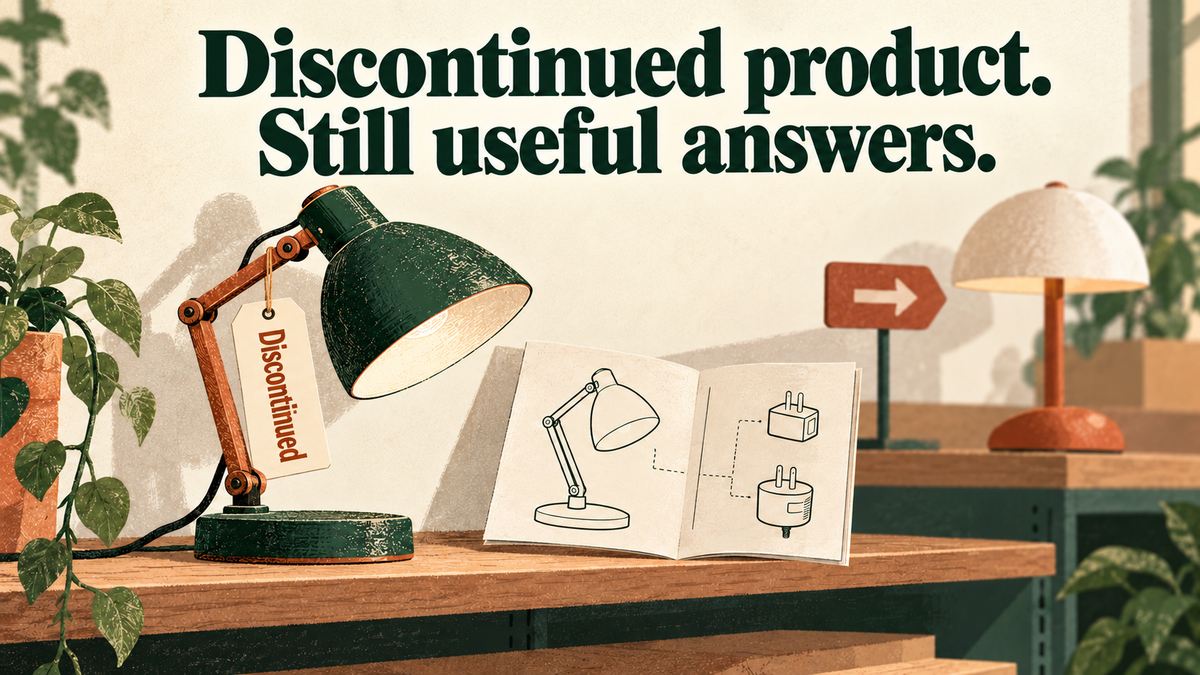
When a store stops selling a product, I would first look at why people still search for it before deciding what happens to its page.
Consider a hypothetical desk lamp. One visitor wants to buy that model, another needs to identify its power connector, and a third is looking for the manual. Redirecting everyone to a newer lamp might interest the first visitor. It could leave the other two without even the old model's specifications.
I would therefore examine both the product's sales status and the job its URL still needs to do. An inventory system can tell me whether there is stock. It cannot, by itself, tell me whether the page is still useful.
Establish what “removed from sale” actually means
A temporary shortage, permanent discontinuation, and a move to a new URL can all make an old link disappear from a sales listing. They call for different responses.
For a temporary shortage, I would generally keep a useful product page and display the current status clearly. A replenishment date belongs there only when it is credible; uncertainty should not become an invented delivery promise. Stock alerts or alternative products can help, provided those options work. Visitors should not have to reach checkout to discover that the item cannot be bought.
I would also check the affected variant and market. One unavailable color, size, or destination does not establish that the entire product is permanently discontinued everywhere. The selected variant, delivery coverage, and checkout behavior need to agree.
If the same product has moved permanently to a new URL, the decision is more straightforward: preserve its identity and content, redirect the old address, and update internal links. Google's redirect documentation identifies 301 and 308 as permanent redirects. Here, the destination is the same product's new location, not simply another item that happens to be available.
Permanent discontinuation needs a closer look at what the old page still offers.
An available replacement may answer the wrong question
Return to the hypothetical lamp. Suppose the newer model looks similar but uses a different power connector. A visitor searching for a replacement adapter for the old model would gain little from an automatic redirect to the new lamp. The missing compatibility information could even lead to a mistaken purchase.
I would keep the old model's images, specifications, manual, and verified compatibility details, with a prominent discontinued notice. Purchasing controls should reflect the actual sales status. If the store no longer accepts orders, the page should make that clear and prevent visitors from placing one. The new model can appear as a clearly identified option, with important differences explained so visitors can decide for themselves.
The opposite situation also occurs: the layout changed, but the same product's complete information has already moved to another page. Maintaining both addresses may be unnecessary. Before redirecting, I would check the destination against the old page's main uses: the right model, important specifications, instructions, language, and market. Sharing a “desk lamps” category would not be enough.
I would not keep every old product page forever. Removal can be reasonable when a review finds no continuing purpose, useful information, or relevant destination. The decision needs that review; zero stock is insufficient on its own.
The page and the product feed have different jobs
The website page and the product data submitted to Merchant Center need separate decisions.
A discontinued product's page may still help someone find a manual, even though the product itself should be removed from the Merchant Center data source. Merchant Center's availability guidance says to remove permanently discontinued products from that data, while a temporarily unavailable item for which orders are not accepted uses out_of_stock. Preorders and backorders have their own requirements and must reflect the real sales arrangement.
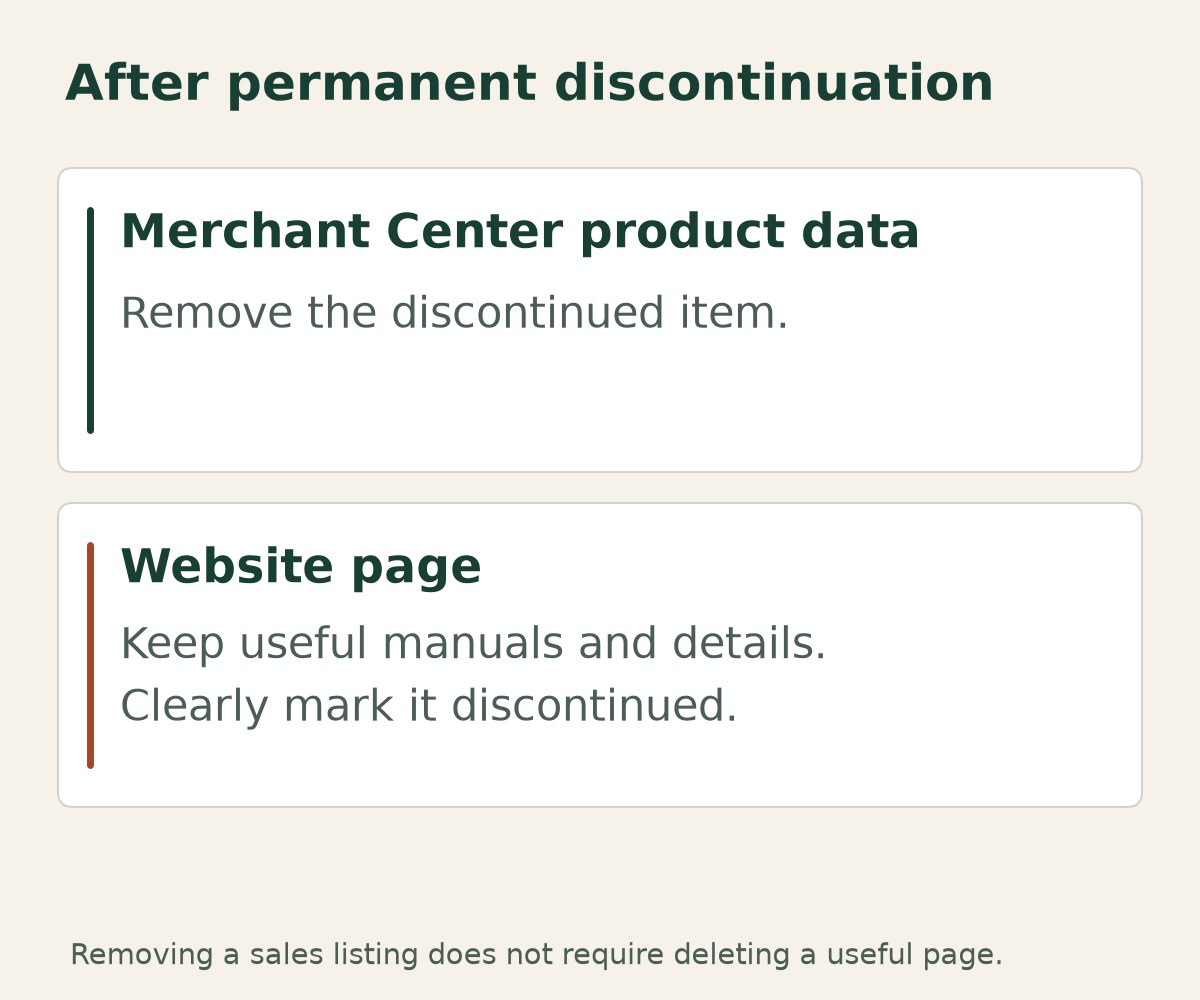
I would check the visible status, checkout behavior, structured data, and any product data still being submitted together. They should describe a consistent sales situation. A page must not say discontinued while its machine-readable availability still promises stock. Merchant Center's guidance also requires availability to agree across these surfaces.
Removing an item from a product data source does not mean its web page immediately disappears from organic search. Keeping a page accessible does not guarantee that it retains rankings. These need separate verification; neither status can stand in for the other.
Give each old URL a deliberate destination
Before a batch change, I would save the old URLs with model, language, market, reason for discontinuation or migration, and intended action. Where a destination is proposed, I would record why it meets the original need. These hypothetical scenarios show how the decision translates into page handling.
| Confirmed product and page situation | How I would handle it |
|---|---|
| Temporarily unavailable, with further sales expected | Keep useful product information and accurate stock status. Offer credible replenishment details, alerts, or alternatives where available. |
| The same product has permanently moved | Redirect to that product's new page, update internal links, and verify the model, language, and content. |
| Permanently discontinued, but manuals, specifications, or compatibility information remain useful | Retain useful content with a clear discontinued notice. Explain alternatives separately and remove the discontinued item from Merchant Center product data. |
| Another page fully serves the same need | Check that useful information has been carried over before applying a permanent redirect. A shared category alone is insufficient. |
| No remaining purpose and no relevant destination | Remove the page with a 404 or 410 and repair broken internal links. The error page can offer search and relevant navigation. |
The last case does not require sending every old URL to the home page to avoid all 404s. A working home page may still fail to answer a question about an old model. Google's HTTP status-code guidance explains how crawlers process removed content. An empty “product not found” page should not masquerade as ordinary product content with a 200 response.
After making the changes, I would walk the original visitor paths. What opens from the old link? Does the manual download work? Are differences in the alternative model clear? Can a discontinued item still be added to the cart? If only one variant is unavailable, can a shopper select and buy another available one? These checks reveal more of the actual experience than a successful page response alone.
I would then follow crawling, indexing, and search performance for the old URLs and their destinations. A decline in clicks on a redirected URL does not automatically establish lost demand. Nor should all clicks on the destination be counted as demand successfully recovered. Model-specific queries, the reasons for those searches, and related pages need to be examined together. Unmeasured purchasing or support outcomes remain unknown.
For me, the job would not end with a list marked “removed from sale.” I would also want to know where someone following the old link can now get an accurate answer.