

Given a list of blog posts with declining clicks, I would not start by marking the least-visited posts for deletion. I would open a few and ask who still needs them.
Imagine two articles with almost no recent search clicks. One promotes an offer that has ended. The other explains how to replace a part in an older device. Customer support might still send the second article to owners, even though those visits do not come from Google. Similar traffic numbers could lead to very different decisions.
I would start by writing down the question each article answers today. If I cannot name it, or the article fails to answer it, that gives me something specific to investigate. It is a more useful starting point than a target for how many posts to delete.
What I want to know after clicks decline
First, I would check the decline itself. Seasonal demand, waning interest in an old product, changes in search results, or a change in measurement can all affect the trend. I would fix the date range and page list, then examine queries, countries, and devices. Google's traffic-drop troubleshooting guidance covers these checks. A falling chart alone would not establish a penalty or show that one topic had damaged the whole blog.
Then I would examine the article's current job. Does it answer a question readers still have? Are people arriving through navigation, email, or other sites? Do support, sales, or product teams still share it? Before using orders or other downstream actions as evidence, I would check that they are being measured and understand how attribution works.
An unmeasured use belongs in the “unknown” column. Where tracking is incomplete, “no conversions in this export” does not establish that an article helps nobody. Equally, old backlinks do not excuse advice that now misleads readers.
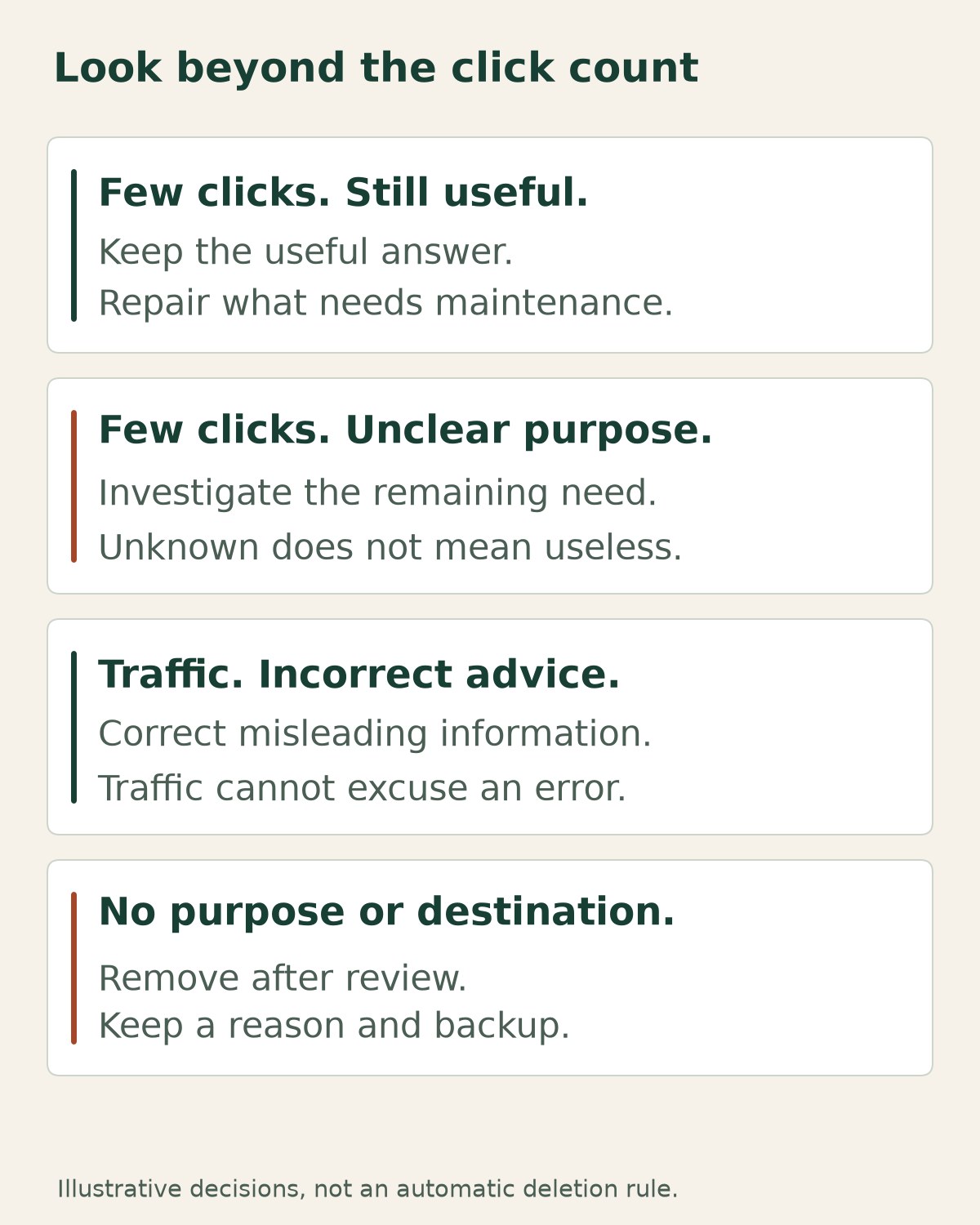
Take the hypothetical replacement-parts guide. If its model coverage is clear and the steps remain accurate, it may only need a few broken links repaired. If it recommends a part that is no longer compatible, that error deserves attention regardless of its search traffic.
Make the update specific enough to help someone
For that parts guide, I would define the work before asking for a rewrite: list compatible and incompatible models, verify which parts are still available, replace unclear step photographs, and check that purchase links lead to the right products. Those changes would give the reader a more usable answer.
Changing the year in the headline or adding a fresh introduction would not fix an incorrect step. Google's people-first content guidance warns against changing dates without substantial revisions and adding or deleting content simply to make a site appear fresh.
Where an article still serves the same need, I would normally improve it at its existing address. A second, nearly identical guide would prompt a consolidation review: do they serve the same readers, model range, and task? Replacing a part and choosing a new device both involve the device, but they are different jobs. Similar keywords would not be enough reason to merge them.
Before consolidating, I would move the useful details, images, and answers into the chosen destination. Someone following the old link should still find what they came for. A permanent move can use a 301 or 308, as explained in Google's redirect documentation. A technically working redirect does not tell us whether we chose a useful destination.
Decide where the reader goes before removing the page
For the expired promotion, I would ask whether anyone still needs its terms, support information, or historical details. Those may justify retaining a clearly marked archive with the expired sales promises removed. The end of an offer does not make every detail on its page obsolete.
These are the treatments I would consider after checking the purpose. None should be assigned automatically from a traffic ranking.
| What the review establishes | How I would handle it |
|---|---|
| The need remains, and the answer is mostly accurate | Keep it and repair links or small errors. Do not rewrite it merely to record an update. |
| The question matters, but facts, steps, or recommendations are outdated | Make a substantive update at the existing page and check that readers can complete the task. |
| Several articles genuinely answer the same question | Choose a suitable destination, preserve useful detail, then consolidate and update old URLs and internal links. |
| Users still need access, but there is a deliberate reason to exclude the page from search | Consider noindex while retaining access. This is a visibility decision, not a shortcut to better quality. |
| The page has no remaining purpose, useful information, or relevant destination | Keep an internal backup, remove the page with a proper 404 or 410 response, and repair internal links pointing to it. |
For noindex to work, Google must be able to access the page and read the instruction. Blocking that URL in robots.txt can prevent this, as the noindex documentation explains. A guide that still deserves to be found through search should not receive noindex simply because its traffic is low.
A removed page needs an appropriate HTTP response. Google's status-code documentation explains that URLs returning 404 or 410 are not indexed; previously indexed URLs are removed after Google recrawls and processes those responses. The error page can offer search and useful navigation, but it should not return a normal 200 response while saying the content does not exist.
Start with a batch whose purpose is understood
Before a broader cleanup, I would select a manageable group of pages with clear decisions and save the originals, old links, reasons, and destination mappings. Unclear cases would stay separate. A deletion quota would not resolve the uncertainty.
The first check after a change would be the original reader journey. Do the old support links work? Are the parts instructions still available? Did the merged guide retain its images and steps? Do redirects reach relevant pages? These are things I can verify without waiting for search traffic.
I would then monitor the same group and its destinations. After a merger, fewer clicks on an old URL may be expected; examining that URL alone can mistake a move for a loss. Old and new destinations need to be considered together, alongside search demand, unchanged pages, and other changes during the period. A recovery would still not prove that deleting old posts caused it.
I would retire an article that no longer serves a purpose and keep a modestly visited guide that answers a real question well. After the review, I want a clear reason for each page that remains and a traceable decision for each one that leaves.