

If I were running an SEO review before Black Friday, I would want everyone to leave knowing one thing: who will return next week with an answer to the problems we found today?
Clicks and crawl activity belong in the discussion. But when a chart ends with “keep monitoring,” the next meeting can easily start the same conversation again. Products, prices, and campaign pages change quickly before a sale. By next week, the page that prompted the discussion may look quite different.
I would build the review around a stable list of important pages and a few assignments someone can pick up without reconstructing the conversation. The numbers help us choose the work. The assignment preserves why we chose it.
Keep a stable watchlist of important pages
I would start with what the business actually intends to sell this season: the Black Friday landing page, relevant categories, priority products, and guides that help shoppers reach them. Before choosing the pages, I would confirm stock, target markets, and launch dates with the product owner. Last year's clicks alone would not put a product we no longer plan to promote at the top of the list.
Once selected, those URLs would stay together for the review period. New pages would go into a separate group, and retired pages would retain a note explaining why they left. Rebuilding the list around each week's best performers could make the trend look healthy while quietly losing track of last week's problem pages.
I would still scan the whole site and its main page types. A language directory returning errors matters even if the priority products have not yet been affected. The watchlist focuses the work; it should not hide the rest of the site.
Before comparing numbers, I would record the data cutoff, equal-length date windows, country, device, search type, and any brand-query exclusion. The exclusion rule needs to stay consistent too. A partial recent week should not be compared with a complete earlier one. The Search Console performance report documentation notes that the latest data can still be preliminary.
Black Friday also calls for two different comparisons. The previous week shows recent movement; a comparable stage before last year's event offers seasonal context. The same calendar date does not necessarily mean shoppers were at the same point in their buying cycle.
Decide whether a change calls for investigation or a fix
I would not use one rule such as “edit every page with a 10% decline.” A handful of clicks can create a large percentage swing on a page with few clicks. In a category with rising demand, flat clicks might deserve more attention than that swing.
I would first locate the change: one country, one product group, or a particular set of queries. Then I would look at the actual pages. Have prices, stock, or campaign details changed? Can visitors still reach the products they came to find? Google's guidance on investigating traffic drops also recommends examining dimensions such as pages and queries and considering seasonality.
Sometimes the right assignment is to establish the cause. More impressions without more clicks may call for a closer look at queries and positions, rather than an immediate title rewrite. Prescribing the fix too early gives someone a clear task built on an untested guess.
For priority, I would consider the pages' role in the coming sale, the obstacle customers face, and the time left to resolve it. Confirmed availability failures, accidental indexing exclusions, or broken purchasing journeys need attention when discovered. They should not wait for the weekly meeting, which is better used for trends, trade-offs, and follow-up.
Write a task someone can pick up next week
Consider a hypothetical example: a localized Black Friday page is live, but a check of the relevant category page finds no link to it. “Improve internal linking” leaves too much room for different interpretations of completion.
I would make the assignment specific enough to verify. The following is an illustrative record, not a completed client task. In actual use, the owner fields need real names.
| What to record | Example entry |
|---|---|
| Scope and observation | One language edition of this campaign. The relevant category page has been checked, and no link to the campaign page was found. Save the URLs, check time, and screenshot. |
| Next step | Confirm that the campaign page has useful content, then add a link in the relevant category's campaign area. Follow the link and check the destination and language. |
| Owner | Assign one page owner to make the change and an SEO owner to verify it. Record their names and the handoff time. |
| First check | On the day the change goes live, verify the visible link, working link, and correct destination content. Attach the live page and check record. |
| Follow-up | At the next review, check the latest crawl observations for both the edited category page and the campaign page, and record the campaign page’s indexing status. Mark checks without newer observations as unconfirmed and set another review date. |
The link being in place and Google having read the change are separate events. I would give them separate status fields.
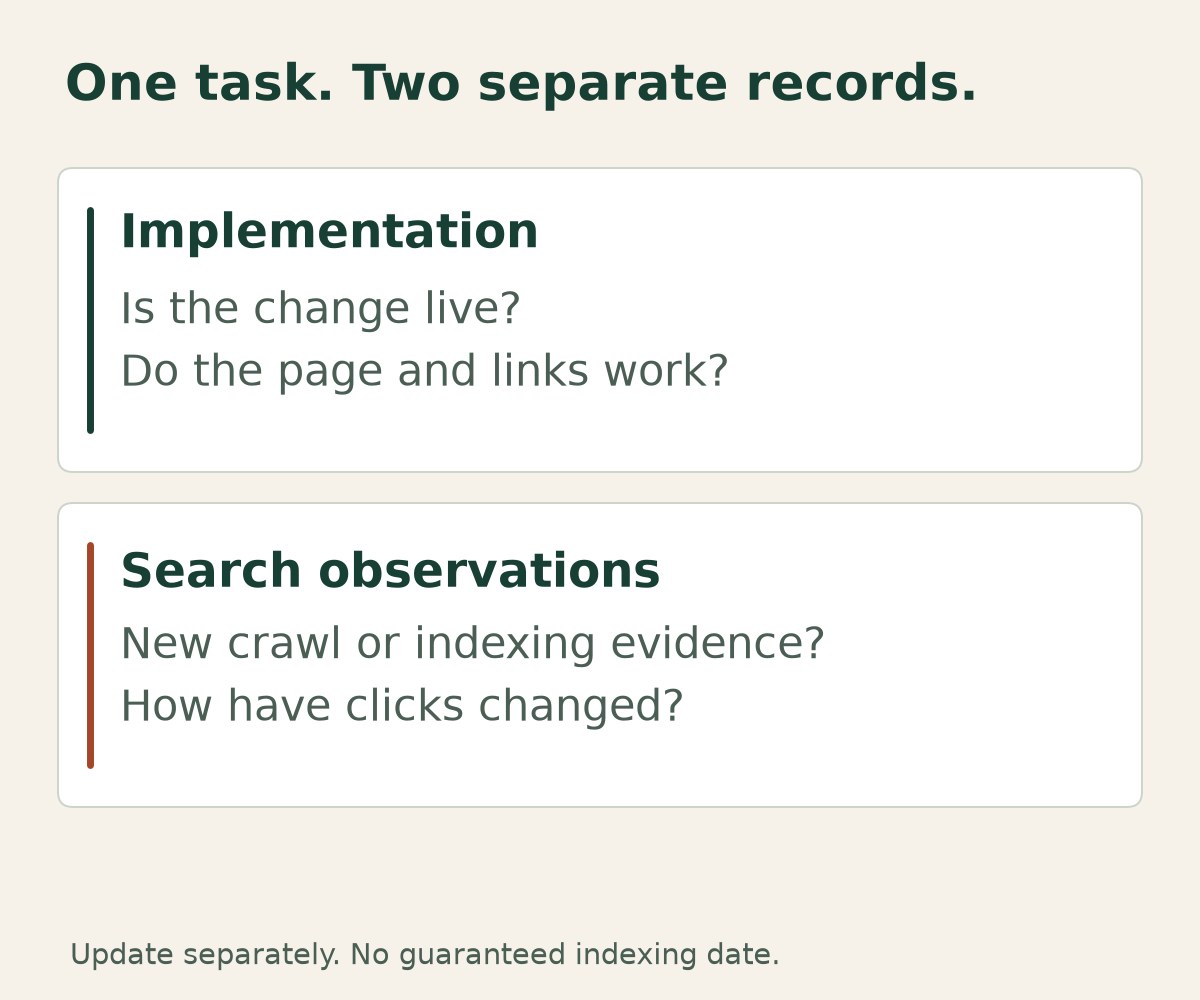
That lets the page owner hand over completed work while keeping the remaining SEO questions visible. The task need not stay “in development” while we wait for search data. Equally, submitting a crawl request does not establish successful indexing: Google's recrawl guidance makes clear that requests guarantee neither immediate processing nor inclusion in results.
You can use the blank review template or the template with an illustrative example. Both are CSV files for Excel or an online spreadsheet. Dates, owners, and page scope must be filled in for the actual work; the example sets no deadline for Google to index a page.
Open last week's tasks before this week's charts
At the next review, I would begin with the existing assignments. Is the entry live? Has someone checked it? Is there a new crawl observation? If we are still waiting, are we waiting for a website change or a response from a search system? Those answers determine where this week's effort belongs.
If the page works and search performance has not changed, seven elapsed days would not be enough reason for another edit. I would check whether there is enough new evidence and whether the original diagnosis still holds. A cancelled campaign, or a newly verified existing route to the page, might change the priority or close the task. The reason should remain in the record.
If clicks increase after a change, I would compare the same pages over equal-length windows while noting promotions, stock, prices, and trends in similar pages across the site. Holding the comparison group stable makes the movement easier to interpret. It does not establish that this repair caused the increase.
By the end of the review, someone should be able to open the task and see why it mattered, what has been completed, and what we are still waiting to learn. Carrying last week's reasoning forward is how the meeting saves time next week.