

If I were planning an ecommerce site's Black Friday page, I'd separate publishing the page from starting the sale. Discounts depend on confirmed products, stock and promotion terms. Some of the work that helps people find the page and choose what to buy can happen earlier.
When I compared click totals for a group of product pages, early November caught my attention. In 2024, weekly clicks rose from 29,000 in early October to 34,600 in early November, then reached 40,600 in Black Friday week. In 2025, the direction reversed: 31,900 in early October, 24,500 in early November and 23,200 in Black Friday week.
The gap was large by Black Friday. Looking back, there was already a reason to investigate in early November.
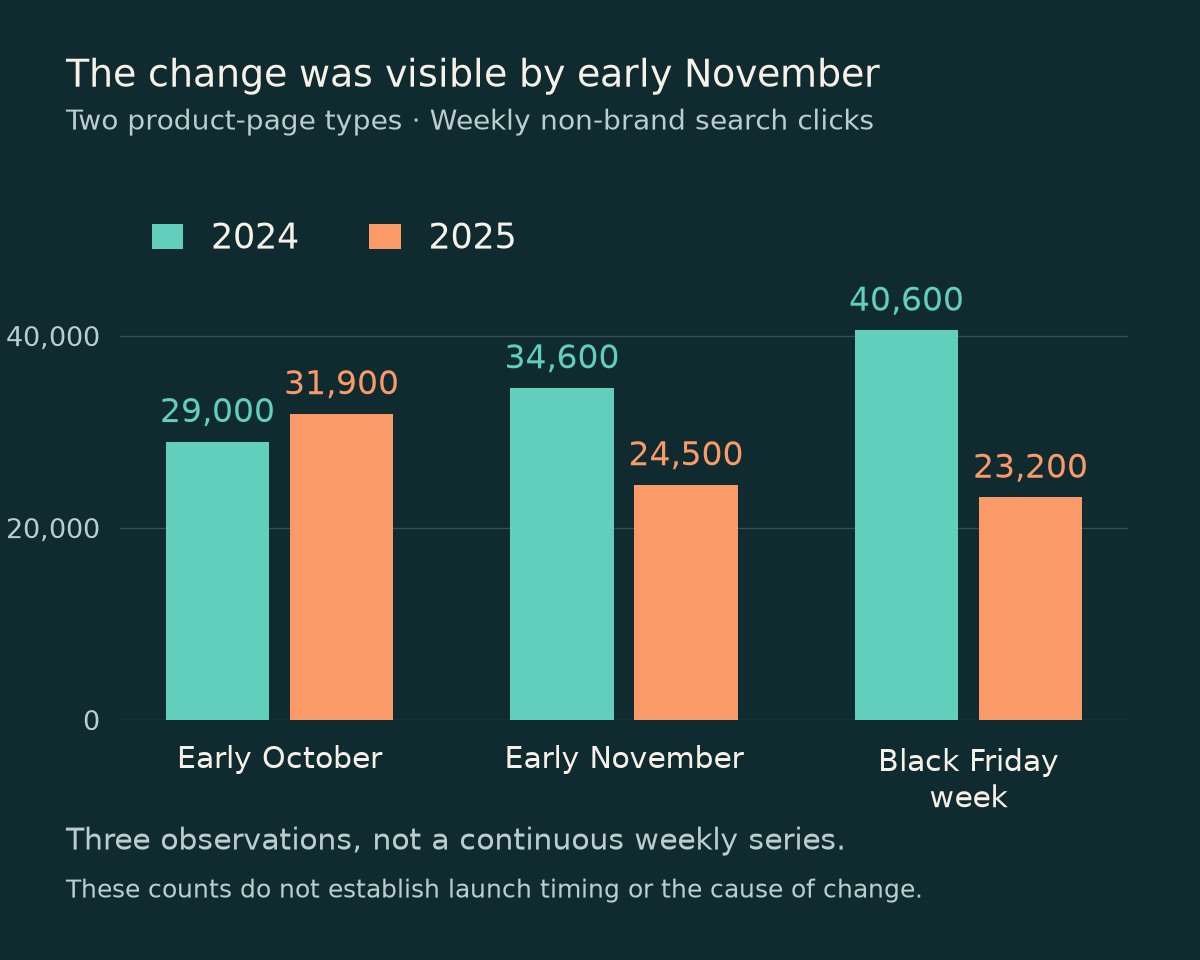
Those numbers don't tell me when the sale pages went live, or establish that publishing dates caused the decline. Rankings, search demand and changes to the products can also affect product-page clicks. But when planning the next season, I'd leave more time to check the pages. I wouldn't want to discover just before the sale that the page was hard to find, showed the wrong products or hadn't been indexed.
The page needs to help people choose, even before discounts are confirmed
Publishing early needs to give visitors something useful.
Suppose I were preparing a Black Friday page for homeware before the participating products had been agreed. Visitors could still browse categories currently available to buy, compare products for small spaces, and check dimensions, delivery coverage and return terms. If the sale dates were confirmed, I'd state them. Discounts and product lists that weren't settled would have to wait.
The distinction between "available to buy now" and "will be on sale" is easy to blur. Listing a product on a Black Friday page shouldn't imply that it will receive a discount. I'd keep current shopping information distinct from confirmed offers, and I wouldn't reuse last year's prices simply by changing the year on the page.
If all I could publish was "coming soon" and a countdown, I'd focus first on the category links, product information and page template. Making an empty page public wouldn't give people much help with choosing, or mean that preparation for the season was complete.
Once the offers were confirmed, there would already be a page to update. Product cards should identify the offers in effect and their conditions, with prices and availability matching what visitors find after clicking through. If the sale hadn't started, I'd make its start time clear rather than presenting a future price as one available now.
What the same page needs to offer changes as the sale progresses.
| Page stage | What visitors should be able to do | What the update needs to address |
|---|---|---|
| Offers not yet confirmed | Browse categories currently available, learn how to choose, and find confirmed event information | Products available now are not a confirmed sale list; don't promise unsettled offers |
| Sale in progress | Find offers in effect, reach the corresponding products and buy them | Prices and conditions must agree across the sale page, product details and checkout |
| Sale ended | See that the promotion has ended, while still using relevant buying advice and browsing current products | Remove expired offers and countdowns; update links or recommendations for discontinued or unavailable products |
I'd look for last year's page first
If the site had run Black Friday before, I'd check what the old page was still doing. People might still visit it, or it might hold the previous year's promotion terms. I wouldn't treat it as a blank template to overwrite.
An event that returns every year usually doesn't need a new URL containing the year each time. Google's Black Friday page guidance recommends creating pages early and reusing the same URL for recurring events. I'd put the year in the title and event details where it needed updating, while keeping the address stable.
That gives links from previous years a useful destination. Someone opening a bookmark or a link in an old article can see the event's current status, and the team doesn't have to keep hunting down internal links to last year's version. But if the old page serves as an archive of promotion terms, I'd retain that purpose and link it to the current event page. Consistent URLs wouldn't justify overwriting an archive.
I'd decide how to maintain the page after the sale before publishing it. If it would serve next year's Black Friday and could still provide useful shopping information, I'd keep it available and make clear that the latest promotion had ended. The large homepage promotion could come down, while relevant categories could retain a link where people would reasonably look for it.
Before the next season, I'd review the categories, delivery arrangements and event details again, replacing anything that no longer applied. The URL could stay the same; last year's products and promises couldn't simply carry over. I'd also include responsibility for those updates and their confirmation dates in the next event's schedule.
Keeping a page available all year has conditions, too. An empty category with no products and only last year's discounts isn't worth leaving as it is just to preserve the address. Google's ecommerce URL guidance recommends treatments such as noindex for categories without products. I'd retain a useful event page, without requiring every old promotion page to remain live indefinitely.
Where can visitors go after they arrive?
I'd also follow the links from the homepage and relevant categories to see whether visitors could find the sale page, then find products from there.
For example, a link about choosing lighting for a small home would be disappointing if it led to the entire homeware catalog. The advice wouldn't have helped narrow the choice. An existing lighting category might serve that need, or a maintained product collection might be more suitable. I'd decide based on whether it could show appropriate products, whether they were in stock and who would keep the selection current.
I wouldn't duplicate existing categories just to increase the number of Black Friday pages. Making a few priority routes work first would make problems with product selection, pricing or link destinations easier to spot. If currencies, delivery coverage and offers differed between markets, I'd check each route separately. Changing the country name in a title wouldn't be enough.
The technical checks would follow those same routes. Google's ecommerce site structure guidance recommends linking pages with href attributes and warns against relying on a search box in place of product navigation. I'd check that links had destinations Google could follow, beyond confirming that site search could find the products. A sitemap can help a search engine discover URLs, but it can't help a shopper choose a product after arriving on the sale page.
I'd check once at publication, then again when the sale starts
When the page first became public, I'd check that its main content and product links were accessible, with no accidental noindex tag or crawl restriction left from testing. Then I'd check whether Google had crawled and indexed it, and whether the version appearing in search was the one intended. Checking early would leave time to investigate a page that still wasn't appearing in search results.
Submitting a URL is only one step. Google makes clear that a crawl request doesn't guarantee immediate indexing, or indexing at all. I wouldn't mark search preparation complete on the day a request was submitted, or promise that a fixed number of weeks would be enough for every site.
Once confirmed offers were added, the checks would change. I'd open the products from the sale page to confirm that the offers were in effect, applied to the right market and could actually be purchased. If a product dropped out of the promotion at short notice, its appearance on the sale page would need updating too. I'd also check replacement recommendations after an item sold out, so the original product's offer wasn't left attached to its substitute. These changes can happen close to the sale. Having a stable page and a working route to the products earlier would leave more room to handle them.
For scheduling, then, I'd plan updates and checks for an existing recurring page. A new page wouldn't need to wait for final discounts once it offered real product choices, accurately explained the current situation and led visitors to the right products. If it couldn't do those things yet, I'd work on the content and links first. Publishing an empty page wouldn't solve the problem.
By the time the final discounts were agreed, I'd want the team to be concentrating on offers, stock and conditions. Where the page belongs, how people reach it and how they find products are things the team can prepare earlier, walk through and improve before then.