
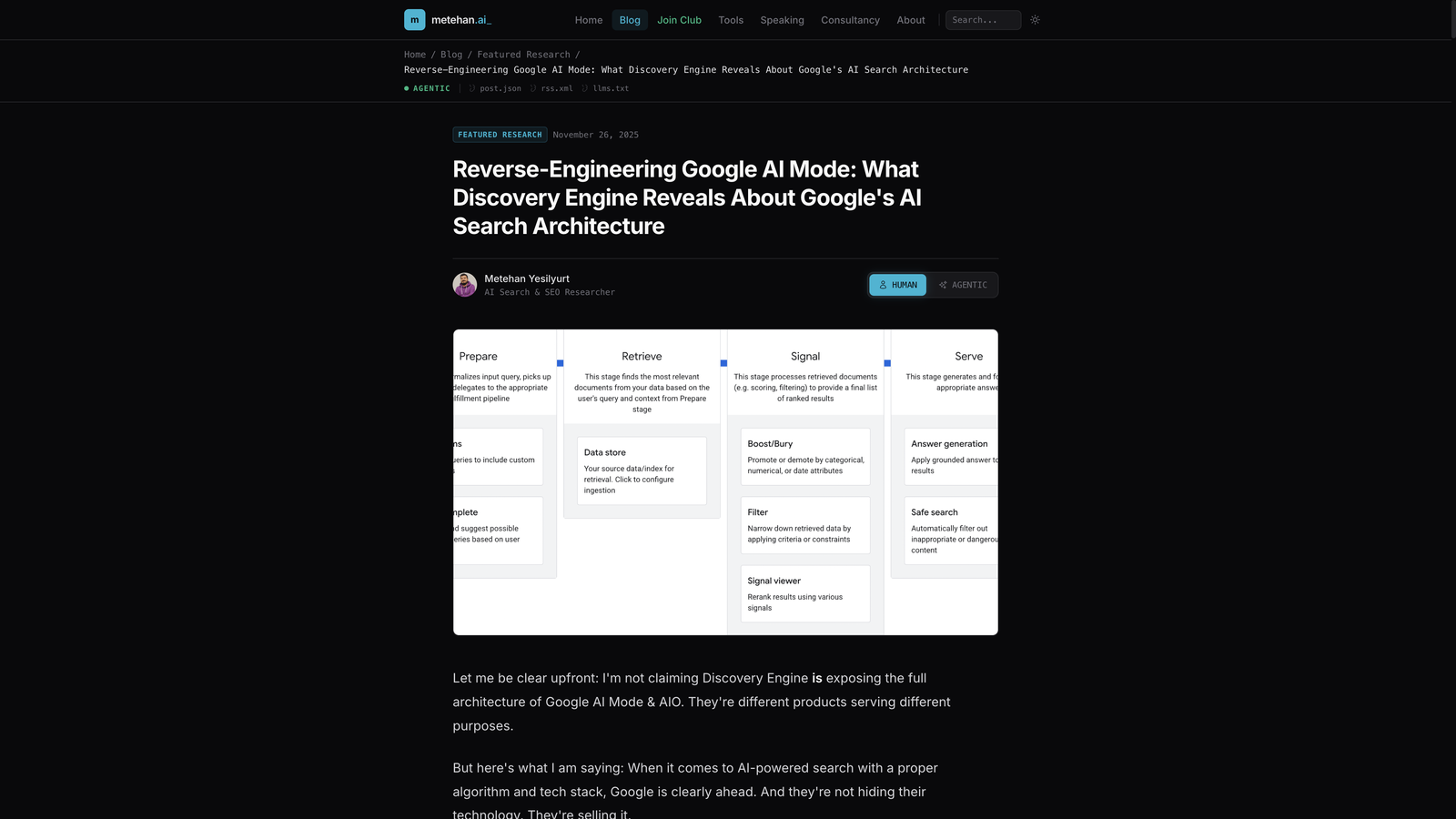
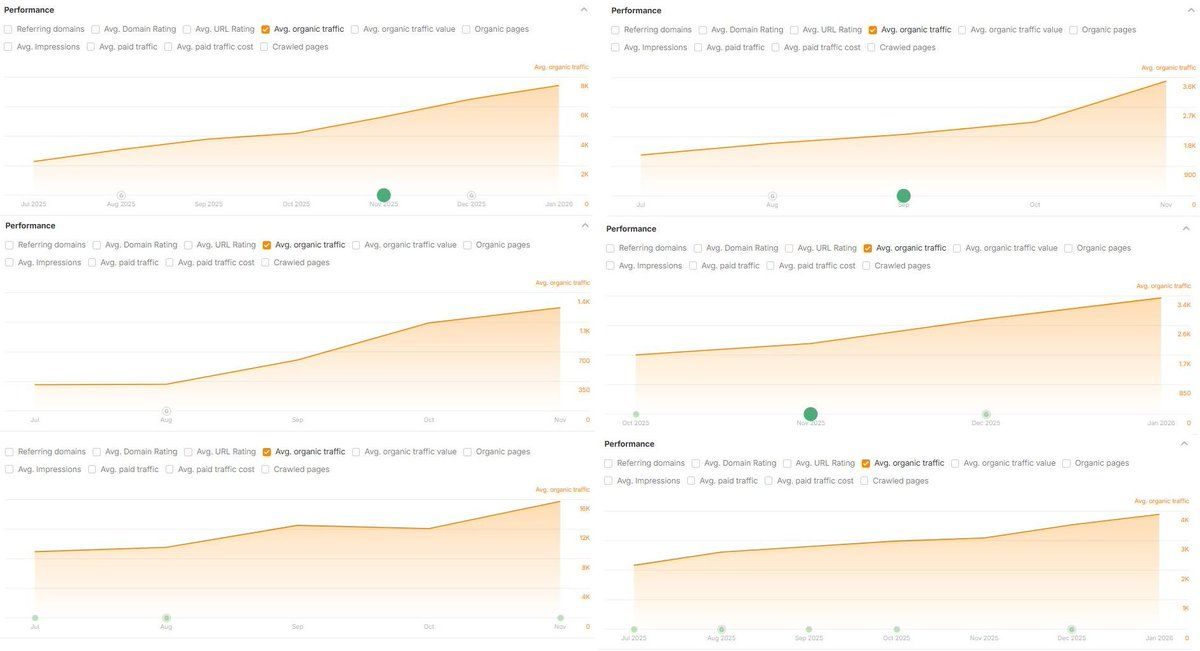
Source research: Metehan Yesilyurt on reverse-engineering Google AI Mode · Official signals: Google Cloud custom ranking docs Short answer: Treat Discovery Engine ranking signals as a public architecture map for Google's AI search products—not as a proven dump of consumer AI Mode source code. Optimize for semantic match, deep relevance, keywords, freshness, engagement prediction, and chunk-level clarity, then measure citations with a fixed prompt pack. Convertos readers can continue with the GEO guides or a free check in the AI Visibility Checker.LEAKED: Google just accidentally revealed how AI search systems actually work. Google just accidentally revealed how its AI search systems actually work. Now that none of it is a secret anymore, let's talk about it. 2026 is going to be a make or break year for a lot of businesses when it comes to traditional search and AI search.-- Alex Groberman (@alexgroberman) January 17, 2026
Key Takeaways
- Google Discovery Engine and related documentation provide the clearest public signals about how Google’s AI-driven ranking and retrieval systems operate, especially for enterprise and AI-powered search experiences.
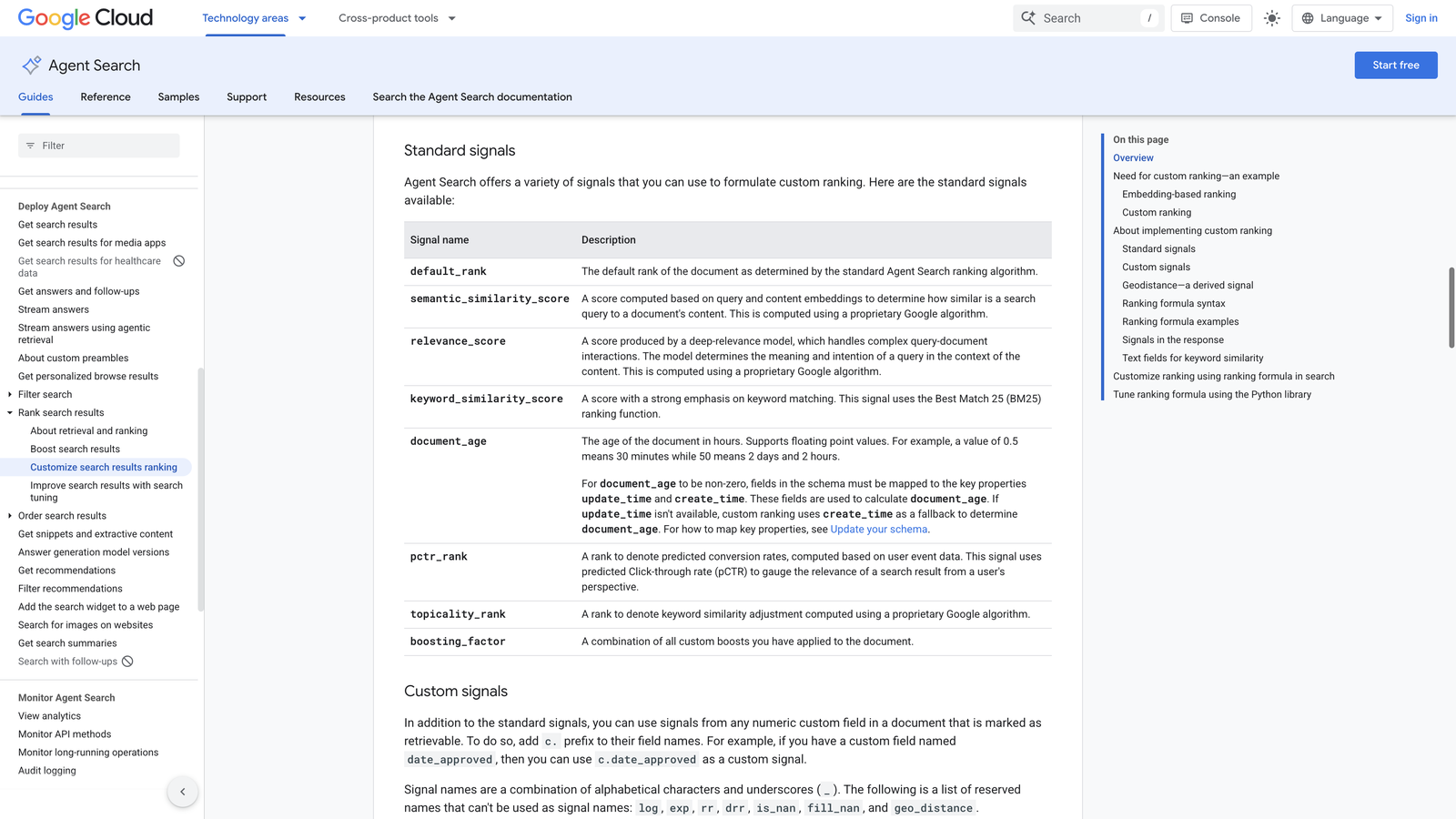
- Core ranking signals include default_rank, semantic_similarity_score, relevance_score, keyword_similarity_score (BM25), document_age, pctr_rank, topicality_rank, and boosting_factor. These are documented in Google Cloud’s Custom Ranking docs.
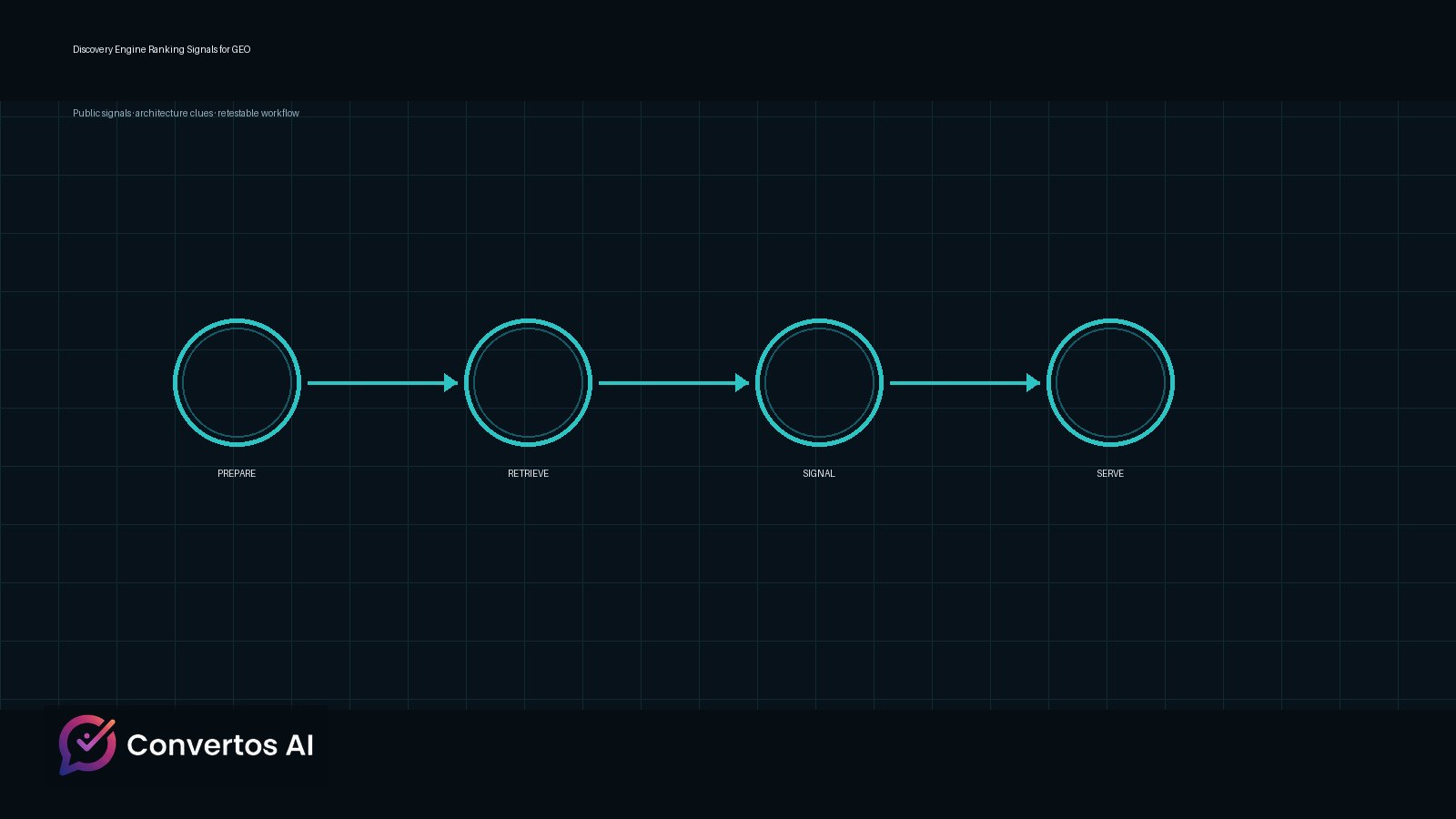
- The practical ranking process involves multiple stages: Prepare (chunking content), Retrieve (embedding and BM25 search), Signal (scoring and ranking), and Serve (final output). This mirrors the “Base Ranking → Embedding → Cross-Attention → BM25 → PCTR → Freshness → Boost/Bury” research framing.
- For GEO (Generative Engine Optimization), understanding these signals is critical to optimizing content for AI-driven surfaces, including Google’s Search Generative Experience (SGE) and Discovery Engine-powered products.
- While Discovery Engine and Agent Search documentation provide strong signals about Google’s enterprise search stack, they are not a direct window into consumer Google AI Mode or SGE source code. They are, however, the most actionable public proxies for ranking logic.
- Reverse engineering efforts (see Metehan’s analysis) and public commentary (Alex Groberman's X article) reinforce the overlap between enterprise and consumer AI ranking architectures, but practitioners should treat these as signals, not absolute proof.
- Convertos GEO practitioners should focus on optimizing for semantic relevance, freshness, topicality, and user engagement signals, as these are consistently surfaced in both documentation and observed ranking behaviors.
What the Discovery Engine Signal Story Actually Means
The Discovery Engine ranking signals story refers to a set of official documentation and research that outlines how Google’s enterprise search products—like Discovery Engine and Generative AI App Builder—rank content. These signals are not direct blueprints for consumer-facing Google Search or AI Mode, but they offer the clearest public view into how Google’s retrieval and ranking systems might work, especially as they evolve toward generative and agentic search. For GEO and B2B SEO, understanding this signal set helps prioritize content and technical strategies that align with modern search expectations. Google’s Discovery Engine signals are detailed in enterprise documentation (see Cloud Generative AI App Builder docs). They include features such asdefault_rank, semantic_similarity_score, relevance_score, keyword_similarity_score (BM25), document_age, pctr_rank, topicality_rank, and boosting_factor. These signals are used in multi-stage ranking pipelines—often described as Prepare → Retrieve → Signal → Serve—to select and order results.
While these signals are documented for enterprise products, they are not guaranteed to be identical to those in consumer Google Search or AI Mode. However, research and reverse engineering (see metehan.ai, Alex Groberman’s analysis) show strong conceptual overlap. For GEO practitioners, these signals provide a practical framework for understanding what matters in AI-powered search environments.
Suppose you use the Convertos GEO toolkit to optimize a product catalog for AI-powered search. By focusing on signals like semantic similarity (matching user intent to product descriptions), document freshness (updating listings), and keyword relevance (BM25-aligned fields), you align your content with the types of signals Google’s enterprise search stack values. This increases the likelihood your content is surfaced in agentic or generative search scenarios.
These signals are documented in enterprise contexts only (Cloud docs). They are not confirmed as the exact mechanisms for consumer Google Search or AI Mode. They should be treated as strong indicators, not definitive blueprints.
Discovery Engine signals offer the most actionable public insight into Google’s evolving ranking logic for AI and agentic search. For GEO, aligning with these signals is a pragmatic way to future-proof content and technical strategies, but practitioners should stay alert to ongoing changes and limitations in public documentation.
| Source/Signal Chain | Source/Authority | Scope/Notes |
|---|---|---|
| Official Cloud documentation | Cloud Generative AI App Builder docs | Enterprise product, not consumer Search |
| Reverse engineering | metehan.ai | Research, not official confirmation |
| Industry analysis | Alex Groberman on X | Informed speculation, not Google source code |
| Google Search AI features | Google Search docs | High-level overview, not signal-level detail |
The Seven Ranking Signals and the Four-Stage Pipeline
Google’s Discovery Engine and Agent Search documentation outline a clear set of ranking signals and a four-stage pipeline that shapes how AI-driven results are prepared, ranked, and served. Understanding these signals and their flow is crucial for GEO and SEO professionals seeking to optimize for Google’s evolving AI-powered surfaces.The Seven Core Ranking Signals
Google Cloud’s official documentation (source) and independent research (source) identify seven primary signals used in the ranking process. These signals are both explicit in Google’s API and visible in research reverse-engineering AI Mode results:| Signal Name | Cloud Docs Name | Research/Industry Name | Function/Purpose |
|---|---|---|---|
| Default Rank | default_rank | Base Ranking | Initial static/document score |
| Semantic Similarity Score | semantic_similarity_score | Gecko/Embeddings | Measures semantic match between query and doc |
| Relevance Score | relevance_score | Jetstream/Cross-Attention | Assesses contextual relevance |
| Keyword Similarity Score | keyword_similarity_score | BM25 | Traditional keyword match (BM25) |
| Document Age | document_age | Freshness | Recency of document/content |
| PCTR Rank | pctr_rank | Predicted Click-Through Rate | Estimated user engagement |
| Topicality Rank | topicality_rank | Topicality | Topical match to query intent |
| Boosting Factor | boosting_factor | Boost/Bury | Manual/algorithmic promotion or demotion |
The Four-Stage Pipeline: Prepare → Retrieve → Signal → Serve
The Discovery Engine pipeline processes queries and documents through four main stages:- Prepare: The system parses the query, expands it with synonyms/related concepts, and segments content into ~500-token chunks for efficient processing.
- Retrieve: Candidate documents are fetched using fast base ranking, keyword/BM25, and semantic embedding methods (Gecko).
- Signal: Each candidate is scored using the seven signals above, including advanced cross-attention models (Jetstream) and engagement prediction (PCTR).
- Serve: The top-ranked results are assembled, possibly re-ranked or filtered, and presented to the user.
Chunking, Schema Flags, and Extractable Answer Blocks
Modern AI-driven search engines—including Google’s Discovery Engine—rely on dividing web content into ~500-token “chunks” that are independently indexed, ranked, and retrieved. Each chunk is evaluated for search relevance, schema signals, and its ability to provide extractable answer blocks. This approach enables more granular, context-aware retrieval and ranking, directly impacting how your content surfaces in AI-powered GEO and SEO environments. Chunking refers to the process of splitting a page’s content into smaller, semantically coherent sections (typically 300–500 tokens). Each chunk is treated as a standalone unit for retrieval and ranking. This method allows search systems to pinpoint and serve the most relevant section of a page in response to a query, rather than relying solely on the page as a whole. Schema flags—such as FAQ, HowTo, and Product markup—act as explicit signals within each chunk, helping AI models identify which sections are most likely to contain concise, extractable answers. These flags increase the likelihood that a chunk will be selected for direct answer blocks or featured snippets in AI Mode and GEO interfaces. Suppose your Convertos-powered site has a comprehensive GEO landing page. By structuring content under clear ancestor headings and using schema markup for FAQs and HowTos, each ~500-token chunk becomes independently indexable and retrievable. For example, a section titled “How to Optimize GEO Pages for AI Ranking” with a schema-flagged FAQ block can be surfaced as a direct answer in AI Mode, even if the rest of the page covers unrelated topics. Google’s own Discovery Engine documentation confirms the use of chunk-based retrieval and ranking, with explicit mention of “retrievable document chunks” and schema-driven ranking signals (source). Research and reverse engineering efforts (source) further support the importance of chunking and schema flags for answer extraction. However, it’s important to note that these findings are based on enterprise Discovery Engine and public research signals, not direct consumer Google AI Mode source code. To maximize your content’s visibility in AI-powered GEO and SEO, structure pages with clear headings and schema markup, ensuring each chunk is independently meaningful and answer-ready. This enhances both indexability and the likelihood of being selected for high-visibility answer blocks in AI-driven search experiences. For more on optimizing content for AI retrieval, see Convertos GEO and AI Visibility Checker.GEO Workflow and Checklist
GEO (Generative Experience Optimization) is a systematic approach to optimizing SaaS money and comparison pages for Google’s evolving AI-driven ranking systems. The workflow below aligns with signals and ranking factors identified in Google Discovery Engine documentation and recent research, ensuring your pages are ready for both traditional and AI-powered search environments.Actionable GEO Checklist for SaaS Money & Comparison Pages
| Step | Action | Why It Matters | Convertos Example | Evidence/Caveat |
|---|---|---|---|---|
| 1 | Define Target Queries | Focus on high-intent, product-specific terms and comparison phrases. | Use Convertos GEO to extract and cluster “best [product] software” and “[product] vs [competitor]” queries. | Semantic and keyword similarity (BM25) are core ranking signals (Cloud Docs). |
| 2 | Structure Content in 500-Token Chunks | Organize content into discrete, answer-focused blocks (features, pricing, pros/cons). | Convertos Toolkit segments your page into logical, retrievable chunks. | Google’s retrieval process works at ~500-token granularity (Metehan analysis). |
| 3 | Optimize for Semantic and Topical Relevance | Use natural language and entity-rich descriptions matching user intent and product context. | Enrich feature lists and comparison tables with product-specific terminology. | Semantic similarity and topicality_rank are official Cloud ranking signals. |
| 4 | Highlight Freshness and Authority | Include recent data, update timestamps, and cite authoritative sources. | Add “Last updated” dates and reference official vendor documentation. | document_age and authority signals impact ranking (Cloud Docs). |
| 5 | Enhance User Engagement Signals | Improve clarity, readability, and interactive elements (FAQs, calculators). | Deploy Convertos AI-Visibility Checker to identify engagement gaps. | Predicted click-through rate (pctr_rank) is a ranking factor; user engagement is a proxy. |
| 6 | Implement Clear Comparison Logic | Use structured tables and explicit criteria for side-by-side product comparisons. | Build comparison matrices with Convertos GEO templates. | Structured, relevant comparisons boost retrieval and ranking (Google AI Features). |
| 7 | Monitor and Iterate | Track performance and update content based on new ranking insights. | Regularly audit with Convertos GEO and AI-Visibility Checker. | AI ranking systems evolve; continuous optimization is required. |
How to Measure Success
Success in Google’s Discovery Engine and AI-powered search environments requires a shift from traditional SEO metrics to a new set of indicators that reflect visibility, authority, and adaptability in generative and agent-driven results. Below is a measurement table and guidance for ongoing tracking using Convertos GEO tools.| Metric | Definition | Why It Matters for GEO/AI Mode | Convertos-Relevant Example | Evidence/Caveat |
|---|---|---|---|---|
| Citation Rate | Frequency your content is cited/quoted in AI results | Indicates authority and trust in AI summaries | Convertos GEO detects your brand cited in SGE snapshots or AI overviews | AI Mode citation patterns are still evolving; see reverse engineering |
| Brand Mention | Instances your brand is referenced (linked or unlinked) | Measures brand presence in generative answers | Convertos GEO tallies mentions across AI-generated panels | Not all mentions are surfaced to users; see AI features |
| Competitor Share | Share of voice vs. key competitors in AI/Discovery | Benchmarks your position in generative rankings | Convertos GEO compares your share to top rivals | Discovery Engine ranking is not identical to classic SEO; see custom ranking docs |
| Extractability | Ease with which AI extracts, summarizes, or links your content | Impacts inclusion in AI-generated answers | Convertos GEO flags extraction issues in your content | Extraction is influenced by technical structure and semantic clarity, not just keywords |
| Freshness Lag | Time between publishing and appearance in AI/Discovery results | Reflects agility and topicality in fast-moving queries | Convertos GEO tracks how quickly your updates surface | Freshness signals (document_age, topicality_rank) are official but not always immediate |
Weekly Prompt Pack for Measurement
To operationalize these metrics, use a “weekly prompt pack” in Convertos GEO:- Citation/mention scan: Prompt Convertos to report new citations and mentions in AI/Discovery results.
- Competitor comparison: Run a weekly share-of-voice analysis for your main topics.
- Extractability check: Audit top URLs for extraction or summarization issues.
- Freshness tracking: Log the time lag between publishing and first AI/Discovery appearance.
FAQ
Community threads, related searches, Reddit-style discussions, and People Also Ask style questions keep circling these points. Short answers below. Source signals: community discussion, related searches, and SERP question clusters.Is Discovery Engine the same as Google AI Mode?
No — it is a Google Cloud enterprise search product, so treat published ranking signals as architecture clues rather than consumer AI Mode source code (custom ranking docs).Do keywords still matter?
Yes — Google Cloud still documents BM25-stylekeyword_similarity_score next to semantic scores, so optimize for both (Google Cloud docs).
Does schema guarantee AI citations?
No — schema can help systems understand a page, but citation still depends on clear answers and competing sources; retest in the AI Visibility Checker.How big should content chunks be?
Aim for roughly 500-token blocks with clean headings and short direct answers, matching the research write-ups on metehan.ai.How often should teams retest?
Retest after major rewrites, then weekly with a fixed prompt pack, and log citations via the GEO guides.Sources and Methodology
This section outlines the hierarchy of sources referenced in our analysis of Google Discovery Engine ranking signals and their implications for AI Mode and GEO. Our research is current as of July 28, 2026. Source Hierarchy and Evidence Our primary evidence comes from official Google documentation and technical references, prioritized as follows:- Google Cloud Discovery Engine Docs
default_rank, semantic_similarity_score, relevance_score, keyword_similarity_score (BM25), document_age, pctr_rank, topicality_rank, and boosting_factor—are sourced directly from Google’s Cloud Discovery Engine documentation (custom ranking). These signals are officially documented for enterprise product use and are the most authoritative source for understanding how Google’s AI-powered retrieval and ranking systems are structured.
- Reverse Engineering and Practitioner Research
- Official Search Documentation