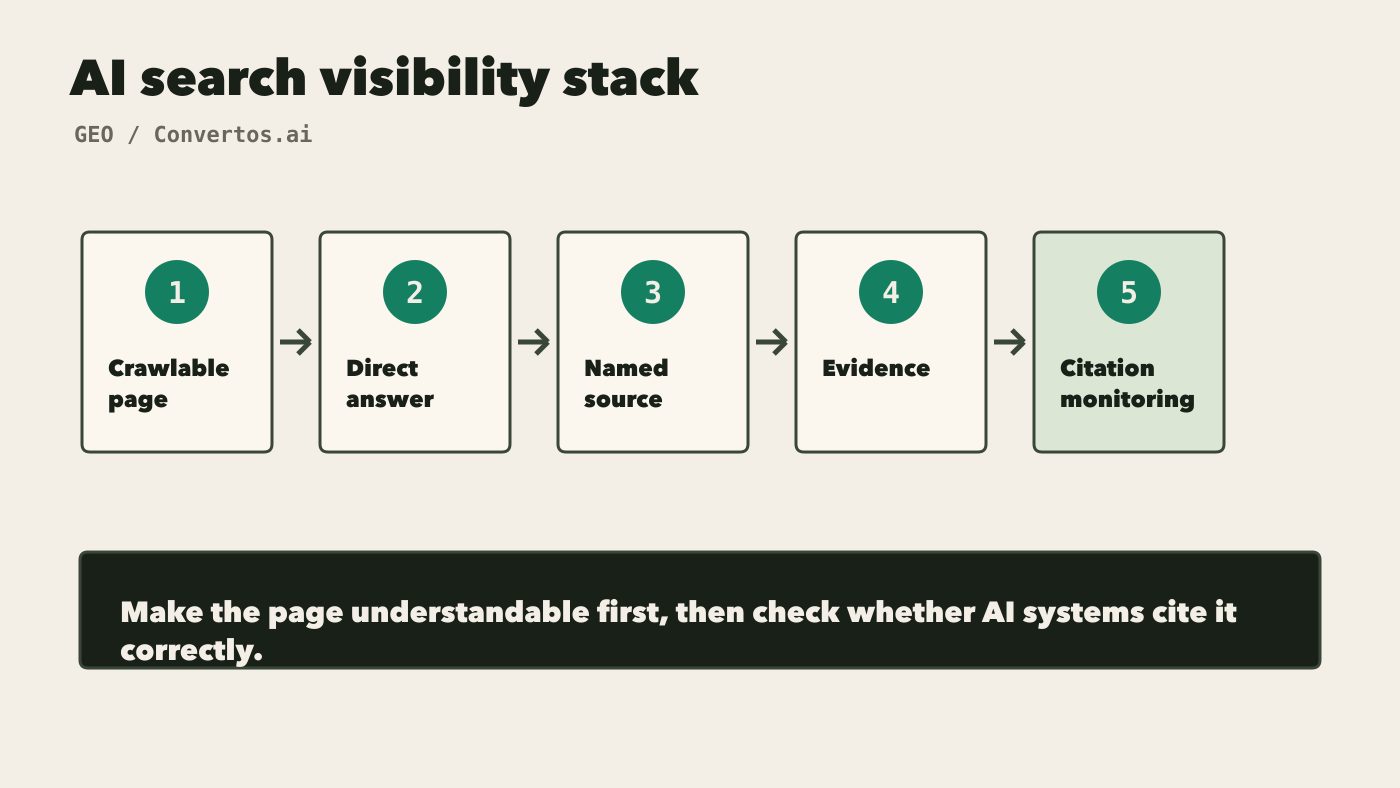
GEO is the work of making a brand and its pages easy for AI search systems to understand, verify, and cite. For Google AI search experiences, GEO does not replace SEO. It sits on top of crawlable, indexable, helpful pages. The practical job is simple: make the page accessible, answer real questions clearly, attach evidence near important claims, name the right entities, and measure whether AI answers mention the brand accurately.
40-second explainer: GEO starts with crawlable SEO, then checks whether AI systems cite the page correctly.AI search visibility stack: access, answer, source, evidence, and monitoring.
Key Takeaways
Google AI search GEO is not a hidden prompt trick. It is a visible-page quality system: crawl access, direct answers, evidence, entity clarity, and citation monitoring.
Start with technical SEO: Google cannot use a page that is blocked, canonicalized incorrectly, or hard to render.
Write answer blocks near the top of major sections so AI systems can extract a complete answer.
Use official sources for Google behavior and use industry studies only as interpretation.
Track citations, brand mentions, and answer accuracy in addition to rankings and clicks.
Build separate GEO and SEO content clusters, then link them together.
The practical takeaway is boring in the best way: make the page easier to fetch, easier to quote, and easier to verify before chasing any AI-specific tactic.
Why Search Central Shanghai 2026 Matters for GEO
Search Central Live Shanghai 2026 matters because Google put AI search resources beside traditional SEO resources in the same event pack. That pairing is the story: AI search is changing how answers are shown, but the requirements still depend on accessible, useful, well-structured web pages.
The event resource list points readers to Google Search Central, the SEO Starter Guide, robots.txt, helpful content, AI-generated content guidance, AI features, Gemini, and AI Overviews / AI Mode material. That is not a separate "AI ranking recipe." It is a reminder that AI answers still need sources. A weak technical page, a vague article, or an unsupported claim gives AI systems little reason to use the page as a source.
For Convertos.ai, this is a strong GEO article angle. A simple event recap would only summarize links. A GEO guide turns those links into a workflow: make the page eligible, make the answer clear, make the claim verifiable, then measure whether AI answers use it.
What Google Actually Says About AI Features
Google's AI features and your website guidance does not ask site owners to create a special AI tag. It points back to the same controls that affect normal search visibility: Search Essentials, robots access, snippet controls, preview controls, and page-level availability.
That matters because many GEO discussions jump to small files, hidden summaries, or mass FAQ blocks. Those may be supporting details, but they are not the core. Google's public guidance still rewards pages that users can access, understand, and trust. Google's post on succeeding in AI search experiences also keeps the focus on helpful, unique content written for people.
The safest GEO rule is this: if a recommendation would make the visible page clearer for a human editor, a search crawler, and a fact-checker, it is likely useful. If it only creates a hidden signal that readers cannot inspect, treat it as secondary until there is stronger evidence.
What Current SERP Patterns Reveal
The current SERP for "Google AI search SEO GEO" is dominated by explainers and practitioner guides. Search Engine Land, The Digital Ring, Pure SEO, SEOmonitor, and community discussions all frame GEO around AI citations, answer visibility, and the difference between ranking and being cited.
The gap is measurement. Many pages explain GEO, but fewer show a repeatable way to test whether a brand appears in AI answers, whether the answer is accurate, and which source was cited. That is where a Convertos.ai article can add information gain.
The article should not claim that GEO guarantees AI citations. It should say that GEO improves the conditions that make citation more likely and gives teams a way to measure outcomes.
The GEO Visibility Stack
A useful GEO audit follows a sequence. Do not start with prompts if the page cannot be crawled, and do not report "AI visibility" if you have not checked whether the answer is correct.
The table is also the order of operations. If access fails, fix technical SEO. If access is clean but AI answers ignore the page, improve answer blocks and evidence. If AI answers cite the page but describe the brand incorrectly, fix entity signals and outdated claims.
How AI Overviews Change Measurement
AI Overviews change measurement because they can satisfy part of the user journey before the click. Semrush's AI Overviews study tracked AI Overview growth across a large set of desktop queries. Ahrefs' click study found lower click-through rates for top-ranking pages when an AI Overview appears. Pew Research Center also observed fewer link clicks when AI summaries are present.
Those findings do not mean SEO is dead. They mean the reporting model is incomplete. A brand may keep rankings and lose clicks. A brand may also be cited in an AI answer without owning the top blue-link position. GEO fills that reporting gap by asking a new set of questions:
Metric
How to measure it
Caveat
Citation rate
Sample priority prompts and record whether the page is cited
Results vary by location, account state, and time
Brand mention rate
Record whether the answer names the brand or product
A mention without a source can still be useful, but weaker
Answer accuracy
Check whether AI describes the brand, feature, limit, or date correctly
Needs human review
Source mix
Compare cited URLs against competitors and official sources
Citations can shift quickly
Post-answer action
Track demo, template, tool, or newsletter clicks
Requires analytics beyond GSC
The best monthly GEO report combines Search Console data with AI answer sampling. That lets the team separate ranking problems, click-distribution problems, citation problems, and answer-quality problems.
How to Write GEO-Friendly Content
GEO-friendly content is written so a person and a machine can both answer: what is this page about, what claim is being made, why should it be trusted, and what should the reader do next?
Use this pattern for each major section:
Start with a direct answer.
Define terms before using them heavily.
Link the source near the claim, not at the bottom only.
Add an example, checklist, table, or decision rule.
State the caveat or case where the advice does not apply.
For example, do not write "AI Overviews will destroy traffic." A better answer is: AI Overviews can reduce clicks for some informational queries, but the impact depends on query type, whether the answer cites your page, whether the answer satisfies the full task, and whether your page offers a next action that AI cannot complete.
Common Mistakes
Most GEO mistakes come from treating AI search as a shortcut. The safer view is that AI search raises the cost of vague content.
Mistake
Why it hurts
Better approach
Publishing hidden AI summaries
Readers cannot verify them
Improve visible intro, H2 answer blocks, and source notes
Adding FAQ without improving the body
FAQ cannot rescue weak content
Put the main answer in the body and use FAQ for long-tail questions
Reporting only rankings
AI summaries can change clicks and discovery
Track citation rate, brand mention, and answer accuracy
Claiming guaranteed citations
No public source supports that promise
Use cautious language and show the measurement method
Using fake screenshots or fake metrics
Breaks trust
Use real tests, public sources, and clear limitations
FAQ
Is GEO replacing SEO?
No. Source signal: related searches for "GEO vs SEO" and Google AI feature documentation. GEO depends on SEO basics such as crawl access, indexability, canonical signals, and helpful content.
Does Google require special schema for AI Overviews?
Google does not publish a special AI Overview schema requirement. Source signal: Google's AI features guidance. Use structured data only when it matches visible content.
Can AI-generated content rank or be cited?
AI-assisted content can be used, but it still needs quality, originality, evidence, and editorial review. Source signal: Google's AI-generated content guidance.
Why can traffic drop if rankings stay stable?
AI summaries and other SERP features can change click behavior. Source signal: Ahrefs and Pew click-behavior research. Compare Search Console CTR with AI answer sampling before blaming one cause.
What should a GEO audit measure first?
Start with access, then answer quality, evidence, entity clarity, and citation monitoring. Source signal: competitor SERP patterns and the prompt cluster around GEO checklists, tools, and measurement.
Source Statement
This article uses Google Search Central documentation, the Search Central Live Shanghai 2026 resource pack, public AI Overview studies, and current SERP observations. AI search behavior changes by query, region, language, account context, and date. Treat the workflow as a repeatable audit method, not a guaranteed citation formula.