Learn how video citations and ghost citations affect GEO visibility, why source links do not equal brand exposure, and how to place brand names in metadata, text, tables, code, and video transcripts.
Video citations can help AI systems find your content, but ghost citations can still keep your brand invisible in the answer text.
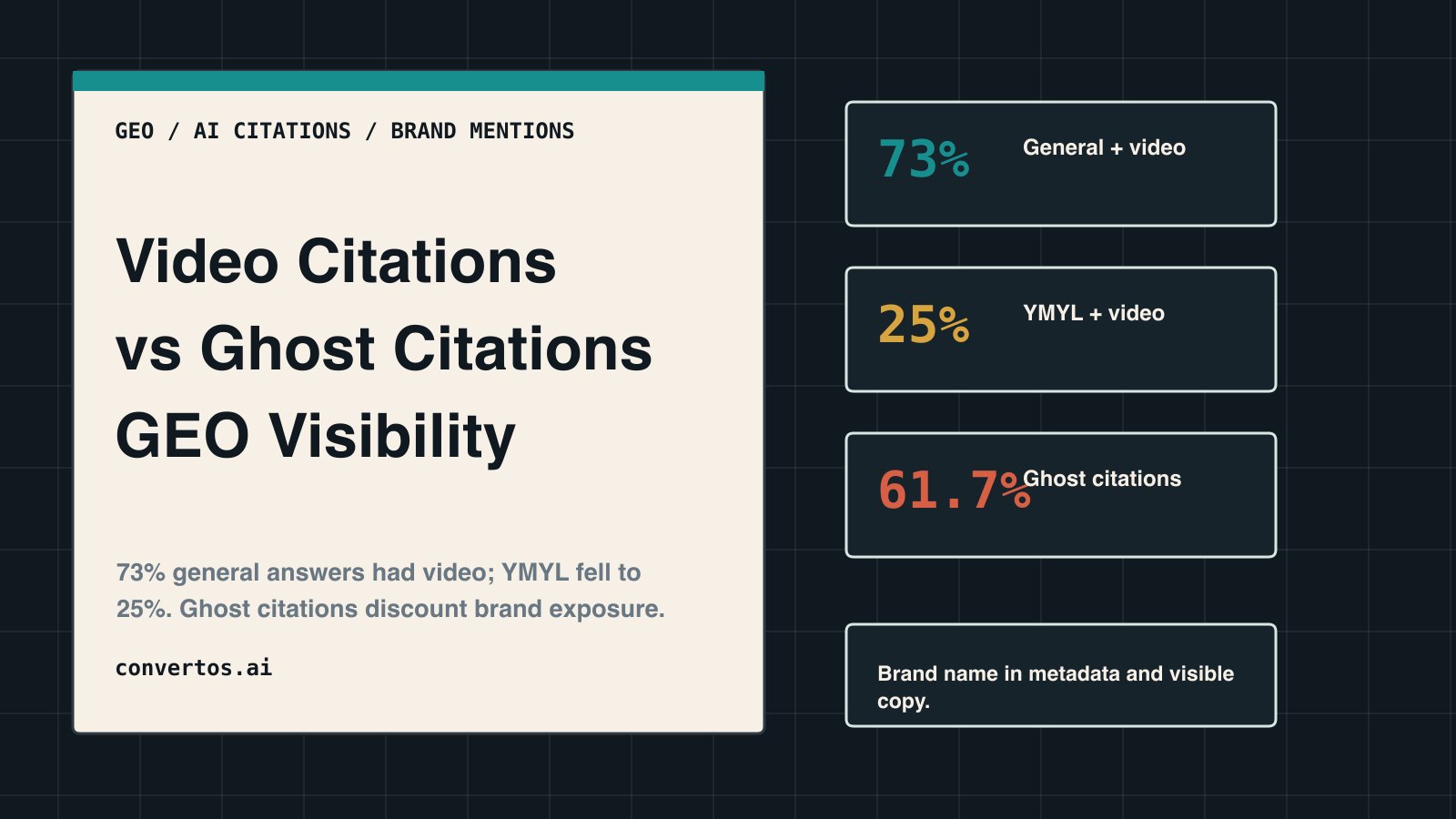
Video can become a citation source in AI answers, but citation is not the same as brand exposure. In the benchmark behind this article, 73% of general AI answers included at least one video, while only 25% of YMYL answers did. A separate ghost-citation finding shows the larger risk: in 61.7% of observed citation appearances, a domain was listed as a source but the brand was not named in the answer body. The fix is not to upload more video blindly. Put the brand name in metadata and in visible body content, including tables, charts, code examples, transcripts, and captions.
English explainer video: how video citations and ghost citations change GEO measurement.
Key Takeaways
The practical GEO takeaway is simple: measure citations and brand mentions separately. A source link can prove that an AI system touched your domain, but it does not prove that the user saw your brand. For video-led GEO, the winning content pattern is a crawlable video asset plus a visible article, table, transcript, and schema layer that repeats the brand entity naturally.
Video citations are rising because transcripts, chapters, titles, and descriptions give AI systems extractable context.
YMYL queries are more sensitive, so video should support authoritative text instead of replacing it.
Ghost citations weaken brand recall because the source box may list a domain while the answer text names no brand.
Convertos.ai recommends tracking four fields together: cited URL, asset type, brand mention in answer text, and brand mention inside the cited asset.
The content fix is entity consistency: use the same brand name in title tags, descriptions, visible copy, tables, image alt text, video transcripts, captions, and structured data.
For a wider operating model, pair this article with the Convertos.ai GEO resource hub and the SEO playbook library. Video citations and ghost citations belong in the same reporting workflow, but they answer different questions.
A video citation means an AI answer uses a video page, a YouTube URL, a timestamped segment, or a transcript-derived passage as a source. In GEO, that matters because the cited asset can influence what the model summarizes. It does not automatically mean the brand is mentioned, credited, or remembered by the searcher.
Otterly.ai's 2026 YouTube AI citation study reported that YouTube has become a major social-media source across AI answers, especially when videos are long-form, explanatory, timestamped, and supported by readable metadata. Adweek's coverage of YouTube overtaking Reddit in AI citations points in the same direction for brand teams watching social sources.
For content teams, the lesson is not “make every page a video.” The better lesson is “make the video machine-readable.” A 12-minute explainer with a vague title, no transcript, no chapters, and a brand name only inside the spoken audio is weaker than a shorter video with a precise title, a clean description, a page summary, timestamps, transcript excerpts, and surrounding article copy.
Video asset layer
What AI systems can extract
Brand placement to check
Video title
Topic, intent, entity hints
Include the brand if it is natural and useful
Description
Summary, links, product context
Name the publisher and product clearly
Transcript
Spoken answer text
Repeat the brand where attribution matters
Chapters
Section structure
Use descriptive labels, not vague timestamps
Embedding article
Definitions, tables, FAQs
Mention the brand in visible, crawlable text
Schema
Publisher, name, description
Align schema with visible page content
Why YMYL Video Citations Behave Differently
YMYL queries involve health, finance, safety, legal, or other high-impact decisions. A video may still appear, but it has to compete with stronger authority signals and higher accuracy expectations. Treat the 25% YMYL benchmark as a prompt-set signal, not a universal law: the direction is useful, but the exact rate will vary by platform, query wording, country, and vertical.
The Guardian reported in January 2026 that Google AI Overviews were citing YouTube in health-related answers often enough to raise public-health concerns. BrightEdge has also tracked healthcare citation patterns across AI-search surfaces. Taken together, those named sources point to a more careful reality: video can appear in YMYL answers, but brands should not rely on video alone when the topic requires expertise, review, and clear sourcing.
For YMYL-adjacent content, use video as a supporting asset. The authoritative page should still include author or reviewer context, source links, methodology, dates, limitations, and a readable summary. If the video is cited but the written page is thin, the answer engine may extract a partial signal and leave the brand underrepresented.
Query type
Benchmark in this brief
GEO implication
General informational queries
73% included 1+ video
Video can be a useful citation surface when metadata and transcript are strong
YMYL queries
25% included video
Video should support authoritative text, not replace it
Brand/product explainers
Varies by entity strength
Use video plus article copy so the brand appears in answer text
How-to and demo queries
Often video-friendly
Add timestamps, steps, screenshots, and transcript summaries
What Ghost Citations Are
A ghost citation happens when an AI answer lists a domain or URL as a source but does not mention the brand in the generated answer text. The user may see the source box, yet the answer itself gives the brand no narrative credit. That means citation rate can look healthy while brand visibility remains weak.
Kevin Indig's Growth Memo analysis described the ghost-citation problem after examining thousands of AI citations and found that 61.7% were source-box appearances without a brand mention in the answer body. Search Engine Land's GEO brand-mention analysis makes the practical point behind the metric: AI systems synthesize entities, authority, and recurring contextual references, so links alone are not enough.
This is why a GEO dashboard needs two columns, not one. “Cited” asks whether your URL was used. “Mentioned” asks whether the answer actually named your brand. A URL without a name can still help crawling and attribution, but it is weaker for awareness, trust, and demand creation.
Visibility state
URL cited?
Brand named in answer?
What it means
Direct citation
Yes
Yes
Strongest visible outcome
Ghost citation
Yes
No
Source credit exists, but brand recall is discounted
Mention-only
No
Yes
Brand appears, but no clickable source is shown
Invisible
No
No
No observable AI visibility in that prompt
The Fix: Put the Brand in Metadata and Visible Body Content
The core fix is entity redundancy without keyword stuffing. Put the brand name where humans can read it and machines can extract it: metadata, introduction, tables, chart labels, examples, captions, transcript summaries, schema, and video descriptions. Convertos.ai treats this as a visibility map, not a one-time SEO field.
Do not hide the brand in only one place. If the article says “our platform,” the video says the brand once, and the schema says a different publisher name, an answer engine has to infer too much. Use one consistent brand entity across the content stack.
Content surface
Weak implementation
Stronger implementation
Title tag
“Video GEO checklist”
“Convertos.ai Video GEO Checklist for AI Citations” when brand intent is relevant
Meta description
Generic summary
Summary that names the brand and the problem solved
Intro paragraph
Brand absent
Brand appears in a natural explanation of the method
Tables and charts
Labels such as “our tool”
Labels such as “Convertos.ai citation tracker”
Code examples
Placeholder publisher
Real publisher and product entity
Transcript
Only spoken topic
Spoken brand attribution plus readable transcript text
Image alt text
Decorative label
Specific description naming the article, metric, or brand
Here is a practical structured-data example. It does not guarantee a citation, and it should match visible page content, but it makes the publisher and video context easier to parse.
{
  "@context": "https://schema.org",
  "@type": "VideoObject",
  "name": "Convertos.ai GEO explainer: video citations vs ghost citations",
  "description": "A Convertos.ai explainer on measuring video citations, ghost citations, and brand mentions in AI answers.",
  "thumbnailUrl": "https://convertos.ai/media/2026/06/geo-video-citations-ghost-citations-en-hero.jpg",
  "uploadDate": "2026-06-03",
  "publisher": {
    "@type": "Organization",
    "name": "Convertos.ai",
    "url": "https://convertos.ai"
  },
  "transcript": "Convertos.ai recommends measuring source citations and brand mentions separately because a cited URL can still be a ghost citation."
}
A Measurement Framework for Video Citations and Ghost Citations
Measure AI visibility at the prompt level, not just the page level. The minimum dataset should capture the prompt, answer engine, locale, timestamp, cited URL, asset type, brand mention, and whether the cited asset itself contains the brand in visible text. This lets teams separate “we were sourced” from “we were actually visible.”
Use a weekly cadence for volatile AI surfaces and a monthly trend view for executive reporting. Do not overreact to one answer. The unit that matters is the repeated prompt cluster across multiple engines and sessions.
Metric
Definition
Why it matters
Video citation rate
Share of AI answers citing at least one video asset
Shows whether video is part of the answer set
Brand mention rate
Share of answers that name the brand in body text
Measures user-visible brand exposure
Ghost citation rate
Share of cited appearances where the brand is absent from answer text
Finds discounted visibility
Direct citation rate
Share of appearances with both URL citation and brand mention
Best combined GEO outcome
Asset-brand coverage
Share of cited assets whose visible text includes the brand
Tests whether your own content gives the model enough entity context
YMYL caution flag
Whether the prompt is health, finance, legal, safety, or similar
Prevents unsafe assumptions from general-query data
For Convertos.ai reporting, a simple scorecard works well:
Run 25 to 100 prompts across a defined topic cluster.
Label each answer as direct citation, ghost citation, mention-only, or invisible.
Split cited assets by article, video, table, PDF, forum, and third-party page.
Check whether each cited asset includes the brand in visible copy and metadata.
Prioritize fixes where a page is cited but the brand is not named.
Source Screenshots and Research Notes
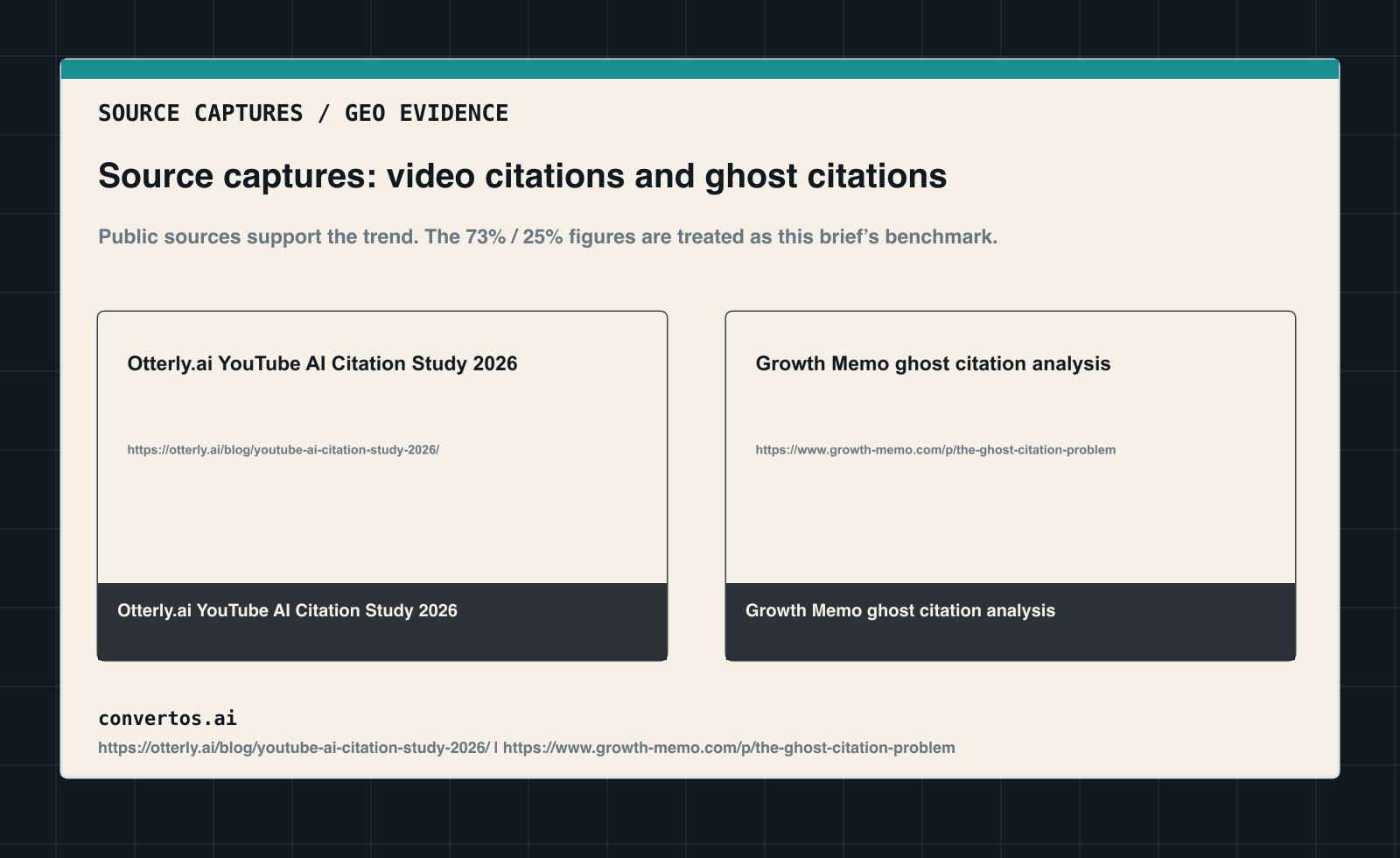
The source screenshots below are included for transparency. They show the public pages used to triangulate the video-citation trend and the ghost-citation problem. The exact 73% and 25% video-reference figures are treated as the benchmark supplied for this brief; the public sources support the broader pattern that video citations are important and that ghost citations require separate brand-mention tracking.
Original source captures used for this article: public research and industry pages on YouTube AI citations and ghost citations.
Common Mistakes
The most common mistake is treating citation rate as the final visibility metric. That is a comfortable dashboard number, but it misses the user’s actual experience. If the answer uses your URL but names a competitor, a generic category, or no brand at all, the citation helped the model more than it helped your brand.
Mistake
Why it hurts
Better move
Counting only citations
Hides ghost citations
Track citation and brand mention separately
Uploading video without transcript
Leaves extraction to the platform
Publish transcript, summary, and timestamps
Brand only in logo or thumbnail
AI systems may not extract it reliably
Put the brand in text, captions, metadata, and schema
YMYL video without authority context
Weakens trust and accuracy
Add reviewer, sources, methodology, and written guidance
Generic charts and tables
Models may extract the data without the brand
Use branded labels where relevant and natural
Different brand names across assets
Splits entity signals
Standardize brand spelling and publisher fields
FAQ
These FAQ questions are based on recurring People Also Ask, related questions, YouTube topic signals, and SERP question signals found during source review.
What is a ghost citation in AI search?
A ghost citation is an AI-search appearance where the answer lists your domain or URL as a source but does not mention your brand in the answer text. It matters because the model used your content, yet the user may not associate the answer with your brand.
Do video citations improve GEO visibility?
They can, especially for tutorials, demos, comparisons, and explanatory topics. The benefit is strongest when the video is supported by a readable transcript, timestamps, a clear title, a useful description, and an article page that repeats the brand entity naturally.
Why are YMYL video citations lower in this benchmark?
YMYL prompts require stronger trust signals. A video may still be cited, but answer engines are more likely to look for authoritative text, expert review, established sources, and safer wording. Treat video as a supporting asset for YMYL topics, not the only evidence layer.
How should brands fix ghost citations?
Start with pages that are already being cited. Add the brand name to visible copy, tables, charts, examples, captions, transcript summaries, and structured data. Then retest the same prompt cluster and watch whether ghost citations convert into direct citations or brand mentions.
Should the brand name be repeated everywhere?
Repeat it where it helps attribution and clarity. Do not force it into every sentence. The goal is consistent entity context across metadata, visible text, media assets, and schema, not spam.
Source Statement
This article combines the benchmark supplied for this topic with public source review on June 3, 2026. Video-citation behavior and AI-answer citation practices can change quickly by platform, language, region, and query wording. Treat the 73% and 25% figures as a benchmark for the prompt set behind this brief, then verify your own prompt cluster before changing production priorities.