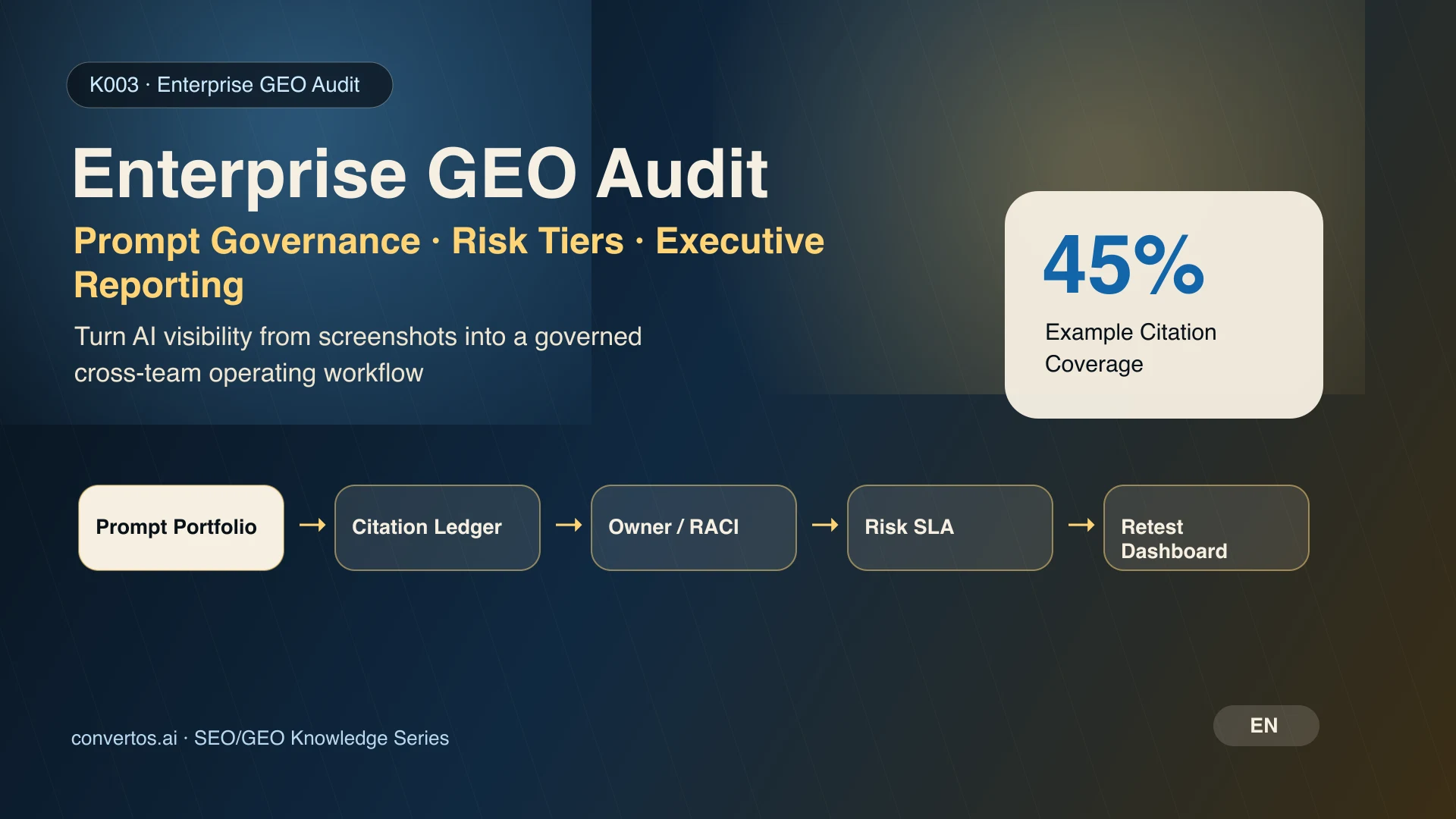
An enterprise GEO audit turns AI visibility into a governed operating system across brands, markets, teams, and risk levels.An enterprise GEO audit brings AI answer visibility, citations, factual accuracy, and brand risk into a shared governance workflow. A small team can track prompts and citations in one spreadsheet. An enterprise team needs prompt standards, market and language tiers, content owners, legal escalation, remediation SLAs, executive reporting, and retesting cycles. Without that governance layer, GEO audit work becomes a folder of screenshots instead of a system that SEO, brand, PR, product marketing, legal, and engineering can act on together.
English video: how enterprise GEO audits move from one-time visibility checks to governed cross-team workflows.
Key Takeaways
The enterprise question is not simply “does AI mention us?” It is “which business units, markets, languages, products, and risk scenarios must be monitored continuously?” A serious enterprise GEO audit covers brand mentions, citations, answer accuracy, competitor share of answer, compliance risk, crawlability, and remediation follow-through.
Build a prompt portfolio across brand, product, category, competitor, risk, and market questions.
Assign every high-value prompt to an owner, target page, risk tier, and retest cadence.
Maintain an AI citation ledger with source URLs, source type, factual errors, competitor mentions, and remediation actions.
Escalate risky answers. Brand misstatements, regulated-industry claims, pricing errors, and safety promises should not stay inside the SEO team.
Report in layers: operators need page-level changes, while executives need risk movement, citation coverage, and competitor answer share.
This guide is for teams that already understand basic GEO audits and advanced citation diagnostics. It focuses on making GEO audit work governable inside an enterprise.
What Is an Enterprise GEO Audit?
An enterprise GEO audit is a cross-functional process for diagnosing and governing how a company appears in AI-generated answers, AI search features, and large language model responses across brands, markets, languages, and teams. It checks whether AI systems name the brand accurately, cite controlled or trusted sources, misstate product capabilities, rely on outdated third-party information, or recommend competitors by default.
Compared with a first GEO audit or a metrics-focused advanced audit, enterprise GEO adds three layers:
Layer
Small-team version
Enterprise version
Prompt management
One core prompt set
Prompts tiered by brand, product, market, language, and risk
Ownership
SEO or content logs the result
SEO, brand, PR, legal, product marketing, and engineering share ownership
Reporting
Mention rate and citation rate
Risk tiers, SLAs, competitor answer share, and market differences
Official documentation does not prove that a specific page will be cited by an AI answer, but it does define practical boundaries for enterprise governance. Google Search Central’s AI features guidance points site owners back to crawlability, indexability, and clear content. Google Search Essentials covers quality and anti-spam expectations. OpenAI crawler documentation describes crawler controls and different crawler use cases. Enterprises should build these boundaries into audit standards instead of relying only on vendor scores.
1. Build an Enterprise Prompt Portfolio
An enterprise GEO audit begins with a prompt portfolio, not a random list of questions. The portfolio should reflect business priorities: brand facts, product discovery, competitor comparisons, regulated or risky claims, and local-market language variants.
Prompt tier
Purpose
Example
Brand facts
Check company description, product lines, site, and pricing facts
“What does [Brand] do?”
Category discovery
See whether the brand enters the right candidate set
“Best GEO audit platforms for enterprise SEO teams”
Competitor comparison
Detect default competitor positioning
“[Brand] vs [Competitor] for AI visibility monitoring”
Risk scenarios
Check outdated claims, compliance language, and unsafe promises
“Is [Brand] suitable for regulated industries?”
Market and language
Compare answers across regions and languages
“Best GEO audit tools for teams in Germany”
For governance, divide prompts into A/B/C tiers. A-tier prompts affect revenue, brand safety, regulated claims, or executive priorities and should be retested monthly. B-tier prompts cover product lines and regional markets and can be retested quarterly. C-tier prompts are long-tail content opportunities. This prevents risk-sensitive questions from getting buried under content ideas.
2. Assign Owners and Risk Tiers
Enterprise GEO audit programs fail when nobody owns the finding. SEO can discover that an AI answer misstates a product capability, but product marketing may need to correct the wording, legal may need to assess risk, engineering may need to fix crawlability, and brand may need to align external messaging.
Use a lightweight RACI model:
Issue type
Responsible
Accountable
Consulted
Informed
Brand description error
Content operations
Brand lead
PR, SEO
Sales, support
Product capability error
Product marketing
Product lead
Legal, SEO
Sales enablement
Pricing or promise error
Product marketing
Commercial lead
Legal, finance
Support, sales
Page crawlability issue
Technical SEO
Engineering lead
Content, SEO
Brand
Competitor default recommendation
SEO
Growth lead
Product marketing, content
Executives
The NIST AI Risk Management Framework organizes AI risk work around governance, mapping, measurement, and management. A GEO audit is not the same as enterprise AI risk management, but the pattern is useful: define risks, assign responsibility, measure outcomes, and manage change over time.
3. Maintain an AI Citation Ledger
Enterprise teams need a citation ledger, not just screenshots. The ledger should support auditing, remediation, and retesting. Each row should make it clear which prompt triggered the issue, which AI surface generated the answer, which sources were cited, what was wrong, who owns the fix, and when the issue will be retested.
Field
Purpose
Enterprise requirement
Prompt ID
Makes the question repeatable
Do not rewrite the prompt every cycle
Business unit and market
Enables ownership
Tie results to brand, country, language, and product line
AI surface
Separates answer behavior
ChatGPT, Perplexity, Google AI features, Bing/Copilot
Citation URL
Shows the evidence chain
Mark owned, third-party, competitor, or community
Risk tier
Determines escalation
P0/P1/P2/P3
Owner
Drives remediation
Assign a person or team, not a vague department
Retest result
Closes the loop
Record before-and-after movement
Metric example: enterprise citation coverage. Calculate it as A-tier prompts supported by owned or trusted third-party sources / total A-tier prompts. If a product line has 40 A-tier prompts and 18 answers cite your site, docs, case studies, or trusted third-party coverage, citation coverage is 45%. This is more useful for enterprise reporting than brand mention rate because it measures whether AI answers have a reliable evidence path.
4. Diagnose Enterprise Content Gaps
Enterprise AI visibility problems often come from fragmented assets, not a lack of blog posts. Common causes include inconsistent product language across pages, important content trapped in PDFs or login-only docs, old third-party references, translated pages that lag behind English pages, and competitor pages that answer buying questions more directly.
Gap type
Enterprise symptom
Fix
Entity inconsistency
Website, PR, and docs describe the product differently
Align the brand entity page and product definitions
Uncitable key pages
Content sits in PDFs, gated pages, or JavaScript-heavy views
Provide crawlable HTML summaries and FAQs
Outdated third-party evidence
Media and directories still use old positioning
Refresh press kits, partner pages, and external profiles
Language lag
English pages are current, but regional pages are stale
Create cross-language update SLAs
Competitor directness
Competitors have clearer comparison tables
Add fair comparisons, limitations, and evidence tables
Bing Webmaster Guidelines and Google’s official search documentation both reinforce accessibility, content quality, and non-manipulative behavior. For enterprise GEO, those basics belong in the technical audit: robots, canonical tags, status codes, rendering, internal links, structured data, and visible content can all affect whether an AI system can reliably understand a page.
5. Set Remediation Priorities and SLAs
Enterprise remediation should not depend on which team happens to have bandwidth. Every finding should be prioritized by business impact, risk tier, evidence strength, implementation cost, and retestability. Brand fact errors, regulated claims, pricing promises, competitor replacement, and core-market misstatements need clear SLAs.
Priority
Trigger
Response SLA
Typical owner
P0
Legal, regulated, financial, medical, security, or safety claim error
The common mistake is labeling every finding “important.” A useful enterprise priority system helps leaders see the tradeoff: which issues create revenue or brand risk, which are content opportunities, which require engineering, which require legal review, and which can wait for the next content cycle.
6. Retest, Report, and Build Executive Dashboards
Enterprise GEO audits become valuable when findings are retested and reported at the right level. Operators need prompt-level movement; executives need risk and business movement. Split reporting into three layers: operating dashboard, risk dashboard, and executive summary.
Dashboard layer
Core metrics
Audience
Operating dashboard
Prompt count, citation URLs, page fix status, retest result
Cadence should follow risk. P0/P1 fixes should be retested immediately after remediation. A-tier prompts can be retested monthly, B-tier prompts quarterly, and C-tier prompts can feed the content backlog. Do not report only one GEO score. A better report says: citation coverage for the core product line improved from 42% to 51%, P1 errors fell from 7 to 3, competitor answer share in buying prompts dropped by 9 percentage points, and 4 regional language pages still need updates.
Enterprise Rollout Path
If your team does not yet have a stable workflow, start with the GEO audit workflow, then connect high-value prompts to AI search visibility monitoring. Once the prompt set exceeds 100 questions or spans several markets and owners, standardize fields with a content citation monitoring template.
Keep the rollout light. In week one, choose one flagship brand and one market with 25-50 A-tier prompts. In week two, add owners, risk tiers, and target pages. In week three, remediate P0/P1 findings. In week four, run the first retest and prepare an executive summary. Once that loop works, expand to more product lines, languages, and regions. This keeps enterprise GEO from becoming a bloated governance program while still preventing serious brand-risk findings from staying in screenshot folders.
FAQ
How is an enterprise GEO audit different from a normal GEO audit?
Source signal: enterprise GEO tools, AI visibility audits, and governance content repeatedly frame scale and ownership as the differentiator.
A normal GEO audit checks whether a brand appears and is cited. An enterprise GEO audit also manages multiple brands, markets, languages, owners, risk tiers, SLAs, and executive reporting. It is an operating workflow, not just an audit report.
How many prompts does an enterprise need?
Source signal: GEO audit checklists and AI visibility audit content emphasize fixed test sets, while enterprise intent adds tiering.
Start with 25-50 A-tier prompts. Mature programs may expand to 100-500 prompts across brands, countries, languages, and risk scenarios. The key is not volume; each prompt needs an owner, target page, and retest cadence.
Should legal be involved in enterprise GEO audits?
Source signal: AI governance and risk-management sources emphasize escalation for high-risk scenarios.
Yes, but not for every issue. Pricing promises, medical, financial, legal, safety, compliance, and crisis-sensitive claims should have a legal escalation path. Ordinary content-structure issues can stay with SEO and content teams.
If AI answers cite competitors, should we fix content or run PR first?
Source signal: GEO audit and AI visibility audit materials split citation problems into owned pages, third-party sources, and competitor pages.
Check the cited source first. If AI cites a competitor page, improve owned definitions and comparisons. If it cites outdated third-party information, update press kits, partner pages, or external profiles.
How often should enterprise GEO audits be reported?
Source signal: GEO metrics, enterprise monitoring, and governance sources focus on retest cadence and reporting layers.
Operators can report monthly. Executives can review quarterly trends. P0/P1 risks should not wait for quarterly reporting; retest and notify owners immediately after remediation.
Disclosure
This article uses SERP results, enterprise AI visibility audit content, GEO tool pages, community discussions, and official documentation available around May 13, 2026. For platform behavior, crawling, indexing, crawler controls, and AI risk governance, it prioritizes Google Search Central, Bing Webmaster, OpenAI crawler documentation, and the NIST AI Risk Management Framework. For enterprise GEO audit workflow patterns, it uses industry and tool materials from Search Engine Land, Semrush Enterprise, Otterly, TrySight, Geoptie, and related sources as interpretation, not guaranteed platform behavior. AI search products change quickly, so enterprise teams should validate findings with logs, GSC, an AI citation ledger, and fixed-prompt retesting.
CTA
If your team has completed a basic GEO audit, the next step is not publishing more disconnected articles. It is turning prompts, citations, risk tiers, owners, and retests into an enterprise governance workflow. Convertos.ai helps teams connect AI search visibility monitoring, citation ledgers, risk prioritization, and content remediation so SEO, brand, product marketing, and legal can act from the same evidence base.
Start with one brand, one market, and fewer than 50 prompts. Prove the record-fix-retest loop. Then expand across business lines, regions, and languages. The value of enterprise GEO is not a thicker audit deck; it is a recurring signal for brand risk, competitor opportunity, and content gaps in AI answers.