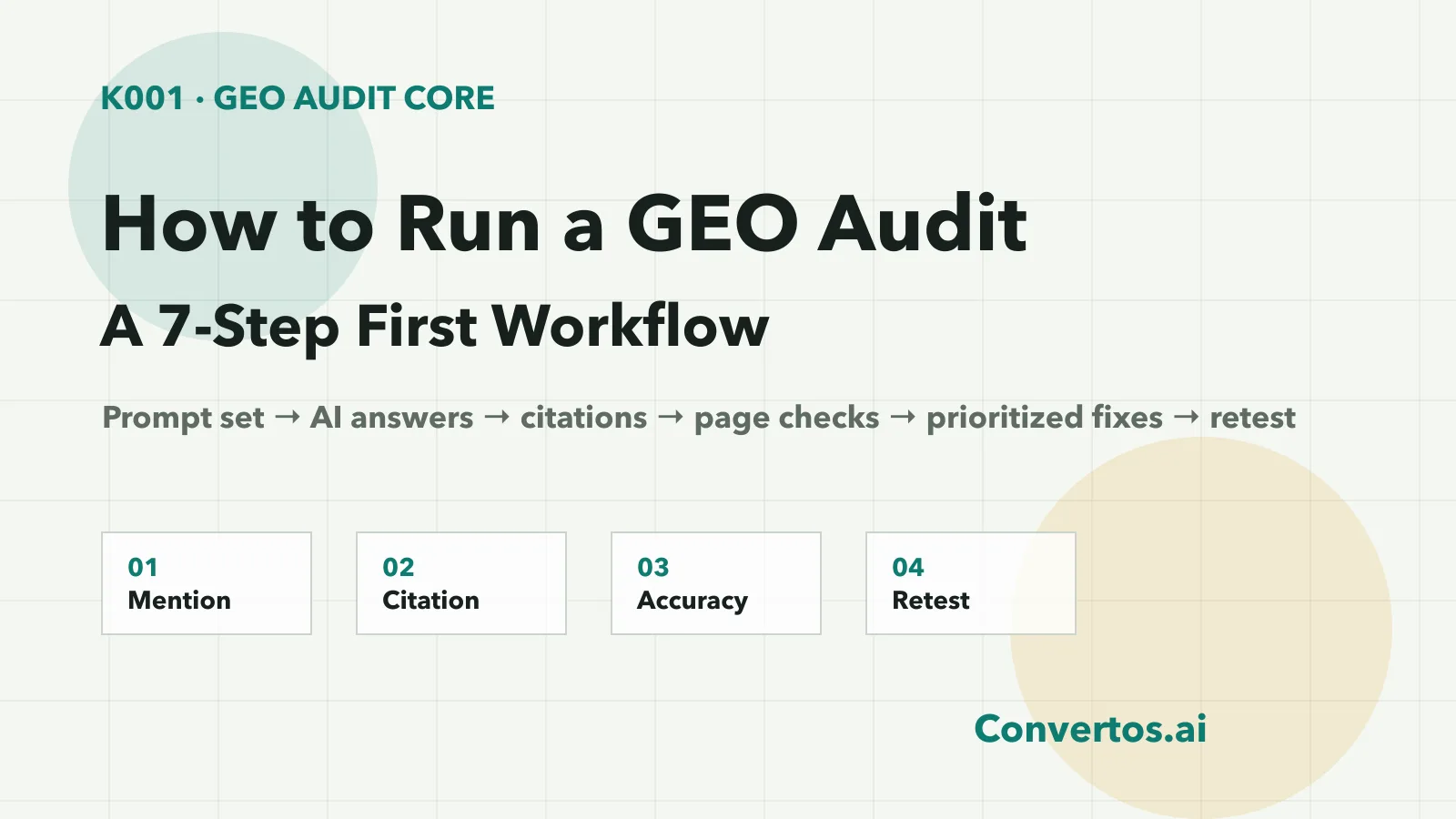
A GEO audit checks whether AI search systems can understand, mention, cite, and accurately describe your brand. For a first audit, keep the workflow practical. Build a small set of real buyer questions, test how AI systems answer them, record brand mentions and source citations, then inspect the pages that should have been cited. The goal is not a pretty score. The goal is a ranked list of fixes that make your best pages easier to trust, parse, and quote.
Last updated: 2026-05-12
A 60-second walkthrough of the first GEO audit workflow: prompts, AI answers, citations, page checks, and retesting.The basic GEO audit loop: test real AI-search questions, inspect answers, fix source pages, and retest.
Key Takeaways
A GEO audit is not just an SEO audit with a new label. SEO checks whether pages can be crawled, indexed, ranked, and clicked. GEO also checks whether AI-generated answers mention, cite, and correctly describe your brand.
Start with 20-30 high-value prompts instead of a huge keyword list. Include definition, comparison, buying, alternative, implementation, and risk questions.
Track four core signals: brand mention, citation, answer accuracy, and competitor presence.
Fixes should be ranked by business impact. High-intent prompts, wrong brand facts, blocked key pages, and missing answer blocks usually deserve attention first.
The practical value of a first GEO audit is focus. Instead of debating whether AI search is "the future," the team gets a concrete list of prompts, answers, source pages, errors, and fixes. That list is easier to discuss with content, SEO, product marketing, and engineering because every issue is tied to a visible answer or a blocked source page.
What Is a GEO Audit?
A GEO audit is a structured review of how your brand appears in AI-generated answers and whether your content is fit to be used as a source. It checks visibility across answer engines such as ChatGPT Search, Perplexity, Google AI features, Gemini, and Bing Copilot, then connects those findings back to your website content and technical setup.
Traditional SEO audits still matter. They check crawlability, indexation, internal links, titles, structured data, page speed, and rankings. A GEO audit builds on that base and asks a different question: when a user asks a complete question, does the answer include your brand, cite your page, and describe you correctly? Convertos.ai's GEO hub can support the surrounding topic cluster for AI visibility, citation tracking, and technical readiness.
Current public search results for "GEO audit" show a mix of free tools, agency checklists, community discussions, and AI visibility platforms. Geoptie's free GEO audit tool frames its audit around citation readiness, answer alignment, technical optimization, and competitive position. Search Engine Land's GEO content audit template emphasizes goals, content inventory, segmentation, and source readiness. These are not neutral academic sources, but they show where the market is converging: GEO audits are about being usable as an answer source, not merely having keywords on a page.
Step 1: Build the Prompt Set Before You Audit Pages
A useful GEO audit starts with questions, not URLs. AI-search users ask full prompts: "What is the best AI search monitoring tool for a B2B SaaS team?", "How is GEO different from SEO?", or "How do I know whether ChatGPT cites my brand?" If you only audit pages, you may miss the actual questions your buyers ask.
For a first audit, create 20-30 prompts across six groups:
Prompt Type
Example
Audit Purpose
Definition
What is a GEO audit?
Check whether your brand can explain the concept
Comparison
How is a GEO audit different from an SEO audit?
See whether your point of view appears in comparison answers
Buying
What tools monitor AI search visibility?
Test commercial-intent visibility
Alternatives
Are there free GEO audit tools?
Capture budget-sensitive discovery
Implementation
What should a GEO audit checklist include?
Test workflow and template demand
Risk
What should I do if AI search describes my brand incorrectly?
Check trust, correction, and monitoring coverage
For each prompt, record the target reader, intent, business value, ideal source page, facts you want AI systems to repeat, and facts that must not be wrong. This turns a fuzzy visibility check into an audit you can repeat.
For a B2B SaaS company, the prompt set should include both top-of-funnel and buyer-stage questions. A top-of-funnel prompt might ask what a GEO audit is. A buyer-stage prompt might ask which AI search monitoring platforms are best for a lean marketing team. The second prompt usually matters more commercially, even if search volume looks smaller, because the answer may influence a shortlist.
Step 2: Record Mentions, Citations, and Accuracy
The main evidence in a GEO audit comes from actual AI answers. For every prompt, record whether the answer mentions your brand, cites your website, names competitors, and describes your product accurately. Do not rely on one run. Answers can vary by date, location, account context, search mode, and the system being tested.
Use a simple evidence table:
Signal
What to Record
Why It Matters
Brand mention
Whether your brand appears in the answer
Shows if you entered the candidate set
Citation
Whether your page is linked or used as a source
Shows whether your content is trusted enough to support the answer
Answer accuracy
Whether product, pricing, positioning, and features are correct
Wrong visibility can hurt trust
Competitor presence
Which competitors are included
Shows where the market is learning from someone else
Source quality
Whether the answer cites official pages, media, forums, or reviews
Tells you whether to improve official facts or external proof
Do not count every mention as a win. If AI systems classify you in the wrong category or repeat outdated pricing, that is a problem to fix, not a success metric.
Step 3: Check Whether Pages Have Citable Answer Blocks
AI systems need clear source material. A page full of slogans may rank in search, but still be hard to quote. A strong GEO source page usually contains direct definitions, comparison tables, workflow steps, evidence, dates, and FAQ answers that can stand alone when extracted.
Check each priority page for these modules:
Module
Passing Standard
Common Failure
Direct definition
40-90 words that explain the concept without extra context
The first screen only says a slogan
Comparison table
Dimensions, differences, and caveats are clear
The page claims to be better without criteria
Step checklist
The reader can follow the order
Advice is written as broad principles
Evidence note
Source, date, method, example, or limitation is visible
Claims use vague authority language
FAQ
Questions come from real search, sales, support, or community signals
FAQ is written only for keywords
This is where a GEO audit becomes editorial work. You are not stuffing terms into a page. You are making each key page easier to understand, verify, and cite.
One useful editorial test is to copy the first 90 words under a section heading and ask whether they still make sense without the rest of the page. If the answer depends on vague pronouns, missing definitions, or a claim with no source, that block is weak for GEO. Rewrite it so the entity, claim, caveat, and next action are visible inside the block.
Step 4: Run the Technical Crawlability Checks
Technical SEO is not the whole GEO story, but it is still the floor. If important content is blocked, hidden, canonicalized incorrectly, or rendered only after complex JavaScript, AI-search systems have less stable material to use.
At minimum, check that:
The page returns a public 200 status.
Important body text appears in crawlable HTML.
robots.txt does not block crawlers you want to allow, such as Googlebot, Bingbot, OAI-SearchBot, or PerplexityBot.
The page is not marked noindex by mistake.
Canonical URLs point to the intended page.
Title, H1, meta description, Open Graph, and visible body content describe the same topic.
Article, FAQ, Breadcrumb, Organization, and Product schema only describe visible content.
Images have descriptive alt text, and videos have transcripts or summaries.
Use official sources for platform behavior. Google Search Essentials documents crawling, indexing, and search result eligibility, while Google's AI features and your website page explains how site content relates to Google AI features. OpenAI's crawler documentation explains crawler purposes such as OAI-SearchBot and GPTBot. Perplexity's bot documentation covers PerplexityBot. Third-party guidance can help interpret the work, but official docs should win when rules conflict.
Step 5: Audit Entity and Fact Consistency
A GEO audit should also ask whether AI systems understand who you are. If your homepage, product pages, docs, schema, social profiles, and third-party listings describe your company differently, AI answers are more likely to be inconsistent.
Audit the facts that should stay stable:
Entity Fact
Where It Must Match
Audit Question
Brand name
Website, footer, schema, social profiles, product pages
Are old names or spelling variants still visible?
Product category
Homepage, product page, comparison page, docs
Is the product category clear and consistent?
Target customer
Case studies, pricing page, feature pages
Does the site say who the product is for?
Feature boundaries
Product pages, FAQ, docs
Are limits and use cases clear?
Company details
Organization schema, footer, about page
Is the business information verifiable?
One practical method is to write a "facts we want AI to repeat" sheet. List 20 approved facts about the brand, product, audience, features, and limits. Then check AI answers, site pages, and external profiles against that sheet.
Step 6: Rank Problems by Prompt Impact
Do not prioritize GEO fixes only by page type or effort. Prioritize by prompt impact. A low-volume but high-intent prompt such as "best AI search monitoring platform for B2B SaaS" may be more valuable than a broad definition query.
Use a simple 1-5 scoring model:
Dimension
Low Score
High Score
Business value
General awareness
Trial, demo, purchase, or shortlist intent
Current visibility gap
Already cited correctly
Missing, wrong, or replaced by competitors
Error risk
Low consequence
Wrong answer can affect buying decisions
Fix effort
Needs heavy product or engineering work
Content and metadata fixes are enough
Retest value
Hard to observe
Easy to rerun and compare
A simple formula works: business value + error risk + visibility gap - fix effort. It will not be perfect, but it helps teams avoid fixing easy issues while high-value AI answers stay wrong.
Use the score as a conversation tool, not as a fake scientific model. If a high-intent prompt contains a wrong answer about pricing, category, security, or product fit, it should move up the list even when the page work is uncomfortable. The point of the scoring model is to make tradeoffs visible before the team spends a sprint on low-impact polish.
Step 7: Retest on a Schedule
A GEO audit is not finished when the report is delivered. AI answers change as pages, indexes, model behavior, product facts, competitor content, and platform features change. Keep the prompt set and rerun it every 30-60 days. Retest sooner after major product, pricing, category, or competitor changes.
For each retest, look for four changes:
Did brand mention rate improve?
Did citations shift from third-party sources toward your official pages?
Did inaccurate descriptions decrease?
Did competitor presence change on high-intent prompts?
Keep the report short. One page is enough: new prompts, mention rate, citation rate, accuracy problems, pages fixed, and next priorities. The habit matters more than the format. Teams building a broader content cluster can connect this workflow back to the GEO hub, then extend into citation tracking, brand visibility, and technical crawlability pages.
Common Mistakes
Mistake
Why It Hurts
Better Approach
Buying a tool before defining prompts
The team gets a score without knowing which business questions it represents
Build a 20-30 prompt set first
Counting any mention as a win
Wrong or outdated mentions can damage trust
Track accuracy and source quality too
Treating GEO as only content work
Crawlability, schema, entity consistency, and source accessibility matter
Audit content, technical access, and brand facts together
Writing FAQ from intuition
AI and readers need answers to real questions
Use SERP, sales, support, and community question signals
Never retesting
AI answers and competitor content change
Retest the same prompt set every 30-60 days
FAQ
These FAQ questions are based on public question signals such as People Also Ask, related searches, YouTube video titles, Reddit and community discussion titles, LinkedIn perspective titles, and competitor FAQ patterns. Similar questions were merged and rewritten for readers.
FAQ source signals: People Also Ask questions about GEO audits and whether GEO replaces SEO; related searches for GEO audit checklist, free GEO audit tools, and GEO readiness; YouTube titles about doing a GEO audit; Reddit/community titles asking whether people have run GEO audits; competitor FAQ headings from GEO audit tool pages.
How is a GEO audit different from an SEO audit?
An SEO audit checks whether pages can be crawled, indexed, ranked, and clicked. A GEO audit also checks whether AI-generated answers mention, cite, and accurately describe your brand. The two audits work best together.
How many prompts should I use for a first GEO audit?
Start with 20-30 prompts. That is enough to see patterns without turning the first audit into a heavy research project. Cover definition, comparison, buying, alternatives, implementation, and risk questions.
Are free GEO audit tools enough?
Free tools are useful for a first screen, especially for page structure, technical signals, or small visibility samples. They are not enough for brand-level monitoring unless you also save prompts, track answer changes, inspect citations, and review accuracy manually.
Will GEO replace SEO?
No. AI search still depends on crawlable, trustworthy, well-structured sources. SEO supports discoverability and indexability; GEO checks whether those sources are selected and represented correctly inside AI answers.
How often should a GEO audit be repeated?
Repeat the same prompt set every 30-60 days. Retest sooner after pricing, product, positioning, crawler-rule, or competitor changes.
Disclosure
This article was informed by public search results, GEO audit pages, tool pages, community discussions, and official platform documentation reviewed on 2026-05-12. Vendor and agency pages were used to understand common audit dimensions, not as final authority for platform rules. For Google, OpenAI, Perplexity, and other crawler behavior, verify the latest official documentation before publishing or changing technical access rules.
The article uses competitor and tool pages to identify common market language, checklist modules, and reader questions. It uses official platform documentation for crawler, indexing, and AI feature behavior. Community discussions are treated as user-pain signals, not proof of platform behavior. This distinction matters because GEO advice can become misleading when vendor claims, community experience, and official rules are mixed together without labels.