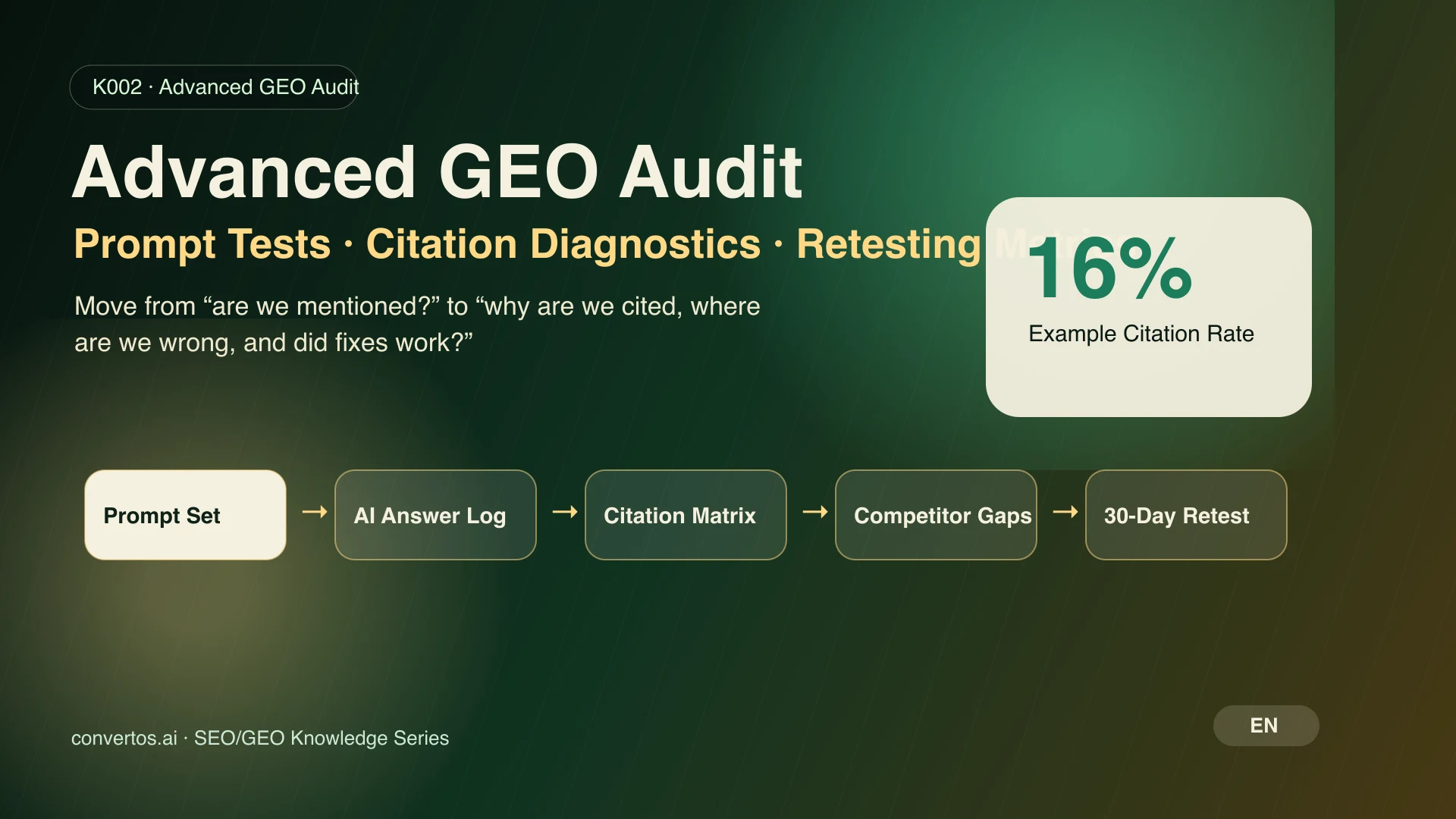
An advanced GEO audit turns AI answers into a repeatable evidence loop: prompts, citations, competitors, fixes, and retests.An advanced GEO audit measures whether AI search systems and answer engines understand, mention, cite, and describe your brand accurately across high-value prompts. A basic audit answers “are we visible?” An advanced audit answers “where are we visible, which sources support the answer, why are competitors cited, what facts are wrong, which pages should we fix first, and did the fix improve the next retest?” If your team has already run a first GEO audit, this is the next operating model.
English video: a 66-second walkthrough of moving from brand mentions to citation diagnostics and retesting.
Key Takeaways
An advanced GEO audit is not a content-volume exercise. It is a visibility, citation, accuracy, and retesting workflow.
The prompt set should cover definition, comparison, buying, problem-solving, and branded questions.
The answer log should capture the AI surface, prompt, answer summary, brand status, citation URLs, competitor mentions, errors, and recommended fixes.
Useful metrics include brand mention rate, citation rate, answer accuracy, competitor share of answer, source quality, and error reduction.
Platform claims need evidence. Google, Bing, OpenAI, and other systems have their own crawling, indexing, content-quality, and crawler-control documentation, so a GEO audit should improve machine readability and verifiability without promising guaranteed AI citations.
This guide assumes you already understand the difference between traditional SEO and basic GEO visibility checks. The focus is the second audit cycle: stabilize prompts, capture answer evidence, classify citations, diagnose competitor gaps, prioritize fixes, and retest with the same prompt set. That turns GEO from a one-time screenshot exercise into an operating workflow that content, SEO, product marketing, and engineering can use together.
What Is an Advanced GEO Audit?
An advanced GEO audit is a structured diagnosis of how your brand appears in AI-generated answers, AI search features, and large language model responses. It checks whether the brand entity is recognized, whether the answer cites your pages, whether product and category facts are accurate, whether competitors are used as the evidence source, and whether your own pages are crawlable, indexable, and easy to extract.
The difference from a basic audit is depth:
Audit layer
Question
Evidence to collect
Visibility
Does the brand appear?
Brand mention, answer position, screenshot
Citation
Which URLs support the answer?
Citation URL, source domain, cited section
Accuracy
Is the brand described correctly?
Incorrect claims, outdated facts, page evidence
Repair
What should be fixed first?
Content gap, technical risk, retest result
This matters because AI visibility is not controlled by one ranking factor. Google Search Central’s guidance for AI features still points site owners back to crawlability, indexability, helpful content, and clear page information. Google’s crawler control documentation and Google-Extended documentation also separate different controls for discovery, search, and model-related uses. The practical takeaway is simple: GEO is not a magic tag. It is the discipline of making your content accessible, understandable, verifiable, and worth citing.
1. Build a Fixed Prompt Test Set
An advanced GEO audit starts with a fixed prompt test set, not a few casual questions. Stable prompts make the audit repeatable. Start with five prompt groups and 5-10 prompts per group.
Prompt type
Purpose
Example
Definition
Test category and entity understanding
“What is a GEO audit for B2B SaaS?”
Comparison
See whether your brand enters the candidate set
“Convertos.ai alternatives for AI search visibility monitoring”
Buying
Test recommendation eligibility
“Best GEO audit tools for a SaaS growth team”
Problem-solving
Test whether your content solves a concrete pain
“Why is my brand missing from AI Overviews?”
Branded
Test factual accuracy
“What does Convertos.ai do?”
The advanced move is to tag every prompt with intent, funnel stage, target page, and expected answer points. That keeps the audit from becoming a vanity mention report. You are not only asking whether the brand appeared; you are asking whether the brand appeared in the right decision context.
Actionable checklist:
Create at least 25 prompts for each major product or solution line.
Map every prompt to a target page, not just the homepage.
Keep prompt wording stable between retests.
Run the same prompt set across ChatGPT, Perplexity, Google AI features, Bing/Copilot, and any surface your buyers use.
Record date, region, language, device, and login state because these can affect answers.
2. Log AI Answers and Citation Fields
The answer log is the core artifact of the audit. It should capture the answer, brand status, citation URLs, competitor appearances, factual errors, and the prompt that triggered the result. A binary “mentioned or not mentioned” field is too shallow for advanced work.
Use a table like this:
Field
Why it matters
Example
Model or surface
Different surfaces behave differently
ChatGPT, Perplexity, Google AI features
Prompt
Enables repeatable testing
“best GEO audit tools for SaaS”
Brand status
Shows presence and position
Missing, mentioned, recommended
Citation URL
Reveals evidence sources
Competitor blog, third-party list, official docs
Competitor mention
Shows answer-set competition
Competitor A appears first
Error
Identifies brand risk
Wrong pricing, wrong category, old feature
Recommended fix
Turns observation into action
Add comparison table, FAQ, entity definition
The goal is not to archive screenshots forever. The goal is to break AI answers into fields your team can diagnose. If the AI answer cites a competitor but not you, do not jump straight to rewriting a title. First ask whether the competitor page has a clearer definition, a better comparison table, stronger third-party evidence, or simply better crawlability.
3. Run Citation Diagnostics
Citation diagnostics answer one question: what evidence does the AI system appear to trust for this prompt? You need to classify cited sources and compare them with your own pages.
Source type
Examples
Audit question
Owned official sources
Website, docs, help center
Are they accurate, clear, crawlable, and indexable?
What buyer questions or objections appear repeatedly?
Competitor sources
Competitor blogs, comparison pages, case studies
Why does the competitor answer the prompt better?
Google Search Essentials and Bing Webmaster Guidelines are useful baseline references here. They do not tell you that an AI answer will cite a specific URL, but they do reinforce the fundamentals: accessible pages, quality content, non-manipulative behavior, and clear information architecture. For advanced GEO, those fundamentals become the floor. The ceiling comes from better answer blocks, clearer entity descriptions, proof, and source consistency.
Metric example: citation rate.
Citation rate can be calculated as: AI answers that cite your domain / total tested prompts. If 8 out of 50 prompts cite convertos.ai, the citation rate is 16%. This is stricter than brand mention rate because a brand can be mentioned without being used as evidence.
4. Diagnose Competitor Answer Gaps
When AI answers cite competitors instead of you, the cause is rarely “the algorithm hates us.” More often, the competitor page answers the prompt more directly, uses clearer entity language, provides better evidence, or is easier to extract.
Use this gap matrix:
Gap type
Symptom
Fix
Definition gap
AI does not understand your category
Add a concise, citable category definition
Comparison gap
Competitors appear but you do not
Add a fair scenario-based comparison table
Evidence gap
AI relies on third parties or competitors
Add data, examples, methodology, and sources
Structure gap
The content exists but is hard to extract
Add H2s, tables, FAQs, summaries, and schema-aligned visible content
Technical gap
Crawling or rendering is unstable
Check robots, status codes, canonical tags, rendering, and internal links
The common mistake is reacting to missing AI visibility by publishing a large batch of new articles. Search Engine Land’s GEO audit coverage and Ahrefs’ AI visibility audit guide both point to a more useful pattern: diagnose sources, answer fit, and competitor gaps before creating more content. Fix the pages that can influence many prompts first: product definition pages, feature pages, comparison pages, pricing or plan pages, case studies, and FAQs. One precise update to a core page can be more useful than ten generic AI-search posts.
5. Prioritize Fixes by Impact and Evidence
GEO fixes should be prioritized by impact, evidence strength, implementation cost, and retestability. If a fix can affect many high-value prompts, is backed by answer logs, is cheap to implement, and can be retested within 30 days, it should go first.
Dimension
High-priority signal
Low-priority signal
Impact
Affects several revenue or category prompts
Affects one low-volume edge prompt
Evidence
Supported by screenshots, citations, and competitor comparison
Based only on a hunch
Cost
Requires a focused content or technical update
Requires a rebuild or unclear dependency
Retestability
Can be checked in the next audit cycle
Cannot be attributed to a prompt or page
For example, if AI answers repeatedly misdescribe your product category and your homepage does not include a clear definition, that fix should outrank a minor update for one obscure prompt. The most useful GEO backlog is small, evidence-backed, and tied to repeatable tests.
6. Retest and Report the Results
An advanced GEO audit becomes valuable only when the same prompt set is retested over time. A 30-day cycle is a practical starting point for most SaaS teams.
Metric
Formula
What it tells you
Brand mention rate
Prompts mentioning your brand / total prompts
Whether AI answers think of you more often
Citation rate
Answers citing your domain / total prompts
Whether your pages enter the evidence chain
Answer accuracy
Accurate brand answers / brand-present answers
Whether the system understands you correctly
Competitor share of answer
Competitor mentions / total candidate-brand mentions
How the answer set is shifting
Error reduction
Previous errors - current errors
Whether fixes reduced brand risk
Do not report only one composite score. A better report shows which high-value prompts improved, which facts are still wrong, which competitors are still cited, which content fixes were shipped, and what the next audit cycle should prioritize.
Next Steps After the Audit
If you have not completed the first diagnosis, start with the GEO audit workflow and identify whether your brand appears, whether the answer is accurate, and whether competitors replace you in high-value prompts. If you already have a prompt set, connect the results to AI search visibility monitoring so mention rate, citation rate, error rate, and competitor share can be tracked over time. Keep the fields consistent with a content citation monitoring template. The goal is to give SEO, content, product marketing, and engineering the same evidence base instead of separate screenshot folders.
In practice, treat the first week as the baseline week: record answers without rushing into fixes. In week two, group issues into content, technical, entity, and third-party evidence problems, then choose one or two fixes that are easy to retest. In weeks three and four, run the same prompt set again and check whether improvements appear around the pages you changed. This keeps attribution cleaner and makes it easier to explain why a few core pages should be fixed before publishing more articles.
FAQ
How is an advanced GEO audit different from a basic GEO audit?
Source signal: SERP questions and industry articles repeatedly separate “are we visible?” from “why are we visible or missing?”
A basic GEO audit checks whether your brand appears in AI answers. An advanced GEO audit checks prompt intent, citation URLs, competitor answer gaps, factual accuracy, crawlability, and the impact of fixes after retesting. The basic version finds the problem; the advanced version explains and prioritizes it.
How often should a team run a GEO audit?
Source signal: GEO metrics, AI visibility audit articles, and community discussions all ask how often teams should retest without overreacting to volatility.
Most teams should retest core prompts monthly and expand the prompt set quarterly. Weekly retests can be useful during launches, major page migrations, or brand-risk events, but they can also overreact to short-term answer volatility.
If AI answers do not cite us, does that mean our SEO is weak?
Source signal: Search Engine Land, Ahrefs, and competitor FAQs frame missing citations as a mix of content, evidence, entity, and technical issues.
Not necessarily. Missing citations can come from content structure, entity ambiguity, weak evidence, crawlability, lack of third-party corroboration, or competitor pages that answer the prompt more directly. Strong SEO helps the foundation, but GEO needs answer-level evidence.
Should we block AI crawlers with robots.txt?
Source signal: Official crawler documentation and community discussions both surface AI crawling controls as a frequent operational question.
Only after you understand the tradeoff. Google-Extended and OpenAI crawler documentation describe different controls and use cases. Production changes should be reviewed by SEO, engineering, and legal stakeholders.
How long does it take to see impact from GEO fixes?
Source signal: AI visibility audit, GEO metrics, and related-search questions all ask when teams should retest.
There is no guaranteed timeline. A 30-day retest cycle is a practical first checkpoint, but the safer objective is not “instant AI citations.” Look for fewer factual errors, clearer entity understanding, better source coverage, and narrower competitor answer gaps.
Disclosure
This article uses SERP research, industry sources, community signals, and official documentation available around May 12, 2026. For platform behavior, crawling, indexing, AI features, crawler controls, and content-quality claims, it prioritizes official documentation from Google Search Central, Bing Webmaster, and OpenAI. For GEO metrics and audit workflows, it uses industry material from Search Engine Land, Ahrefs, Semrush, Quattr, and related sources as interpretation, not as guaranteed platform behavior. AI search products change quickly, so teams should validate findings with GSC, logs, analytics, and a fixed prompt retest process.
CTA
If your first GEO audit already found where your brand appears, the next step is to diagnose why. Convertos.ai helps B2B SaaS teams turn prompts, AI answers, citations, competitor gaps, and retests into a repeatable visibility workflow. A practical starting point is to run 25 core prompts, mark every cited URL, identify competitors that appear repeatedly, and convert the top gaps into 30-day content or technical fixes. On the next retest, the team can judge progress by fewer errors, stronger citation coverage, and narrower competitor gaps instead of relying on one-off screenshots.
If your resources are limited, do not try to monitor every model, market, and keyword on day one. Start with prompts closest to revenue, trial signups, sales conversations, or brand-risk moments. Once that set has a stable record-fix-retest cadence, expand to more product lines, languages, and buyer segments. The value of GEO is not a thick audit deck. It is a working signal that tells the team which AI answers are improving, which errors still hurt the brand, and which competitors still own the answer path.