
Key Takeaways
Quick answer: Treat E-E-A-T as a quality lens, not a magic score. For SEO, it helps teams create useful, reliable pages. For GEO, it helps answer engines identify clear claims, credible sources, author identity, and extractable answer blocks. The safest scorecard measures page evidence, not imagined algorithm secrets.- Google frames E-E-A-T through helpful, reliable, people-first content and quality rater guidance, not as one confirmed ranking factor.
- "Computable E-E-A-T" is best understood as a set of proxy checks: semantic completeness, entity coverage, source traceability, author clarity, structured data consistency, and topic context.
- Vendor studies and GEO rubrics can be useful, but numbers such as citation multipliers should be treated as directional until tested on your own site.
- The strongest pages combine human trust signals with machine-readable clarity: visible answers, named sources, dates, author pages, schema that matches the page, and internal topic links.
- For Convertos-style SEO and GEO programs, update existing important pages first. Add answer capsules, improve citations, repair schema, and monitor AI search citations before creating more near-duplicate articles.
What Google Actually Says About E-E-A-T
E-E-A-T stands for experience, expertise, authoritativeness, and trustworthiness. Google uses it as a way to explain qualities of helpful content, especially for topics where wrong information can harm people. Google does not say E-E-A-T is one direct ranking factor or a public numeric score. Google's official guidance on creating helpful, reliable, people-first content says its automated systems prioritize useful content made for people, and the self-assessment questions ask whether a page has original information, substantial coverage, clear sourcing, and signs that readers can trust the author or site. The same page says E-E-A-T itself is not a specific ranking factor, but a mix of factors can help identify content that demonstrates those qualities. That distinction matters. If a team says, "We improved E-E-A-T by 17 points, so rankings will rise," it is overclaiming. If the team says, "We added named sources, author accountability, update dates, original examples, and complete answers, then monitored ranking and AI citation changes," it is using E-E-A-T responsibly. Google's Search Quality Rater Guidelines overview also clarifies that quality ratings help evaluate and improve systems; a single rating or rater does not directly change a page's ranking. Raters are a feedback system, not an editorial control panel for your URL. For AI search, the boundary is similar. Google's AI features guidance for site owners says standard SEO best practices remain relevant for AI Overviews and AI Mode, and that there are no special schema.org requirements for appearing in those features. It also recommends making important content available in text, supporting text with useful images and videos, using structured data that matches visible content, and ensuring pages are indexable. This article therefore uses "measurable E-E-A-T" as an audit method. It does not claim to reveal Google's ranking formula.What "Computable E-E-A-T" Can and Cannot Mean
Computable E-E-A-T means turning a fuzzy trust discussion into observable page checks. It cannot prove how Google scores a page, but it can help editors review whether a page is complete, sourced, attributable, technically legible, and easier for AI systems to quote. The phrase is popular in GEO circles because answer engines need clean evidence. A model cannot cite your private intention. It can only work with page text, source links, entity names, author information, structured data, and off-page corroboration it can retrieve. Use the phrase carefully:| Claim | Safe version | Unsafe version |
|---|---|---|
| E-E-A-T scoring | "We use an internal E-E-A-T scorecard for content QA." | "Google assigns our page an E-E-A-T score." |
| Semantic depth | "Each H2 should answer its own question before expanding." | "Semantic depth is a confirmed Google ranking factor." |
| Entity density | "We check whether key entities are named clearly and naturally." | "Add 15 entities per 1,000 words to trigger AI citations." |
| Structured sourcing | "Important factual claims need source, date, and institution context." | "Tier-1 links guarantee AI Overview inclusion." |
| Schema | "Article schema can help clarify author, date, headline, and image." | "FAQPage, HowTo, and Speakable schema are required for AI search." |
The Three Proxy Metrics Worth Tracking
The three most useful E-E-A-T proxy metrics are semantic completeness, entity coverage, and structured sourcing. They map to real editorial tasks: answer the question fully, name the relevant people and organizations clearly, and make factual claims traceable.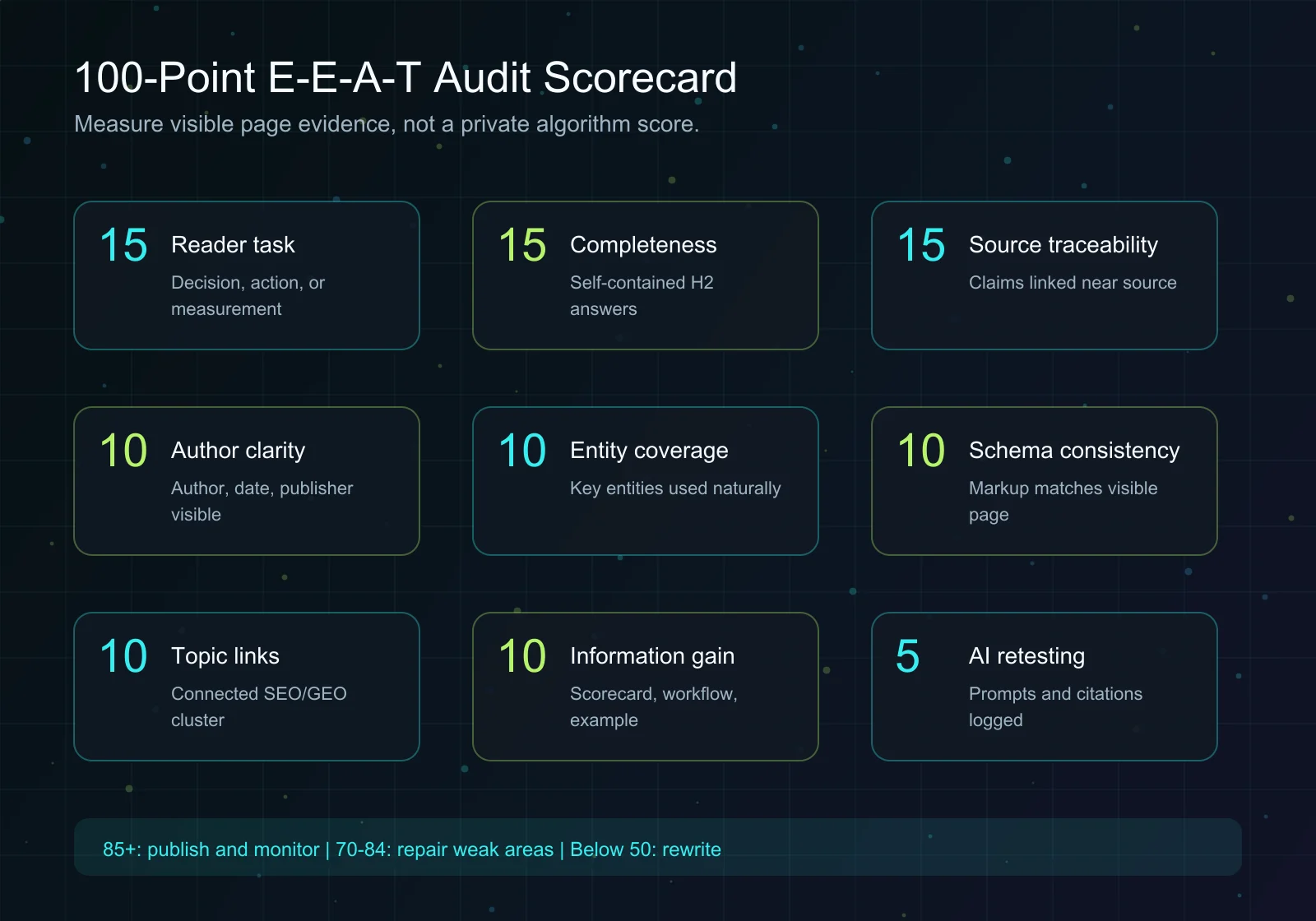
1. Semantic Completeness
Semantic completeness asks whether a section can stand on its own. If an AI answer engine extracts only the paragraph after an H2, will the answer still make sense? A useful section opener usually does three things: defines the answer, states the condition or caveat, and gives the reader a next action. This is why answer capsules work well for GEO. They reduce ambiguity and make the page easier to cite without forcing a model to stitch meaning across five scattered paragraphs. Measure it with a simple check:- Does every major H2 open with a 40-90 word direct answer?
- Does that answer include the main entity, not only "it" or "this"?
- Can the paragraph be quoted without losing the caveat?
- Does the full section add evidence, example, and action after the answer?
2. Entity Coverage, Not Entity Stuffing
Entity coverage asks whether the page names the important things a knowledgeable reader expects: organizations, products, standards, dates, studies, laws, tools, authors, and concepts. This is related to entity density, but density alone is a weak target. A page can mention "Google, Bing, Gemini, ChatGPT, Perplexity, Schema.org, Wikidata, Knowledge Graph" and still say nothing useful. What matters is whether entities are used to clarify claims. For this topic, strong entity coverage includes Google Search, Search Quality Rater Guidelines, AI Overviews, AI Mode, Schema.org, Article structured data, FAQPage changes, Search Console, Ahrefs, Semrush, MarketMuse, Frase, Profound, Otterly, and the specific source or study behind each claim. Measure it with a reviewer checklist:| Entity type | What to check | Good example |
|---|---|---|
| Official entity | Search platform or documentation named clearly | Google Search Central, Search Quality Rater Guidelines |
| Method entity | Tool or framework named with context | Search Console for indexing and performance checks |
| Evidence entity | Study, institution, or publisher attached to the claim | Vendor rubric from AI Dev, treated as directional |
| Page entity | Author, company, product, and category are clear | Convertos.ai, SEO, GEO, AI answer engines |
3. Structured Sourcing
Structured sourcing means a reader can tell where an important claim came from. In practice, the strongest factual claims include an institution, a date or freshness cue when relevant, and a link. Google's structured data documentation says structured data can help Google understand page content, but the markup must describe visible content. The Article structured data guide recommends properties such as author, date, headline, and image when they apply. It also notes that Google does not guarantee rich result display. This is where many GEO checklists go too far. Adding schema that does not match the visible page is a trust problem. Adding FAQPage markup to a thin marketing page is not a strategy. Google's Search documentation updates say the FAQ rich result feature stopped appearing in Google Search starting May 7, 2026, so FAQ content should exist because it helps readers and answer engines, not because the old SERP expansion is expected. Measure structured sourcing with a claim audit:| Claim type | Minimum source treatment | Higher-trust treatment |
|---|---|---|
| Official search behavior | Official documentation near the claim | Official documentation plus date-reviewed note |
| Vendor study or multiplier | Link and label as vendor/industry research | Explain sample limits and test internally |
| Tactical recommendation | Explain why it follows from sources | Add before/after page example |
| Tool recommendation | Link official tool page | Add what the tool measures and what it misses |
A 100-Point E-E-A-T Scorecard for SEO and GEO
A useful E-E-A-T scorecard gives editors a repeatable review process. It should weigh evidence quality, answer completeness, source traceability, author clarity, schema consistency, topic context, and AI citation monitoring. It should not pretend to be Google's internal score. Use this as a practical QA model before publishing or refreshing a strategic page:| Dimension | Points | What earns full credit | What fails |
|---|---|---|---|
| Reader task solved | 15 | The page helps the reader decide, do, compare, or measure the topic. | It explains the concept but leaves no next action. |
| Semantic completeness | 15 | Major H2s start with clear answer blocks and then expand with examples. | Sections depend on vague setup or hidden context. |
| Source traceability | 15 | Important factual claims link to official, primary, or clearly labeled third-party sources. | Claims use vague proof language without naming the study. |
| Author and publisher clarity | 10 | Author, publisher, update date, and relevant experience are visible. | The page has no accountability or stale date. |
| Entity coverage | 10 | Key people, tools, platforms, standards, and documents are named naturally. | Entities are missing or stuffed without meaning. |
| Structured data consistency | 10 | Article schema and any FAQ/Video schema match visible content. | Schema describes content users cannot see. |
| Topic cluster and internal links | 10 | The page links to related SEO/GEO resources and receives links from hubs. | The article is isolated. |
| Original information gain | 10 | The page adds a scorecard, workflow, data, checklist, or example not found in generic SERP summaries. | It rewrites existing guides. |
| AI answer monitoring | 5 | The team tests prompts in AI Overview, AI Mode, ChatGPT, Perplexity, or Gemini and records citations. | No post-publish measurement. |
| Score | Meaning | Action |
|---|---|---|
| 85-100 | Strong page | Publish, internally link, and monitor citations. |
| 70-84 | Useful but uneven | Fix weak sections before promotion. |
| 50-69 | Risk of thin or untrusted content | Rewrite the structure and sourcing. |
| Below 50 | Do not publish | Rebuild the page around a clearer reader task. |
Apply the Scorecard to an Existing Page
Start with pages that already matter: high-impression URLs, pages that lost traffic, pages that trigger AI search results, and pages used by sales or customer teams. Improving a strategic page usually beats creating another article with a slightly different slug. Follow this workflow: 1. Map the query and prompt set. Use Search Console queries, People Also Ask patterns, AI answer prompts, sales questions, and competitor comparison searches. 2. Read the current page as a skeptical reader. Highlight every claim that needs proof, every section that does not answer its heading, and every unsupported superlative. 3. Add answer blocks after major H2s. Keep them direct, self-contained, and caveated. 4. Improve source structure. Put official sources near official claims and label vendor studies as vendor studies. 5. Check entity coverage. Add missing entities only when they clarify the topic. 6. Repair schema. Use Article schema for author, date, headline, and image where appropriate. Add VideoObject only for visible video. Add FAQPage only when visible FAQ content is genuinely useful. 7. Build internal links. Connect the page to relevant hubs such as the SEO tutorials hub, GEO tutorials hub, AI-citable content basics, and SEO vs GEO relationship guide. 8. Retest. Check indexing, rendering, mobile layout, source links, image loading, video playback, and AI answer citations. For teams using Convertos.ai workflows, pair this review with an AI visibility check so the page is evaluated in the places where buyers increasingly ask questions.Tool Stack for Measuring E-E-A-T Proxies
No tool can certify E-E-A-T. The useful tool stack splits the job into crawlability, content completeness, entity review, source quality, schema validation, and AI citation tracking. Each tool should answer one measurable question.| Job | Tools to consider | What to record |
|---|---|---|
| Crawl and index readiness | Google Search Console, URL Inspection, site crawler | Indexed status, canonical, robots, noindex, rendered text |
| Content completeness | Manual review, MarketMuse, Frase, SurferSEO | Missing subtopics, thin sections, answer block gaps |
| Entity coverage | Wikidata/Wikipedia checks, NLP entity extraction, InLinks-style workflows | Named entities, missing official documents, irrelevant stuffing |
| Source quality | Manual source audit, citation spreadsheet | Source tier, date, claim supported, source bias |
| Structured data | Rich Results Test, Schema.org validator, Search Console reports | Valid Article/Video/FAQ markup and visible-content match |
| AI citation visibility | Profound, Otterly, Ahrefs Brand Radar, manual ChatGPT/Perplexity/Gemini tests | Prompt, answer, cited sources, competitor mentions, errors |
Common Mistakes When Teams "Optimize for E-E-A-T"
The biggest mistake is turning E-E-A-T into cosmetics: adding an author box, stuffing entities, or generating schema without improving the answer. Real E-E-A-T work makes the page more useful, more accountable, and easier to verify.| Mistake | Why it hurts | Better approach |
|---|---|---|
| Claiming E-E-A-T is a direct ranking factor | It conflicts with Google's public explanation. | Say it is a quality framework and audit lens. |
| Copying vendor multipliers as universal truth | Vendor samples may not match your category. | Treat them as hypotheses and test your own pages. |
| Adding author bios without expertise | Readers and AI systems need meaningful context. | Link to a real author/about page and show relevant work. |
| Using schema for invisible content | Structured data guidelines require consistency with visible content. | Mark up only what the page actually shows. |
| Adding sources at the end only | Readers cannot tell which claim each source supports. | Place source links near the claim. |
| Repeating the same answer blocks mechanically | It reads like a template and reduces trust. | Write direct answers, then vary examples and evidence. |
| Creating a new article for every angle | It causes cannibalization and weak clusters. | Upgrade the best URL and redirect or consolidate overlaps. |