An anonymized ecommerce analysis found a 19-point performance spread between two language groups. Learn how to diagnose crawl, index, demand, CTR, and AI visibility by market.
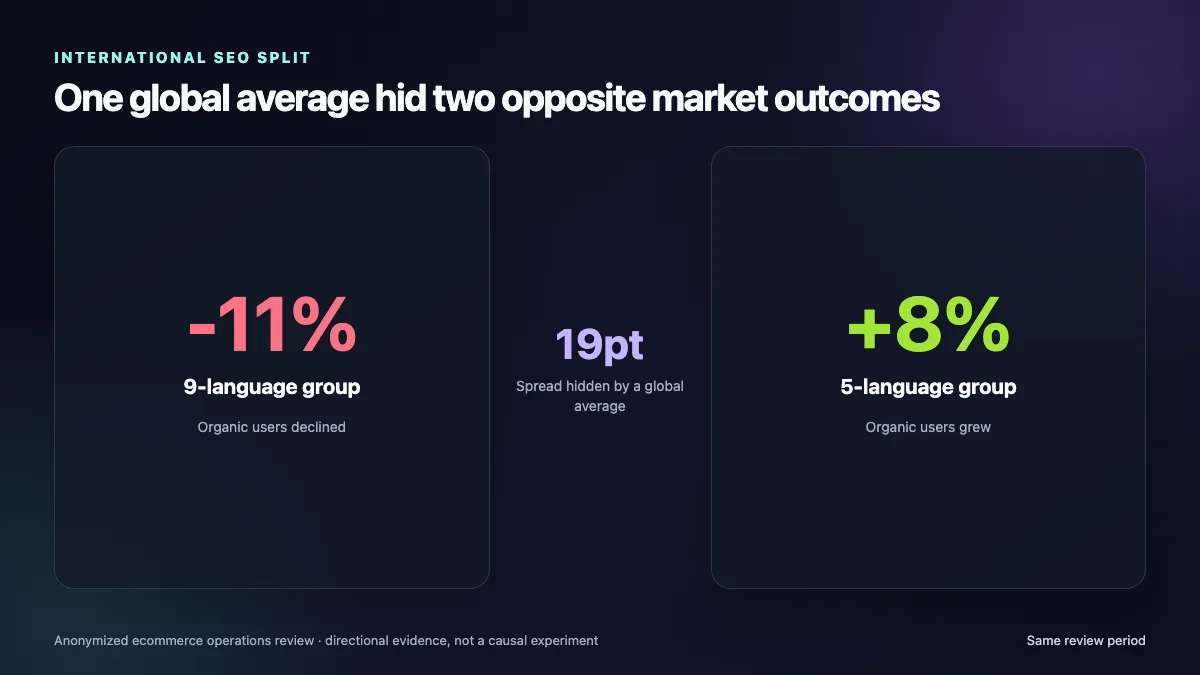
A single global number can send a team in the wrong direction when language markets are moving apart. In one review period, a nine-language group lost 11% of organic users while a five-language group gained 8% on the same platform. That is not a reporting quirk. It is a 19-percentage-point spread, and it changes what a team should inspect, ship, or pause first.
The same platform produced two opposite outcomes
The key fact is not that the aggregate moved up or down. It is that the same platform produced two opposite outcomes at the same time. A blended average pushes teams toward a false story: either the platform is broadly healthy or broadly broken. The pattern supports neither. It supports a narrower conclusion: performance differed by locale group, so the next decision has to be locale-specific.
The math is simple. The nine-language group declined by 11%. The five-language group increased by 8%. The distance between those outcomes is 19 percentage points. That spread is large enough to hide very different operating conditions, including uneven indexing, mismatched localization, or market-level demand shifts.
On multilingual sites, even basic implementation checks such as Google hreflang syntax are evaluated at the page and locale level, not as one global state. Google’s broader guidance on multilingual and multiregional sites points the same way: international SEO is managed through localized versions and regional targeting choices, not one blended score.
Locale group
Number of language sites
Organic users change in review period
What the number means for diagnosis
Group A
9
-11%
Investigate loss mechanisms in those locales first
Group B
5
+8%
Preserve winning conditions and avoid “fixes” that flatten gains
Spread
14 total across both groups
19 percentage points
Do not approve a global explanation without locale evidence
When two language groups on the same platform move in opposite directions, reject any first-pass diagnosis that is not segmented by locale. A release gate built on the global average would miss that one set of markets needs protection while another needs recovery work.
Diagnose multilingual SEO market by market — Convertos.ai original workflow poster.Diagnose multilingual SEO market by market — Convertos.ai original explainer.
This original narrated explainer reduces the article to three checks: Market × language, URL × hreflang, SEO × AI visibility. Captions and a transcript are included for accessibility.
Video transcriptMultilingual SEO should be diagnosed market by market, not as one language total. Spanish in Spain and Spanish in Mexico can have different queries, competitors, result layouts, and conversion paths. The same applies to AI answers and citations. Map each market and language to the intended URL. Validate hreflang and canonicals, then compare search demand, clicks, rankings, and AI visibility inside that market. A global average can look stable while one market grows and another loses its landing pages. Local evidence leads to local fixes.The two language groups were 19 percentage points apart in the same review period.
A global average erases the decision you need to make
A global roll-up is useful for reporting scale. It is weak for diagnosis.
In the review period used here, one nine-language site group lost 11% of organic users while a separate five-language group gained 8%. That is a 19-point spread inside the same portfolio, in one period, so it shows divergence, not controlled causation.
The reason the roll-up fails is straightforward. A global average is weighted by traffic concentration, not by the number of locales. If a few high-volume languages are stable or growing, they can dilute a decline elsewhere. If the declining languages hold most of the traffic, the reverse happens. Either way, the aggregate tells you what happened to the portfolio total, not which market needs intervention.
This is why international SEO guidance treats language and regional targeting as implementation-specific rather than globally interchangeable. Google’s documentation on managing multilingual and multiregional sites and hreflang syntax is built around alternate versions, targeting, and consistency at the locale level.
So the rule is simple: never approve or reject a release from the global average alone. If language groups move in different directions, treat the aggregate as a summary metric and the locale trend as the diagnostic metric.
Build one diagnostic row per locale
If the diagnosis starts with a blended dashboard, the next action will be wrong for at least some markets. The practical fix is to give each locale one row and run the same checks across all rows.
That turns “traffic is down” into a more useful question: where is the break? Crawl access, indexation, demand, click capture, ranking footprint, or inclusion in AI answers? In the reviewed period, one nine-language group was down 11% in organic users while a separate five-language group was up 8%. That is a 19-point spread inside the same platform and review window, so any single global average is already too coarse for release decisions. These figures are observational for one period, not proof of causation.
A useful row has six fields. Crawl asks whether bots can reach the intended URLs. Indexation asks whether the right localized URLs are actually stored and eligible. Demand asks whether the market is searching for the topic set at all. CTR asks whether snippets and intent match are winning the click once impressions exist. Ranking coverage asks how much of the tracked query cohort has a visible footprint. AI answer inclusion asks whether the brand or page family appears in answer surfaces for the same query cohort.
For multilingual sites, hreflang belongs in the crawl and indexation checks, but only as a hint, not a guarantee, which is how Google documents it in its localized versions guidance and broader multiregional documentation.
Locale
Crawl parity
Indexation parity
Demand vs prior period
CTR vs site median
Ranking coverage
AI answer inclusion
Likely first action
[locale]
[record]
[record]
[record]
[record]
[record]
[record]
Inspect the first field that clearly diverges from peer locales
The decision rules should stay blunt and qualitative. If crawl or indexation is the clearest outlier, investigate technical parity before blaming demand or content. If parity looks clean but demand is the clearest outlier, avoid shipping a global template fix to solve a market problem. If demand is stable or improving and CTR is the main outlier, work the snippet layer before rebuilding pages.
One row per locale keeps those calls separate. That is the only way to explain how one language group can fall while another grows on the same stack.
Separate technical parity from market demand
Locale diagnosis breaks when teams mix two different questions: can Google correctly index and route the right page, and does this market actually want, trust, and click what you published?
The first is technical parity. The second is market demand. They interact, but they are not the same failure class. A locale can have clean implementation and still lose because the query mix softened, the assortment missed local intent, or the snippet failed to earn the click. Another locale can have healthy demand and still underperform because hreflang, canonicals, or sitemaps send mixed signals.
Google’s own international guidance treats these as separate concerns, especially around localized versions and regional targeting (hreflang syntax, managing multilingual and multiregional sites).
The review-period evidence makes that distinction practical. In one period, a nine-language group lost 11% of organic users while a five-language group gained 8% over the same period. That is a 19 percentage point spread inside the same broader estate. The figures show association, not controlled causation, but they are enough to reject a lazy diagnosis like “the platform is down globally” or “demand is weak everywhere.” If one cluster rises while another falls, test whether the losing locales share technical defects, demand weakness, or both.
A simple decision grid helps:
Locale signal
Technical parity check
Market demand check
Likely next move
Rankings down, impressions down
Validate hreflang return links, canonical targets, XML sitemap inclusion
Review local query seasonality and category demand
Fix routing or indexation first, then reassess demand
Rankings stable, CTR down
Confirm correct locale URL is eligible and not consolidated elsewhere
Rewrite titles and meta for local phrasing, price cues, and trust signals
Treat as a snippet and merchandising problem
Impressions up, conversions down
Check page equivalence and template parity
Audit payment, shipping, sizing, and cultural fit
Prioritize local UX and offer alignment
One locale falls while peers rise
Compare implementation parity across the language cluster
Compare assortment and SERP snippet fit by market
Do not ship one global explanation
Use this sequence before escalating engineering. If the locale has indexation inconsistencies, fix those first because demand analysis on the wrong URL set is noisy. If technical parity is clean, stop blaming hreflang and move to demand evidence: query mix, local inventory depth, pricing presentation, review language, and snippet wording.
That separation keeps teams from treating every decline as a template bug and every gain as proof that all locales are healthy.
Release by language group, not by global template
A multilingual release should not pass because the template passed once in the dominant market. It should pass because each language group cleared the checks that matter for that group.
In the reviewed period, one nine-language group was down 11% in organic users while a separate five-language group was up 8%. That is a 19 percentage point spread inside the same broader estate, over the same review window, and it is enough to reject any single global go or no-go decision. The numbers are observational for that period, not proof of causation, but they are strong evidence that rollout risk is not evenly distributed by locale.
The practical fix is to define canary markets by language group, not by traffic rank alone. A canary should represent the release conditions most likely to break: one market with complex templates, one with lower-authority pages, one with heavy translated inventory, and one where regional targeting depends on clean annotations.
Google’s own international guidance makes this clear in effect: multilingual and multiregional behavior depends on implementation details such as localized URLs and hreflang, and those signals are only hints, not guarantees (managing multilingual and multiregional sites, Search Engine Journal summary). If hints can be interpreted imperfectly, release validation has to happen where those hints are actually used.
Use a release gate that separates parity checks from localized QA and assigns rollback ownership before deployment:
Gate
Pass condition by language group
Owner
Rollback trigger
Technical parity
Canonicals, indexability, status codes, XML inclusion, and hreflang reciprocity match the intended pre-release state
Platform SEO + engineering
Any critical parity defect in a canary locale
Localized QA
Navigation labels, internal links, currency, pagination, faceted rules, and translated metadata render correctly on sampled templates
Local market lead + QA
User path break or wrong-market page served
Search validation
Search Console impressions and valid indexed pages remain directionally consistent with the intended release outcome during the review window
SEO lead
Sustained adverse deviation in the affected language group
Ownership
Named approver for each language group and named rollback executor
Release manager
Missing owner blocks launch
The operating rule is straightforward: release a language group if its canary locales pass parity and localized QA, hold a group if a canary fails, and roll back only the affected language group if post-release validation shows a clear problem.
Compare markets only after the measurement contract matches
Cross-market comparison is only valid when the measurement contract is identical. In practice, that contract has five parts: the same review window, the same page types, the same brand mix, the same analytics coverage, and the same prompt set if AI surfaces are part of the readout. If any one of those shifts by locale, the comparison stops being diagnostic and becomes a blend of market behavior and measurement drift.
Start with time. The approved case evidence covers one shared review period only: during that period, a nine-language group lost 11% of organic users while a five-language group gained 8%. That is a 19 percentage point spread, but only inside the matched window. Change the dates for one locale, even by a holiday week or campaign launch, and the spread no longer means the same thing.
The same applies to page types. Comparing product detail pages in one language to category pages in another will manufacture differences that look like market effects.
Then lock the inventory and attribution rules. Brand mix matters because branded demand can cushion one locale while non-brand falls. Analytics coverage matters because some markets have cleaner tagging, consent behavior, or subfolder tracking than others. International implementations also need the same localization rules before you infer performance differences. Google treats hreflang as a hint, not a directive, so parity checks belong in the contract before market comparison begins: Google hreflang syntax, Search Engine Journal summary.
Contract item
Match requirement
If unmatched, what the comparison really shows
Review period
Same start and end dates
Seasonality or campaign timing
Page types
Same templates and intent class
Mix shift, not locale performance
Brand mix
Same brand or non-brand rule
Demand composition, not execution
Analytics coverage
Same tracking and consent treatment
Instrumentation bias
Prompt set
Same prompts, language intent, and scoring rubric
Retrieval variance, not market outcome
Use a hard gate before any cross-locale readout: compare markets only when all five contract items match. If one item fails, diagnose within locale first and do not rank markets against each other. If all five match, reject the global average as the release gate and make the decision by language group.
Use the SEO audit workflow to preserve the cohort and evidence. Refer to the Convertos SEO guides when the diagnosis reaches a specific page or template decision.
Disclosure
The case data comes from a private 2026 operating review of a large cross-border marketplace. It is reproduced with permission after company, vendor, domain, system, and personnel identifiers were removed. The figures show association, not controlled causation.