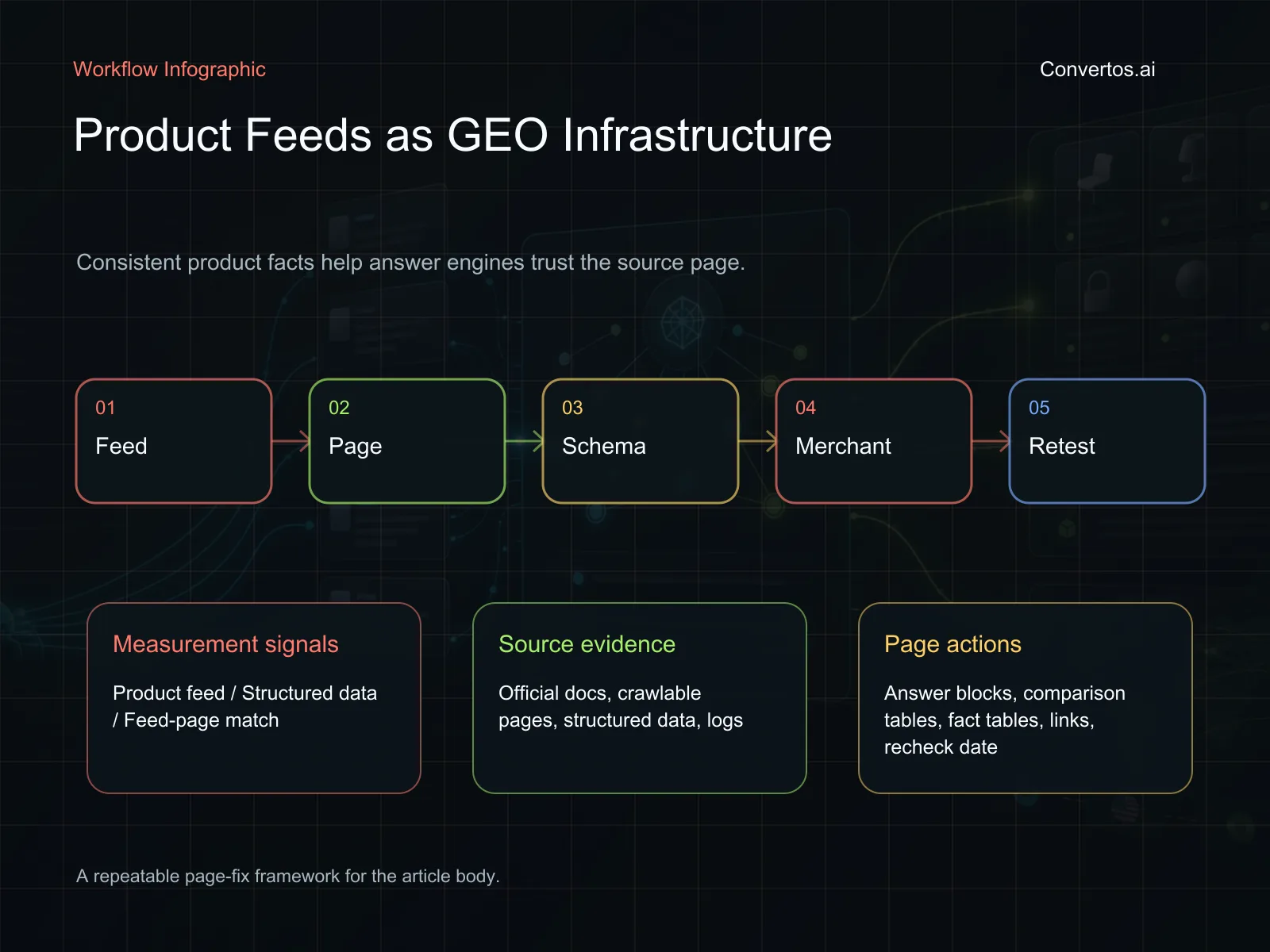
Product feeds are GEO infrastructure because they define the product facts that search and AI systems try to verify: name, price, availability, shipping, returns, variants, identifiers, images, and reviews. A feed does not make a weak page trustworthy by itself. But when feed data, Product structured data, merchant listings, and visible page copy agree, answer systems have fewer reasons to replace your page with a marketplace or review site.
A short summary of how product feeds become the factual layer for AI-search visibility.Use the workflow to find feed-page mismatches before adding more product copy.
Key takeaways
A feed is not just a shopping channel asset. It is a structured product-fact layer.
Product pages, feed attributes, Product schema, and merchant listings should agree on important facts.
AI answers often need product attributes such as size, material, compatibility, availability, shipping, and returns.
Fix feed-page mismatches before writing more category or product content.
Why product feeds are GEO infrastructure
Generative answers about products depend on stable facts. If one source says a product is in stock, another says out of stock, and the page hides shipping or return details, the answer engine may avoid your page or cite a marketplace instead. The feed becomes infrastructure because it supplies normalized facts at scale.
Google's Merchant Center product data specification exists to make product information consistently formatted for ads and free listings (Google Merchant Center product data specification). Product structured data and Merchant Center structured markup then help search systems read product facts from the page itself (Google product structured data docs, Merchant Center structured data guidance).
Fact layer
What it controls
AI visibility risk if inconsistent
Feed
Submitted product attributes and identifiers.
Answers may use stale or incomplete facts.
Product page
Visible claims, specs, pricing, availability, and proof.
AI systems may cite a marketplace or review page instead.
Product structured data
Machine-readable page facts.
Schema conflicts with visible copy reduce trust.
Merchant listings
Eligibility and product display surfaces.
Missing shipping, returns, or availability can limit product visibility.
Align feeds, product pages, and Product structured data
The first audit is a consistency check. Pick a sample of top products, then compare feed attributes against visible page text and Product structured data. Do not start with every field. Start with facts buyers ask about: price, availability, brand, GTIN or MPN, size, color, material, shipping, returns, rating, and variant relationships.
Schema.org defines Product as a broad type for products and services, but search features need the fields that fit the page and merchant context (Schema.org Product type). Google also separates product snippets from merchant listings, so a review page and a purchasable product page do not need identical markup (Google product structured data docs).
Attribute
Feed check
Page / schema check
Price
Currency and value match the current offer.
Visible price and Offer markup agree.
Availability
Feed status is current.
Page status and schema availability agree.
Identifiers
GTIN, MPN, brand, and variant IDs are stable.
Product page does not mix variant identifiers.
Shipping / returns
Attributes are present when required for the market.
Policy text is visible and not contradicted by markup.
Prioritize attributes answer engines need
AI answers are often generated from buyer questions, not from feed field names. The user may ask "which waterproof hiking shoe ships fastest in size 10" or "does this laptop work with two external monitors". That means the feed and page need attributes that answer real selection questions, not only minimum listing fields.
Build an attribute map by category. For apparel, size, material, fit, color, gender, return window, and image quality may matter. For electronics, compatibility, model number, warranty, ports, and power specs matter. For B2B products, availability, minimum order, integration, support region, and documentation can become answer evidence.
Product type
Attributes to stabilize first
Why AI answers use them
Apparel
Size, color, material, fit, shipping, returns.
Buyers ask fit and delivery questions before purchase.
Answers need precise specs to avoid wrong recommendations.
Marketplace SKU
Brand, GTIN/MPN, availability, seller, price.
Duplicate listings need strong identifiers.
B2B product
Integration, support region, implementation time, documentation.
Selection questions depend on operational fit.
Use product cards and merchant listings as evidence surfaces
Product cards, free listings, and merchant surfaces are not only traffic channels. They are places where search systems compare structured product facts against the landing page. If those facts are inconsistent, the page may lose eligibility, trust, or freshness. Google notes that structured data can help Merchant Center retrieve up-to-date product information from websites (Merchant Center structured data guidance).
For GEO work, treat each product surface as an evidence surface. The same core facts should appear in the feed, the visible page, the schema, and the listing. If a product is seasonal or changes often, define which system owns the truth and how quickly the page and feed update after inventory changes.
Surface
Question to ask
Action
Feed
Is this the source of truth for the attribute?
Define owner and update cadence.
Page
Can a buyer and crawler see the same fact?
Put important facts in visible text, not only tabs or scripts.
Structured data
Does markup match visible content?
Validate after template or feed changes.
Merchant listing
Does the listing reflect current offer details?
Monitor disapprovals and automatic item updates.
Audit feed-page mismatches before adding content
Many product SEO projects skip the mismatch audit and jump to content. That creates polished copy around unstable facts. Start with a mismatch report: feed value, page value, structured data value, listing value, owner, severity, and fix date.
Severity depends on buyer impact. A minor color wording difference may not matter. A price, availability, shipping, return, or identifier conflict can affect trust and eligibility. Google publishes Merchant Center specification updates, so teams should also review changes when attributes or policy requirements shift (Merchant Center announcements).
Mismatch
Severity
Fix owner
Feed price differs from page price.
High
Merchandising / feed owner and template owner.
Schema availability says InStock; page says sold out.
High
Engineering or commerce platform owner.
Variant GTIN reused across sizes.
High
Catalog data owner.
Return window visible on page but absent from feed/listing where required.
Medium to high
Policy and feed owner.
Description wording differs but facts match.
Low
Content owner if it affects clarity.
Measure product visibility across prompts and citations
After the facts align, measure whether AI answers use your product pages. Use prompts that mirror buyer selection: compatibility, price range, shipping, returns, alternatives, comparison, and category recommendations. Record whether the answer cites the product page, a category page, a marketplace, a review site, or a competitor.
Prompt type
Example
Expected source
Attribute question
Which products support X feature?
Product or category page with visible specs.
Availability question
Which option is in stock and ships to this market?
Product page or merchant listing.
Comparison question
Product A vs Product B for this use case.
Comparison page or structured product page.
Policy question
What is the return window for this product?
Policy section linked from product page.
FAQ
Is Product structured data enough without a feed?
Usually no for larger catalogs. Structured data helps page understanding, while feeds help manage product facts and listing data at scale.
Should every product attribute appear in visible copy?
Important buyer-decision attributes should be visible. Low-level internal fields can stay in the feed, but facts that affect purchase confidence should not be hidden.
What mismatch should be fixed first?
Fix price, availability, identifiers, shipping, and returns before softer description issues. Those fields affect buyer trust and listing eligibility.
How does Convertos fit into product-feed GEO?
Use Convertos to test whether product prompts cite owned pages, then use the mismatch audit to decide whether the fix belongs in feed data, page copy, or structured markup.
Source statement
Reviewed on June 26, 2026. This article references Google Merchant Center product data documentation, Google Product structured data guidance, Merchant Center structured data guidance, and Schema.org Product definitions. Product data requirements change, so review official specifications before changing production feeds.