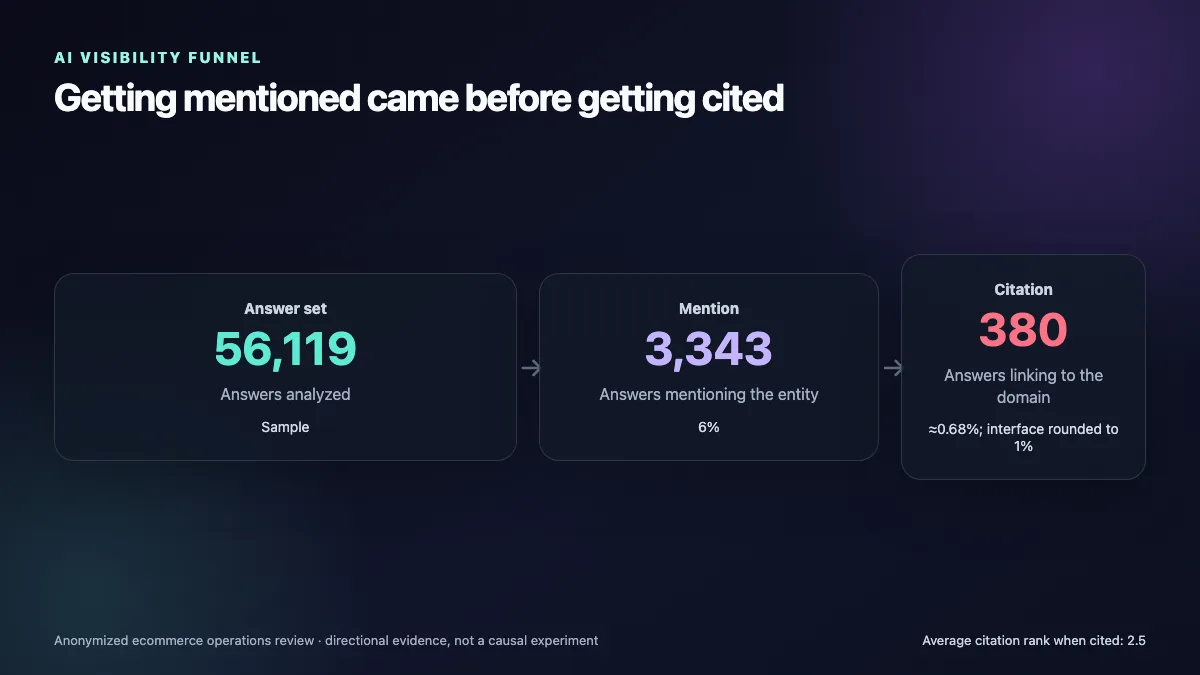
In 56,119 AI answers, mention rate was 6%, citation rate was about 1%, and average citation order was 2.5. The bottleneck was inclusion, not source order.
A high citation position does not mean a brand is regularly included in AI answers. In this case, the brand averaged citation rank 2.5 when it was cited, which looks strong at first glance. Across the full sample, though, it was still close to invisible: 56,119 answers were reviewed across four major AI answer surfaces, the brand was mentioned in 3,343 answers, and only 380 answers linked to the marketplace domain. That is 380 out of 56,119, or about 0.68%, often rounded to 1%.
The practical point is simple: when inclusion is rare, citation rank describes performance after selection. It does not explain why the brand is missing in the first place. The figures here show association, not controlled causation.
A strong citation rank can coexist with near-invisibility
The easiest mistake is to see rank 2.5 and assume the brand is already winning visibility. It is not.
Rank exists only inside the subset of answers where the brand was selected at all. If selection is scarce, a good average rank can sit on top of a tiny base. That is why answer inclusion matters before citation position does. If you want a clean definition of that distinction, Answer Inclusion Rate is the better lens.
Metric
Count
Rate
Total answers in sample
56,119
100%
Answers mentioning the brand
3,343
6.0%
Answers linking to the domain
380
0.68%
Average citation rank when cited
2.5
n/a
The gap is the story. A 6% mention rate means the brand appeared in roughly 1 out of 17 answers. A 0.68% linked-answer rate means the domain appeared in roughly 1 out of 148 answers. Those are not rounding artifacts. They show a structural absence.
At the same time, comparison entities appeared while the marketplace was absent in 81.3% of answers. So the category was often present even when this brand was not.
That pattern fits how answer systems typically work: candidates are generated, scored, and reranked. Strong placement among selected candidates does not guarantee frequent selection upstream. Google’s overview of candidate generation, scoring, and reranking is useful here as a conceptual model, not as proof about this specific case. When linked inclusion is this rare, citation rank is not the first optimization target.
Mention comes before rank in AI answers — Convertos.ai original workflow poster.Mention comes before rank in AI answers — Convertos.ai original explainer.
This original 30-second narrated explainer reduces the article to three checks: Mention, Recommendation, Citation. Captions and a transcript are included for accessibility.
Video transcriptIn AI answers, ranking is often the wrong first question. A brand must enter the answer before its position can matter. Start by recording whether it is mentioned at all. Then check whether it is recommended, how it is described, and which sources are cited. A brand can be mentioned without a citation, or cited without a strong recommendation. Those are different failures. Measure the stages separately, improve the missing evidence or entity signals, and only discuss position after the brand is selected consistently.Only about 0.68% of the answer sample linked to the marketplace domain, although the interface rounded this to 1%.
Recognition, inclusion, and citation are different gates
AI answer visibility works more like a funnel than a single score.
First, the system has to recognize the brand as relevant to the prompt. Then it has to include the brand in the answer text. Only after that might it cite a source tied to the brand. Those are separate events, and collapsing them into one visibility number hides the real failure point. In recommendation systems, candidate generation, scoring, and reranking are distinct steps for the same reason: being eligible is not the same as being selected, and selection is not the same as final placement (candidate generation, scoring, and reranking).
The sample here covers 56,119 answers across four major AI answer surfaces, so the numbers describe one observed dataset, not a controlled test. Within that sample, the marketplace was mentioned in 3,343 answers, a 6% mention rate. But only 380 answers linked to the marketplace domain, which is 380 / 56,119 = 0.68%, often rounded to 1%.
The useful comparison is not just total mentions versus total citations. It is each stage against the one before it.
Funnel stage
Count
Rate from total sample
Rate from prior stage
Total answers observed
56,119
100%
—
Brand mentioned
3,343
6.0%
—
Brand-cited answers
380
0.68%
11.4% of mentions
That last figure matters here: 380 / 3,343 = 11.4%. Once the brand was included in the answer, a citation to its domain appeared only about one time in nine. That is a leak, but it is not the first one. The larger leak comes earlier, because 94% of answers never mentioned the brand at all.
The comparison signal makes the diagnosis clearer. In the same sample, the marketplace was absent while comparison entities appeared in 81.3% of answers. That suggests the system often recognized the category and found alternatives worth naming, yet still did not include this brand in the answer set. So if the brand is cited near the top when cited at all, citation rank is not the first job. The first job is improving Answer Inclusion Rate: the share of answers where the brand makes the answer before anyone worries about whether its link lands first or third.
The rounded citation rate needs a denominator
A rounded citation rate can make a weak outcome look merely small instead of structurally rare.
In this sample of 56,119 answers across four major AI answer surfaces, 380 answers linked to the marketplace domain. That is 380 ÷ 56,119 = 0.677%, which many dashboards will display as 1%. The display is not mathematically wrong, but it hides the denominator that tells you how often inclusion actually happened. If a team reports, “we are cited in 1% of answers,” people tend to hear “occasionally present.” The underlying reality is harsher: absent in 55,739 of 56,119 answers.
The denominator matters even more because the brand was already recognized in some cases. In the same sample, the mention rate was 6%, or 3,343 answers. So the brand was named far more often than it was linked. Only 380 of 3,343 mentions became citations, about 11.4%. That is why citation rate should never be read alone. It sits downstream from recognition and answer inclusion, much like later-stage scores in recommendation systems cannot explain earlier-stage misses by themselves (candidate generation, scoring, and reranking).
Metric in this sample
Raw count
Share
Total answers observed
56,119
100.0%
Answers mentioning the brand
3,343
6.0%
Answers citing the domain
380
0.68%
Mentioned but not cited
2,963
5.28%
Not cited
55,739
99.32%
This is why teams should keep raw counts, not just rounded percentages. Small rounded rates can hide meaningful movement when the denominator is large.
If you are measuring answer inclusion rate or citation rate, keep the numerator, denominator, and exact decimal before rounding, then segment by surface and query cohort instead of relying on a single headline number (Answer Inclusion Rate).
A practical rule helps: always show raw counts alongside rounded rates.
Find the bottleneck before choosing a tactic
When a brand barely makes answers, “improve citation rank” is usually the wrong first move.
In this sample of 56,119 answers across four major AI answer surfaces, the brand was mentioned in 3,343 answers, or 6%. Only 380 answers linked to the marketplace domain, which is 380/56,119 = 0.68%, often rounded to 1%. Yet when a citation did appear, its average rank was 2.5. That pattern matters. The system was not mainly saying, “yes, but too low.” Most of the time, it was saying nothing at all, or mentioning the brand without turning it into a source.
On measurement terms, this is an inclusion problem before it is a ranking problem. That is why answer-level inclusion metrics are more useful than a single blended visibility score at diagnosis time (Answer Inclusion Rate).
A simple decision matrix keeps teams from prescribing link tactics to a retrieval problem or authority tactics to a formatting problem.
Observed state
What it usually means
First tactic to test
What not to prioritize first
Absent
The brand is not making candidate sets for the prompt class, while comparison entities do
Expand prompt-entity coverage, comparison-page fit, and explicit topical associations
Fine-tuning citation placement
Mentioned without link
The model recognizes the brand but does not see it as the best supporting source
Strengthen source-worthiness: original data, clear claims, quotable pages, stable URLs
Chasing average citation rank
Cited low
The brand is selected as a source but loses in scoring or reranking
Improve evidence density, page specificity, and query-page match
Broad awareness campaigns
Cited high but weak context
The source is chosen early, but the surrounding answer frames it poorly or narrowly
Rewrite pages for clearer entity-role signals and better comparative framing
More homepage links
The case numbers point to the first two rows. If 3,343 answers mentioned the brand but only 380 linked to it, then 2,963 answers recognized the brand without citing the domain. That means about 88.6% of mentions did not become citations. Separately, comparison entities appeared while the marketplace was absent in 81.3% of answers, which is a stronger sign of candidate-set exclusion than of poor citation ordering. Recommendation systems routinely separate candidate generation from later scoring and reranking; answer systems behave similarly enough that the distinction is useful here (candidate generation, scoring, and reranking).
The rule is straightforward. If absence dominates, work on eligibility. If mentions dominate without links, work on source selection. If citations are common but low, work on rank. If citations are high but the answer context is weak, work on framing.
What increases the chance of inclusion
Inclusion usually rises when a brand is easy to classify, easy to verify, and easy to compare.
The case numbers show why. In a sample of 56,119 answers across four major AI answer surfaces, the brand was mentioned in 3,343 answers, about 6%. Only 380 answers linked to the marketplace domain, or 0.68%, often rounded to 1%. Yet when it was cited, its average citation rank was 2.5. That suggests the main problem was not weak position after selection. It was weak selection into the answer set in the first place.
This fits how retrieval and reranking systems work: candidate generation and scoring reward items that fit the task cleanly and carry usable evidence, not just items that are generally prominent in the category (candidate generation, scoring, and reranking).
The first lever is clear category fit. If a page tries to be marketplace, logistics guide, editorial review, and seller resource all at once, the model has to infer which role matters for the prompt. Inclusion improves when the source page states the entity type, use case, geography, and audience in plain language near the top. Comparison prompts especially need the brand to look like a valid member of the comparison set. In the case data, comparison entities appeared while the marketplace was absent in 81.3% of answers. That is a strong sign that answer systems often found a comparison frame but did not consistently slot the marketplace into it.
The second lever is answer-ready facts. Models favor pages that expose concrete fields they can lift into an answer: fees, shipping windows, return terms, supported countries, seller protections, payment methods, and eligibility rules. Corroboration matters too. If those facts appear only on one page, or differ across help, blog, and product pages, inclusion gets harder because the model has less confidence that the claim is stable.
Inclusion lever
What the page should make obvious
Why it helps selection
Category fit
“Cross-border marketplace for X buyers and Y sellers”
Reduces ambiguity about whether the brand belongs in the answer
Answer-ready facts
Structured, current facts with units, dates, and scope
Gives the model quotable material
Comparison evidence
Side-by-side pages versus common alternatives
Makes the brand eligible for comparison prompts
Corroboration
Same facts repeated across product, help, and policy pages
Increases confidence in factual stability
Crawlability
Indexable HTML pages, not hidden app states or PDFs only
Improves retrieval and extraction
Entity consistency
One canonical name, same logo, same descriptors everywhere
Prevents fragmented recognition
The decision rule here is practical: if citation rank is strong when present, work on eligibility before prominence. In this case, 380 citations from 3,343 mentions means only about 11.4% of mentions turned into linked inclusions. Improving rank from 2.5 to a slightly better position would not fix the larger gap if the brand still fails category matching, lacks comparison pages, or spreads key facts across uncrawlable states. Better inclusion odds come from making the brand legible to the answer system, then making the evidence easy to lift and cross-check. For teams measuring this directly, the useful metric is Answer Inclusion Rate, not raw mention count alone.
Track the funnel as cohorts, not a single score
A single visibility score hides the only question that matters operationally: where did this week’s prompts fail?
Track prompts as weekly cohorts, then follow each cohort through the same gates: answers where the brand was mentioned, answers where it was included in the body of the answer, and answers where it was cited or linked. That structure matches how answer systems typically work, with candidate generation, scoring, and reranking deciding what survives into the final response, not just what was available to cite (candidate generation, scoring, and reranking). If you collapse all of that into one blended score, you cannot tell whether the problem is recognition, answer fit, or citation attachment.
The evidence here shows why cohorting matters. In a sample of 56,119 answers across four major AI answer surfaces, the brand was mentioned in 3,343 answers, or 6%. Only 380 answers linked to the marketplace domain, which is 380/56,119 = 0.68%, often rounded to 1%. Yet when a citation did appear, the average citation rank was 2.5. Read as a funnel, that is not a rank problem first. It is a survival problem between prompt eligibility and answer inclusion. The strongest clue is the comparison set: the marketplace was absent while comparison entities appeared in 81.3% of answers. Association only, not controlled causation, but enough to direct measurement.
Weekly cohort view
Count
Rate from prior stage
Rate from total sample
Answers observed
56,119
—
100.0%
Brand mentioned
3,343
6.0%
6.0%
Domain cited/linked
380
11.4% of mentions
0.68%
Use that table shape every week, but attach prompt-level evidence to each row movement. For every prompt in the cohort, save the prompt text, answer surface, date, whether the brand appeared, whether the answer actually included the brand in the recommendation set, whether a citation appeared, citation rank if present, and which comparison entities were included instead. This is the minimum evidence needed to calculate Answer Inclusion Rate cleanly and inspect misses without guesswork.
The first metric to move is not average citation rank. It is the share of prompts where the brand is absent while comparison entities appear. If citation rank is already strong when present, but comparison-entity presence with brand absence stays high, work on inclusion evidence and answer fit before citation tactics.
Record the cohort, limitation, and owner in the AI Visibility Checker. Move to the Convertos SEO guides only for the action that the evidence supports.
Disclosure
The case data comes from a private 2026 operating review of a large cross-border marketplace. It is reproduced with permission after company, vendor, domain, system, and personnel identifiers were removed. The figures show association, not controlled causation.