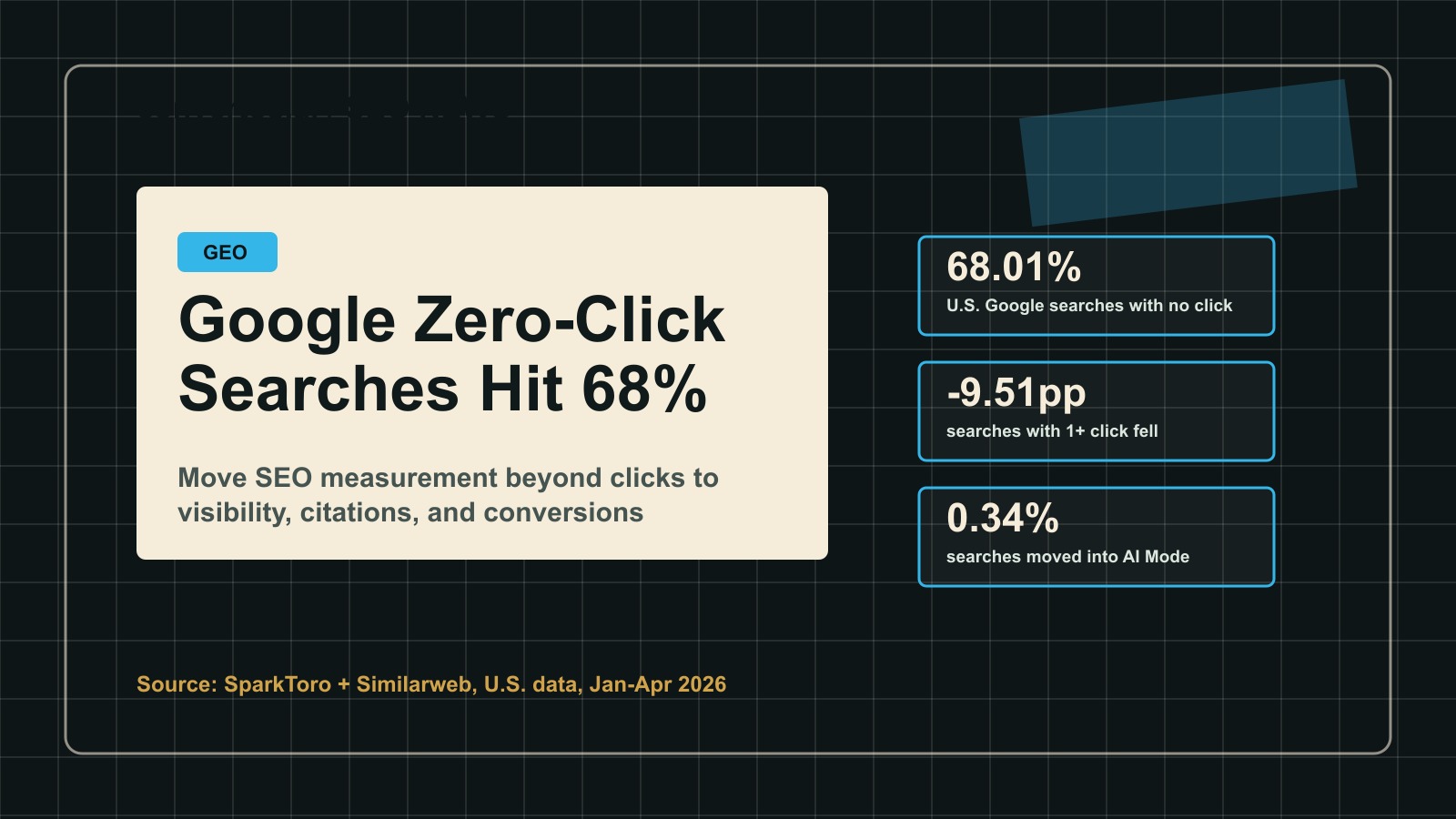
Clicks are thinner, but search influence is not gone.English voiceover video: what the 2026 zero-click study means for SEO and GEO measurement.Search Engine Land reported on June 9, 2026 that Google zero-click searches reached 68.01% in the U.S. during the first four months of 2026. The underlying SparkToro study used Similarweb desktop and mobile web panel data and found that fewer Google searches now send users to a website.
The useful takeaway is not "SEO is dead." It is this: click volume is no longer a complete measure of search value. SEO teams still need crawlable, useful pages. GEO teams also need to measure whether AI answers, Google AI features, and zero-click results represent the brand correctly before a user ever lands on the site.
The Short Answer
Google zero-click searches matter because they weaken the old reporting habit of treating organic sessions as the main proof of SEO value. If more users get answers inside Google, teams need a broader dashboard: clicks, impressions, rankings, AI citations, brand wording, assisted conversions, direct demand, and page-level evidence quality.
For a publisher, this changes the question from "Did the article get a visit?" to "Did the article help the search system answer correctly?" For a SaaS team, it changes the question from "Did the keyword send traffic?" to "Did the answer make the buyer more likely to remember, trust, and search for our brand later?"
That is why the response should not be panic or resignation. It should be better segmentation. Some queries still need classic SEO work because users want to compare, buy, book, troubleshoot, or contact a company. Other queries may now create value inside the search result, which means the page has to be useful as a cited source even when the click never comes.
What changed
Why it matters
What to measure next
68.01% of U.S. Google searches ended without a click in Jan-Apr 2026
Many search interactions never become website sessions
Search visibility, answer presence, brand wording, and click quality
Searches with at least one click declined from 2024 to 2026
Traffic can fall even when demand is still present
Conversion rate, assisted revenue, branded search, and direct visits
AI Overviews and AI Mode shape the answer layer
The user may form an opinion before clicking
AI citations, supporting links, answer accuracy, and entity consistency
AI Mode was still small in this study period
The current 68% number is not only an AI Mode story
Separate AI Mode, AI Overview, classic SERP, and query-refinement effects
What The 2026 Study Actually Says
SparkToro's 2026 analysis says 68.01% of U.S. Google searches ended without a click during January through April 2026. The same analysis says U.S. zero-click searches were 60.45% in 2024, so the reported increase is 7.56 percentage points across two years.
The study also found that the share of searches generating at least one click fell by 9.51 percentage points between 2024 and 2026. That figure includes clicks to organic results, paid ads, and Google-owned properties such as Maps and YouTube, while excluding follow-up searches inside Google. Search Engine Land summarized the same point and noted that the share of searches leading to another Google search rose by 7.2 percentage points.
The methodology matters. SparkToro says the 2026 data comes from Similarweb's desktop and mobile web panel, covers U.S. Google searches, assumes a two-thirds mobile and one-third desktop split, and excludes the Google mobile search app. That means the headline number is useful, but it should not be treated as a perfect benchmark for every country, device, vertical, or historical comparison.
Why This Is A GEO Problem, Not Only An SEO Problem
Classic SEO asks whether a page can rank and earn a click. GEO asks whether the brand appears correctly inside AI-generated or answer-style search experiences. Zero-click growth makes GEO more important because the answer itself can become the user's first impression.
Google's AI features guidance says the same foundational SEO practices apply to AI Overviews and AI Mode. Pages still need to be indexed, eligible for snippets, crawlable, internally findable, and supported by visible text, images, videos, and structured data that match the page. Google also says AI features are reported in Search Console's Web search type, not as a separate clean reporting bucket.
That creates a measurement gap. If a page helps an AI Overview answer a question but the user does not click, the work may still influence brand memory. If the answer cites a competitor or describes your product incorrectly, a traffic report may understate the business risk.
The New Measurement Stack
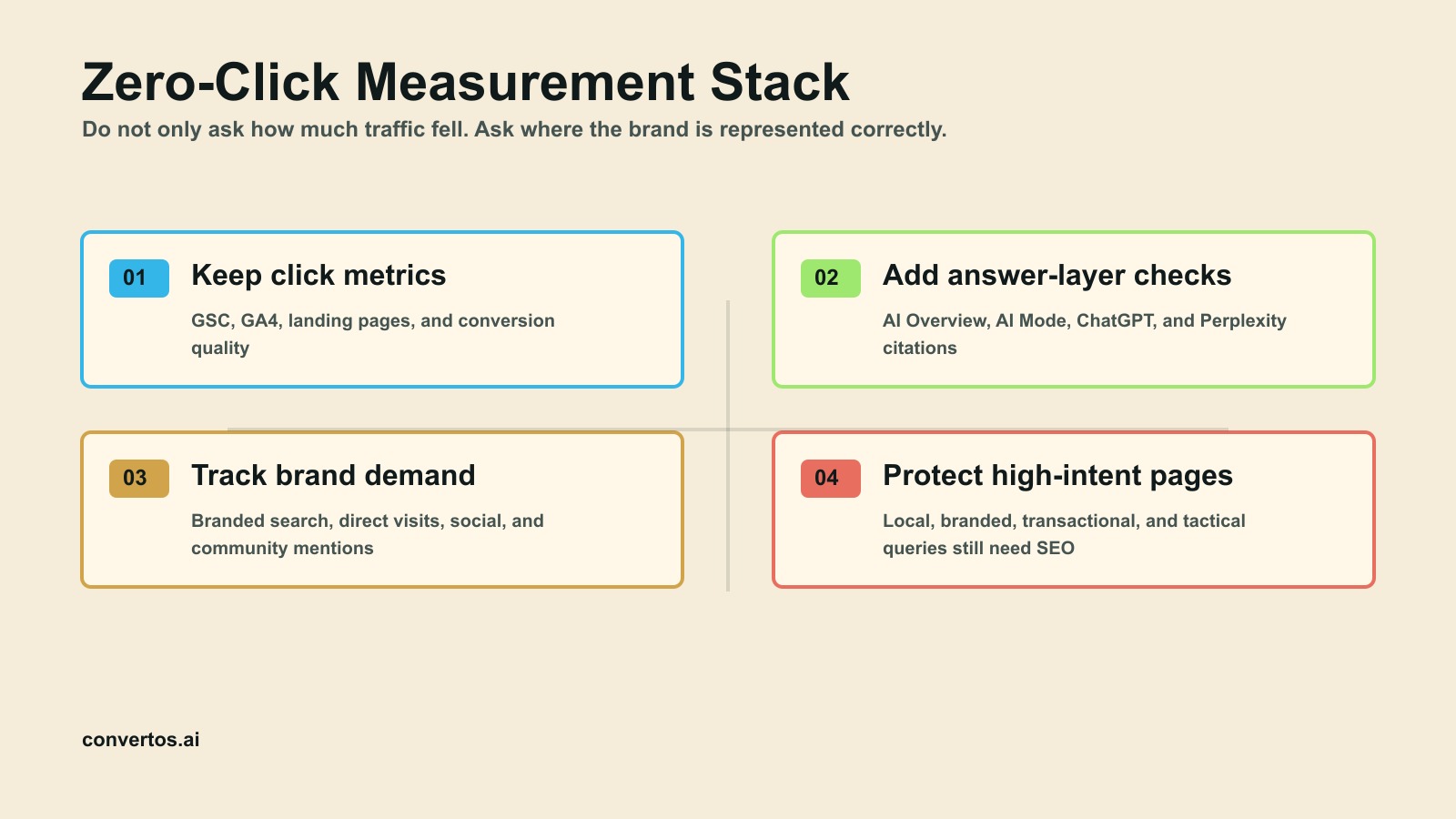
Use a four-layer dashboard instead of a single traffic line.
AI Overview presence, AI Mode links, ChatGPT/Perplexity/Gemini citations, brand mentions
Captures zero-click influence and citation risk
Entity strength
Homepage clarity, About page consistency, product facts, schema, third-party profiles
Helps AI systems connect the right facts to the right brand
Search Console performance reports still matter. They show queries, pages, clicks, impressions, CTR, and position. Google Analytics default channel group documentation is useful for separating Organic Search, Referral, Direct, and other traffic types. But neither tool alone can tell you how a zero-click answer described your brand.
Zero-click search measurement stack: keep click reporting, then add answer visibility, brand demand, and conversion quality.
What To Do This Month
Start with the pages and queries where zero-click behavior can change business outcomes.
Identify pages that already have impressions but weaker clicks. These are not automatically failures; they may be evidence pages in AI answers or zero-click results.
Test priority prompts in Google AI features, ChatGPT, Perplexity, Gemini, and Bing Copilot. Record whether your brand appears, how it is described, and which URLs are cited.
Rewrite weak source pages. Put definitions, criteria, caveats, dates, proof, and next steps near the claims AI systems are likely to extract.
Connect zero-click visibility to business signals. Watch branded search, direct visits, demo requests, paid search lift, newsletter signups, and assisted conversions.
This is where Convertos.ai's AI visibility snapshot, GEO resources, and SEO resources fit together. The point is not to replace SEO reports. The point is to show what traditional reports miss when the user's decision starts inside the answer layer.
Where SEO Still Wins
The zero-click trend does not affect every query equally. SparkToro's article specifically notes that some categories still benefit from SEO, including branded searches, local businesses, and high-intent transactional or tactical queries.
Those categories need normal SEO discipline: indexable pages, clear internal links, strong titles, helpful content, good page experience, and conversion paths that work. They also need GEO discipline: entity clarity, consistent product facts, comparison-ready pages, and proof that can be cited by AI answers.
The better mental model is not SEO versus GEO. It is SEO as eligibility and GEO as representation. SEO helps the page become available to search systems. GEO checks whether the answer layer uses that page accurately.
Common Mistakes
The most expensive mistake is treating zero-click search as one simple story. It is not one story. A weather query, a branded product query, a local service query, and a B2B comparison query can all lose clicks for different reasons. Each one needs a different response.
Use the table below as a practical review checklist. If an SEO report, content plan, or executive update makes one of these mistakes, the team may be overreacting to the headline number or missing the part of search influence that now happens before the visit.
Mistake
Why it hurts
Better approach
Calling the 68% number universal
The study is U.S. web panel data and excludes the Google mobile app
Treat it as a strong signal, then segment by market and query type
Reporting only organic sessions
Zero-click answers can influence demand before a session happens
Add impressions, brand demand, AI citations, and assisted conversions
Abandoning SEO
Google says AI features still rely on foundational SEO practices
Keep technical SEO and content quality work, but broaden measurement
Writing generic "best" pages
AI answers need criteria, caveats, and evidence
Publish comparison tables, fit guidance, limits, and proof
Ignoring brand wording
A wrong answer can hurt even without a lost click
Monitor how AI and SERP features describe the brand
The fix is editorial as much as technical. Strong zero-click content gives search systems a clean answer, a clear source, and a reason to trust the page. Weak content tries to rank for a phrase but does not provide the facts, examples, caveats, or next step that an answer system can safely reuse.
FAQ
Does 68% zero-click mean SEO is no longer worth doing?
No. It means clicks are a smaller part of the value picture. SEO still helps pages become eligible, useful, and citable, while GEO measures whether answers use those pages correctly.
Source signal: Search Engine Land coverage, SparkToro study, and Google AI features guidance.
Can Search Console show AI Overview traffic separately?
Google says AI features are included in overall Search traffic and reported in the Web search type. Teams should use Search Console as a baseline, then add separate answer-level checks for AI citations and wording.
Source signal: Google AI features documentation and Search Console performance documentation.
Should publishers invest less in content?
No. They should invest less in content that only exists to capture a click. Useful pages still shape search answers, AI citations, branded demand, and high-intent conversions.
Source signal: SparkToro's response section and Google helpful-content guidance.
Which query types should be protected first?
Protect branded, local, high-intent transactional, comparison, and tactical how-to queries first. These are the queries where clicks, answer wording, and conversion paths most directly affect business outcomes.
Source signal: SparkToro's category caveats and Convertos.ai GEO measurement workflow.
Source Statement
This article was researched on June 12, 2026. It summarizes the Search Engine Land report, SparkToro's original study, Google Search documentation, Google's I/O 2026 AI Search update, and Ahrefs research on AI Overview click behavior. Zero-click percentages should be interpreted by market, device, query type, and data source because panel methods differ across studies.