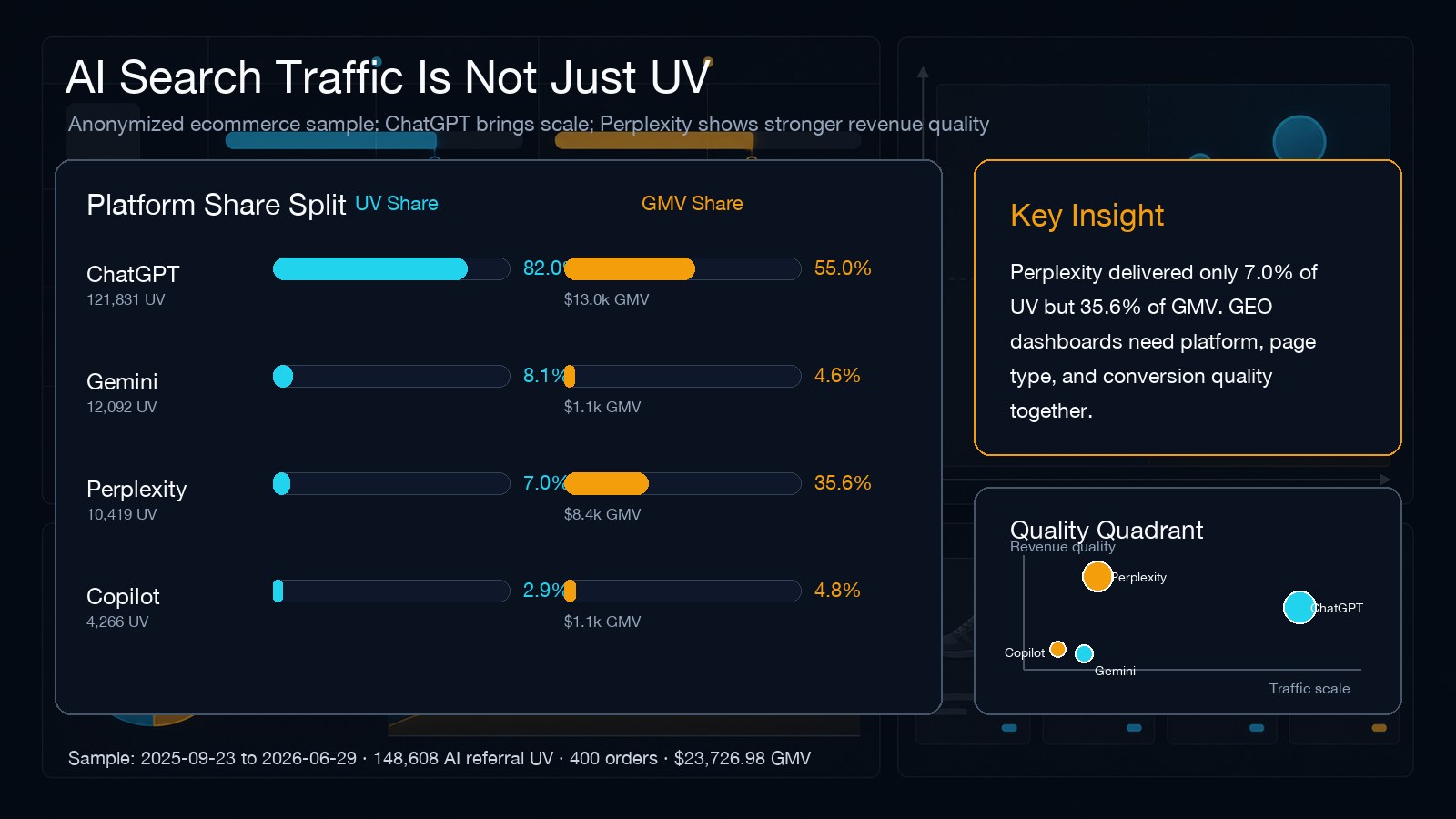
AI search traffic is no longer a one-platform report. ChatGPT still sends the largest measurable volume in many datasets, but newer traffic from Gemini, Perplexity, Claude, and Copilot can change the growth story. In one anonymized cross-border ecommerce sample from September 2025 to June 2026, ChatGPT sent 82.0% of AI referral visits, while Perplexity sent only 7.0% of visits but produced 35.6% of tracked GMV. That is the practical lesson: ecommerce teams should measure AI search by platform, page type, and conversion quality, not only by total sessions.
Short voiceover summary: why ecommerce GEO dashboards should track AI platforms beyond ChatGPT.
Key Takeaways
AI referral reporting should answer three questions at once: which AI platform sent the visit, which page type received it, and whether the visit moved the buyer closer to revenue. A simple source report can show ChatGPT dominance. A useful GEO report shows where smaller platforms are producing stronger intent.
ChatGPT remains the scale baseline. In the anonymized ecommerce sample, it produced 121,831 AI referral UV, or 82.0% of the tracked AI referral total.
Perplexity was the clearest quality outlier. It produced 10,419 UV, but 97 orders and $8,443.71 GMV. That was a 0.93% order rate, about 4.4x the ChatGPT order rate in the same sample.
Gemini needs separate monitoring even when conversion is still early. Public research from SE Ranking’s AI traffic study reported rapid Gemini growth from a small base in 2026, and the sample had Gemini at 8.1% of AI referral UV.
Page type matters. The sample’s homepage received 77.0% of AI referral UV, while product pages received 17.1%. That pattern is useful, but not enough; ecommerce teams should also track category, product, comparison, and buying-guide pages.
Attribution is imperfect. Google’s documentation says AI Overviews and AI Mode are part of Search, not separate referral engines, and Google’s generative AI control page ties visibility and reporting to Search features. Some AI influence will appear as organic search, direct traffic, copied URLs, or brand search.
The operating rule is simple: treat AI search as a portfolio. Use ChatGPT to understand scale, Gemini to watch growth, Perplexity and Claude-style research journeys to understand consideration-stage traffic, and Copilot or other assistants as emerging referral pockets. Then connect those platform rows to revenue, citation visibility, and page optimization.
For teams starting from scratch, the first step is a baseline visibility check. A free AI visibility snapshot can help identify whether answer engines mention a brand and cite its pages before the team spends weeks rewriting content.
What Is AI Search Traffic Beyond ChatGPT?
AI search traffic beyond ChatGPT is the measurable and partially measurable demand that comes from AI answer engines other than ChatGPT. For ecommerce, that usually means tracking referrals, citations, and influenced visits from Gemini, Perplexity, Claude, Copilot, and Google’s AI search surfaces. The point is not to declare one winner. The point is to see which assistant changes discovery, comparison, and purchase behavior.
Traditional referral reports were built around websites. AI search breaks that habit. A buyer may ask Perplexity for supplier comparisons, use Gemini to summarize product options, click a cited product page from ChatGPT Search, and later return through brand search. Some of that path is visible. Some of it is not.
OpenAI’s help article on ChatGPT Search confirms that search answers can include inline citations and a Sources panel. Those links can send measurable referral traffic when users click. Perplexity often behaves more like a research engine, because source links are central to the answer experience. Google is different: its guide to generative AI features in Search says AI Overviews and AI Mode are rooted in core Search ranking and quality systems. That means some AI-driven exposure will live inside Search Console and organic search rather than a clean referrer called “AI.”
For ecommerce reporting, this creates two layers:
Layer
What It Measures
Why It Matters
Visible referrals
Sessions or UV from identifiable sources such as chatgpt.com, perplexity.ai, gemini.google.com, copilot.microsoft.com
Shows which platforms send clickable traffic now
AI-influenced demand
Branded search, direct visits, Search Console generative AI visibility, product-page lift after citations
Captures demand that does not preserve referrer data
Citation presence
Whether AI answers cite product pages, category pages, buying guides, or support pages
Explains why one platform can drive better buyers than another
Conversion quality
Orders, leads, GMV, revenue per visit, repeat buyer rate
Prevents teams from optimizing only for visit volume
This is why a GEO dashboard should sit beside analytics, not replace it. GEO looks at answer visibility and source citations. Analytics looks at sessions and revenue. The useful view joins the two. If an answer engine cites a product comparison page and that page begins receiving higher-intent visits, the team has a testable signal. If visits rise but orders do not, the page may be receiving curiosity traffic rather than purchase traffic.
Convertos’ GEO guides cover the visibility side of that workflow. For this article, the focus is narrower: how to turn AI referral and citation signals into a practical ecommerce reporting view without exposing private brand data.
What The Public Benchmarks Say
Public benchmarks point in the same direction: ChatGPT is still large, but AI search referrals are fragmenting. Goodie’s May 2026 report says ChatGPT’s measurable B2B AI referral share fell to 62.6% in March-April 2026, while Claude, Gemini, Perplexity, and Copilot took meaningful share. SE Ranking’s 2026 studies also show Gemini gaining traffic share from a small base. The exact numbers will vary by site, but the direction is clear enough to change the reporting model.
The Goodie report table shows a useful mismatch. Platform visits from January to April 2026 were concentrated in ChatGPT and Gemini, but normalized referral share looked more balanced across ChatGPT, Claude, Gemini, Perplexity, and Copilot. That matters because platform popularity is not the same as outbound traffic. A platform can have fewer total users but send more source-click behavior for a specific B2B or ecommerce query.
SE Ranking’s AI traffic research gives another angle. It says Gemini’s average traffic share grew from 0.0114% in 2025 to 0.0368% in 2026, a 231% increase, while Perplexity’s US share fell in their sample. Its separate Gemini versus ChatGPT traffic analysis says Gemini overtook Perplexity globally in January 2026 by its measurement. Those numbers should not be copied into a company forecast, but they do justify separate rows for Gemini and Perplexity in a dashboard.
Here is the practical interpretation:
Platform
Public Signal To Watch
Ecommerce Reporting Implication
ChatGPT
Largest visible AI referral baseline in many reports
Track scale, cited pages, and branded follow-up demand
Gemini
Fast growth from a small base in SE Ranking’s 2026 reporting
Separate from generic Google traffic where possible; watch Search Console and analytics together
Perplexity
Smaller reach, often research-heavy source behavior
Track order rate and revenue per visit, not only UV
Claude
Goodie reports high B2B referral share relative to platform visits
Monitor research and procurement-style prompts even if direct volume is low
Copilot
Visible but still smaller in many referral mixes
Keep as an emerging row so early changes are not hidden
Google’s own documentation gives the measurement caveat. The Google AI optimization guide says generative AI search depends on core Search systems, retrieval, and query fan-out. That means ecommerce sites should not create a separate “AI SEO” silo that ignores crawlability, product data, structured content, and helpful pages. The same page must be understandable to Search and useful enough for answer engines to cite.
What An Anonymized Ecommerce Sample Shows
The anonymized ecommerce sample shows why platform quality needs its own report. Across 148,608 tracked AI referral UV from September 23, 2025 to June 29, 2026, ChatGPT dominated visits. But the revenue pattern was less obvious: Perplexity produced a much smaller visit base and a much larger share of GMV than its traffic share would predict. That is the kind of finding a single “AI traffic” row would hide.
AI search platform quality infographic
Platform
UV
UV Share
Orders
Order Share
GMV
GMV Share
Order Rate
GMV / UV
ChatGPT
121,831
82.0%
261
65.2%
$13,040.91
55.0%
0.21%
$0.11
Gemini
12,092
8.1%
30
7.5%
$1,096.96
4.6%
0.25%
$0.09
Perplexity
10,419
7.0%
97
24.2%
$8,443.71
35.6%
0.93%
$0.81
Copilot
4,266
2.9%
12
3.0%
$1,145.40
4.8%
0.28%
$0.27
The sample does not prove that Perplexity always converts better. It proves something more useful: the right metric depends on the platform role. ChatGPT can be a broad discovery channel. Perplexity may over-index on comparison and research journeys. Gemini may grow through Google-related discovery behavior. Copilot may show up in professional workflows. A dashboard should let each role show up separately.
The landing page split adds another clue:
Page Type
UV
UV Share
Orders
GMV
Home
114,474
77.0%
267
$16,592.98
Product pages
25,483
17.1%
99
$5,255.88
Goods/listing pages
3,335
2.2%
26
$1,496.29
Smart-shopping pages
3,139
2.1%
0
$0.00
Wholesale pages
1,370
0.9%
6
$338.27
Homepage-heavy AI traffic can be useful for brand discovery, but it is weak evidence for purchase intent. Product and listing pages are closer to conversion, so they deserve separate tracking even when they receive lower volume. If an answer engine keeps citing the homepage for product-specific prompts, the team may need better product comparison pages, cleaner category copy, and stronger evidence blocks on pages that deserve to be cited.
The data also has attribution limits. The sample counts visible referrals. It does not capture every AI-influenced visit. It misses app-open behavior, copied URLs, visits that become direct, and Google AI exposure that appears under organic Search. That caveat should appear in the dashboard itself, because otherwise stakeholders will treat the AI number as complete.
How To Build A Multi-Platform GEO Traffic Dashboard
A useful dashboard has five blocks: platform mix, page-type mix, conversion quality, citation evidence, and attribution caveats. Start with visible referral data, then add prompt tests and citation checks. The goal is not perfect attribution. The goal is a repeatable view that helps the team decide which pages to improve and which AI platforms deserve monitoring.
Use this field set as a minimum:
Field
Example Value
Decision It Supports
Platform
ChatGPT, Gemini, Perplexity, Claude, Copilot
Keeps non-ChatGPT growth from being hidden
Page type
Home, product, category, guide, support
Shows whether traffic lands on pages that can convert
Visible referral, likely direct spillover, Search feature
Prevents false precision
Run the dashboard in this order:
Normalize source names. Map variants like chatgpt.com, chat.openai.com, perplexity.ai, gemini.google.com, and Copilot sources into one platform field.
Classify landing pages. Use deterministic URL patterns first: homepage, product, category, listing, article, support, and country pages.
Join business metrics. Add orders, revenue, leads, new buyers, repeat buyers, or whatever business outcome the site already trusts.
Add prompt testing. For each priority category, test 10-20 prompts across ChatGPT, Gemini, Perplexity, Claude, and Copilot. Record whether the brand appears, whether a page is cited, and which competitor pages appear.
Review monthly. AI surfaces change too quickly for a quarterly-only report. A monthly view is usually enough for content and SEO teams; weekly is useful during launches or major platform changes.
This is also where internal links matter. A product page cited by an AI answer should not be isolated. It should connect to category definitions, buying guides, comparison pages, and support evidence. A page audit can help identify crawlability, structured content, and internal-link gaps before a team starts rewriting copy.
For GEO teams, the reporting question is not “Which AI platform is best?” It is “Which platform-page-intent combination is worth improving next?” That question forces a cleaner priority list.
Common Mistakes When Reporting AI Search Traffic
The biggest mistake is treating AI traffic as one source. That hides platform behavior, page quality, and attribution gaps. The second mistake is the opposite: over-reading tiny platform rows without checking conversion quality or citation evidence. A good report keeps both discipline and caution.
Mistake
Why It Breaks The Report
Better Practice
Reporting only total AI visits
ChatGPT volume can bury smaller high-intent platforms
Split by platform and add order rate or lead rate
Ranking platforms by UV only
A smaller source may convert better
Add GMV/UV, order rate, or qualified-lead rate
Ignoring page type
Homepage traffic and product-page traffic mean different things
Split homepage, product, category, guide, and support pages
Treating Google AI traffic as a separate clean referrer
Google AI Overviews and AI Mode sit inside Search systems
Pair analytics with Search Console and platform prompt tests
Optimizing only content text
AI answers need crawlable, clear, well-linked source pages
Fix technical SEO, product data, internal links, and evidence blocks
Publishing claims from one sample as an industry benchmark
A single dataset can show a useful pattern but not a universal rule
Label private samples as anonymized and directional
Two caveats deserve special attention.
First, source visibility is not the same as answer influence. A buyer can read an AI answer, remember the brand, and return later through direct or branded search. That visit will not always carry an AI referrer. If a campaign shows rising brand search, rising direct traffic, and more citations in answer engines at the same time, treat the pattern as influenced demand, not a perfectly attributed click path.
Second, platform optimization should not become platform theater. Google’s AI optimization guide says site owners do not need special AI-only files or tiny AI-targeted chunks. The basics still matter: useful content, crawlable pages, clear structure, images and video when they help the user, and product data for ecommerce surfaces. AI search rewards pages that answer specific questions with evidence. It does not reward a generic paragraph that says the brand is great.
The safest operating habit is to keep an evidence log. For each platform, record the prompt, answer date, cited URLs, competitors cited, landing page, and outcome metric. When a page improves, the team can tell whether the change came from better citation visibility, better page conversion, or both.
FAQ
These questions come from the search and community signals reviewed for this article, plus the prompt cluster around AI referral reporting and GEO measurement.
How do I track AI referral traffic from ChatGPT, Perplexity, Gemini, Claude, and Copilot?
Start with visible referrers in analytics, then normalize them into platform names. Source signal: related search questions and community discussions repeatedly ask how to identify AI visits when traffic arrives through referrers, direct, or brand search.
Is ChatGPT still the only AI search platform ecommerce teams should optimize for?
No. ChatGPT is still the scale baseline in many reports, but Goodie’s 2026 AI Search Traffic Report and SE Ranking’s AI traffic study both point to a more fragmented market. Source signal: search results compare ChatGPT, Gemini, Perplexity, Claude, and Copilot together.
Why can Perplexity send fewer visits but stronger conversion quality?
Users may be comparing sources; source signal: the anonymized sample showed 7 percent UV and about 36 percent GMV.
Should ecommerce teams optimize product pages, category pages, or home pages for AI citations?
Start with the pages AI systems already cite, then build missing comparison and product evidence around them. Source signal: search questions around AI traffic measurement often connect tracking with page-level optimization, and the sample showed very different homepage and product-page behavior.
How should AI search traffic be reported when referrers are incomplete?
Report visible AI referrals separately from AI-influenced demand. Source signal: community discussions and Google documentation both point to attribution gaps, especially when AI visibility appears inside Search or later direct visits.
What metrics should go into a multi-platform GEO dashboard?
Include platform, page type, UV, orders or leads, revenue, conversion rate, cited URL, prompt group, and an attribution note. Source signal: the prompt cluster for this topic centers on tracking, platform priority, page type, and reporting caveats.
Source Statement
This article uses three source types: public AI search traffic studies, official platform documentation, and one anonymized ecommerce analytics sample supplied for editorial analysis. The anonymized sample is used only in aggregate form. It does not name the source brand, domain, internal team, or original file.
The public sources include Goodie’s 2026 AI traffic report, SE Ranking’s 2026 AI traffic research, SE Ranking’s Gemini versus ChatGPT analysis, Google’s generative AI optimization guide, Google’s Search generative AI control documentation, and OpenAI’s ChatGPT Search help page. AI search behavior changes quickly, so readers should re-check platform documentation and their own analytics before making budget or roadmap decisions.
The anonymized sample covers September 23, 2025 through June 29, 2026. It is useful for explaining dashboard design, not for estimating the whole ecommerce market. A different site, category, country mix, or attribution setup can produce a different platform ranking.