Page loaded

AI Citation Readiness Benchmark:B2B SaaS AI引用就绪度报告

2026-06-29·46 分钟·作者 Ethan

Convertos.ai 抽样抓取 50 个 B2B SaaS 官网,评估 AI 引用就绪度信号,包括可抓取性、结构化数据、客户证据、信任页面与对比页面。

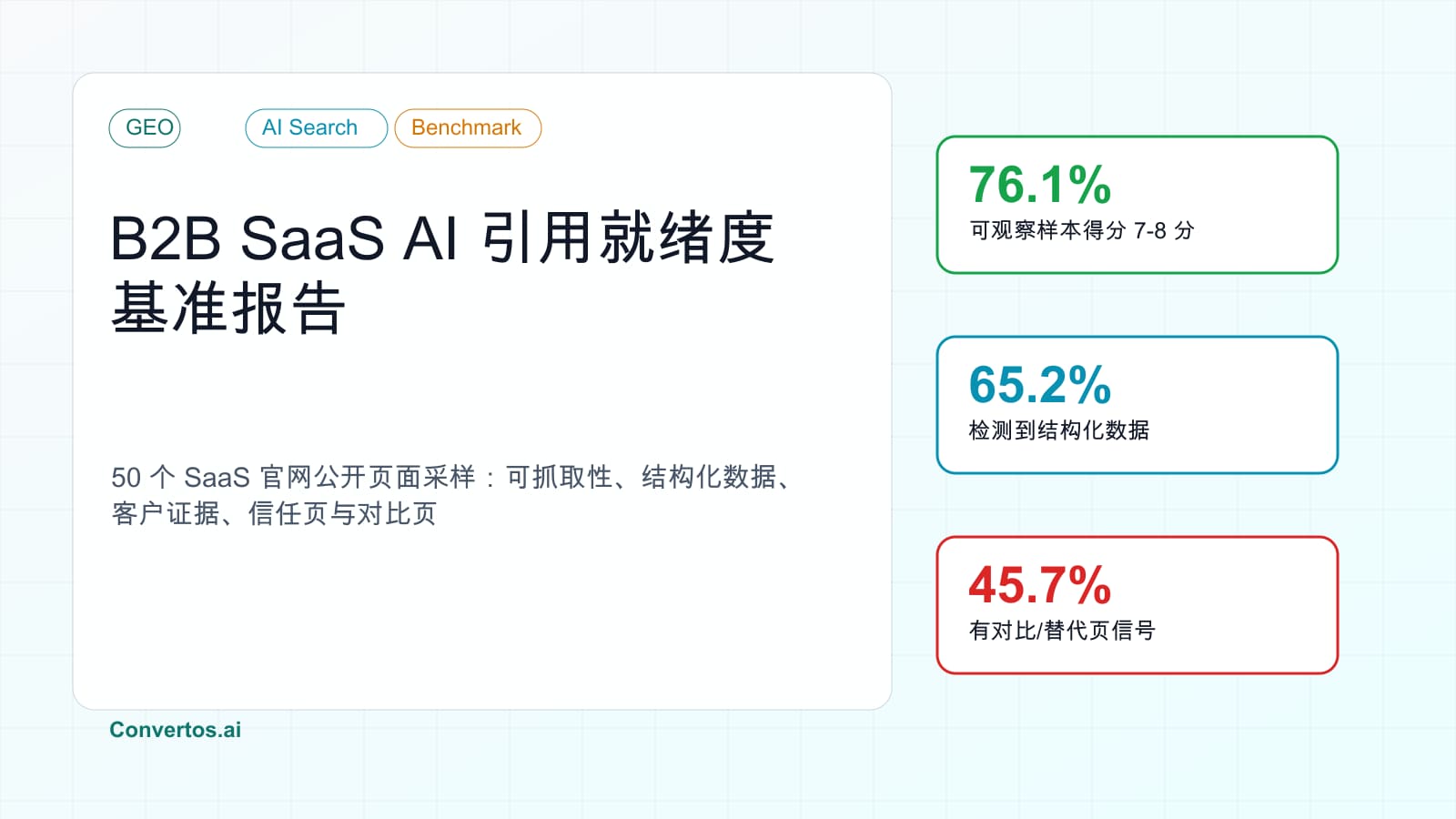
AI citation readiness is the public web footprint a B2B SaaS company gives search engines and answer engines to understand, retrieve, and cite the company accurately. In a Convertos.ai crawl of 50 public B2B SaaS websites on June 29, 2026, 46 returned crawlable homepage HTML to our benchmark fetch. Among those observable sites, 76.1% scored 7 or 8 out of 8 on our public citation readiness rubric, but only 45.7% showed a visible comparison or alternatives signal. The gap is not basic SEO. It is structured, verifiable evidence that helps an answer system explain why a product fits a specific use case.

Key Takeaways

  • Most established SaaS websites have the basics: among the 46 observable sites, pricing and company/entity pages appeared on 100%, resource or blog hubs appeared on 97.8%, and customer proof appeared on 93.5%.
  • The weakest public signal was comparison coverage. Only 21 of the 46 observable sites, or 45.7%, showed a clear comparison, alternatives, or "vs" signal during the crawl.
  • Structured data is still uneven. We detected schema-like structured data on 30 of the 46 observable sites, or 65.2%. This does not guarantee citation, but it gives crawlers cleaner entity and page context.
  • Four sites did not return full crawlable homepage HTML to the benchmark fetch. We treated that as an access observation, not as proof that those companies lack the pages we tested for.
  • A practical AI citation readiness benchmark should not ask "Can an AI mention us?" first. It should ask: can a crawler access the page, can the answer system identify the entity, can it find proof, and can it compare the product against alternatives without guessing?
This report turns those observations into a workflow SaaS teams can reuse. If you want to test your own brand after reading, run an AI visibility snapshot and compare the answer evidence against the checklist below.

What Is AI Citation Readiness?

AI citation readiness is the degree to which a brand's public pages make it easy for search and answer systems to retrieve, identify, verify, and quote the brand. It includes normal crawl access, entity clarity, structured page context, proof pages, third-party evidence, and pages that answer comparison or purchase questions directly. For B2B SaaS, the concept matters because AI answers often summarize a market rather than list blue links. A system may need to explain what a product does, who it is for, how it compares with known alternatives, whether it has credible customer proof, and where the source information came from. If those facts are scattered, blocked, thin, or only implied in marketing copy, the answer may skip the brand or describe it poorly. This is not a separate replacement for SEO. Google's guidance on AI features still points site owners back to normal Search fundamentals: helpful content, crawlability, indexability, and preview controls. OpenAI's crawler documentation and Perplexity's crawler documentation also make access control part of the audit rather than an afterthought. The useful framing is simple: SEO helps pages be discovered; citation readiness helps a page become usable evidence. Google's crawler overview is a reminder that access and retrieval are measurable, not mystical. A homepage may rank, but it may not explain the product in a way an answer engine can quote. A pricing page may exist, but if it hides key limits behind scripts or vague plan names, it is weak evidence. A case study may impress a human visitor, but it is stronger for AI retrieval when it names the customer context, measurable outcome, product feature, and publication date.

How the Benchmark Works

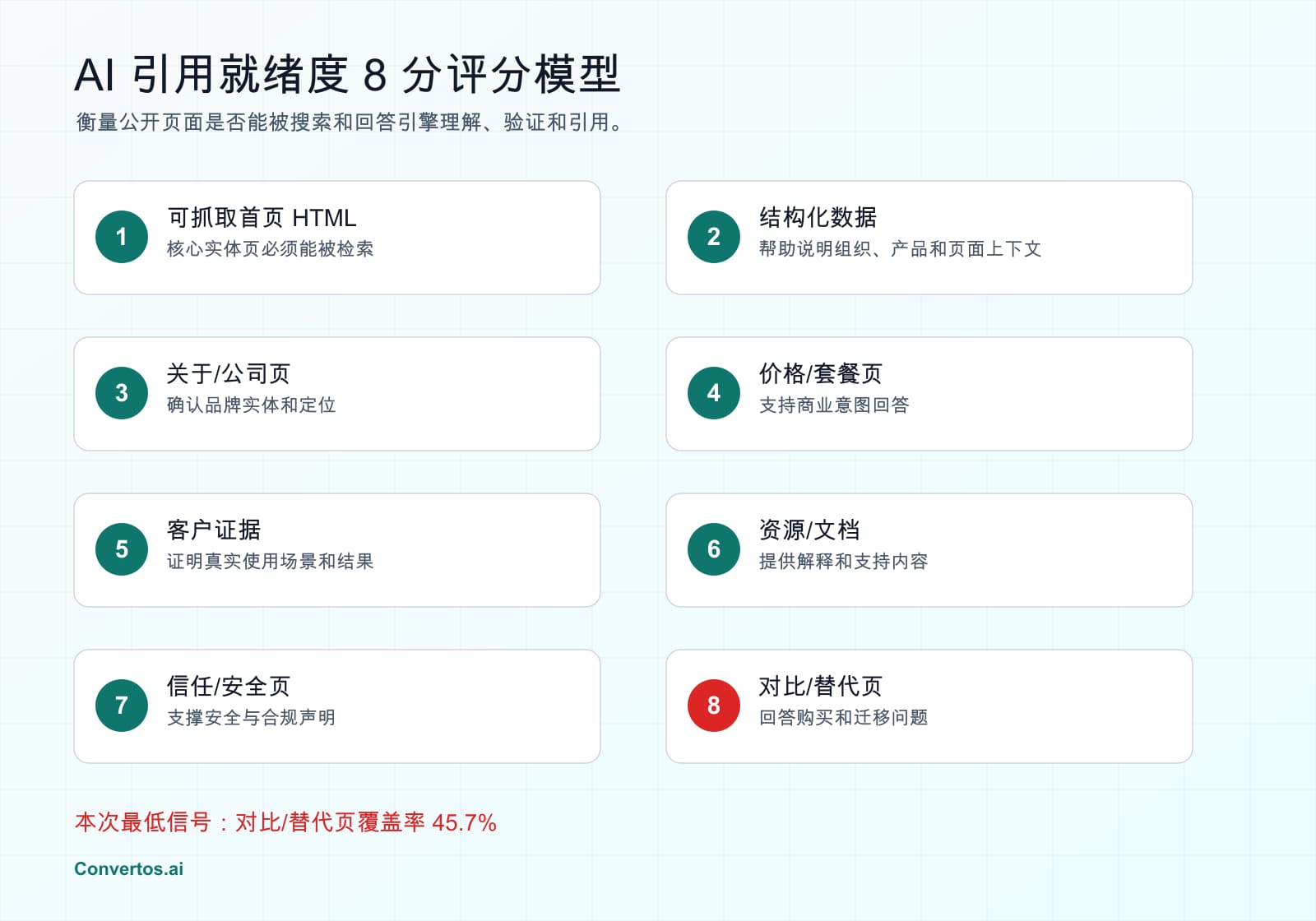
The benchmark scores public, observable evidence. We do not score product quality, market share, or private customer data. Each site is checked for crawlable homepage HTML, structured data, company/entity information, pricing or plans, customer proof, resource or documentation depth, trust or security evidence, and comparison coverage. The June 2026 sample covered 50 well-known B2B SaaS websites across CRM, support, productivity, project management, design, analytics, SEO, commerce, payments, HR, finance, DevOps, developer platforms, databases, infrastructure, communication APIs, and email marketing. The sample is directional, not statistically representative of every SaaS category. It is useful because the same checks are visible and repeatable for any SaaS team. Here is the scoring model used in the crawl:
Signal Point Why it matters for AI citation
Crawlable homepage HTML 1 The brand's core entity page must be retrievable before it can be used as evidence.
Structured data 1 Schema-like markup can clarify organization, product, page, FAQ, and website context.
About or company page 1 Helps answer systems confirm entity identity, ownership, and positioning.
Pricing or plans page 1 Supports commercial-intent answers without forcing the model to infer costs.
Customer proof or case studies 1 Gives evidence for adoption, use cases, and outcomes.
Resources, blog, docs, or help content 1 Supplies explainers and support context beyond the homepage.
Trust, security, privacy, or compliance page 1 Helps risk-sensitive buyers and answer systems verify operational claims.
Comparison or alternatives page 1 Helps answer systems place the product in a market map without relying only on competitors.
This is why the comparison gap matters. A SaaS company can look strong on traditional site architecture and still leave answer engines with weak material for "best for X", "alternatives to Y", or "A vs B" prompts.
AI citation readiness signal coverage among observable SaaS sites Bar chart showing comparison coverage at 45.7 percent, structured data at 65.2 percent, trust pages at 91.3 percent, customer proof at 93.5 percent, resources at 97.8 percent, and pricing/about pages at 100 percent. Observable citation-readiness signals, n=46 Comparison45.7% Structured data65.2% Trust/security91.3% Customer proof93.5% Resources/blog97.8% Pricing/about100%
In the observable sample, comparison coverage was the clearest gap. The visual is based on the June 29, 2026 Convertos.ai crawl described in the methodology section.

AI Citation Readiness Checklist for SaaS Teams

Use this checklist as a monthly audit. The goal is not to create pages for bots. The goal is to make the facts a good editor would need visible, crawlable, and specific enough to quote.
Check Pass condition Fast fix
Crawl access Important public pages return useful HTML and are not blocked by robots or noindex rules. Test homepage, pricing, docs, comparison, and case-study URLs with a crawler and Search Console.
Entity clarity The site states product name, company name, category, audience, and primary use cases consistently. Add a concise definition block to the homepage, about page, and key product pages.
Structured data Organization, WebSite, Article, FAQPage, Product, or SoftwareApplication markup appears where truthful. Start with Organization and WebSite markup, then add page-specific schema only when visible content supports it.
Buyer evidence Pricing, plan limits, integrations, support, security, and compliance pages are findable. Link these pages from nav, footer, product pages, and relevant guides.
Use-case proof Case studies name the scenario, product capability, outcome, and date. Rewrite thin testimonials into structured stories with measurable context.
Comparison context Alternatives, comparisons, and migration pages answer buyer questions without attacking competitors. Create balanced pages for the prompts sales and support teams hear most often.
Third-party corroboration Review sites, directories, partner pages, podcasts, and independent articles support the brand entity. Prioritize real review, interview, data, and partner mentions over low-quality directory blasts.
Monitoring loop The team tracks prompt answers, cited sources, and incorrect claims over time. Keep a prompt set and rerun it after major site, product, or external mention changes.
The quickest starting point is to build a small prompt set around your real buyer journey: category discovery, comparison, implementation, pricing, security, and alternatives. Then record whether ChatGPT, Perplexity, Gemini, Google AI answers, and normal search results mention the brand, cite the brand's own pages, cite third-party pages, or make unsupported claims. Convertos' GEO guides cover the broader workflow.

How to Measure Success

A useful citation-readiness program measures evidence quality before it measures rankings. You want to know which facts answer systems can find, which pages they cite, which competitor pages fill the gaps, and which claims need stronger proof.
Metric What to record Good sign Warning sign
Prompt coverage Number of buyer prompts where the brand is mentioned. Brand appears for category and use-case prompts, not only exact brand prompts. Brand appears only when the prompt includes the brand name.
Citation coverage Which URLs are cited or used as source evidence. Own pages and credible third-party pages both appear. Competitor blogs or thin directories define the category for you.
Evidence completeness Whether pages answer who, what, for whom, proof, limits, and next step. Product, pricing, docs, trust, and case-study pages reinforce each other. Key claims appear only in vague homepage copy.
Comparison presence Whether AI answers can explain differences between products. The answer uses balanced comparison pages or third-party reviews. The answer guesses or cites only competitor-owned pages.
Correction backlog Wrong or missing facts found in AI answers. Errors are mapped to missing evidence and fixed in public pages. Errors are discussed in Slack but never tied to page changes.
Retest cadence How often prompt sets and source checks run. Monthly for stable markets; weekly during launches or category changes. One-off checks with no baseline.
In our sample, the comparison signal was the clearest gap. Among observable sites, comparison or alternatives coverage appeared on 45.7%, while pricing and about/company signals appeared on 100%. For mature SaaS sites, the next advantage may come less from adding another generic blog post and more from publishing fair, specific comparison and migration material that answers real buyer prompts. For teams already tracking SEO, this becomes a new layer in the same reporting rhythm. Keep GSC, rankings, and traffic. Add prompt visibility, citation URLs, source quality, and unresolved answer errors. The best dashboard is boring: it shows what changed, why it changed, and which page or external proof needs work next.

Common Mistakes

The most common mistake is treating AI citation readiness as a directory submission task. Directories can help discovery, but answer systems need reliable facts, source diversity, and pages that match specific questions. A thin listing cannot do the job of a crawlable pricing page, a strong customer story, or an independent review.
Mistake Why it weakens citation readiness Better move
Publishing one-line tool descriptions everywhere Thin pages rarely add facts that an answer engine can use. Write richer profiles with category, use cases, proof, limits, and official source links.
Hiding key facts behind scripts or gated flows Some crawlers and answer products may not retrieve the same content a browser user sees. Keep essential facts in crawlable HTML on public pages.
Writing only "best X" pages with no evidence This looks promotional and gives little reason to trust the claim. Use balanced criteria, named fit scenarios, and clear caveats.
Ignoring external proof A brand's own site is necessary but self-interested. Build real third-party evidence: reviews, partnerships, interviews, podcasts, data studies, and expert mentions.
Measuring only mentions A mention without a good source can still be fragile or inaccurate. Track cited URLs, claim accuracy, and whether the source is first-party, third-party, or competitor-owned.
Adding schema that visible content does not support Misleading structured data can create trust and maintenance problems. Use structured data only when the page visibly supports the entity or claim.
The second mistake is asking for "Wikipedia links" too early. Wikipedia is not a backlink channel. A company normally needs significant coverage in reliable, independent, secondary sources before an article or link makes sense. The path is not "add Convertos to Wikipedia"; it is "earn enough independent coverage that a neutral editor has something real to cite."

FAQ

Is AI citation readiness the same as SEO?

No. SEO helps pages become discoverable in search. AI citation readiness checks whether answer systems can use those pages as reliable evidence. Source signal: prompt cluster question, "AI citation readiness benchmark vs SEO".

Do SaaS companies need comparison pages for AI search?

They do not need spammy comparison pages, but they do need clear comparison context. In our observable sample, comparison or alternatives coverage was the weakest signal at 45.7%. Source signal: prompt cluster question, "AI citation readiness benchmark for B2B SaaS checklist".

Does structured data guarantee AI citations?

No. Structured data does not guarantee inclusion or citation. It helps clarify page and entity context when it is accurate and supported by visible content. Source signal: related question from the audit checklist and Schema.org SoftwareApplication documentation context.

What pages should a new B2B SaaS company build first?

Start with a clear homepage definition, about/company page, pricing or plans, docs or help center, trust/security page, and one detailed customer or use-case proof page. Source signal: prompt cluster question, "how to do AI citation readiness benchmark for B2B SaaS".

How often should a team rerun an AI visibility audit?

Monthly is enough for a stable category. Rerun weekly during launches, rebrands, pricing changes, major content updates, or when a competitor receives new media coverage. Source signal: prompt cluster question, "AI citation readiness benchmark measurement cadence".

Can directories and UGC pages help?

They can help discovery and entity reinforcement when they are relevant and detailed. They are weak if they contain only a sentence, no proof, no category context, or no public link. Source signal: outreach and directory-quality question from the Convertos backlink audit.

Sources and Methodology

This report combines original Convertos.ai crawl data with public platform documentation. The external documentation informed the access and crawler-control parts of the framework. Google's AI features documentation was used for Google Search and AI feature eligibility context. Google's crawler overview informed the crawler-access framing. OpenAI's crawler documentation and Perplexity's crawler documentation informed the bot-access caveats. For the original benchmark, Convertos.ai crawled 50 public B2B SaaS websites on June 29, 2026. The sample covered well-known companies across CRM, support, productivity, project management, design, collaboration, forms, analytics, SEO, commerce, payments, HR, finance, DevOps, developer platforms, infrastructure, databases, communication APIs, and email marketing. The crawl checked each homepage plus common public page paths such as pricing, about, customers, case studies, resources, docs, support, security, trust, compare, alternatives, and vs pages. Primary percentages in this report use the 46 sites that returned crawlable homepage HTML to the benchmark fetch. Four sites returned 403, edge-protection, or app-shell-only responses during the test. We reported those as access observations. We did not treat them as proof that the company lacks a page or signal. The score is directional. It is not a ranking of product quality, revenue, brand strength, or actual AI-answer inclusion. A high score means the public website exposed more of the evidence types an answer system may need. A low or blocked observation means the audit should be repeated with additional fetch methods, Search Console data, server logs, and manual page review before making business decisions.

Content Statement

This article was last researched on June 29, 2026. It uses public documentation and a point-in-time crawl of public SaaS websites. Platform behavior, crawler names, robots controls, and AI answer products can change, so teams should verify current documentation before changing access rules or structured data.

需要我给你一些具体建议?

直接来问我,沟通你的 SEO / GEO 问题

你可以直接通过邮箱、微信或 LinkedIn 联系我。我会先帮你判断问题优先级,再给你一个可执行的起步方案。

邮箱: 发送邮件微信: 15765565449LinkedIn